'The Odyssey': the Greek epic that has survived millenniahttps://en.majalla.com/node/332344/culture-social-affairs/odyssey-greek-epic-has-survived-millennia
Christopher Nolan’s new film revives a story long confined to schoolbooks. Its new lease of life on the big screen has not only racked up box-office sales but also reintroduces viewers to a story composed nearly 3,000 years ago, in a form of ancient Greek no longer spoken, whose gods have passed into myth and whose small kingdoms have vanished.
The Odyssey is, above all, a story of return. The Greek epic follows an ancient traveller named Odysseus, the king of the small island of Ithaca, who is attempting to reach home after the fall of Troy. He fought for ten years beneath the city’s walls and then spent another ten wandering the seas, while his wife Penelope and his son Telemachus waited for him at home.
The seemingly simple tale has resonated with many over millennia who have tried to return to a place that was lost, a time that has passed, or a face that has disappeared. In that breadth lies the first secret of its survival: the mystery behind its author.
Homer’s identity remains obscure. The period in which he lived is uncertain, and scholars still dispute whether he was one author at all. This uncertainty is known as the Homeric Question. It has divided scholars for centuries, with some viewing TheIliad and The Odyssey as the work of one extraordinary mind, while others believe they emerged from a long oral tradition, passed from singer to singer and from generation to generation until they assumed their final form.
Whatever its origins, The Odyssey consists of roughly 12,000 lines divided into 24 books and is generally dated to the eighth century BCE. It is the second of the two great epics attributed to Homer, following The Iliad, which recounts an episode from the Trojan War.
The Iliad is the epic of war and its fury; The Odyssey is the epic of return and its cunning. It begins where the first poem leaves off: with a city in ruins and a victor who desires nothing more than to see the smoke rising from his own hearth. The poem belongs to an ancient Greek world that preceded philosophy and the great cities—a world of sailors and kings of small realms separated by treacherous seas. Hospitality carried the force of sacred law, for the stranger who appeared at the door might be a god in disguise.
A clay tablet bearing an inscription of verses from the Odyssey, discovered in ancient Olympia, Greece.
The entire epic rests upon a key principle: whoever honours a guest survives, while whoever violates the sanctity of hospitality is destroyed. This is illustrated by the giant who devours his guests, only to bring blindness and a curse upon himself.
The evolution of an epic
The epic probably took shape as an oral body of work long before it became a written text. It was recited at festivals to the accompaniment of a stringed instrument, with the singer adapting and reshaping it at each performance. This is why The Odyssey opens with an appeal to the Muse: 'Sing, goddess, of the man of many turns and many wiles.' From its first words, the poem presents itself as a living voice, meant to be sung and summoned anew.
The seemingly simple tale has resonated with many over millennia who have tried to return to a place that was lost or a time that has passed
Even its recurring descriptions bear witness to its oral beginnings: the wine-dark sea and dawn with her rosy fingers. Such fixed phrases helped the singer remember and perform the poem. They remain as traces of a work that was sung long before it was written. Its oral origins also help to explain its endurance. A poem shaped by many voices, growing and changing at every gathering, carried within its very form the capacity to be recited endlessly.
Once the epics were committed to writing, they became foundational texts through which the Greeks learned their language, their ethics and their vision of the world. Homer came to be known as the teacher of the Greeks, and the text became a foundational part of Greek history.
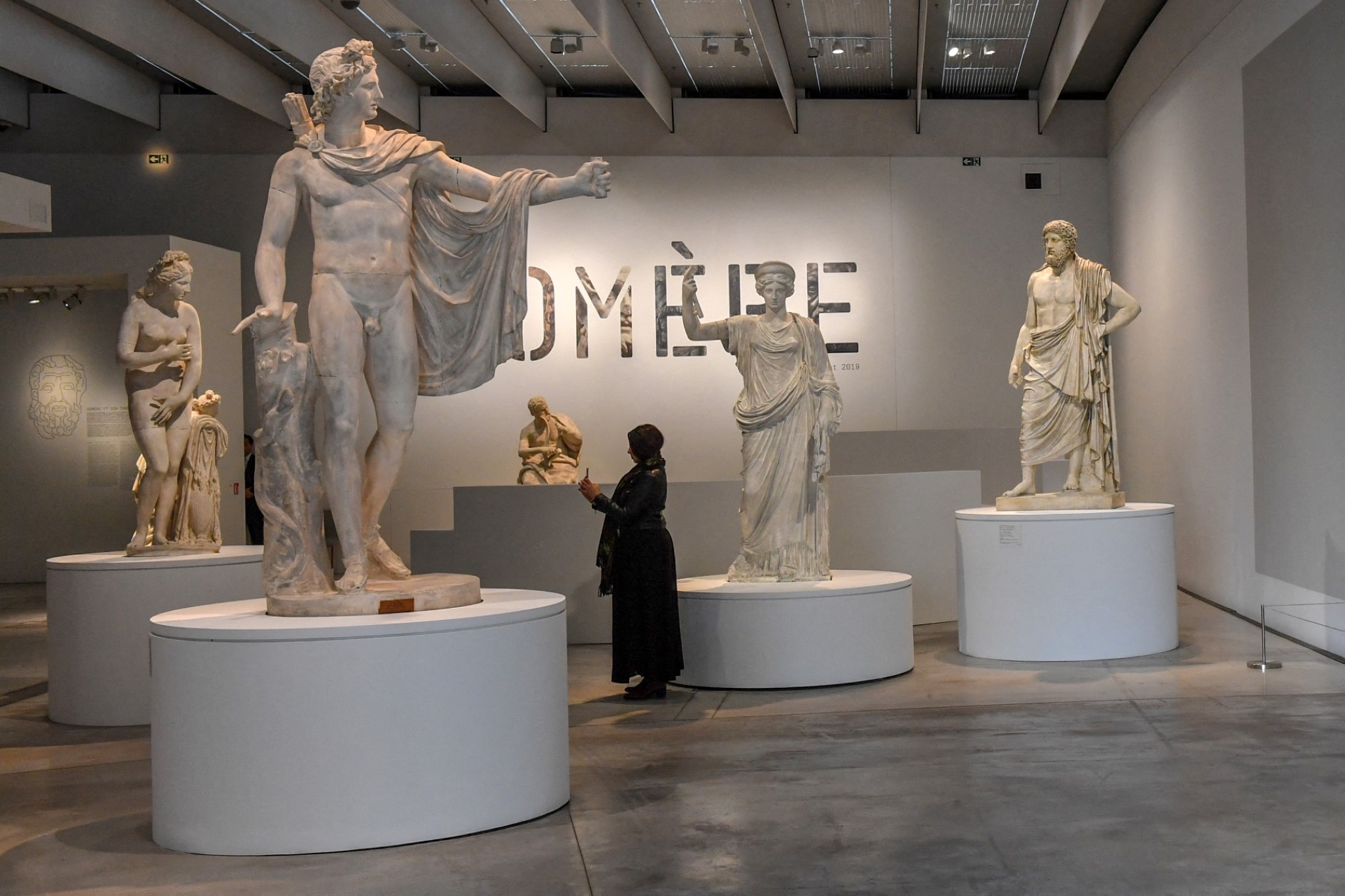
A visitor takes photos of statues in an exhibition about Homer at the Louvre Museum, Lens
Setting the scene
After the hero's 20-year absence, his palace in Ithaca is overrun by more than 100 suitors, all coveting his wife Penelope and his throne. His son Telemachus sets out in search of his missing father, and the search for the father becomes a search for self.
Readers are then introduced to Odysseus, who had been held captive by the goddess Calypso. Athena, his divine protector, intervenes to secure his release, while Poseidon's anger dogs his path. The hero recounts his greatest adventures in his own voice while enjoying the hospitality of a generous people on his journey home. The most marvellous episodes of the epic therefore reach us as memories retold, until Odysseus arrives in Ithaca, takes vengeance on the suitors and reclaims his house.
The journey moves from absence to wandering—from a wandering narrated by the wanderer himself to a homecoming followed by reckoning.
The world of The Odyssey ignites tension between two forces: cunning, which propels the hero forward, and longing, which draws him back. Odysseus was not the mightiest of warriors, but he was the cleverest, and his mind was his weapon of choice.
This was illustrated by what unfolds in the cave of Polyphemus, where a one-eyed Cyclops traps Odysseus and his companions and devours several of them. However, Odysseus defeats him through cunning alone. He tells the Cyclops that his name is 'Nobody', plies him with wine and blinds his single eye. When the giant cries out to his neighbours that 'Nobody' is harming him, they leave him to his fate, believing him delirious. Yet the trick exacts its price. Once his ship has drawn away from the shore, Odysseus shouts out his real name in triumph, provoking the wrath of the sea god and prolonging his wanderings for years.
The scene turns on two uses of a name: one concealed to save a life, the other proclaimed even at the risk of losing everything. That tension runs through the epic to its final scenes. Odysseus completes much of his journey in disguise, searching for those who will recognise him by his true name. The cave scene thus finds its echo in the acts of recognition that close the poem.
The sea he crosses is full of temptations to forget. On the island of the Lotus-Eaters, his companions taste a fruit that erases all memory of home, and all desire to return, leaving them content to remain there.
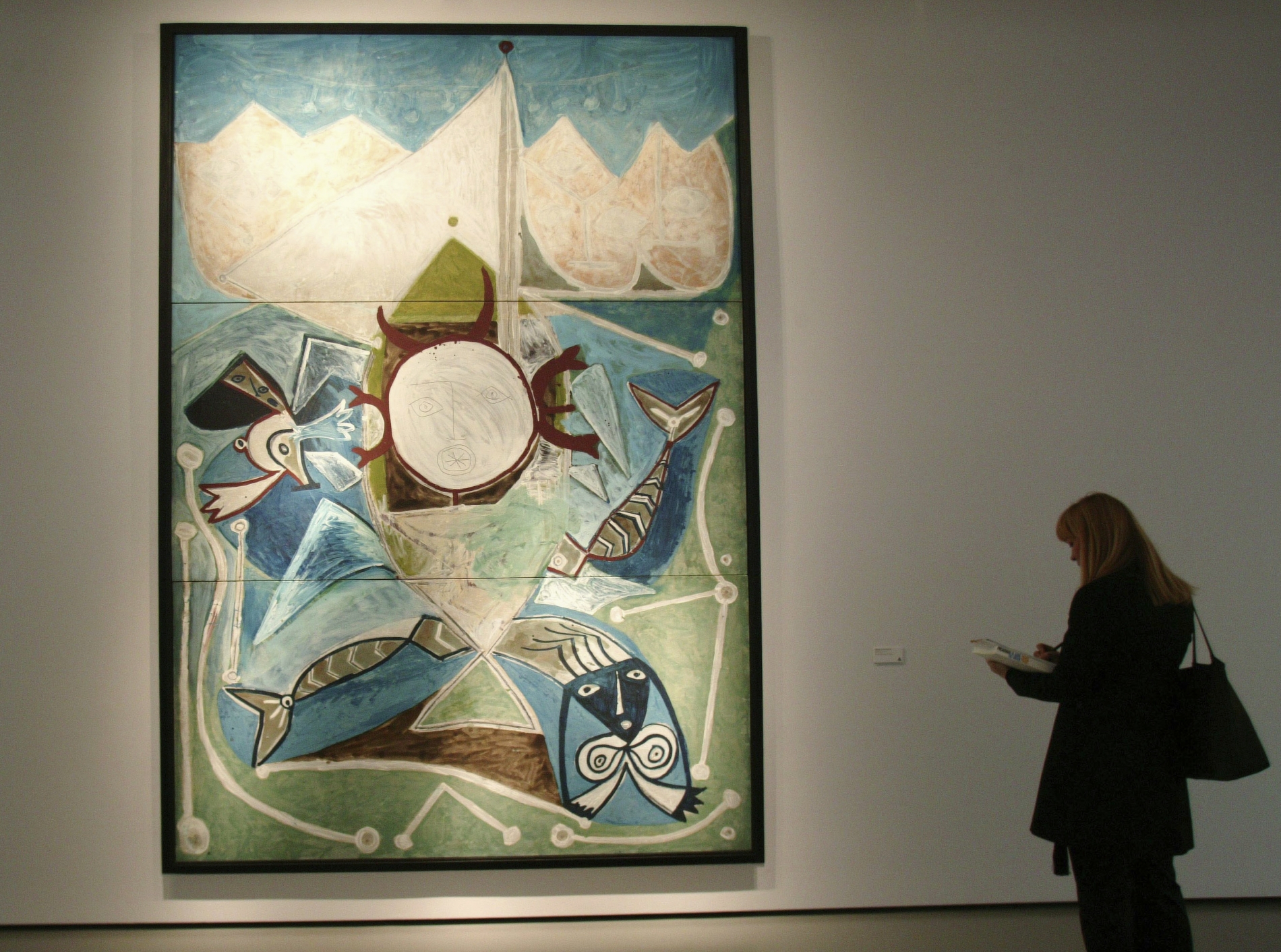
Pablo Picasso's painting "Ulysses and the Sirens" at an exhibition at the Palazzo Grassi in Venice.
On the island of the sorceress Circe, they drink a potion that transforms them into swine, robbing them of their human form and confining them within the bodies of beasts. The gravest danger in this world is to forget who one was, or to lose the form that made one human.
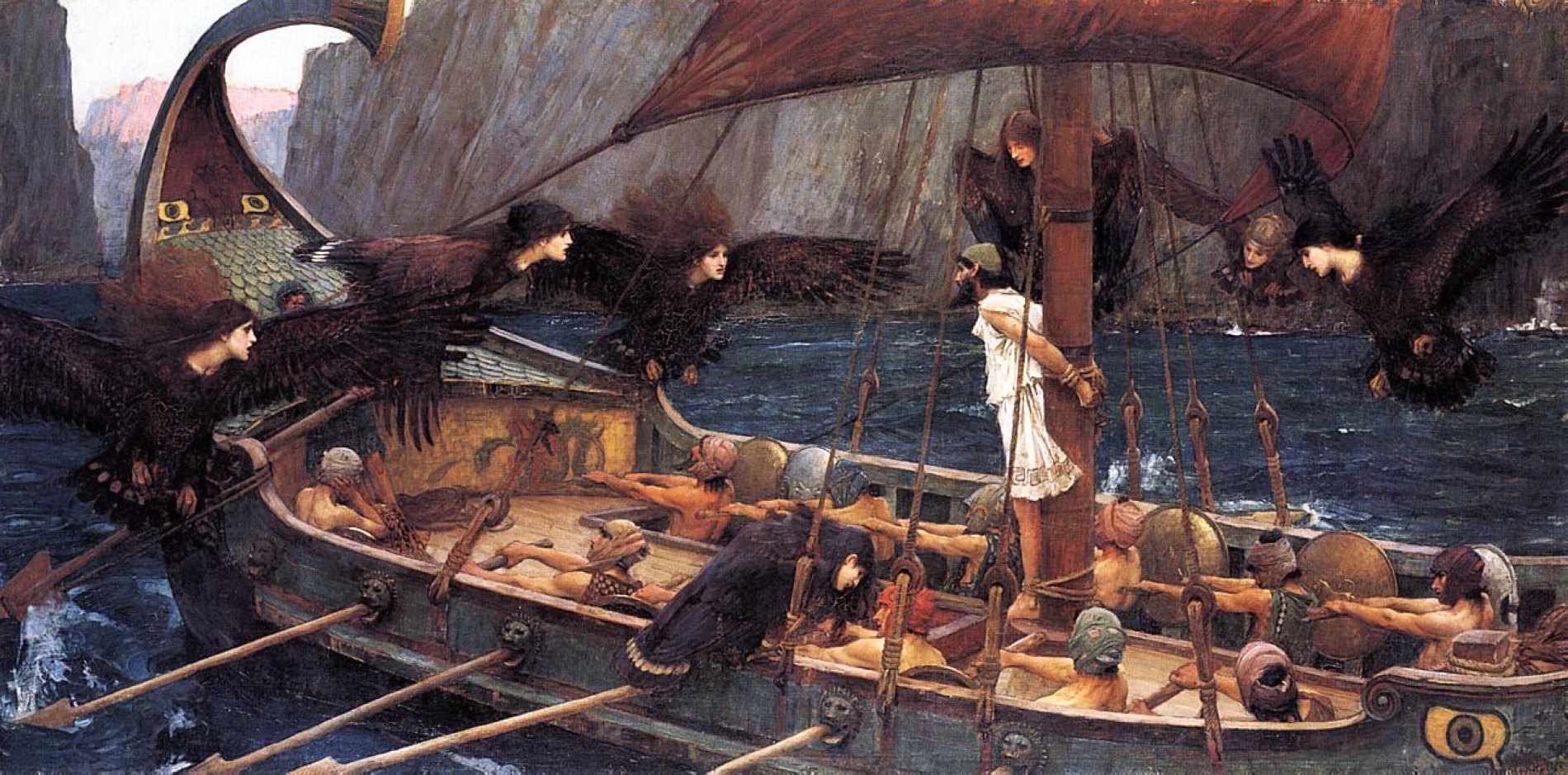
When Odysseus draws near the island of the Sirens, whose song brings death to all who hear it, he orders his men to seal their ears with wax and bind him to the mast. He wants to hear the song and survive it.
Calypso offers him a greater temptation still: immortality, provided he remains with her. He refuses, choosing his mortal wife and his small island rather than accept eternal life. He sits weeping on the shore, gazing towards Ithaca. Here lies the heart of the epic: the return to what is human and perishable becomes more precious than immortality itself.
Homecoming, however, means more than arrival. The house Odysseus seeks is no longer the house he left. It has been occupied by rapacious suitors who consume his wealth and press his wife to choose one of them, violating the sacred laws of hospitality. Before the house can be reclaimed, it must be purged. The deepest form of exile is to discover that one's own home has become strange.
Penelope channels her husband's cunning. She resists the suitors through patient deception, promising to choose one of them when she has finished weaving a burial shroud, then weaving by day and unravelling her work by night for years. Husband and wife meet first in ingenuity, long before they meet again beneath the same roof.
When Odysseus returns disguised as a beggar, a sequence of recognition scenes makes memory the epic's hidden heroine. His old dog Argos, who has waited 20 years, lifts his head and wags his tail when he sees his master, then dies. The nurse who cared for Odysseus as a child recognises him while washing his feet, when she notices the scar left by a childhood wound.
Penelope reserves one final test. She orders her servant to move their bed, and Odysseus flares with anger, for the bed cannot be moved. He fashioned it with his own hands from the trunk of a living olive tree rooted in the earth. Through this secret, known to them alone, Penelope knows that he has truly returned. In these small signs, the epic offers its final proof: homecoming is complete when memory recognises us, and we recognise it, beyond the mere crossing of a threshold.
A visitor takes photos of statues in an exhibition about Homer at the Louvre Museum, Lens
Translations and adaptations
Translation is one of the principal ways in which this ancient song has renewed itself, and Arabic became one of the harbours at which the epic came ashore. Arab readers first encountered Homer when Sulayman al-Bustani rendered The Iliad into rhymed and metrical verse in the early 20th century. It was a monumental undertaking of thousands of lines and remains a landmark in the history of Arabic translation, despite the heaviness some readers found in its form.
The Odyssey, meanwhile, entered Arabic through Anbara Salam al-Khalidi, one of the pioneering women translators of the Nahda. Working from English, she translated both epics into lucid prose, and Taha Hussein contributed an introduction to her Iliad. She chose prose to make the text more accessible to readers who found al-Bustani's metre taxing.
Others followed a freer course. Durayni Khashaba recast the epic as a novel, drawing on older English translations and rearranging its events into chronological order for the modern reader. His version came closer to a retelling than to a literal translation. For his part, Amin Salama's version comes with explanations of Greek mythology intended to guide readers unfamiliar with its gods and heroes.
This variety demonstrates the age-old dilemma of every translator of Homer: whether to preserve a stately metre that may burden the reader, or to adopt a fluid prose that sacrifices some of the music. Since no final resolution is possible, each translation becomes another homecoming, carrying the poem into a new linguistic home.
Ulysses and the Sirens
The poem's most profound renewal, however, has taken place through imaginative recreation. In Divine Comedy, Dante portrayed Odysseus as an old man who sails with his companions into the unknown in pursuit of knowledge, until the sea engulfs them. He becomes a figure of longing that no discovery can satisfy. For his part, in his poem Ulysses, Lord Tennyson imagined a hero who has reached home and grown old there, yet still yearns for one last voyage. And the Greek poet C. P. Cavafy, in Ithaka, suggests that the journey towards the island is itself the true gift, and that the traveller should hope for a long road.
However, the greatest modern literary legacy of The Odyssey is perhaps James Joyce's Ulysses. Joyce turned a single day in Dublin into an entire odyssey and transformed the Greek hero into Leopold Bloom—an ordinary man who wanders through the city before returning to his wife at night. Each episode of the novel corresponds to a book of the ancient epic.
For his part, Nikos Kazantzakis sent Odysseus on further voyages beyond Ithaca in his vast modern poem The Odyssey. Derek Walcott transposed the epic into the world of Caribbean fishermen in Omeros, while Margaret Atwood retold the story through Penelope and her maids in The Penelopiad, allowing those long confined to the margins to speak.
Cinema, too, has repeatedly returned to the story, recasting its pattern of wandering and homecoming in popular forms, up to Nolan's film today. The ancient lyre has become a vast screen, and the circle once gathered around a singer has become a darkened auditorium crowded with strangers. The essential act remains unchanged: a community assembling once again to hear the story of a man trying to return home.
Enduring legacy
The epic also permeated language itself, with the word 'odyssey' coming to mean any long and arduous journey in several languages. Also, the character named Mentor, the companion of Odysseus whose form Athena assumed when guiding Telemachus, became a word meaning trusted guide or adviser. The Sirens, meanwhile, became enduring emblems of fatal temptation.
The Odyssey contains a prophecy that is seldom recalled, though it is among the poem's most eloquent. Odysseus is told that even after he reaches Ithaca, another journey awaits him. He must shoulder an oar and travel inland, far from the sea, until he comes to a people who know neither salt nor ships and mistake the oar for a winnowing fan. There, in a land untouched by the sea, he must plant the oar in the earth and offer a sacrifice to the sea god in order to appease him. Even the triumphant return contains another voyage within it. Arrival gives birth to departure, and every destination opens towards one still farther away.
The reader who now closes the book, or steps out of the darkened cinema and heads home, also undertakes a small return carrying within it the seed of another journey. Perhaps this is the secret of the epic's endless wandering. It promises us the road more readily than the destination, and leaves all who reach its threshold still drawn towards what lies beyond.