
Rewind almost a century, to the 1930s, and the FIFA World Cup had no need to produce an official song or fashion a unified sonic identity. This was a purely sporting event, shaped by the era's politics and communication methods. Match results were printed in newspapers, and fans followed the games either from inside the stadium or via shortwave radio. In that era, the World Cup’s soundscape was confined to the spontaneous reactions of the terraces and the referee’s whistle.
No institutional vision had yet emerged to connect the tournament with the creation of a parallel musical memory. Football had not yet become a transcontinental cultural product; it remained a physically competitive sport untouched by ambitions to commodify supporters’ passions and export it as a globalised form of entertainment.
The absence of an official audio archive reflected the nature of the period and the self-sufficiency of local identities, each drawing on its own modes of expression. Sporting activity still rested on a clear separation between competitive value and the mechanisms of commercial marketing. The immediate impact of the event ended with the match itself, rather than living on via audio media or targeted advertising.
Things began to change with some limited individual or local initiatives that lacked the status of an ‘official’ song but nevertheless prepared the ground for linking the FIFA World Cup to the aesthetics of sound broadcasting. At the 1934 World Cup in Italy, the host nation was ruled by the fascist dictator Benito Mussolini. The song played during the trophy ceremony, Cancion Azzura, showed how military rhythms and classical orchestral arrangements were used to project the strength of the state and present a polished image of Italian cultural superiority before foreign delegations, fusing politics and sport.
The 1950 World Cup in Brazil witnessed the birth of the La Copa del Mundo chant. Its melodic structure drew on early samba rhythms and brass instruments. Although it had no institutional recognition from FIFA, it represented the first conscious attempt to craft a lyrical text celebrating the World Cup as an event, and was played in stadia and broadcast on local radio stations to mobilise Brazilian crowds.
This embryonic phase culminated at the 1958 World Cup in Sweden with VM-Marsch, a military march with a dry, classical rhythm that reflected the conservative Scandinavian cultural temperament of the time. It was composed by Swedish musician Martin Ekström and remains one of the most recognisable and nostalgic sports anthems in Swedish football. The song emphasised the values of sportsmanship and fair competition in a traditional chant-like style, far removed from dance or entertainment. That edition therefore stands as one of the last sonic milestones before the explosion of pop culture and the tournament’s entry into the age of football as a mass television commodity.
Shift towards visuals
With the development of visual media, football moved beyond its limited spatial frame into global broadcasting. This reshaped the cultural consumption of sport, where events became visual and sonic spectacles engineered to meet the demands of the screen. This helps explain the emerging need for a fixed auditory element that could give the tournament a distinctive identity across languages, condensing the event into a brief melodic theme for broadcast.
The 1962 World Cup in Chile marks this transformation with the release of El Rock del Mundial by Los Ramblers. The song was the first institutionalised link between music and the FIFA organising committee. Its significance lies in part in the choice of rock ‘n roll—then associated with youth and protest—in a sporting space governed by conservative administrative structures. This further eroded the boundaries between culture, music, and sport.
Despite the success of the Chilean experiment, this direction did not immediately become a fixed marketing strategy. Between 1966 and 1986, World Cup songs continued to be shaped more by the socio-cultural particularities of host countries than by any drive to transform them into a unified global entertainment project. The songs often presented the national and political identity of the host state.
At the 1966 World Cup in England, for instance, the tournament’s musical theme was tied to the official mascot—World Cup Willie—and drew on light British pop rhythms, while in Mexico in 1970, the theme was folkloric mariachi music showcasing Latin identity. At the 1978 World Cup in Argentina, the tournament song took on a more complex character with the involvement of Italian composer Ennio Morricone, who fashioned an epic orchestral theme. Marcha del Mundial (also widely known as El Mundial) emphasised the values of sportsmanship and fair competition in a traditional chant-like style, far removed from dance or entertainment.
Beyond background
Spain followed in 1982 with opera singer Plácido Domingo’s song El Mundial, intended to give the event a classical aura. Yet there was still no unified musical identity for the tournament as an independent entity; the songs were merely national representations within a global space.
The structural transformation began at the 1990 World Cup in Italy with Un’estate Italiana (An Italian Summer). For the first time, the music moved beyond the background, such as in an opening broadcast signature. In so doing, it elicited emotional responses and collective memory among international audiences. Through its melodic structure and its performers, the song became a shared sonic motif around the world.
This prompted FIFA to reconsider the musical ‘product’ of World Cup competitions as a functional instrument capable of unifying consumption patterns and shaping a shared emotional climate around the event. The timing coincided with the rise of cultural and economic globalisation in the 1990s, with the consolidation of media markets and the emergence of transcontinental satellite channels. The World Cup song therefore became a cross-border marketing tool.
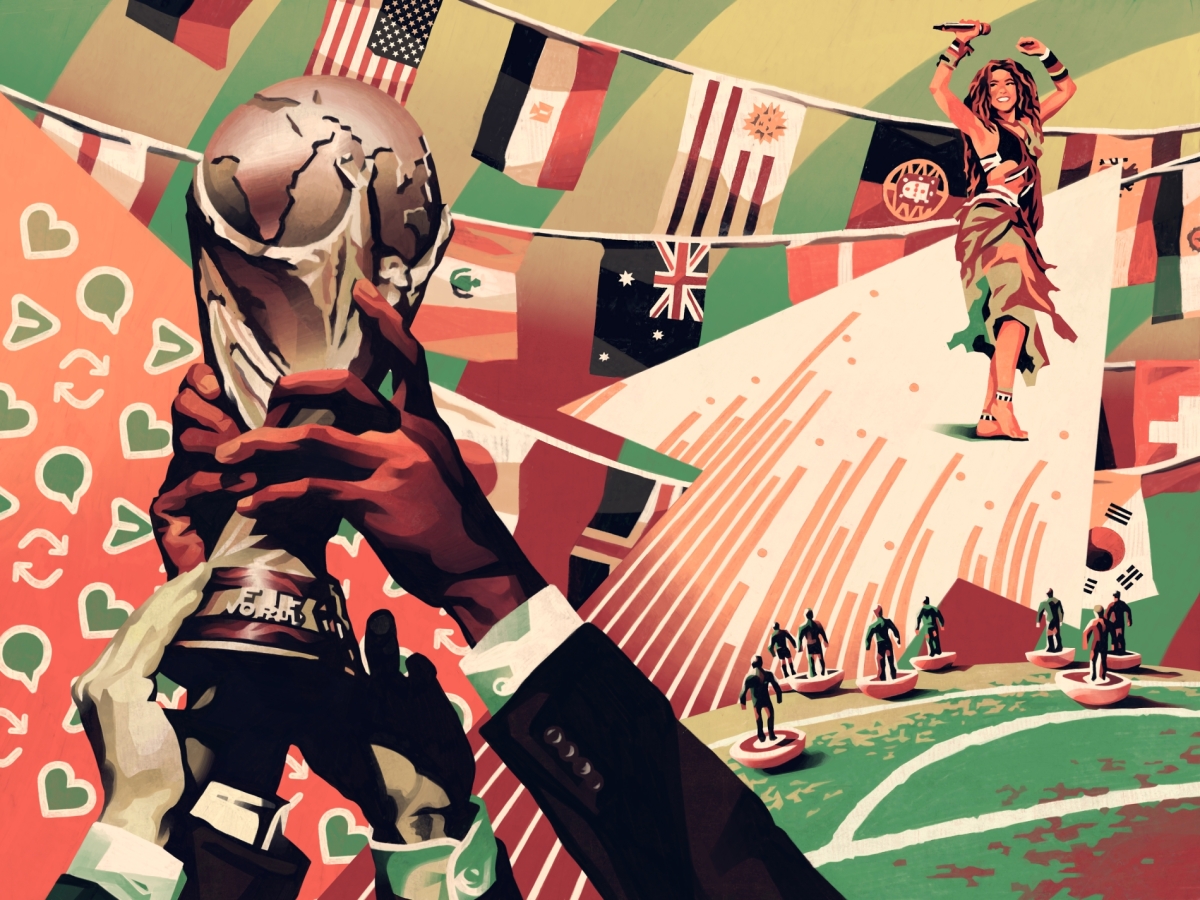
The 1998 World Cup in France witnessed a commercial turn with Ricky Martin’s La Copa de la Vida, which moved beyond conventional artistic success to become a vast marketing phenomenon, permeating broadcast channels, multinational corporate advertising campaigns, and global commercial markets. Some think this was the beginning of the commodification of sporting emotion.
Open to manufacture
Crowd interaction and collective excitement were now understood to be convertible, from spontaneous behavioural phenomena into raw material open to manufacture, modelling, and commercial redistribution. The World Cup song thereby acquired autonomy as a cultural and economic product in its own right, with its own cycle of production and profit, independent of the technical details of the tournament or the performance levels of the participating teams.
At the 2002 Korea-Japan World Cup and the 2006 World Cup in Germany, the official song was fully integrated into the complex marketing and planning mechanisms of major production companies. This narrowed the space available for artistic experimentation or the expression of cultural plurality. Instead, the emphasis was on securing the broadest reach.