Mark Carney’s first year: rebuilding Canada amid crisis and tariffshttps://en.majalla.com/node/331283/business-economy/mark-carney%E2%80%99s-first-year-rebuilding-canada-amid-crisis-and-tariffs
Mark Carney’s first year: rebuilding Canada amid crisis and tariffs
Faced with tariffs and geopolitical instability, Canada’s prime minister has responded with state-backed investment, energy pragmatism, and a push for economic independence
Andrej Ivanov/AFP/Al Majalla
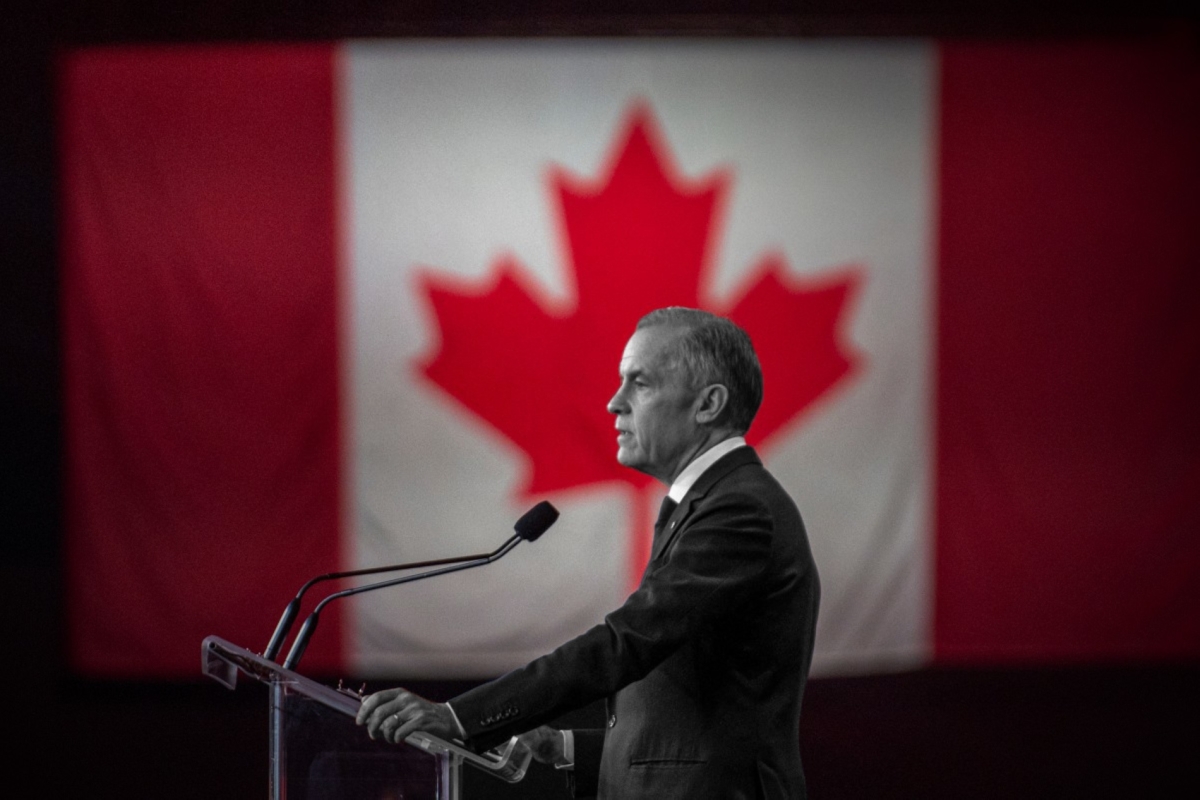
Canadian Prime Minister Mark Carney speaks during the 2026 Liberal National Convention in Montreal, Canada, on 110 April 2026.
Mark Carney’s first year: rebuilding Canada amid crisis and tariffs
Just over a year ago, Mark Carney became prime minister of Canada amid an exceptional political and trade storm. Already a figure of international economic stature, with a reputation forged in moments of crisis, first at the Bank of Canada during the 2008 financial crisis, then at the Bank of England during the turbulence of Brexit, he stepped into Canadian politics at a moment of acute economic uncertainty.
More than a year later, the central question has moved beyond whether Carney can steer the economy. It is now how far he has been able to reshape it under extraordinary external pressure, from US tariffs to turmoil in global energy markets.
It took nearly a year of political manoeuvring and by-elections for Carney to turn a fragile minority government into a stable majority. The shift carried clear economic weight. It freed the government from constant bargaining with opposition parties and allowed it to act with greater speed and ambition on taxation, energy, and trade.
That parliamentary stability gave Ottawa wider room for manoeuvre, reduced the risk of political obstruction, and opened the way for long-term economic planning, with the next election now likely to be held in 2029. On 13 April, a series of by-elections consolidated this transformation, giving Carney a parliamentary majority and allowing his government to pass major legislation without relying on opposition support.
After the results were announced, Carney wrote on social media that his government aimed to build a stronger economy, make life more affordable, create well-paid jobs, and empower Canadians to shape their own future.
Building ‘One Canadian Economy’
Carney began his tenure with bold reforms aimed at strengthening domestic growth and reducing costs for Canadians. In April 2025, his government abolished the consumer carbon tax, after he argued that it “was not working” and had become “divisive,” while preserving the industrial emissions pricing system.
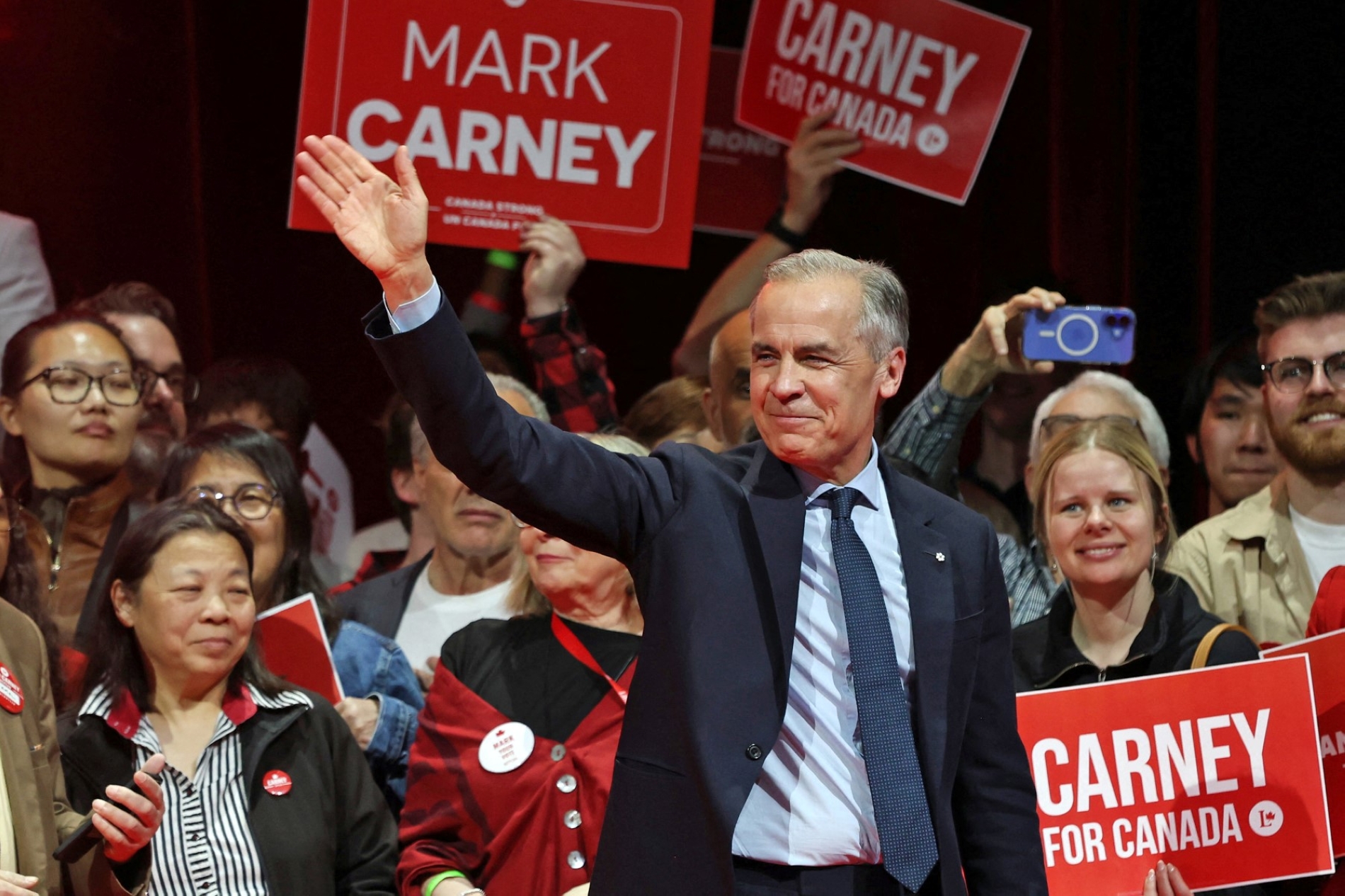
Canada's Prime Minister and Liberal Party leader Mark Carney waves to supporters at a victory party in Ottawa, Ontario on 29 April 2025.
This was followed by tax cuts for the middle class, with the lowest income tax bracket reduced from 15% to 14%. The measure saved a middle-income family around $608 a year and provided direct relief to roughly 22 million Canadians. Over five years, it is expected to deliver more than $19.5bn in tax savings. The cuts were financed by restructuring the tax base for large corporations, revising cross-border tax arrangements, and temporarily removing the goods and services tax for first-time homebuyers.
The cornerstone of Carney’s agenda is the One Canadian Economy Act, which seeks to dismantle long-standing internal barriers and create a more unified and efficient national market. According to government-backed estimates, reducing internal trade barriers could lower trade costs by as much as 15% and gradually lift GDP by up to $145bn, or roughly $3,695 per person. The legislation also aims to accelerate approvals for major national projects, cutting bureaucratic delays from five years to about two.
The cornerstone of Carney's agenda is the One Canadian Economy Act
In the 2025 budget, the government also announced plans to reduce the federal public service by around 40,000 positions by the end of the 2028-29 fiscal year. The move drew sharp criticism from public sector unions, which warned of its impact on workers and public services, with some describing the scale of the cuts as "alarming".
Investing in Canada's future
These initiatives were followed by the launch of Build Canada Homes, a new federal agency backed by $9.4bn in funding to address the housing crisis. Using public land and modern construction methods, including prefabricated homes, modular housing, and engineered timber, the agency aims to cut construction time by up to 50%, reduce costs by 20%, and lower emissions by a similar margin. It will also adopt a 'Buy Canadian' policy to strengthen domestic supply chains.
Carney has framed these measures as part of a broader effort to rebuild productive capacity and strengthen long-term economic resilience. In a February interview, he said his first year had delivered 84,000 net new jobs. However, the following month, Statistics Canada reported that the unemployment rate had climbed to 6.7% and that 84,000 jobs had been lost in February, more than most economists had expected.
The cornerstone of Carney's agenda is the One Canadian Economy Act, which seeks to dismantle long-standing internal barriers.
In March, Carney announced more than $2.1bn in infrastructure and defence investments in Atlantic Canada as part of a broader push to strengthen long-term defence capacity. The same month, Canada reached NATO's defence spending target of 2% of GDP five years ahead of schedule. On 27 April, Carney unveiled the Canada Strong Fund, Canada's first national sovereign wealth fund, with initial capital of $18.1bn. Structured as an arm's-length entity, the fund will invest domestically in strategic sectors to generate long-term returns and support future generations.
On 14 May, Carney unveiled the National Electricity Strategy, which aims to double power grid capacity by 2050, with a focus on clean and reliable energy. "The path to affordability is electrification; the path to competitiveness is electrification; the path to net zero is electrification," he said in Ottawa. "Electrification underpins everything, our emissions, our environment, our economy." The plan is projected to deliver up to $10.8bn in energy savings by 2050 and lower total energy costs for seven in 10 Canadian households. The following day, Carney and Alberta Premier Danielle Smith signed an energy and climate agreement in Calgary, linking expanded oil and gas production with a gradual, negotiated increase in industrial carbon pricing.
A budget of austerity
In September last year, the prime minister told Canadians to prepare for the harsh reality of austerity as the government attempted to balance near-record defence spending, cuts to government programmes, and a trade war with the US.
Carney's tax measures relied on reallocating government resources as well as public borrowing, rather than major tax increases. Savings from programme reviews and reductions in the public service were redirected towards defence spending and support for sectors affected by the trade conflict with the US. Higher revenues, including from a stronger energy sector, provided additional fiscal room as Ottawa sought to balance rising spending commitments with fiscal restraint.
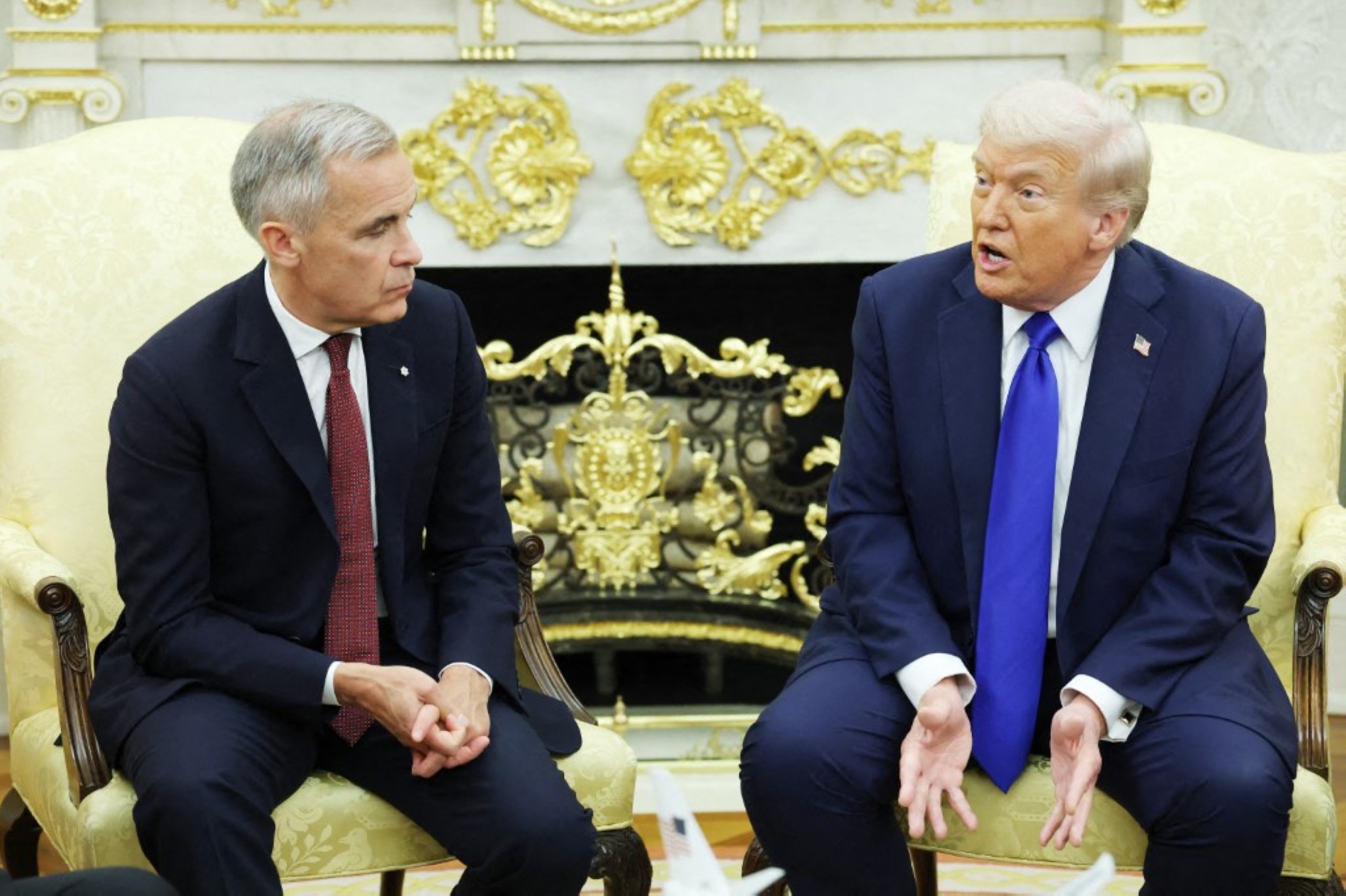
US President Donald Trump (R) and Canadian Prime Minister Mark Carney in the Oval Office of the White House on 7 October 2025 in Washington, DC.
Facing aggressive US tariffs—50% on steel and aluminium, 25% on cars, and new duties on forestry products—Carney pursued a dual strategy: defending key sectors at home while diversifying trade abroad. He created a $3.6bn strategic fund to support affected industries, financed by reallocating existing spending rather than broad tax rises. Canada also abolished the digital services tax in mid-2025, ahead of US-Mexico-Canada Agreement review talks on 1 July, a move widely seen as an attempt to ease tensions with Washington. At the time, Carney insisted that Canada would not accept unfavourable terms in negotiations with the US.
Carney went beyond reacting to events. He pursued new trade agreements with the UK, Indonesia, and China aimed at expanding market access. One of the clearest signs of this strategy came in early May, when 150 Canadian-built Airbus A220 aircraft were sold to Malaysia's AirAsia for around $19bn—the largest export deal in Canadian industrial history. The deal reflects a broader effort to reduce Canada's dependence on the US market. Yet the two economies remain deeply intertwined, meaning any reduction in that dependence is likely to be gradual and vulnerable to renewed trade tensions.
Balancing growth and economic security
As global energy prices surged during the US-Israeli war on Iran, and following the closure of the Strait of Hormuz, Carney temporarily suspended the federal fuel tax, cutting petrol prices by 10 cents per litre and diesel by four cents. He also backed a $11.9 billion west coast oil pipeline while continuing to invest in both conventional and clean energy. The approach underscored a defining tension of his premiership: how to expand energy capacity while meeting Canada's environmental commitments.
One year into office, Carney appears less a crisis manager than the architect of a longer-term economic realignment. Challenges remain, including the federal deficit, inflation, and tensions with some First Nations communities, but a stable parliamentary majority has given him unusual political room to pursue structural change.
The success of that project will depend largely on whether Canada can reduce its reliance on the US economy while reconciling energy ambitions with climate obligations. As Carney put it: "We are responding with speed and ambition. Focusing on what we can control: building our strength at home and diversifying our partnerships abroad."