
Hajj represents the fifth pillar of Islam, during which millions of Muslims from around the world travel to Makkah to perform religious rituals that unite them despite their different cultural, linguistic, and geographic backgrounds.
Beyond its spiritual significance, the pilgrimage has increasingly become a test of logistics, coordination, and technological innovation, as Saudi Arabia continues to modernise the management of the holy sites under its Vision 2030 transformation agenda. From digital registration systems to AI-supported crowd management and expanded infrastructure, Hajj is evolving into a highly organised and integrated operational ecosystem designed to enhance safety, efficiency, and the overall pilgrim experience.
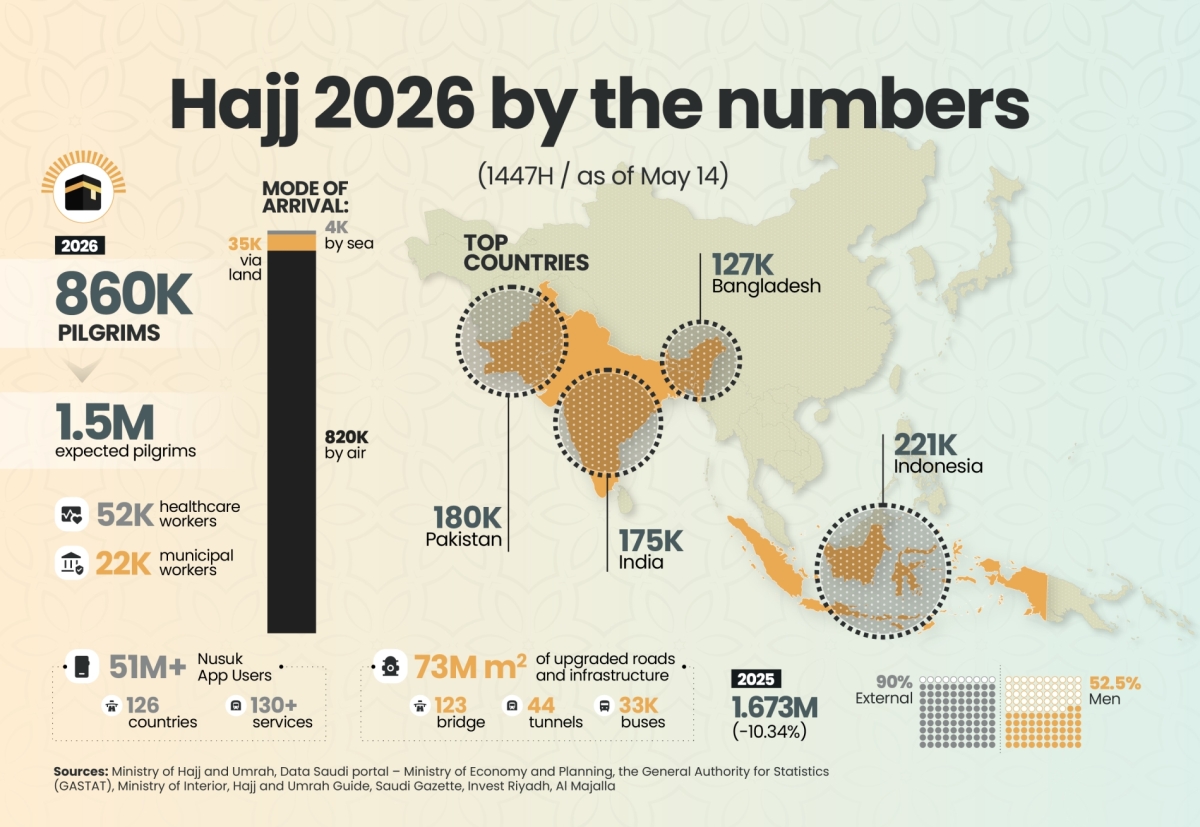
As of 14 May, official figures indicate that around 860,000 pilgrims had already arrived in Saudi Arabia for this year’s Hajj season. Authorities expect the total number to reach around 1.5 million, down from 1.673 million in 2025, representing a decline of roughly 10.3%.
International pilgrims continue to form the overwhelming majority of arrivals. In 2025, they accounted for about 90% of the total. That year, pilgrims represented 171 nationalities. Asian pilgrims accounted for 904,360 arrivals, followed by Arab countries (334,657), African countries (196,542), Europe (33,044), GCC states (37,507), and North and South America (466). That year, Saudi nationals participating in Hajj numbered 166,654.
The scale of the pilgrimage's operations reflects extensive logistical preparation and infrastructure upgrades. The latter covered around 73 million square meters of roads and public areas, including 123 bridges and 44 tunnels to facilitate movement.
This year’s Hajj highlights a deeper structural transformation in management and service delivery. Saudi authorities have expanded the use of the Nusuk digital ecosystem, alongside the mandatory Nusuk smart card, which integrates pilgrims’ identity, accommodation, transport, and health data into a single system. The Nusuk platform itself has surpassed 51 million global users and now offers more than 130 digital services linked to Hajj and Umrah.