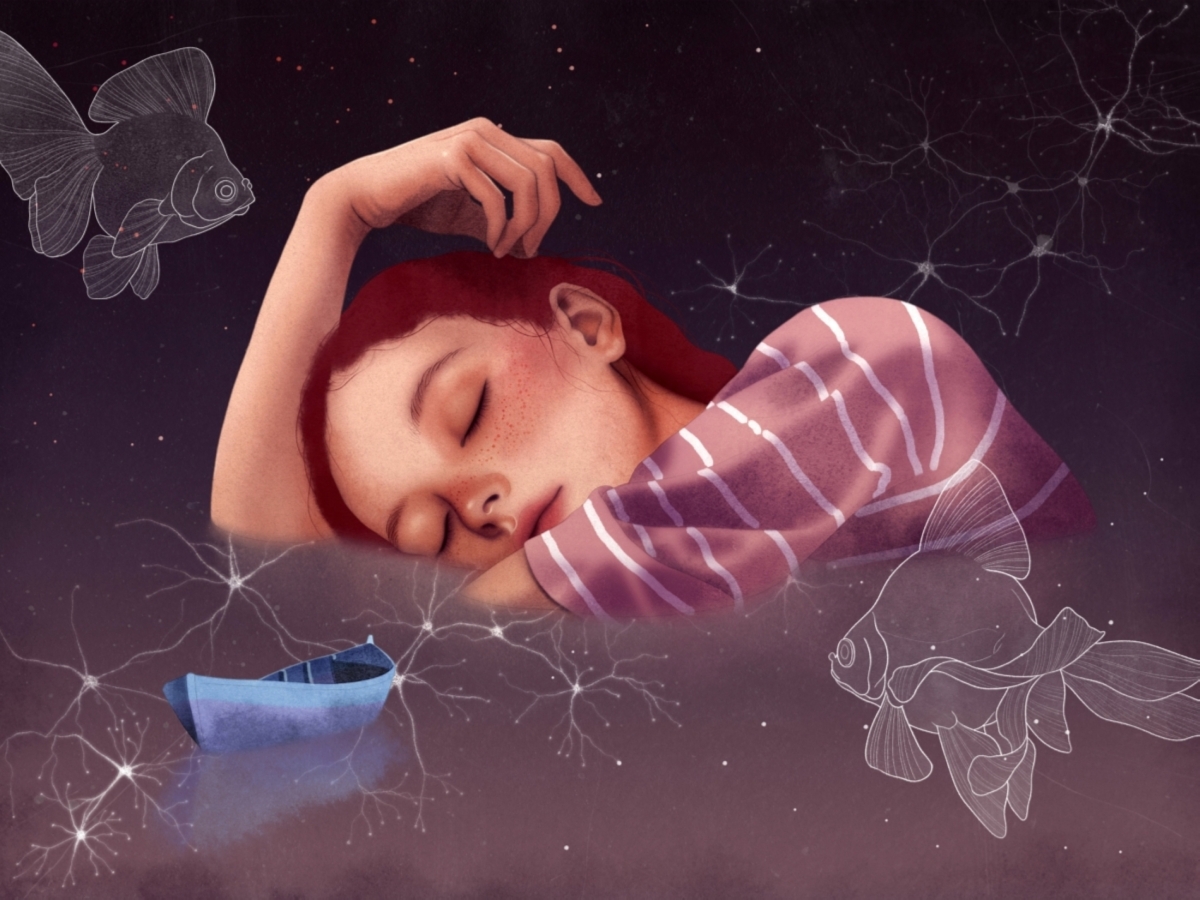

A recent scientific study from Italy suggests that when it comes to sleep, what matters is not just how long we sleep, but how deeply we sleep. Immersive dreams, even during a stage of sleep not traditionally associated with vivid dream activity, may play a surprising role in preserving the feeling of deep sleep, the study finds, even when the physiological need for sleep has already begun to recede.
Published on 24 March in PLOS Biology, it was conducted by researchers from the IMT School for Advanced Studies Lucca and from the University of Modena and Reggio Emilia, who asked why we sometimes feel like we are in a very deep sleep, when in fact brain activity shows that not to be the case. Why does the depth of sleep we experience not always coincide with the neural indicators used to measure sleep?
The research team used high-density brain recordings from 44 young adults across 196 laboratory nights, with more than 1,000 repeated awakenings during Stage 2 non-REM sleep. This stage accounts for roughly half of total sleep time, spans the night, and is highly variable. At times, the sleeper may be immersed in a mental or dream-like experience.
They wanted to compare activity in the cerebral cortex with the sleeper’s perceptions about the depth of their sleep, the extent of their drowsiness, and whether they had been dreaming or experiencing any form of awareness. To do this, they repeatedly woke participants throughout the night, asking them about their sleep immediately before waking. They compiled 1,024 documented awakenings from non-REM sleep, linking each case to a precise self-report and to electrical brain measurements taken during the two minutes prior to wakening.
Accounting for dreams
Traditional expectations were clear: the lower the brain’s high-frequency activity, and the more slow-waves came to dominate, the deeper the sleep appeared. The results confirmed this, at least in part. The researchers found that the feeling of deep sleep is usually associated with a decline in the ratio of high-frequency to low-frequency activity, a general indicator of cortical activation. Put simply, when the brain looks less like it does in wakefulness, a person is more likely to say they were in a deeper sleep.
The results looked different once dreams were accounted for, however. It was here that conventional understanding began to unravel. When participants reported some form of conscious experience—a vivid dream, or a sense that something had been unfolding without being able to recover its content—the link between brain activity and the feeling of deep sleep grew weaker. In other words, a rise in certain markers of cortical activation, usually taken as a sign of lighter sleep, no longer necessarily translated into the impression that sleep had been shallow, provided it was accompanied by a dream or an immersive inner experience.
This stands among the study’s most striking findings because it unsettles a common assumption in sleep science: that ‘deep sleep’ must be a state of little or no awareness. Instead, the ‘felt depth’ of sleep is shaped not only by how far brain activity declines, but the nature of the inner experience through which the sleeper passes during that stage. When the dream experience is rich and absorbing, sleep may still seem deep even if the brain retains patterns of activity relatively closer to wakefulness.
To understand these experiences more precisely, the researchers did not stop at the conventional division of states into a remembered dream, a sense that an experience had occurred without being recalled, or an absence of awareness. They introduced an important refinement within that final category. It turned out that the absence of content does not always mean the absence of consciousness.
In roughly half of these cases, participants described a faint awareness without content, a sense of presence, or a sense of time passing, distinct from complete unconsciousness. The results showed that the weakest sense of sleep depth was associated with this dim intermediate state, while the greatest depth appeared either with a vivid, immersive dream or with a complete absence of awareness.
This suggests that the issue lies less in the mere presence of consciousness than in its fragility and attenuation. Sparse inner experience makes sleep seem lighter, whereas coherent dreams, or the total disappearance of awareness, make it seem deeper. This helps explain why some people feel their sleep was not deep, even when it was physiologically sufficient. The quality of consciousness during sleep varies. A rich dream reinforces the sense of depth; less awareness diminishes it.

Dream quality
The researchers also analysed the qualities of dreams themselves, distinguishing between perceptual immersion (vivid, sensory and emotional dreams) and reflective thought (more abstract, less sensory). They found that the former is associated with a stronger feeling of deep sleep. This suggests that the decisive factor lies in the nature of the dream, not merely in its presence.
Strikingly, this effect appeared even when participants could not remember the dream’s actual content. Some awoke unable to recall details but with a distinct sense that a rich and intricate dream had dissolved from memory. This suggests that remembering a dream may not be necessary for it to shape our sense of sleep quality. It may be enough that the dream was an immersive experience, even if it could not be recounted in the morning.
Another striking aspect of the study lies in its distinction between two sensations that are often conflated: the depth of sleep and drowsiness on waking. Both are, to some extent, linked to the state of the brain during sleep, yet the findings clearly showed that they are not the same.
Complete unconsciousness was associated with the highest levels of sleepiness on waking, whereas all forms of conscious experience were linked to a relative reduction in that sleepiness. In other words, someone emerging from a dream, even if their sleep had felt deep, may feel less drowsy than someone emerging from a state of total unawareness.
The researchers suggest that dreams may be accompanied by varying degrees of cortical activation that facilitate the transition into wakefulness and reduce a phenomenon known as sleep inertia. This distinction matters because it shows that the subjective depth of sleep cannot be reduced to a mere feeling of heaviness or a wish to remain asleep. A person may feel they have slept very deeply and yet not be especially drowsy on waking, and the reverse may also be true. This reinforces the idea that sleep is a multidimensional experience and that different subjective indicators may reflect partly distinct neural and psychological processes.
A paradox emerges
When the researchers turned to tracing what happens over the course of the night, another, even more intriguing paradox emerged. Physiologically, it is well established that sleep pressure gradually declines as the night advances. Slow waves (which mark the need for sleep) diminish over time, while brain dynamics shift in response to the interplay between internal sleep pressure and the biological clock.