Syria's deputy defence minister on founding the YPG
In Part 1 of a two-part interview, Sipan Hamo explains how the Kurdish People's Protection Units were born and talks about his jailing and torture in Syrian prison after Russia turned him over
Al Majalla
Syria's deputy defence minister on founding the YPG
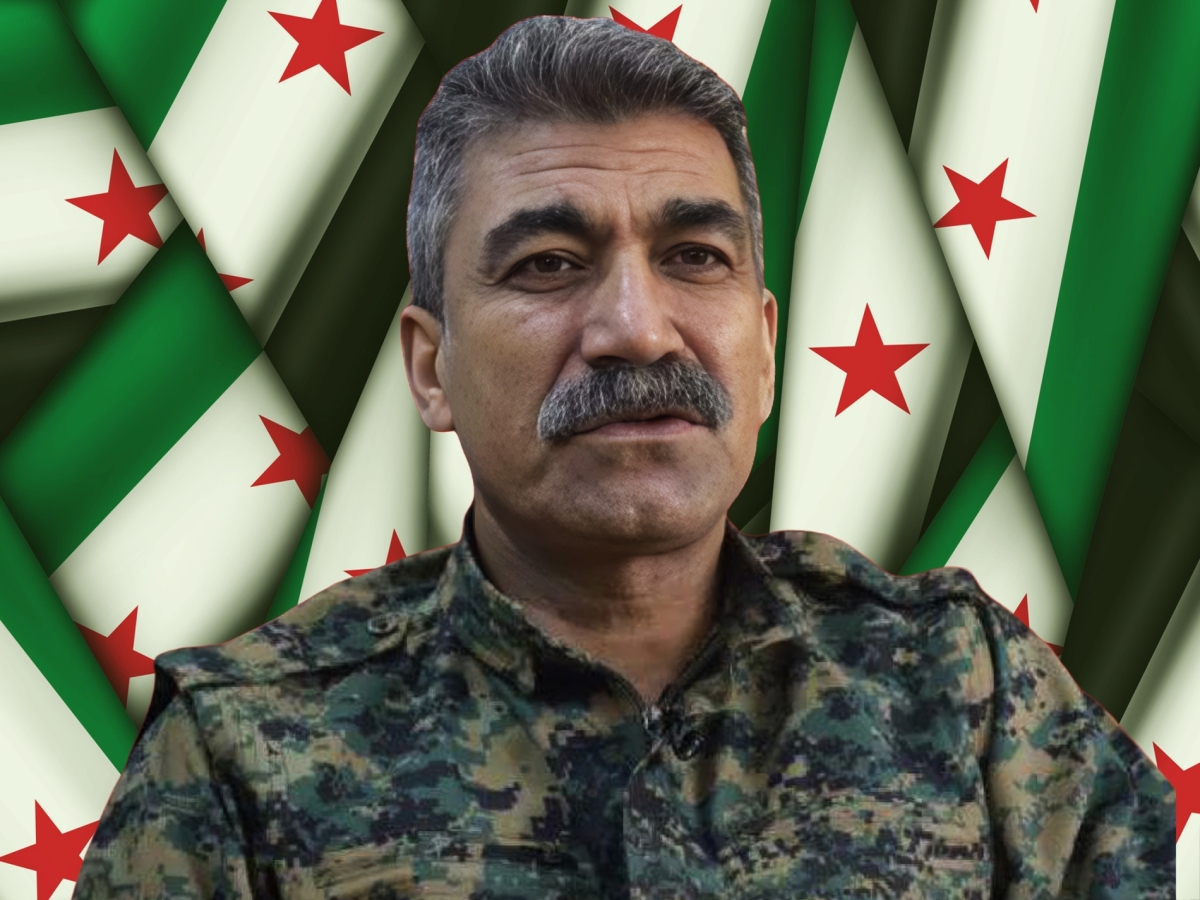
Syrian Kurdish leader Sipan Hamo was this month appointed the country’s Deputy Minister of Defence for the Eastern Region, marking the latest chapter of a life that had already assumed epic proportions. A former Kurdistan Workers’ Party (PKK) operative, he sat down to speak to Al Majalla, including everything from solitary confinement to his dealings with Bashar al-Assad’s top spies.
Born in 1973, his birth name being Samir Aso, he has been involved with armed Kurdish groups since the 1990s, and has fought both the Assad regime and Islamic State fighters, working alongside the Americans, the Russians, and the Syrian opposition, to name but a few.
In 2013, when Syria’s current president was leader of the jihadist organisation Jabhat al-Nusra, based in Syria’s north, the two men struck a deal over the Kurdish-majority city of Afrin. Now, 13 years later, they are once again working together, with Hamo having just been appointed as the deputy to Defence Minister Maj. Gen. Murhaf Abu Qasra, under the terms of an agreement concluded between the Syrian government and the Syrian Democratic Forces (SDF) in January.
In an extensive and wide-ranging discussion, he spoke of his student years in Damascus, his involvement in “liberation movements”, and his imprisonment in Syria and Türkiye after the abduction of PKK leader Abdullah Ocalan, when Moscow handed him over to Ankara. He also spoke of how he founded the Kurdish People’s Protection Units (YPG), which formed the backbone of the SDF.
Part of his role now as minister is to help Syrians heal and come together, so it was of interest that he recalled growing up in the Barzeh housing complex in the Syrian capital, where the residents came from different backgrounds. He describes the languages and dialects spoken in the building as part of its beauty, “as though we were one family”. He could not be clearer in his views: all peoples of Syria are Syrian first.
Having seen several of the 21st century’s most prominent terrorist organisations at close quarters, and having fought in some of its bloodiest battles, Hamo’s story at times makes for sobering reading. Of the prison cells of Damascus under Assad’s rule, for instance, he says, “every day was torture, every day was humiliation”. Interestingly, he bears no ill will towards the Russians, even though they handed him over to his jailors. It was just realpolitik, he suggests. They simply had bigger interests to consider.
The agreement we reached with the government last month, naturally, unsettled some who hadn't come to terms with it. With time, perhaps they will.
Sipan Hamo, Syria's deputy defence minister
During his life, he lived in Georgia and Iraqi Kurdistan, where he spent time after his release, pursuing his true passion: history. Syria's history is still being made, of course, and Hamo may still have a bigger role to play, as Damascus seeks to integrate the country's restive north-east into the national project. With the inevitable bumps in the road, a calm head such as his may be needed in the coming months.
Hamo's insights open a window onto an entire era, one in which choices were made under immense pressure and the price paid was often extraordinarily heavy. Al Majalla spoke to him extensively by phone on 21 March 2026. The interview has been edited and split into two parts. Here is the first instalment.
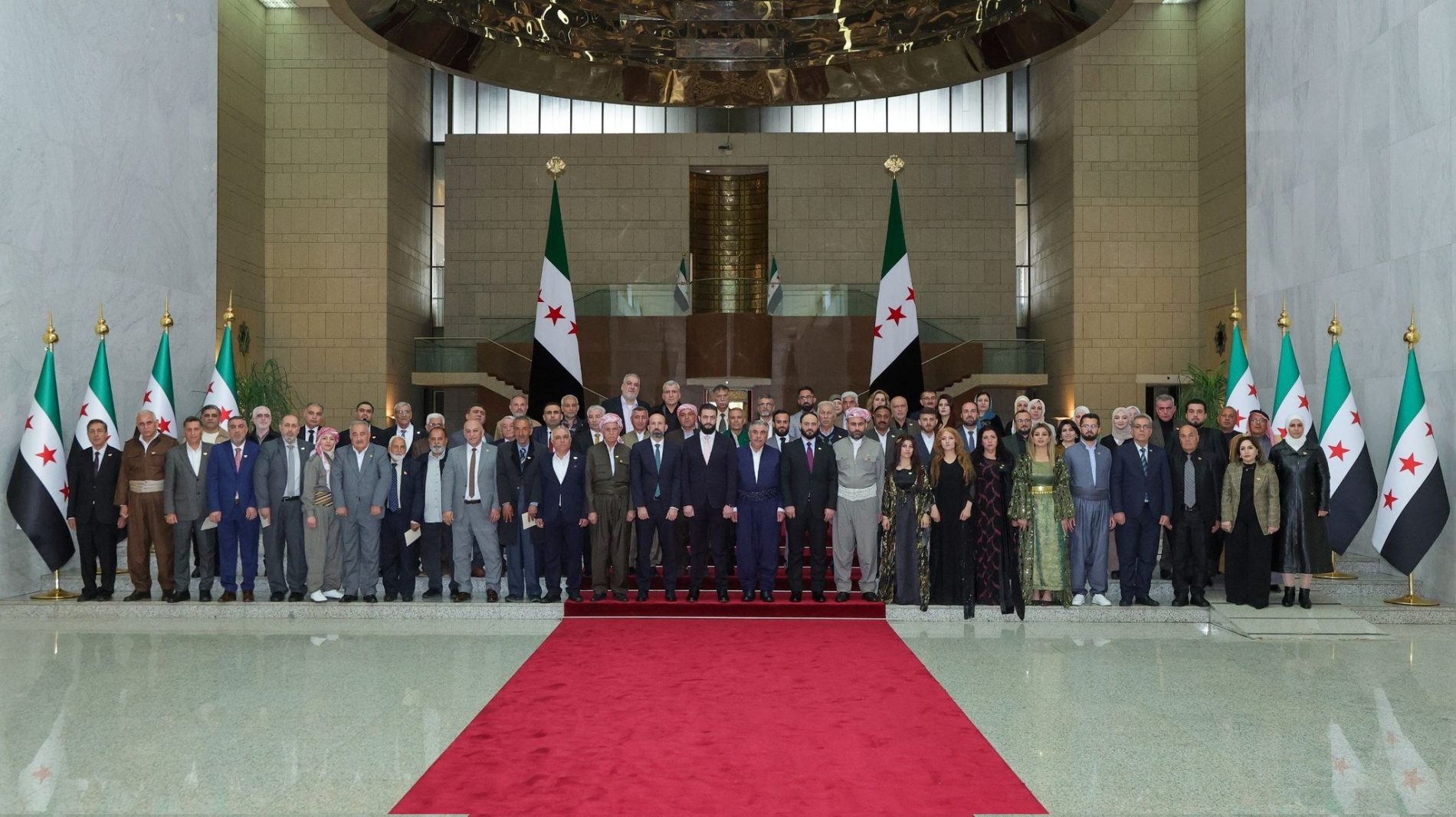
President Ahmed al-Sharaa received a delegation from the Kurdish community in Syria at the People's Palace in Damascus on the occasion of Eid al-Fitr and Nowruz.
Two things happened today: the Syrian flag was burned, and a Kurdish delegation in traditional dress visited the Syrian presidential palace on Nowruz to meet President Ahmed al-Sharaa. How do you view these two developments?
Let me first extend my greetings to the Islamic and Arab nations on the occasion of Eid al-Fitr and Nowruz. I also send my greetings to the Kurdish people, the Arab people, and all the peoples of the region. God brought these two occasions together on a single day, and we hope this may prove an auspicious sign, first for Syria and especially for the Kurdish people. God willing, the worst days that Syrians have endured are now behind us, and much better days lie ahead.
Regarding the situation today, certain parties are uneasy with it. The visit of Hassakeh Governor Nour al-Din Ahmed and Internal Security Forces leader Mahmoud Khalil to Damascus, in Kurdish dress, to meet President Ahmed al-Sharaa, was a beautiful sight. For the Kurds of Syria and more broadly, it was a historic day.
But we were taken aback by the lowering of the flag in the Kobani area (also known as Ain Al-Arab). Events spread rapidly. Kurdish symbols were insulted, and youths were beaten. The whole picture changed completely. The unrest that erupted in parts of the Aleppo countryside spread to other areas, and the backlash became clearly visible in Kurdish areas such as Qamishli and Hassakeh. I was at the gathering in Hassakeh and tried to calm the situation, but in truth, matters were far from comfortable. It felt as though certain parties were trying to sabotage events.
Who?
I don't wish to inflame the situation, so I would rather not identify them. Forgive me. Some are uneasy with the steps that we are taking. We reached an agreement with the government last month and have implemented it clause by clause. We moved ahead with a genuine process of integration, from the military forces to the Asayish security forces, as well as the other institutions already in place. Naturally, that may have unsettled some who had not yet fully come to terms with it. That is not unusual. Perhaps, with time, tensions will ease.
Connected to this, the return of citizens to Afrin was—for the people of Afrin—a historic day. After many long months, their return in this manner became an image of genuine historic weight. That, too, disturbed some people. Then came Nowruz and Eid. What followed in the street tilted the balance further towards the Kurdish side. There are those who are agitated and troubled by the situation, and they want to spoil it for us.
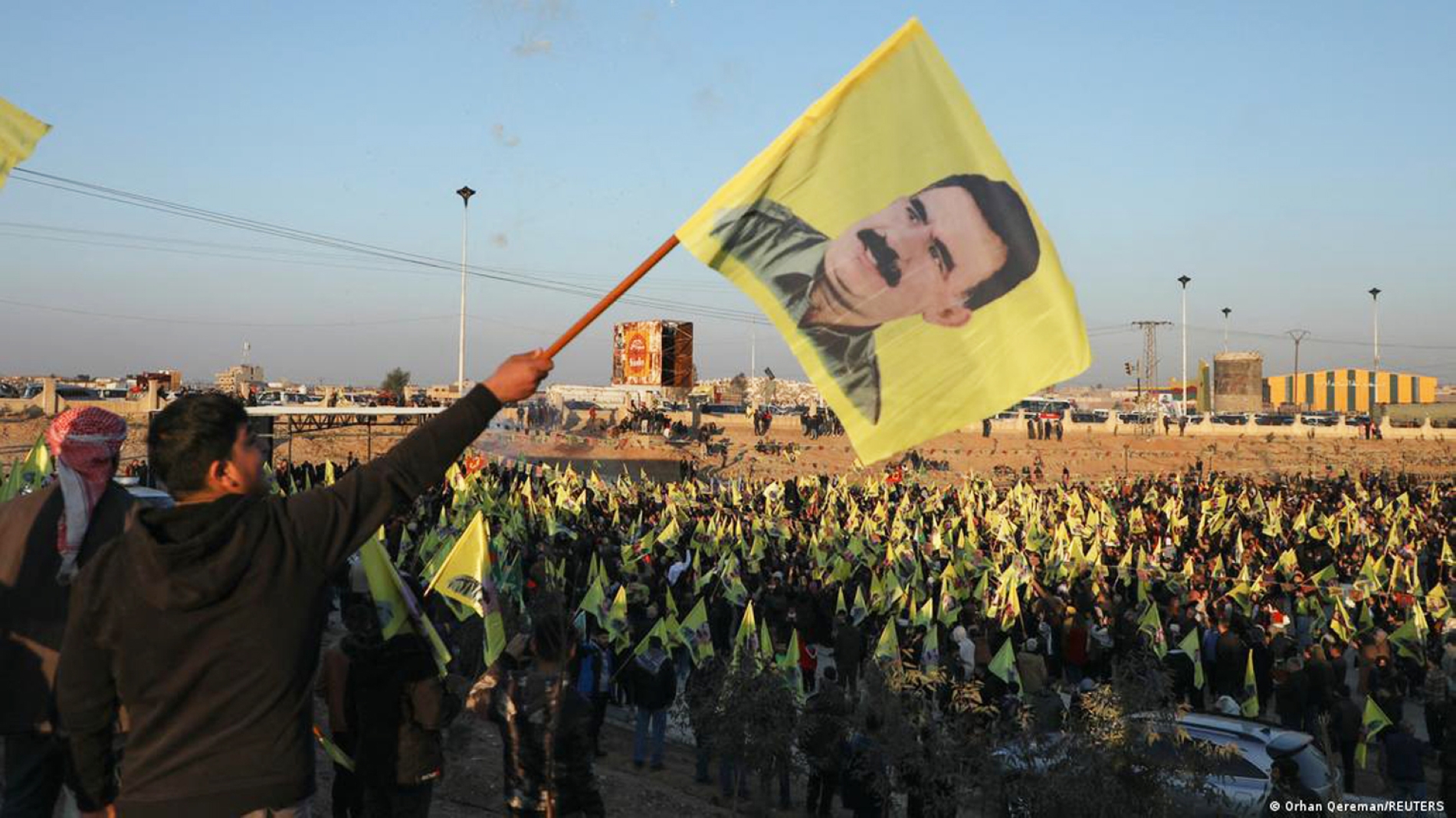
SDF fighters raise a picture of Abdullah Ocalan, the imprisoned PKK leader in Türkiye.
Do you mean the Kurdistan Workers' Party (PKK)? That there are those who cannot bear to see Kurds on the (national) political stage?
No, but as I told you, I don't wish to identify a specific party. But take my appointment as deputy minister of defence, for example. It prompted some very strange reactions in the Arab street, even though I have not been active in those areas and have had no friction with those communities. My dealings with them have been decent and respectful. Ask the people of Raqqa or Deir ez-Zor; you won't find anyone who knows me personally who has had any dealings with me other than fair and honourable ones.
So why the reactions?
Because some do not want a Kurdish presence on the political stage. They are unwilling to accept that the Kurds should have a role in Syria. So, I would like to remind all Syrians, once again: we are Syrians first and last. Syria, for us, is the common roof under which all its components gather. Whether I am Kurdish, Arab, or anything else, I am Syrian first, and I am proud of that Syrian identity.
I see Syria's diversity as beautiful. It is a garden with a million flowers. Of course, things have changed after 14 years of crisis, war, and upheaval. This opened a rift between Syria's communities. But I am a son of Damascus. I was born there, I grew up there, and I was raised there.
I met Ali Mamlouk several times. My first meeting with him was at Hmeimim Airport in Latakia.
Sipan Hamo, Syria's deputy defence minister
I was born in 1973 and grew up in the Massaken Barzeh, directly opposite the Agricultural Bank. The building was home to Arabs from Idlib, Hauran, and other places. No one ever asked where someone came from. On the contrary, we saw the different languages and dialects in the building as part of its charm, as though we were all one family. Later, I was a student in Damascus at a vocational institute until circumstances changed and I found myself drawn to political movements.
Was it then that you joined the Kurdistan Workers' Party (PKK)?
I would rather not say 'the Workers' Party'. Let me call them liberation movements. That was the form they took in 1990. I was at Damascus University, living in the student dormitories. There were two young men from the Workers' Party there. At that time, there were active young men everywhere, even in the secondary schools, trying to recruit students.
From 1985-95, the Workers' Party organisation was mainly confined to schools and universities. At its core, it was a student movement. I didn't go to university. After the baccalaureate, I enrolled at an industrial college in Qaboun, near the Police College. I enrolled but never attended. I joined when I was 17.
Then what happened?
We can speak about that later.
Were you imprisoned?
Yes. I was arrested in 1991, on Labour Day, and held for six months in the Political Security detention centre in Aleppo. Then they transferred me to al-Sulaymaniyah Prison in northern Aleppo. In 2005, I was arrested again and held at the Fayhaa detention centre of Political Security in Damascus.
Government forces patrol the Sheikh Maqsoud neighbourhood after taking control of the area, following the collapse of an agreement between the Syrian government and the SDF, in Aleppo, Syria, on 10 January 2026.
I know it, I was imprisoned there too.
After what happened in Qamishli in March 2004, we tried to defuse the tension and were active in the town at the time. As a result, I was arrested. I was in solitary confinement. I couldn't distinguish day from night. This was under Brig. Mohammad Khlouf, the most vile man. There is no one fouler on earth.
Where were you in 2005? In the Qandil Mountains?
No, no. Since 1990, I had been outside the country, in Türkiye, where I was also arrested and imprisoned. I remained there until 2004.
With the Workers' Party?
In 1999, when the conspiracy against (PKK leader) Abdullah Ocalan unfolded, I was arrested. I was in Georgia at the time, where Russian forces were present. The Russian army arrested me and handed me over to Türkiye in March 1991. I remained imprisoned there until the summer of 2004, when there was an understanding between Syria and Türkiye. The Turks handed over all their (Syrian) PKK people over to the Syrians after the Adana agreements in 1998.
When protests broke out in Qamishli in March 2004, you remained in prison?
I remained in prison in the Fayhaa branch, as an 'honoured guest' as they say, from the end of 2004 until the beginning of 2005. Every day brought torture and humiliation. Khlouf was the filthiest man in the world. He insulted me non-stop with words I am ashamed even to repeat. The cold was bitter. It was deep in the middle of winter. We were in prison in January.
After I got out, I went to northern Iraq to stay with relatives until 2010. By then, the Arab Spring had begun in Tunisia. We made arrangements. Little by little, it was moving towards our region, so we began preparing. In early 2011, I founded the YPG.
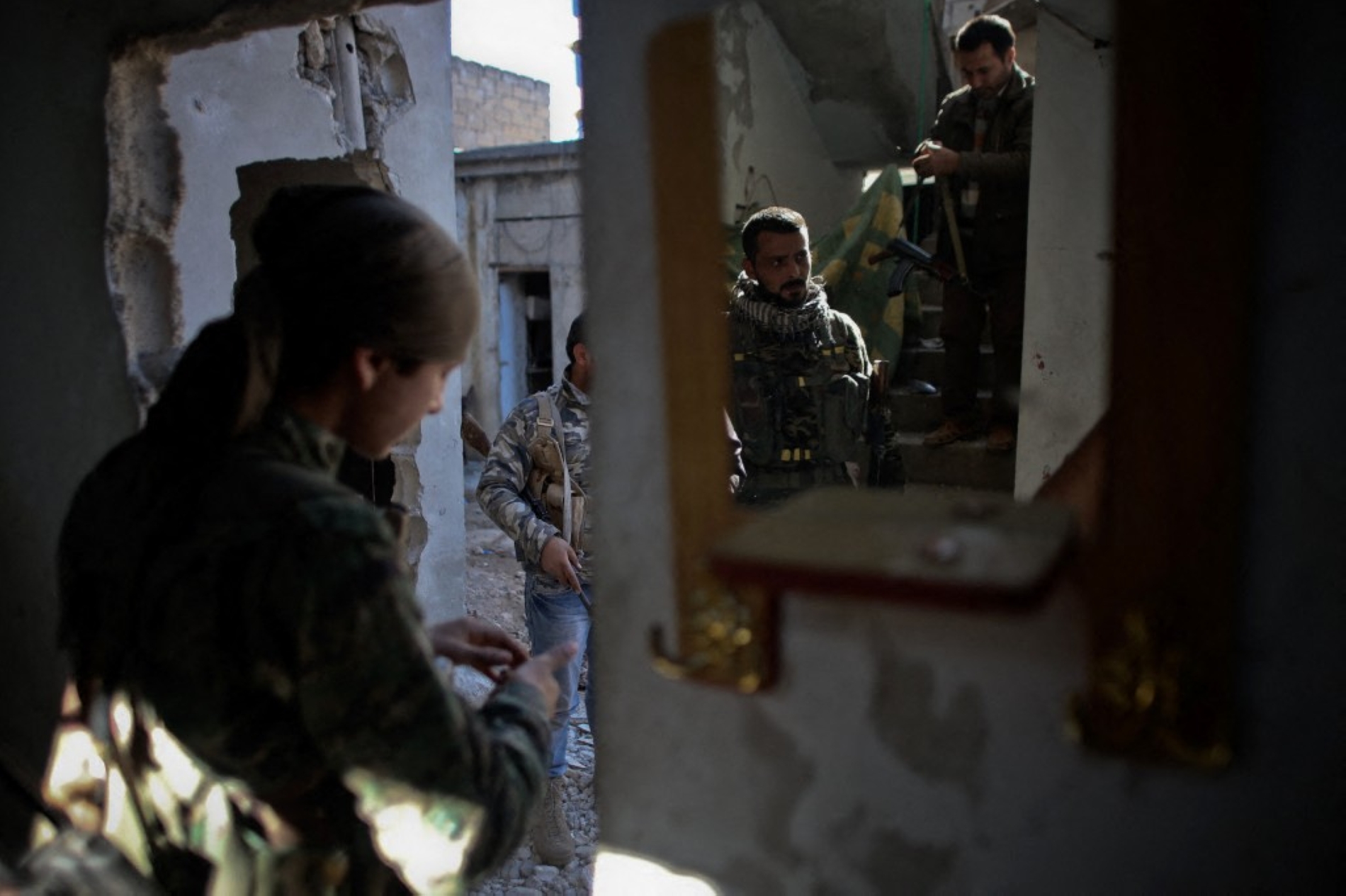
We began by liberating the Kurdish villages from the checkpoints, from the presence of the state, from everything. Matters then developed. Confrontations reached the point of the Islamic State's assault on Kobani. The whole world came to know about this. The equation changed when the Americans and the coalition entered alongside us.
Syrian Kurdish People's Protection Units (YPG) fighters prepare to fight against Islamic State (IS) group on 7 November 2014 in the Syrian besieged border town of Ain al-Arab (known as Kobani by the Kurds).
There were reports of coordination between you and the regime, with them handing over areas to you so that the Free Syrian Army did not take control of them. Is that true?
It wasn't a matter of a handover. We gave them the choice: either we drive you out by force, or you hand everything over and leave. We just gave them the chance to leave alive. In certain places, like Rmeilan, we clashed. There were battles and casualties. The same in al-Malikiyah, with Military Security. Some of our fighters were killed attacking their headquarters. We also fought them at the Air Force Intelligence headquarters in Kobani, killing some of their officers. We formed an alliance with the Free Army, with Ahmad Afash's Liwa Jabhat Souria, and stormed regime positions in Sheikh Maqsoud in Aleppo.
It was never just a case of a 'handover'. It is true that the regime did not want to push us towards the opposition, because that might have led to fighting, and we would have been forced into an alliance with it. In that sense, its approach was calculated. But the state did not simply hand everything over to us. It dealt with us much as it dealt with the Free Army. In fact, the regime always tried to avoid placing us in the opposition's camp. There were certain facilitation measures, yes, but they were not negotiated. It was imposed on them. Where they refused (to negotiate), we fought.
After that, the US-led international coalition was formed, along with the Syrian Democratic Forces (SDF)...
Yes. After the formation of the SDF, things changed. We moved out of the Kurdish areas into the Arab areas to fight the Islamic State along with the coalition. That was a different programme altogether. We cooperated with the coalition forces. Whether on the ground or at the table, implementation was by agreement.
You founded the YPG, and then Gen. Mazloum Abdi took over the SDF...
It was connected to and came about through coordination with the Americans.
But there was a decisive turning point in your story, namely Afrin at the beginning of 2018. Before Afrin, you went to Moscow and met Russia's Chief of Staff, and they told you there would be no intervention and that they would protect you. But the Russians deceived you, correct?
In political and diplomatic relations, there is no such thing as one side deceiving another. It is all a matter of interests. If we build a relationship with a side, there is naturally something in it for us and something for them. Great powers don't engage with anyone without getting something in return. They are not close to anyone out of affection.
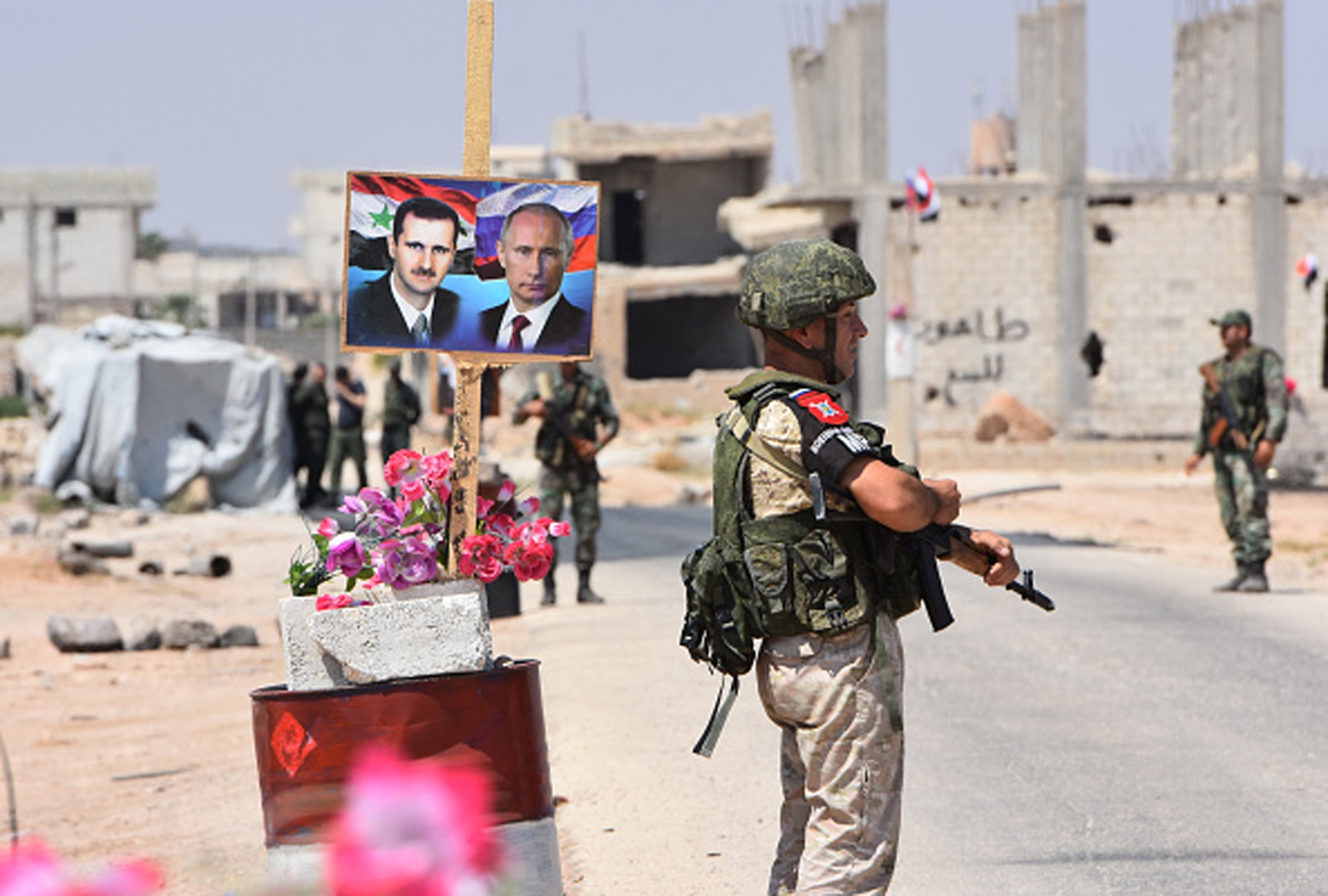
Members of Russian and Syrian forces at the Abu Al-Duhur crossing on the eastern edge of Idlib province on August 20, 2018.
But you felt the Russians betrayed you, and afterwards you withdrew, correct?
Afrin was emotional. Perhaps I used such words at the time. Now, I do not see it as betrayal. It was a matter of interest. Perhaps they were trying to balance the scales, and their interest in Türkiye was stronger.
You disappeared after that...
I went to Erbil to continue my studies through open learning. I wanted to continue in the field I loved: history. I returned last year. The people now in power were said to dislike me, but I had very good relations with them, from President Ahmed al-Sharaa to Abu Maria al-Qahtani, Anas Khattab, the interior minister, and others. In the days of Afrin, our relations were good.
In 2013, we signed an agreement with Jabhat al-Nusra (which al-Sharaa led from 2012-17) along the borders of Afrin, so I felt we might once again reach constructive understandings, and I wanted to find such a formula. Yet after my return, I saw that matters had moved in other directions, with other forces entering the scene. Everyone now has a presence in Syria.
As for the programmes being put forward today, it is as though we are two sides with overlapping interests that might still reach an agreement, as we did in 2013. Yet the relationships have changed. Back then, they were an organisation, and we were an organisation. Now they are the state, and they regard the Kurds as a limited or secondary actor in Syria.
Perhaps I used such words at the time, but now I don't view Russia turning me over as a betrayal. It was a matter of interest.
Sipan Hamo, Syria's deputy defence minister
When you commanded the YPG alongside Gen. Mazloum, you negotiated more than once in meetings with Maj. Gen. Ali Mamlouk (a senior intelligence officer and military advisor to the former president Bashar al-Assad), correct? What was your relationship with him like?
I met Ali Mamlouk several times. Our first meeting was at Hmeimim Airport in Latakia. When I was speaking to you about our clashes with the regime, I forgot to mention Hassakeh, which we sought to liberate. I met him in that context. It was arranged through Russian mediation around 2016.
After that, there was an agreement and coordination between you?
There was coordination. Since he was the intelligence chief, there was, of course, coordination.
Part 2 of the interview will be published tomorrow