Why proposed Israel-Lebanon talks are so important

Even as the bombs fly between Hezbollah and the Israeli army, there is suddenly an opportunity to sort out some longstanding problems. If Syria can help, all the better.

Nesma Moharam

Why proposed Israel-Lebanon talks are so important

The negotiations expected to open between Israel and Lebanon are a key development occurring at a time of war. After Hezbollah fired rockets into Israel on 2 March, it became involved in the broader US-Israeli war on Iran.

Fearing a worsening of the conflict and powerless to restrain Hezbollah, Lebanese President Joseph Aoun launched a diplomatic initiative aimed at shifting the confrontation to the political arena, expressing a willingness to engage in direct talks with Israel under international auspices, hoping this would lead to a ceasefire and shield Lebanon from Israel's wrath.

The delegation is intended to represent Lebanon’s diverse population and sectarian communities, signalling both the seriousness of the Lebanese government and broad domestic support for whatever agreements might emerge from talks with Israel.

Aoun’s initiative is supported by Parliament Speaker Nabih Berri. Other members of the Lebanese delegation include Ambassador Abd al-Sattar Issa (chosen by Prime Minister Salam as the representative of the Sunni community), former Ambassador Simon Karam (the Maronite representative), Shawki Abu Nassar (the Druze representative), Paul Salem (who previously headed the Middle East Institute in Washington), and most likely a representative of the Orthodox Christian community. Berri, 88, heads the Amal Movement, one of the larger Shiite blocs.

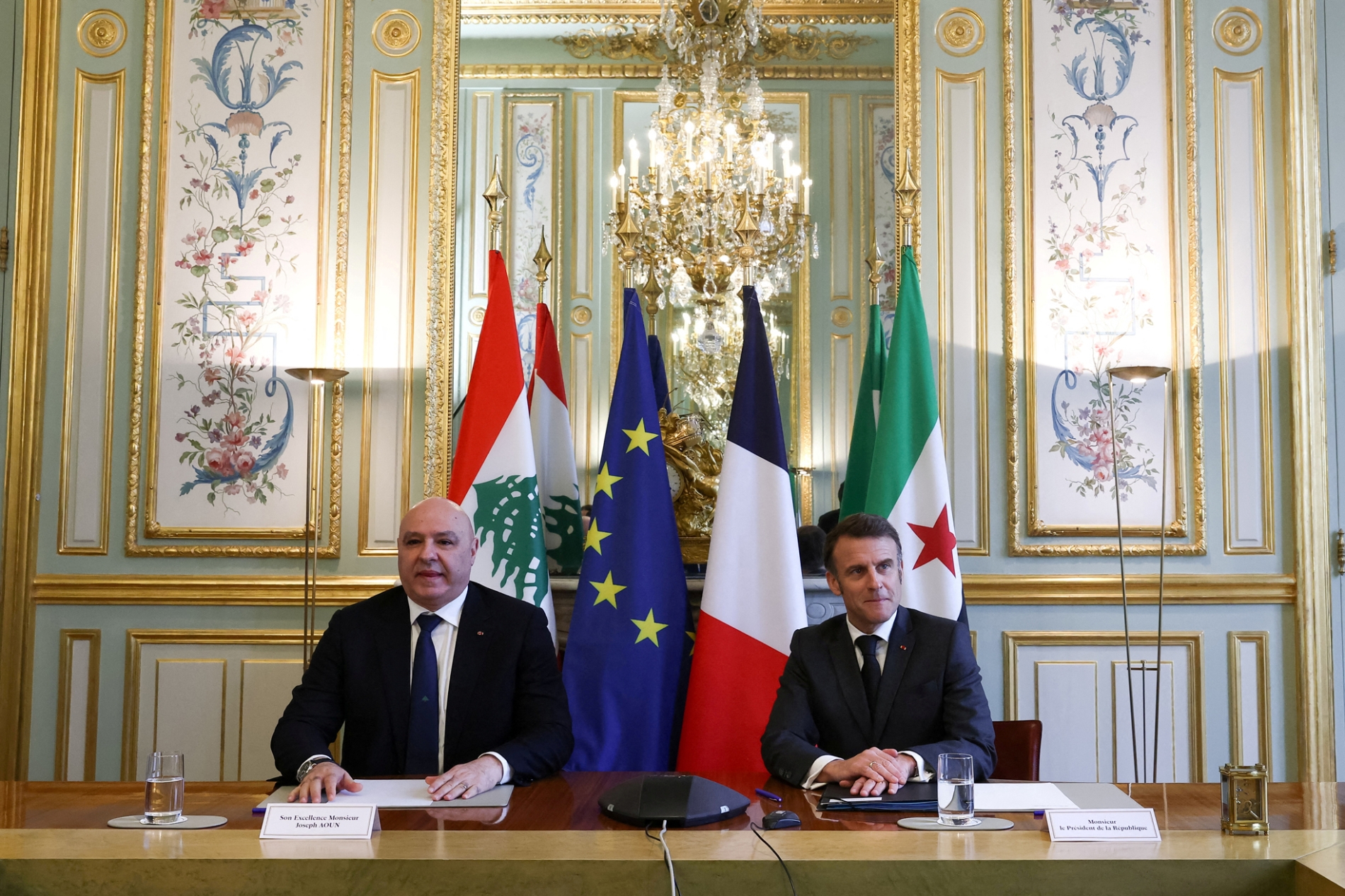
France is also engaged diplomatically, with President Emmanuel Macron speaking with President Aoun and President Ahmed al-Sharaa of Syria. Paris wants to promote Israeli-Lebanese negotiations alongside Israeli-Syrian talks, or even a trilateral format, in an effort to achieve meaningful progress, at the very least on the issue of the border between Lebanon and Israel.
Reuters
French President Emmanuel Macron and Lebanese President Joseph Aoun during a meeting, joined remotely by Syrian interim President Ahmed al-Sharaa, during a visit to the Elysee Palace in Paris, France, 28 March 2025.

French support

France initiated a recent UN Security Council meeting to discuss Lebanon and gain support for its diplomatic push. It is also coordinating with Washington, where US President Donald Trump has more influence over Israel.

It appears that the Israelis have agreed to negotiate, and it has been reported that former minister Ron Dermer will head the delegation. Israel is sceptical about the Lebanese Army’s ability to disarm Hezbollah, and this is understandable. Nevertheless, the current round of fighting in Lebanon requires a change in the way Israel conducts itself.

Israel should respond positively to the Lebanese president's call for direct negotiations

Aoun's call for direct negotiations demands a different response. Israel should respond positively to the Lebanese president's outstretched hand. Its answer to the call for direct talks should be public, positive, and capable of generating diplomatic momentum.

Israel should exploit Hezbollah's bruised position to increase pressure on it from Lebanese society. More importantly, it can drive a wedge through the Shiite community, between Hezbollah's supporters and those aligned with Berri's Amal.

AFP
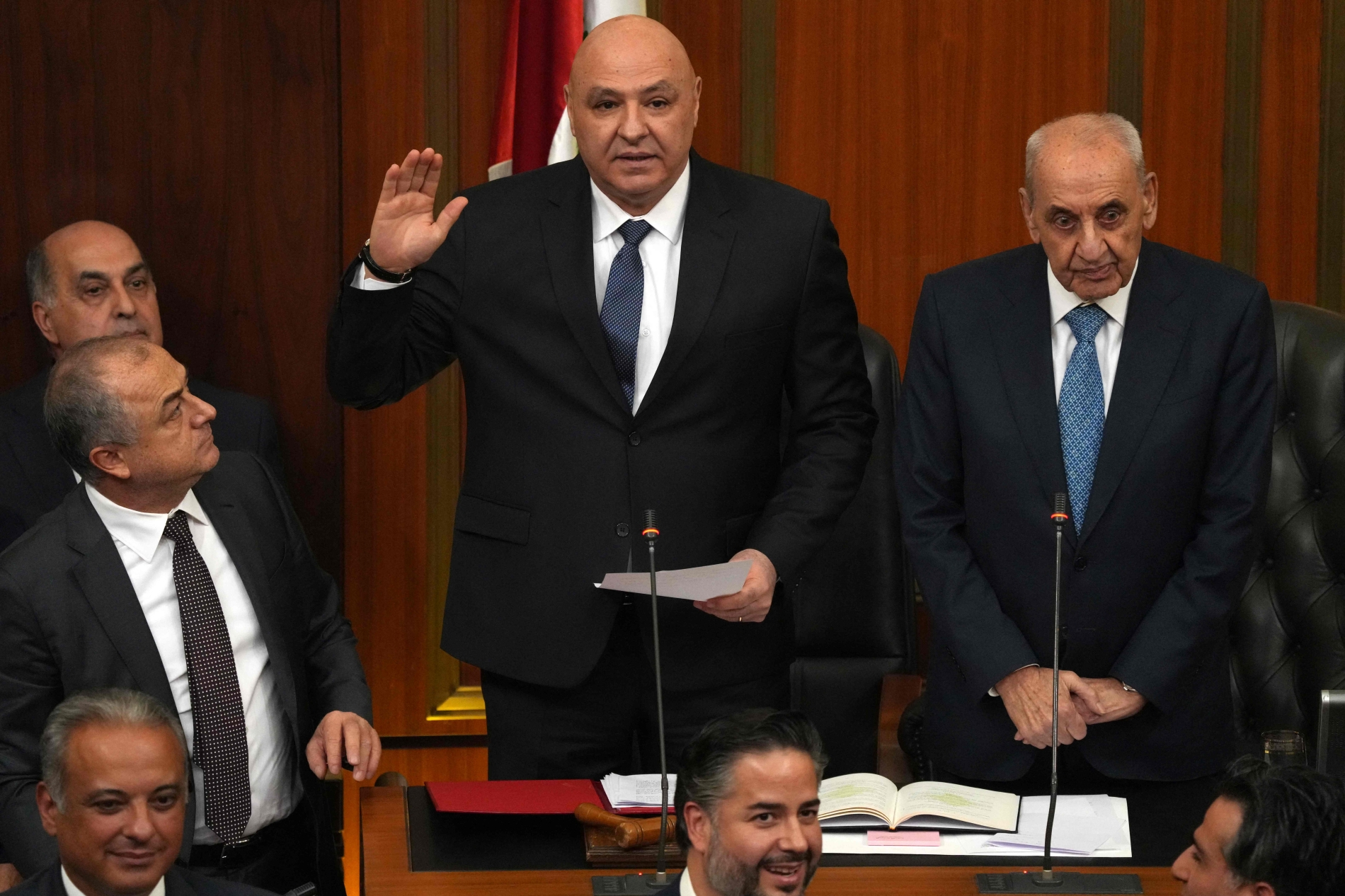
Newly elected Lebanese president Joseph Aoun (L) stands next to the parliament speaker Nabih Berri as he delivers a speech during a parliamentary session to elect a president in Beirut on 9 January 2025.

Avoiding a larger war

The ceasefire question is the most immediate and difficult issue. Lebanon wants Israel to stop bombing and talk, in the hope of avoiding a large-scale military operation of the kind that has been so costly to the country over recent years. At the same time, Beirut knows that it cannot impose its will on Hezbollah. For Israel, the decision to cease firing is extremely unlikely, especially since it sees this moment as an opportunity to further degrade the group.

Israel should nevertheless take the unilateral decision to stop bombing ahead of negotiations. If Hezbollah continues fighting, Lebanese public anger toward Hezbollah would grow, which could give Israel ample justification to step up its campaign against the group. And should  Hezbollah accept the ceasefire and reciprocate, this would sow discord between its leaders and its patron, Iran. Both are good outcomes for Israel.

Israel should drive a wedge through the Lebanese Shiite community to increase pressure on Hezbollah

Although still uncertain, the possibility of including Syria in negotiations creates a unique opportunity to address the long-standing Israel-Lebanon border dispute. 

The disarmament of Hezbollah is still the most immediate and difficult issue. The Lebanese government has already ordered Hezbollah to disarm. A structured action plan to achieve this must be put in place with a defined timetable, but external support must be secured for the Lebanese Army, including finance and equipment.

Disputes over the land border are solvable, despite the complexity of several points. Constructive Syrian involvement, particularly in clarifying the status of the Shebaa Farms, could facilitate a resolution and show Washington and Tel Aviv that creative diplomacy from Damascus can help solve long-standing problems. 

REUTERS/Ayal Margolin
Interceptions of rockets launched from Lebanon to Israel over the border, amid ongoing cross-border hostilities between Hezbollah and Israeli forces on 27 June 2024.

When it comes to Israel-Lebanon talks, it's important to set ambitious yet realistic goals. Beyond the immediate issue of Hezbollah's disarmament, they could consider a non-belligerency agreement and mutual recognition between the two states. Given Lebanon's urgent need for stability and economic recovery, such a prospect is now more feasible than before.

There will be obstacles, but it is crucial not to squander the opportunity. Even if it had little choice in the matter, Hezbollah's decision to join the fighting on the side of Iran was misguided to the extent that it may have sealed its own fate. That development alone opens the door to a new reality between these neighbours. Such opportunities are rare.

font change

Related Articles