Jesse Jackson made a black president possible

The activist and civil-rights leader died on February 17th, aged 84

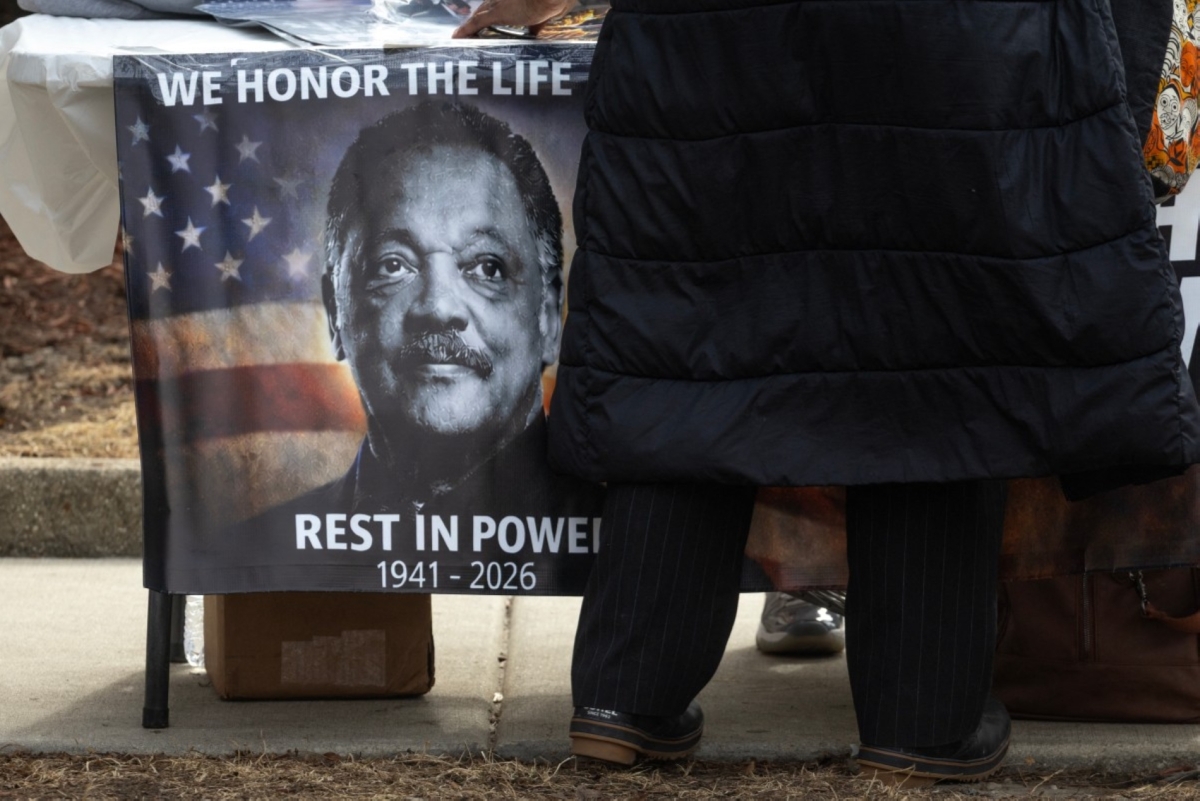
A vendor sells merchandise to people paying their respects to the late civil rights leader Rev. Jesse Jackson outside of the Rainbow PUSH Coalition national headquarters on 27 February 2026 in Chicago, Illinois.
SCOTT OLSON / AFP
A vendor sells merchandise to people paying their respects to the late civil rights leader Rev. Jesse Jackson outside of the Rainbow PUSH Coalition national headquarters on 27 February 2026 in Chicago, Illinois.

Jesse Jackson made a black president possible

He heard the crack of the gun. Then saw the impact: blood gushing from the neck and jaw, the tie blown off. The date was 4 April 1968; the place was Memphis, Tennessee. Immediately, he raced upstairs to the balcony of the motel where Martin Luther King lay dying. As he told it, he cried out to him, cradling his head, letting his mentor’s blood pour over his clothes.

All King’s closest aides had rushed to help him, but it was he, Jesse Jackson, burning with grief and righteous anger, who flew back to his base in Chicago to appear on the “Today” show with King’s blood still on him. He told the audience that there had been a crucifixion: the man of love killed by hate, the man of peace killed by violence. He had been there. And for a certainty, he would also be there when resurrection came.

Other witnesses remembered King’s end differently. It hardly mattered. He knew he was the man with the energy, electricity and sublime preacher’s oratory to carry on where King had left the civil-rights cause. Fired by this persuasion, he carried on for half a century campaigning, protesting, motivating and getting under the skin of those who thought he was mostly serving himself. He was adamant that he was not. It needed a leader—someone with intelligence and courage, will, discipline, divine inspiration—to make King’s long arc of moral justice bend just that bit faster.
AFP
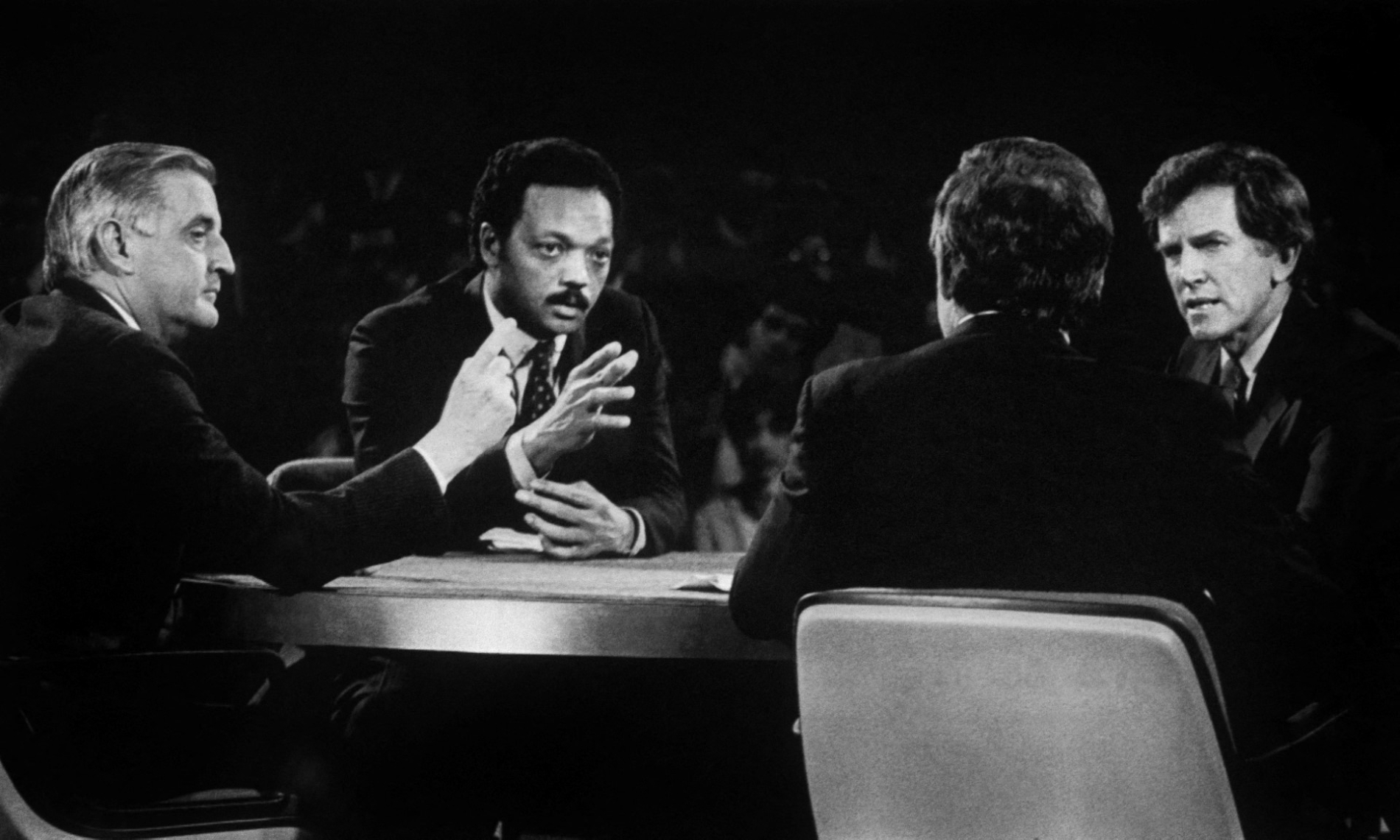
Democratic presidential candidates Walter Mondale (L) and Jesse Jackson (2nd, L) participate in the Democratic debate at Columbia University on 28 March 1984, in New York.

Twice, in 1984 and 1988, he ran for president, the first African-American man to do so for a major party. His platform was partly classic left-liberal: taxing the rich, cutting defence, and using the savings for social programmes. But he also had a glorious vision of an America where the disinherited and disrespected, the despised and rejected, were taken up, cared for and placed at the centre of national politics; where there was true equality of education and opportunity and abundant jobs; where the priority of government was to feed the hungry, clothe the naked and choose not the nuclear race, but the human race. Jesus’s Sermon on the Mount showed how the Democratic Party could revive itself this way, block by block, precinct by precinct. Vote by vote.
Jesse Jackson ran for president twice, in 1984 and 1988, the first African-American man to do so for a major party

Broader still was his mission to transform the American mind, from conflict and self-interest to co-operation, with all colours, trades and professions working together to find common ground for the common good. From finger-pointing to clasped hands. His political vehicles, eventually combined, were the National Rainbow Coalition and People United to Save Humanity (PUSH); their names said it all. America's great diversity put him in mind of the quilts his grandmother used to make, using every scrap and patch of wool, silk, gaberdine and crockersack. Sewn together, they made a thing of beauty. They also made the perfect metaphor for an expanding, all-embracing Democratic Party.

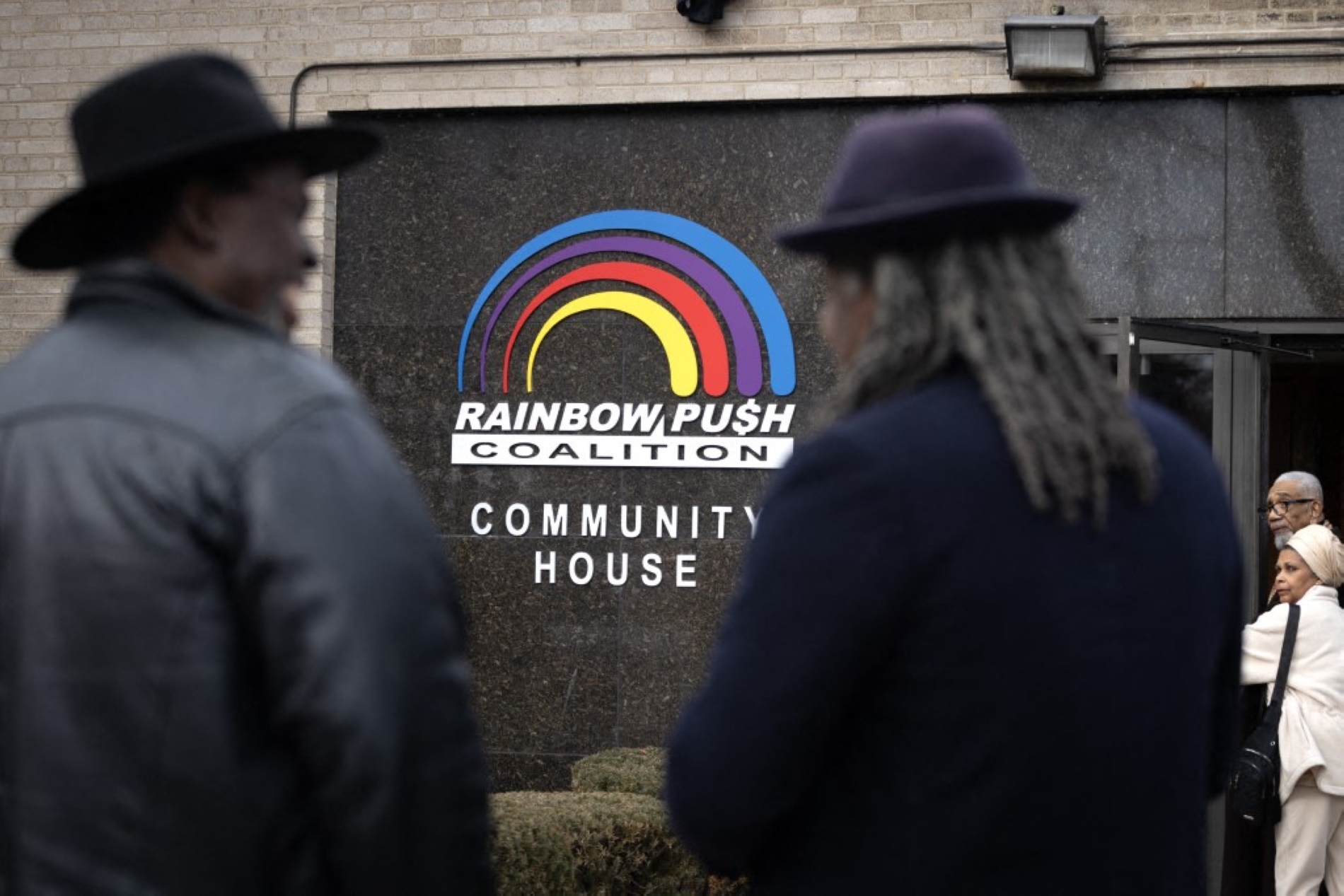
SCOTT OLSON / AFP
People arrive at the Rainbow PUSH Coalition's national headquarters to mourn the death of its founder Rev. Jesse Jackson on 17 February 2026 in Chicago, Illinois.

Those quilts told a story of personal poverty that he loved to emphasise. It was not untrue. Born to a teenage mother with runs in her stockings, abandoned by his father, he was largely raised by his grandmother in a shotgun shack with a slop-jar by the bed. A boy good for nothing, probably. Yet he was clever, loved words and naturally took charge. As a star quarterback, he learned to think tactically and motivate people.

Until he went to college in Illinois, he was in the segregated South; an early memory was being led, by his mother, to the back of the bus. It did not take him long—just to the moment he was turned away from a public library in his hometown, Greenville, South Carolina—to start organising protests. His future as a minister was put on hold then, though he later resumed it. In 1965, he met King by chance and felt his whole body tremble as his hero greeted him by name. His activism had been noted. They did not always agree, but he, at least, knew he was the heir apparent.

When he ran for president, though, the nation as a whole turned its back on his dreams. The sight of him winning primaries sent establishment Democrats scuttling to find a safer, whiter, and (they vainly hoped) properly electable candidate. In 1988, he was overlooked even for vice president. But the quarterback played a long game. His drive to get African Americans to register increased the total vote in the 1984 Democratic primaries in Georgia and Alabama by almost 80%. PUSH made itself felt at ground level in long-neglected places, not only organising boycotts of prejudiced businesses but also paying for college scholarships and saving poor homeowners from foreclosure. (Teach the illiterate, house the homeless.) 

He led children of all colours in chants of "I am somebody!" and urged adults to "Keep hope alive!" Their time would come. In 2008 came that highest of high moments, when his party produced the first African-American president. With his oratory, his slogan "Yes We Can!" and his deliberate pitch to those disrespected ones, Barack Obama followed the very path Mr Jackson had mapped out in 1984.

That remained the way he saw himself. He offered leadership, but he was truly a trailblazer, a freewheeling public servant whose place was ministry, not elected office. He preferred to be, like King, a moral force. He was not much impressed with the groups, such as Black Lives Matter, that were trying to provoke the whole system from outside. By his later years, he had learned to work with a boundless loving heart both with capitalism and with institutions that were still doggedly white. Anger should be turned into votes. The rainbow vision persisted.

So too did his memories of the events of 4 April 1968. To think of them was like tearing the scab from a sore. On Mr Obama's victory night, he wept that King had not lived to see it. After describing his death in later years, he would sometimes pause and pant for breath, as though he was exhausted. In truth, he had never stopped campaigning from that moment, and the resurrection had still not fully come to pass. But as he had promised, and as he firmly believed, God was not finished with him yet.

font change