Bad Bunny: the unapologetic Puerto Rican pop star

The six-time Grammy Award-winner ruffled MAGA feathers during his Super Bowl performance by singing entirely in Spanish, which, to some, was seen as an affront to ‘American’ identity

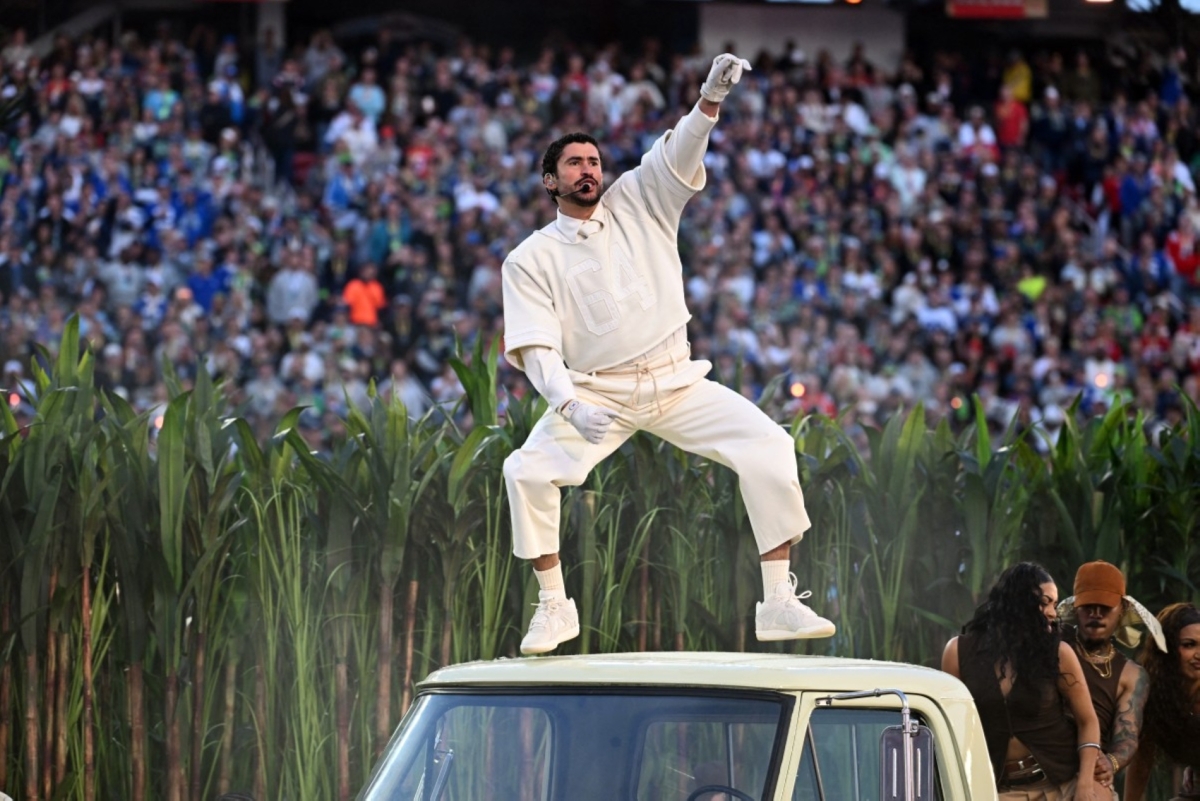
Puerto Rican singer Bad Bunny performs during Super Bowl LX Patriots vs Seahawks Apple Music Halftime Show at Levi's Stadium in Santa Clara, California, on 8 February 2026.
JOSH EDELSON / AFP
Puerto Rican singer Bad Bunny performs during Super Bowl LX Patriots vs Seahawks Apple Music Halftime Show at Levi's Stadium in Santa Clara, California, on 8 February 2026.

Bad Bunny: the unapologetic Puerto Rican pop star

The Super Bowl is supposed to be a familiar ritual: a crowded stadium, a television audience in the hundreds of millions, and a halftime show designed to entertain the viewers. This time, Benito Antonio Martínez Ocasio, better known as Bad Bunny, took the stage in Santa Clara, California and performed entirely in Spanish, sparking a firestorm of criticism from conservative America.

His performance was meant to be an ode to the Americas, not just the United States but the entire Western Hemisphere. Within hours, that choice had been recast as political provocation. President Donald Trump called the show “absolutely terrible” and “a slap in the face” to the country, implying that English was the sole language of the United States, even though it isn’t designated as an official language, and that large swaths of the country speak Spanish.

Despite the controversy, Bad Bunny’s performance drove record viewership, with Apple Music reporting, “Within the first 48 hours, the Super Bowl LX Halftime Show Press Conference with Bad Bunny became the most watched in Super Bowl history with more than 63 million views across an array of related content, including the live stream and social clips.” The company also confirmed that Bad Bunny’s overall listeners on Apple Music jumped seven times immediately after halftime.

Early life and career

To understand why his performance stirred so much controversy, it helps to begin where Bad Bunny began. Martínez Ocasio was born on 10 March 1994 in Bayamón and raised in Vega Baja, Puerto Rico, an island in the Caribbean considered a US territory but not a state, even though its residents hold American citizenship. His father, Tito Martínez, worked as a truck driver, while his mother, Lysaurie Ocasio, is a teacher. His childhood was shaped by church and community life, including choir singing, before fame propelled him to bigger stages. He grew up listening to Latin music like reggaetón, Salsa and Latin trap.

After high school, Martínez enrolled in an audiovisual communications programme at the University of Puerto Rico at Arecibo while earning money part-time as a bagger and cashier at an Econo supermarket. His music career took off before he could complete the course. Without understanding Bad Bunny’s upbringing, his political stances during his rise could be misread as grandstanding. They are, however, consistent with choices he made early in life, including building his career without feeling the need to cater to English-speaking audiences, often treated as the gateway to stardom in the United States.

Even when packaged as entertainment, political motifs can ruffle feathers, especially in the US MAGA climate. But Bad Bunny didn't shy away from it.

High-profile collaborations proved that Spanish could sit comfortably next to global pop without translation or novelty framing. And his albums travelled far beyond the confines of the Latin world. Platform metrics, tours, and headline slots made it clear that his music was mainstream. 

In the lead-up to the Super Bowl, Bad Bunny won a whopping six Grammys, and he made history by becoming the first artist to win Album of the Year for a record sung entirely in Spanish for his song DeBÍ TiRAR MáS FOToS. He did not shy away from using his acceptance speech to talk about migration and criticise the violent actions of Immigration and Customs Enforcement (ICE). For its part, the White House slammed his statement, accusing him of demonising law enforcement.

Political messaging

Given his record of speaking out, his Super Bowl appearance was never expected to remain in the realm of entertainment, and he delivered exactly that. It was loaded with clear symbolism and political statements on identity, language, home and historical grievances. But even when packaged as entertainment, political motifs can ruffle feathers, especially in the United States' MAGA climate. But Bad Bunny didn't shy away from it. He opened his show in a sugarcane field, an homage to Caribbean sugarcane plantations, which were closely tied to colonialism and the slave trade, as European colonial powers built large plantations with enslaved labour to produce sugar for export.

Furthermore, he made a point of naming every country in the Western Hemisphere, known as the Americas, which reinforced his point that Americans are not only people in the 50 US states. He also chose to wave the sky-blue Puerto Rican flag during his performance, a version that is not the current, officially recognised flag of the country, which is dark blue. The light blue flag is Puerto Rico's original pro-independence flag, making his decision to use it a clear political statement against colonialism.

Clearly, the backlash over his halftime show wasn't just about aesthetics; it was about identity. Conservative white American talk shows and podcasts lambasted his performance for not representing 'America', or at least their notion of what it means to be American. Spanish, despite it being the second-most used language in the United States, was framed as an intrusion rather than a cultural adage. Pundits effectively used the Super Bowl stage as a checkpoint, policing legitimacy through their idea of who belongs and who doesn't.

Essentially, the controversy had less to do with what happened on stage and more to do with who is authorised to feel at home in the United States. Across Latin America, spectators saw the performance as recognition and a message of solidarity rather than a showy political statement.

Like him or not, Bad Bunny's unapologetic stances, coupled with his meteoric success, make certain realities harder to dismiss, especially diversity and multilingualism. He then carried that reality onto the most visible cultural stage in the United States, the Super Bowl.

font change