Hamnet: emotional banality taints would-be cinematic masterpiece

Chloé Zhao’s Hamnet enters the awards season adorned with prestige, affirming its place among this year’s most anointed films. Yet beneath the acclaim lies a curious emotional hollowness.

Hamnet: emotional banality taints would-be cinematic masterpiece

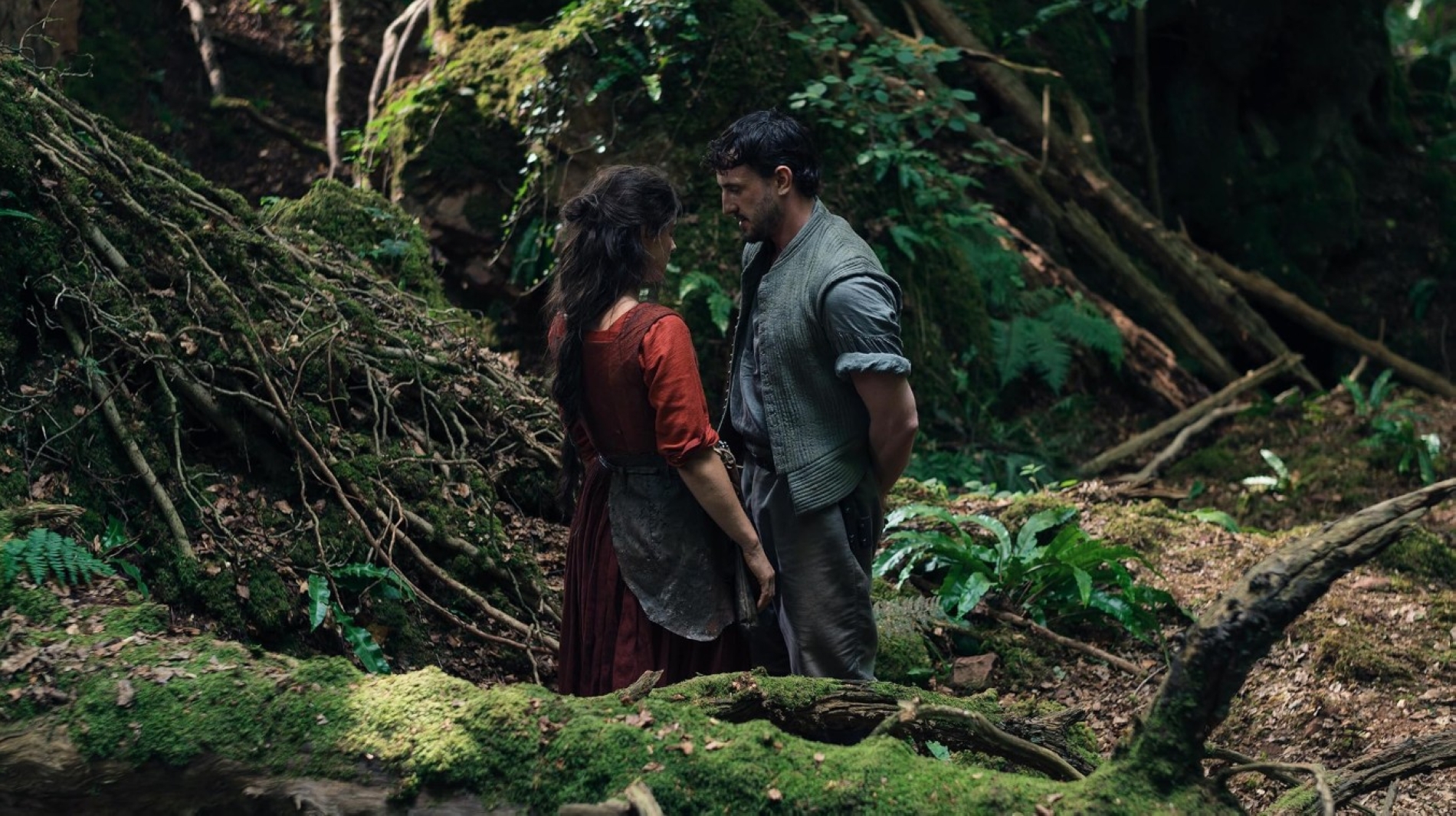
Renowned for the Oscar-winning Nomadland, Chloé Zhao opens Hamnet with an image that borders on the mythic. Agnes, played with haunting grace by Jessie Buckley, is seen embracing the earth beneath an ancient, towering tree. From the tree’s cavernous base, she seems to emerge, not unlike a newborn from a primordial womb. She lies still, cradled by roots and silence, untouched by the clamour of the world.

The scene unfolds as a visual incantation, heralding a film that prioritises feeling over plot, intuition over exposition. Characters arrive not to propel narrative, but as vessels of mood and memory, swept along by tides of ineffable sorrow and longing.

The film’s arrival has been met with a flourish of honours, including an Academy Award nomination in the newly minted best casting category. Adapted from Maggie O’Farrell’s celebrated novel, O’Farrell herself shares screenplay credit, with Hamnet bringing together a distinguished cast that features Paul Mescal, Emily Watson, and Joe Alwyn alongside the magnificent Buckley.

Though ostensibly a portrait of William Shakespeare and his family, it is Agnes who gives the film its soul. Her perspective frames the story, capturing the quiet ache of living alongside a man whose creative devotion eclipses domestic bonds. The camera cleaves to her gaze, to the interiority of a woman tethered to genius and solitude alike.

Agnes’s opening scene in the forest serves as an exquisite overture. From her mother, she inherits a spectral bond with nature, a herbalist’s touch, a wariness of towns, and a fierce affinity for wilderness. Her communion with the untamed renders her suspect in society’s eyes, casting her as an almost elemental figure—earthy, unknowable, and radiant with otherness. At her side, a falcon, wary of strangers, loyal as breath.

Love unfolds in light and silence

The film’s early movements promise something rare. Here is a work that listens to its characters’ emotions rather than binding them to mechanical narrative beats. Zhao allows love to unfold unannounced, unlabelled. Scenes of Agnes and Shakespeare discovering one another brim with unspoken depth. There is no need for explanatory devices; the performances, the cinematography, the rhythms of nature speak louder than words. In these passages, one senses the influence of Terrence Malick—a cinema attuned to silence, light, and the brush of wind across skin.

Visually, the film achieves a lucid beauty. Sound and image cohere with poetic clarity. Verdant landscapes, the shimmer of natural light, and an enveloping soundscape transport the viewer into Agnes’s world. Even costume design joins the harmony, weaving her into the fabric of the forest. She does not merely inhabit the setting—she becomes part of its breath and pulse.
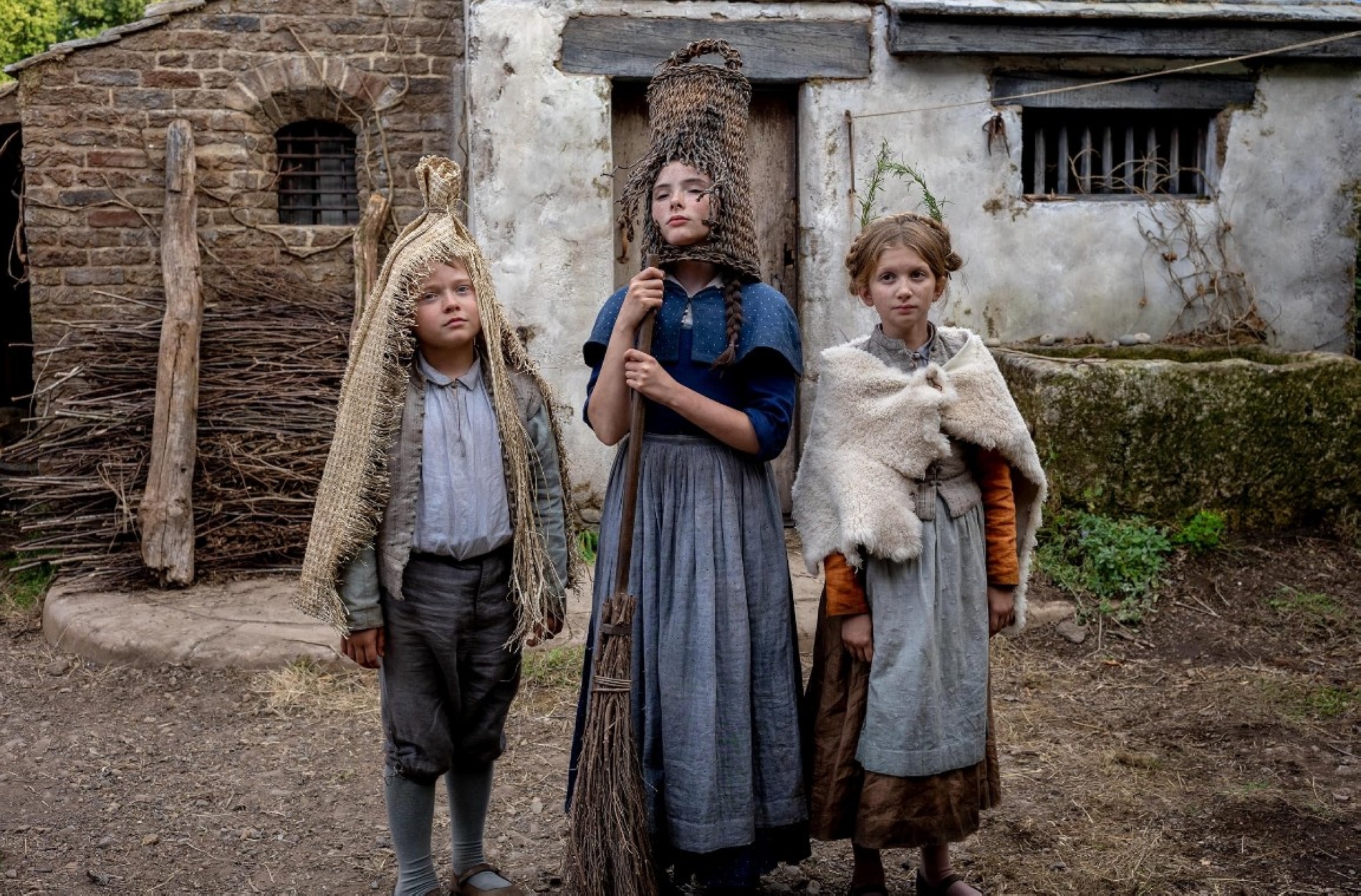
Visually, the film achieves a lucid beauty. Sound and image cohere with poetic clarity.

In such a realm, her bond with Shakespeare requires no rational proof; the atmosphere Zhao and cinematographer Łukasz Żal summon is so suffused with feeling that their love seems less a choice than a natural law.

As the story advances, Agnes rises to narrative prominence while Shakespeare gradually recedes into shadow. It is here that the film reveals its most luminous strength: Buckley's performance. She navigates the emotional spectrum with quiet mastery, shifting from measured restraint to moments of aching intensity. Her presence steadies the film, dictating its rhythm, holding its fragility with a resolute hand.

Focus Features
A scene from the film.

A melodramatic turn

Midway through the film, following the birth of twins in a sequence that crescendos into unabashed melodrama, the work begins to reorient its emotional compass. Until this juncture, the heightened register of feeling serves the narrative with admirable finesse, particularly in a scene shared by Buckley and Watson, where intensity is tempered by nuance. Yet with the central catastrophe—the death of young Hamnet—the film relinquishes its earlier, elliptical approach to character in favour of overt theatricality. What once felt intimate and intuitive becomes increasingly laboured in its pursuit of sorrow.

Grief and loss open a terrifying chasm, and in the scene depicting Agnes's childbirth, where her daughter Judith is feared dead, the film renders this abyss with chilling immediacy. The shock of that moment, coupled with Buckley's unfiltered reaction, proves piercing enough to stop the breath. No further accentuation is needed. Yet after Hamnet's passing, the film seems to lose confidence in the emotional clarity it has already achieved. Each central figure is granted a solitary vignette, an opportunity to showcase the spectrum of grief, whether in hushed sobs or operatic lamentation.

This pivot marks a lamentable turn. Theatricality, especially in a narrative steeped in Shakespearean echoes, is not inherently misjudged. But the film's earlier half offered something richer: a contemplation of love, loss, and endurance that embraced ambiguity and resisted simplification. In its later chapters, however, Hamnet succumbs to the seduction of performance itself, staging one awards-ready crescendo after another. The quiet courage of the first act gives way to a series of increasingly choreographed cries for sympathy.

Buckley, despite this tonal shift, continues to command the screen with a performance rooted in emotional precision. She glides between restraint and eruption, each transition imbued with internal logic. Her expression of grief is seldom generic; it carries the particular weight of a character whose silence often speaks louder than her wails. Only when the film presses too hard upon the register of loss does even her artistry begin to strain beneath the burden of repetition.

Mescal, cast as Shakespeare, proves less impervious to the film's indulgences. Lauded for the tender depth of his performance in Charlotte Wells's indie hit Aftersun, here he appears boxed in by a script that privileges visible suffering over psychological complexity. His portrayal leans on recognisable cues—haunted stares, furrowed brows, the slow unravel of composure—until the arc of his pain feels more familiar than revelatory.

Yet amid the overwrought, a moment of piercing quiet emerges. It is the burial of Agnes's falcon—an act small in scale but immense in resonance. In this scene, Agnes releases a creature tethered not only to her mother's memory but also to her own sense of self. She suppresses sorrow in front of her children, and in its place offers a calm meditation on death—not as annihilation, but as passage. 

The emotion here is earned not through display, but through history. The falcon's silent presence in the opening frames, coupled with Agnes's unspoken devotion to it, imbues her composure with aching eloquence. Her choice to shield her children from the full tempest of her grief reveals not detachment but a profound form of love. In that moment, motherhood becomes an act of moral grandeur, choosing protection over catharsis and bending her own heartbreak into a gesture of hope.

A scene from the film.

Shakespeare unrevealed 

Approached without foreknowledge, the film withholds Shakespeare's true identity. The audience meets only 'Will', an artist wholly devoted to his craft; a man who organises his entire being around creation, even if it means abandoning those he loves. His path is one of silent sacrifice and, eventually, of consuming remorse. 

Whether this veiling of identity is a calculated artistic gesture or an incidental ambiguity remains uncertain. Its revelation arrives not with subtlety, but in a flourish of theatricality: Shakespeare, alone on a wind-swept shore, recites 'To be, or not to be' as Mescal strives to inject the soliloquy with renewed life. The result, however, diminishes much of the film's earlier enigma. Atmosphere gives way to announcement; mystery is traded for spectacle.

This rupture is made all the more curious by the fact that Shakespeare's name had already surfaced, quietly, in a scene where Agnes searches for her husband with her brother, played by Alwyn. When a local child is asked where Shakespeare resides, the moment holds latent potential: a gentle, perhaps revelatory nod to the audience. Yet this opportunity is bypassed. Instead, the later coastal scene makes an unnecessary declaration, undercutting the narrative's earlier delicacy.

The film withholds Shakespeare's true identity. The audience meets only 'Will', an artist wholly devoted to his craft.

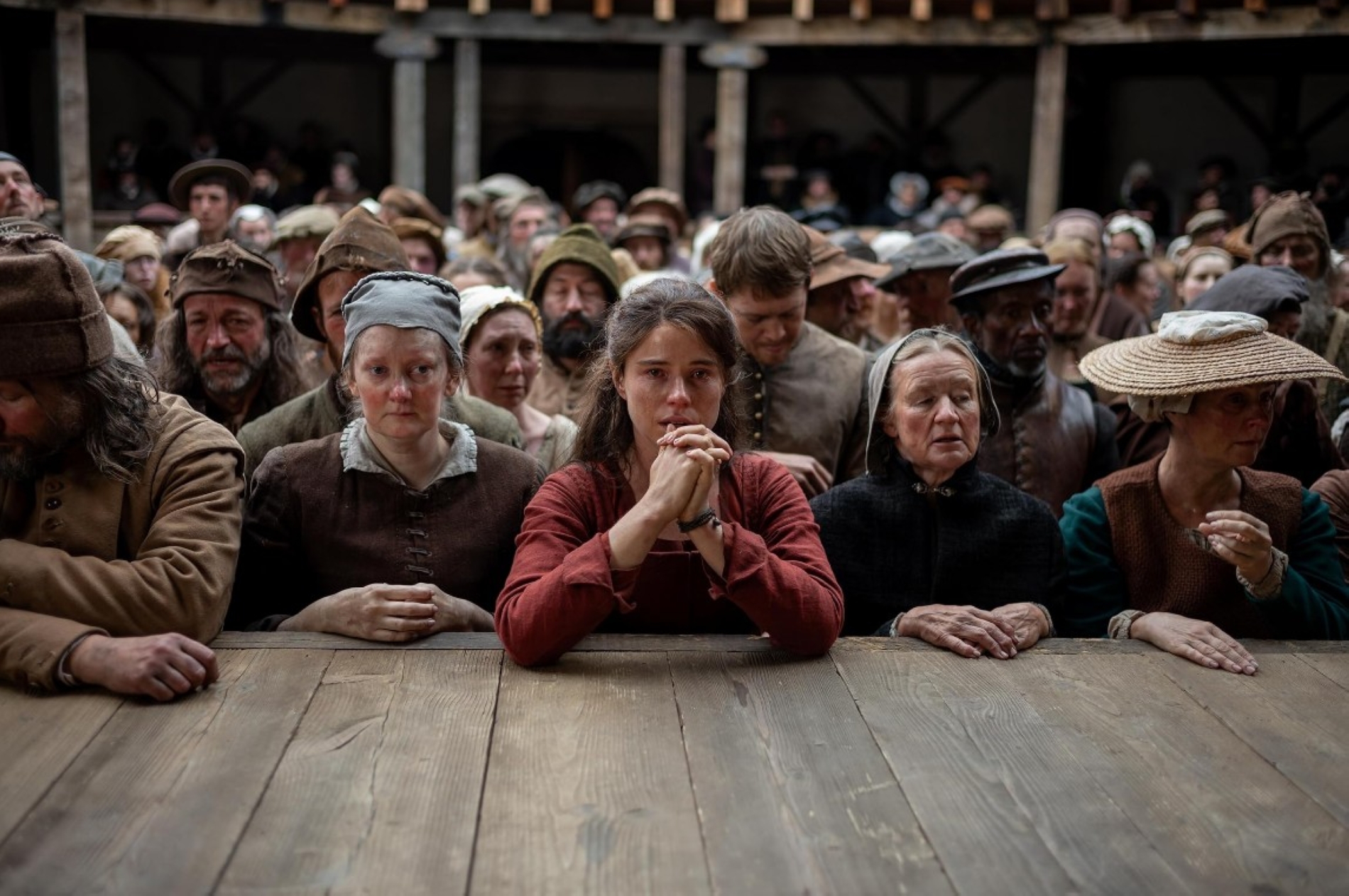
In the film's final movement, the story converges with Shakespeare's inaugural staging of Hamlet. The sequence in which the audience gathers at the theatre, elevated by Max Richter's stirring score, radiates a sense of grandeur that borders on the mythic. This is no mere premiere; it is a reckoning. The stage becomes the site where Shakespeare's deepest wound is rendered visible, though only Agnes truly recognises it.

That recognition is quietly transformative. Agnes, having once chastised Will for his absences and what appeared to be a failure to fully mourn their son, now apprehends the true nature of his grief. She sees that he has not eluded sorrow but has instead submerged himself in it, allowing it to saturate every syllable he writes. His mourning differs from hers; while it is not nocturnal or weeping, it is no less ruinous. It devours him in silence, just as hers does in solitude.

Focus Features
A scene from the film.

Yet even here, at a moment so pregnant with potential, the film defaults to the familiar. In the emotional apex of Hamlet's staging, Zhao turns to Richter's widely circulated On the Nature of Daylight. The selection is disappointing not only because of its ubiquity across screens large and small, but because Richter also composed the film's original score. He had already given the work several luminous musical motifs, most notably the piece accompanying the theatre's opening. To reach again for a well-worn composition, however moving, is to forfeit the opportunity for a singular moment of musical expression.

As Hamnet draws to a close, one is left contemplating a film that seemed poised to reimagine Shakespeare from the margins, only to retreat toward convention. The theatre, after all, is a space that magnifies emotion, bringing it into blinding clarity. Zhao's vision, in its early passages, sought something more elusive: an evocation of feeling that glimmered beneath gesture, glance, and breath. It promised a mode of storytelling that allowed sorrow to linger unspoken, to emanate like perfume from half-opened doors. In the end, that promise is subdued. The film chooses instead to articulate what it might once have merely implied, insisting that grief be named, illuminated, and performed.

font change