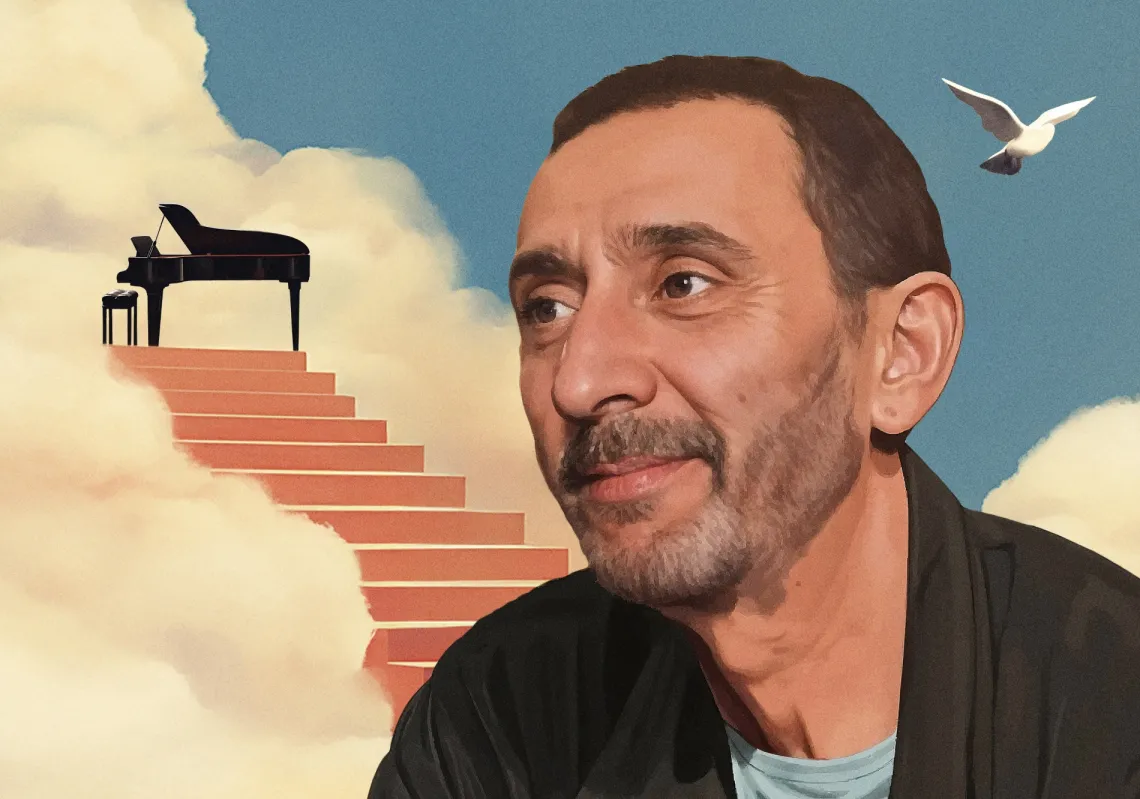

Meeting the young Kuwaiti, Faris Al-Muhanna, on a rainy day in downtown Beirut, I immediately sensed a profound musical kinship. A shared devotion to Fairuz and her son, Ziad Rahbani, had drawn us together, united by a common passion that transcended borders.
Al-Muhanna is far more than an avid Fairuz fan; he is a devoted collector of her most significant and rare original records, endowed with an extraordinary depth of knowledge. Ask him a question, and he will have the answer: where she performed, where she refused to perform, the stories behind her archive, backstage moments, and the subtlest nuances of her stage presence.
What binds a 33-year-old Kuwaiti software developer so deeply to Fairuz, and to Lebanon itself? It all began at home, listening to the radio in Kuwait, says Al-Muhanna, whose most influential figure was his Lebanese mother, with whom he spent summers in Zahlé. Those visits nurtured his attachment to Lebanon, but his mother was only a gateway to Fairuz. In time, he ventured further, becoming—by his own admission—even more immersed in Fairuz and Lebanese culture than she was.
“We grew up with Fairuz’s voice every morning before school, without it being planned or deliberate,” he remembers. “She wasn’t part of the school curriculum or activities; she was simply part of everyday life: on the radio, on television, in the car. At that time, my knowledge was limited to a few of her best-known songs. It was a simple affection tied to memory and childhood rather than a conscious passion. The first song I distinctly remember was Katabna w Ma Katabna, which my mother used to sing. I also remember Hal Siyara Mish Am Temshi, which played often."
From pastime to passion
It was while studying in the US that his pursuit of Fairuz deepened into something more deliberate. He began to unearth her history, trace her artistic evolution, and explore the lesser-known dimensions of her work. A friend from Saudi Arabia also introduced him to a vast trove of recordings. The effect was revelatory: he realised that he was unfamiliar with 90 to 95% of Fairuz’s work.
Through this deeper exploration, he came to understand that Fairuz was not just a singer, but also a stage and screen actress, a figure whose calm demeanour spoke volumes, and whose silences in interviews often conveyed more than spoken words. “I came to know her in conferences, behind the scenes, in the studio, and during rehearsals,” he says. “I discovered Fairuz in hymns, in that spiritual voice. That was when I realised she was not an ordinary artist. I came to see that Fairuz is Lebanon in human form, not just the Lebanon that exists, but the Lebanon of goodness, culture, and purity that we aspire to.”
The first item he acquired was a Lebanese postage stamp featuring Fairuz. Not long after, he came across a book chronicling Fairuz’s 1980 US tour, which included messages of welcome and reflections from American political and cultural figures. These early discoveries opened the door to a far more expansive world. Fuelled by a growing interest in Lebanese history, he began scouring platforms such as eBay. What struck him was the paradox: Fairuz’s early recordings were often far more accessible outside Lebanon than within it.
Back in Kuwait, cassette shops were beginning to disappear, and Al-Muhanna sensed an entire musical legacy was quietly vanishing. That’s when curiosity turned into a sense of duty. He began collecting everything he could, not just of Fairuz, but of Ziad Rahbani too. Initially, his focus was cassettes, although technology had all but rendered them obsolete. In time, his approach grew more refined.
“I stopped collecting randomly,” he explains. “My understanding of these musical artefacts deepened. I started distinguishing between different editions, particularly the Radio Orient tapes produced by the Lebanese company closely linked to Fairuz, and the Al-Nazaer tapes released in Kuwait.” This distinction, he notes, is more than technical; it is historical and cultural, reflecting the different contexts in which Fairuz’s work circulated and was received across Lebanon, Kuwait, and the Gulf.
From ownership to archive
As he reached the limits of cassette collecting, Al-Muhanna turned his attention to vinyl, where he encountered a broader and more intricate realm—one marked by variations in pressings, editions, and release dates. “In the beginning, I didn’t know how to tell the old from the new,” he admits. “But as I connected with other collectors and explored more sources, my understanding evolved. Collecting stopped being about ownership; it became about grasping the history and journey behind each piece.”
His research led to an important realisation: many songs that people knew as stand-alone pieces were originally part of theatrical works or films. His focus shifted from isolated tracks to complete works and their broader political and social contexts. What began as acquisition gradually became a mission to archive memory itself.
Over the years, Al-Muhanna has sourced his collection from an array of locations, including Kuwait, Lebanon, and the wider Gulf, particularly Bahrain and Saudi Arabia, as well as North America, the UK, Germany, and Ukraine. Some pieces he acquired through auctions, others via indirect or unexpected channels. In the process, he discovered that much of Fairuz’s archive had, in fact, been preserved abroad, held by private collectors or found in editions no longer available in the region.
Such dedication can be costly, though Al-Muhanna does not measure his passion in financial terms. For him, it has never been an expense but rather a cultural and emotional investment. While the market value of his collection has risen significantly over time, owing to scarcity and age, that was never his motivation. The true value, he says, is not material but moral: a deep love of art, of history, of Fairuz, and of all those who helped to shape her enduring legacy. What he has amassed is not a commercial venture, but a profoundly personal relationship with the archive of a cultural icon.
He has never attended a Fairuz concert, partly because of his age and partly because her last major public performance was more than 15 years ago. He recalls a missed opportunity to see her at her final public appearance in December 2011, at a private celebration in Sahel Alma, Lebanon. However, the demands of his university studies in the US, particularly at the end of the academic term, prevented him from attending.
At the time, he urged several friends to go in his place. Their experience, he says, was profoundly moving. It later became clear that the event was one of the last significant occasions on which Fairuz would perform. Despite his lingering regret, Al-Muhanna takes solace in knowing that he was the reason others witnessed a historic moment—an experience they now carry as an indelible memory.
Kuwaiti love for Lebanon
Fairuz’s immense popularity across the Arab world is unquestionable. Yet, a common perception persists—likely shaped by the thematic focus of her songs—that she is most revered in the Levant, particularly in Syria, Lebanon, and Palestine. She sang for these lands, reinforcing the belief that she resonates most deeply there.
But what of the Gulf—and Kuwait in particular? How is Fairuz viewed there? “Fairuz holds a special place in the Gulf, especially in Kuwait,” replies Al-Muhanna. “During the 1970s and 1980s, Lebanese art enjoyed a strong presence in Kuwait, which was then one of the most culturally open societies in the region, welcoming artists and embracing Arab creative output.”
One of Fairuz’s earliest appearances in the Gulf was her 1966 concert in Kuwait. Among the songs associated with the country is Marhaba Ya Eid Biladi, written by the Kuwaiti poet Abdulmohsen Al-Rasheed Al-Badr, who, Al-Muhanna believes, may be the only Gulf poet for whom she has sung.
He sees this closeness as both artistic and social. With the rise of air travel, Kuwaitis travelled increasingly to Lebanon, many purchasing homes there and weaving a web of cultural and social ties. Kuwait also became home to a large Lebanese expatriate community. Marriages between the two communities, including within his own family, further cemented these bonds, fostering familiarity and shared experience.
He believes this cultural intertwining made Lebanese art both familiar and accessible to Kuwaiti audiences, giving Fairuz’s presence a sense of intimacy and a natural sense of belonging. He acknowledges, however, that the emotional bond in the Levant remains deeper, shaped by geographic and cultural proximity.
Between two Rahbanis
Every admirer of Fairuz carries within them a quiet pendulum, swinging between devotion to the era shaped by the Rahbani brothers (she was married to Assi Rahbani) and the bold transformations ushered in by her son, Ziad Rahbani. With the latter came a profound shift in both musical style and lyrical tone, pushing Fairuz into artistic territories few imagined she would explore.
“My musical relationship with Fairuz began with the works of the Rahbani brothers, simply because they were the most widespread and familiar,” says Al-Muhanna, when asked which era he favours. “But as I listened more deeply, I found myself strongly drawn to the melodies of Philemon Wehbe—his compositions had a melodic intensity and unique rhythm that captivated me. For a long time, my favourite song—the one I considered Fairuz’s most complete in melody, lyrics, and performance—was Ya Rayt Mennon. Every element in that song felt perfectly placed, balanced, and whole.”
Over time, his listening broadened to encompass the wider constellation of poets and composers who collaborated with Fairuz, including Saeed Akl, Joseph Harb, Talal Haidar, Mohammed Abdel Wahab, and Zaki Nassif. In their diversity, Al-Muhanna found particular joy in the multitude of creative schools and styles through which Fairuz expressed herself, each contributing to her artistic legacy.
Yet, for Al-Muhanna, the true artistic summit came with Ziad Rahbani. He reimagined Fairuz’s voice, presenting her in an entirely new light. Fusing her vocals with jazz—his natural idiom—and with a modern interpretation of traditional Arabic tarab, he created a body of work that resonated deeply with younger generations. In doing so, he enabled Fairuz to speak to them in their own language: honestly, with modernity, and without compromising her identity or stature.
Owing to his deep attachment to Ziad Rahbani’s creative world—his plays, songs, and the intellectual and political debates that surrounded him—this period became the most meaningful for Al-Muhanna. “Ziad was not just a composer,” he reflects, “but an intellectual presence we experienced in real time. That is what made his collaboration with Fairuz the most sincere, intimate, and influential for me.”