Fleeing Gaza: artists open up about survivors' guilthttps://en.majalla.com/node/329475/culture-social-affairs/fleeing-gaza-artists-open-about-survivors-guilt
The departure of Palestinian creatives from Gaza has led those writers and artists to consider fundamental questions relating to belonging, ethical choices, guilt, survival, and the role of culture when the world in which it is produced is being destroyed. In a place where death is never far away, the act of leaving can be misunderstood and interpreted as abandonment, yet for those who do, it is also salvation.
The cultural and creative scene in Gaza that they left behind has—like everything else in the Strip—been destroyed and erased by Israeli bombing. This includes cultural institutions, galleries, workshops, and libraries. Visual artist Maisara Baroud, one of three intellectuals who spoke to Al Majalla after leaving, described the situation as “shattered, weak, and fragmented by the brutality of war, repeated displacement, and the constant struggle to survive”.
Baroud said war reduced cultural discourse to “sporadic events or participation via social media,” adding: “It is no longer right to speak of cultural ‘decline’ but of outright erasure: places destroyed, intellectuals and artists killed, others displaced repeatedly, and cultural practice itself now threatened with extinction.” Yet, in a painful paradox, Gaza’s creativity surged even amid the genocide, as if it were a scream giving birth to a new and insistent language, despite the devastation.
Young poet Haidar al-Ghazali touched on this. “Perhaps for the first time, I feel we possess a creative energy that goes beyond the familiar, experimenting with new tools, especially in poetry. This eruption was not merely aesthetic; it carried a human and national awareness in tune with the authentic voice of people in the street.” Yet there are limits to what language can do. “After the war? After the genocide? Such a framing feels misplaced while the genocide continues by other means.”
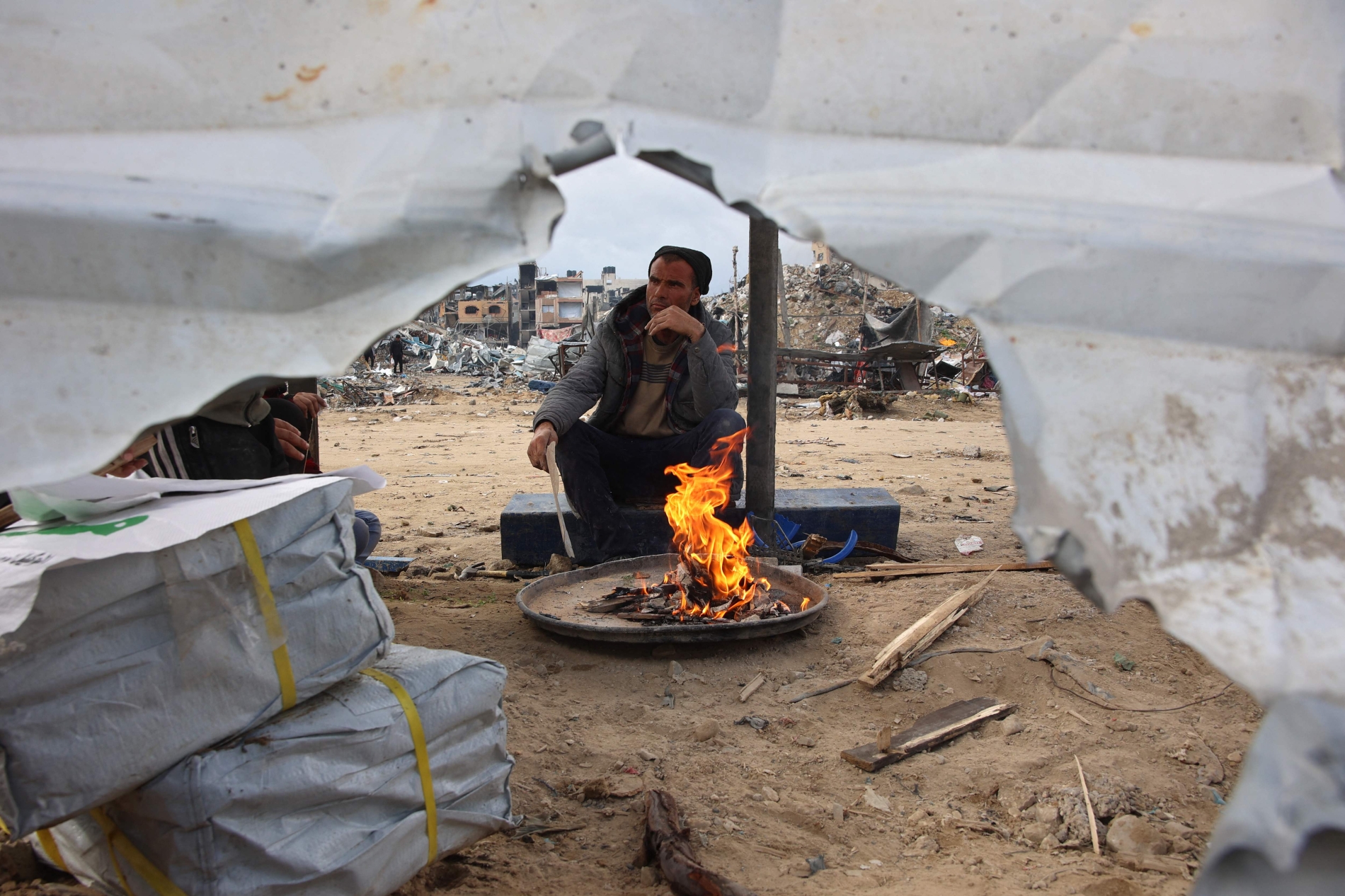
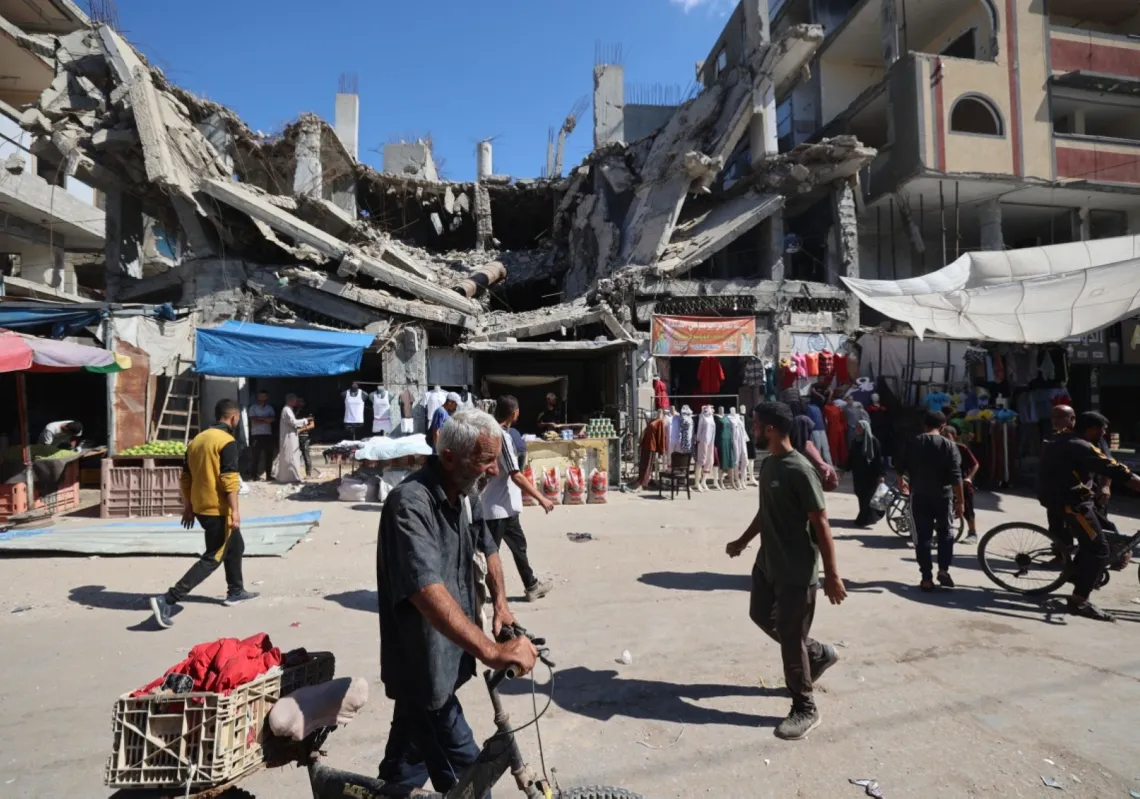
A man lights a fire as displaced Palestinians return to the northern areas of the Gaza Strip, in Jabalia, on 23 January 2025.
Saving what remains
Novelist Reham Al-Sabe said there was no space for culture in Gaza during the war. “I do not think there is anything that can be called a cultural scene, only attempts to save what remains of it. What was written was not literary production in the traditional sense, but a last attempt to survive, to record what is happening and to engage with it as human beings stripped of the right to life.”
Displacement, then departure, has fractured Gaza’s cultural scene. Most writers and artists have had to think about their own safety and survival before they can return to true creativity. Those who have moved abroad to unfamiliar settings find that it has altered their relationship to culture and reshaped their practice, but their experience of displacement remains etched in their work.
Many feel the pain of estrangement and the loss of land, of a home that had formed their creative identity
Many feel the pain of estrangement and the loss of land, of a home that had formed their creative identity. "Displacement caused cultural institutions to stall, creative groups to fragment, and creatives to be consumed by the struggle to survive, which weakened organised cultural production," Al-Sabe said, before adding: "Culture did not disappear. It reshaped itself. It became less dependent on institutions and more closely tied to the human experience."
Many Palestinian intellectuals left Gaza during the war. Baroud said: "I was displaced 18 times inside Gaza. My displacement to France was the 19th time." For the Palestinian creatives who left, there is one point on which they agree: the person comes before the intellectual. "The urgent human need to escape the hell of Gaza is a need that goes beyond any identity or role," Al-Ghazali said.
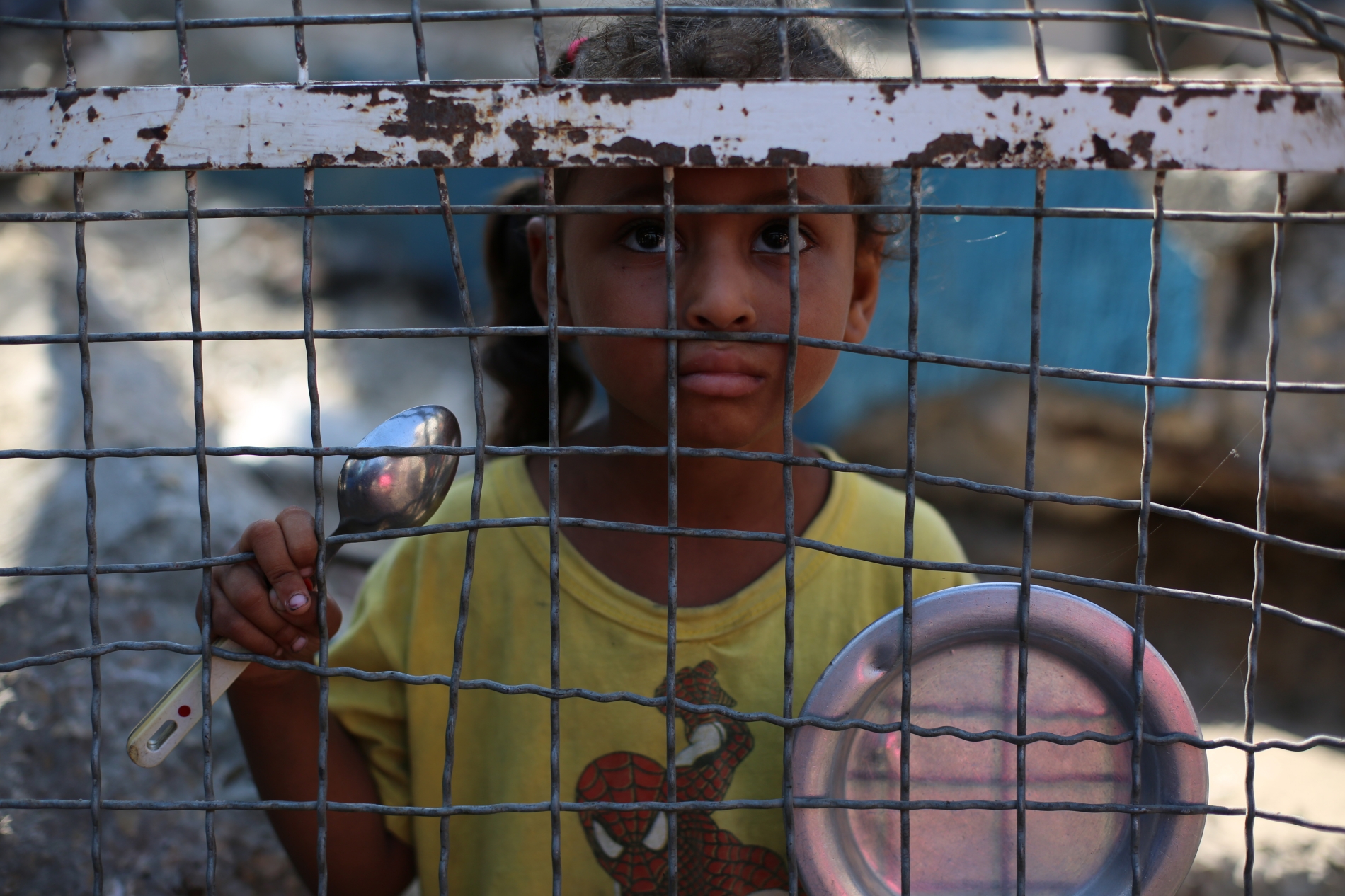
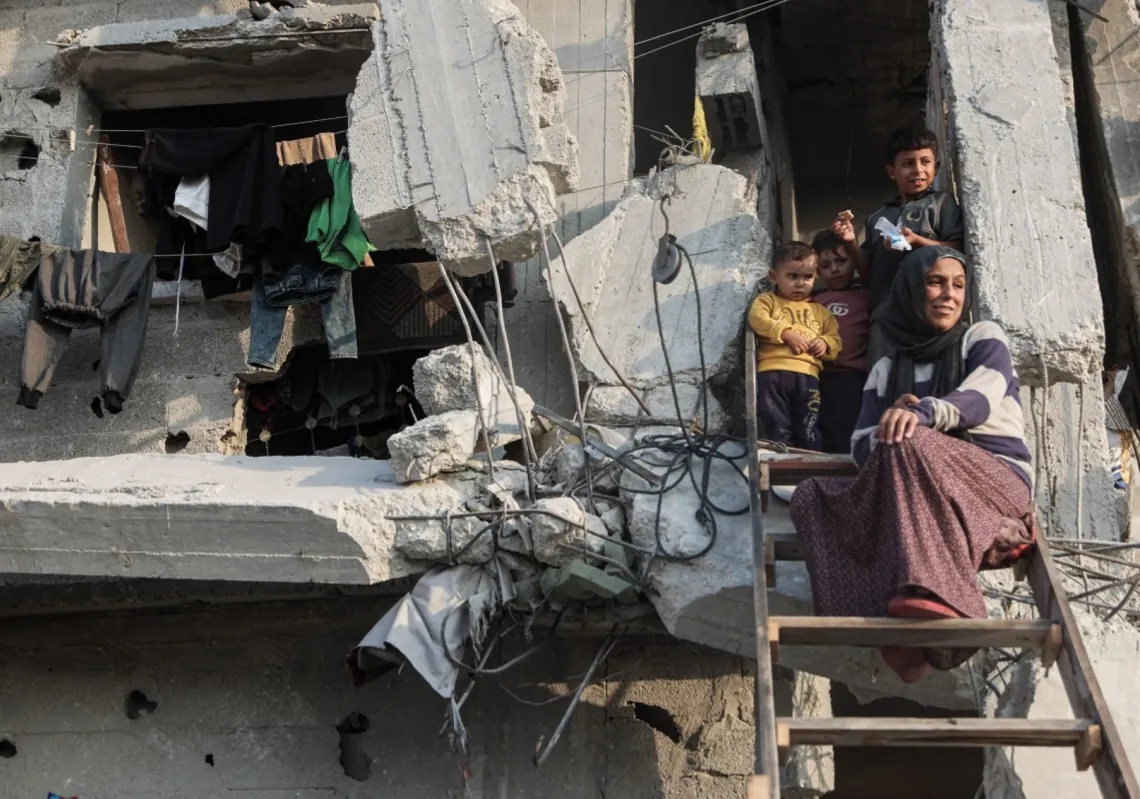
Displaced Palestinians sheltering at the UNRWA-affiliated Girls' Middle School held a protest against hunger, calling for an immediate end to the ongoing attacks and urgent delivery of humanitarian aid in Gaza, on 20 July 2025.
Al-Sabe agrees. "The search for safety and the securing of basic needs outweigh any creative pursuit… I left to escape a very real death that was closing in on my family and me." This has had differing effects on the artists. Al-Ghazali describes Gaza as having given him "the hardest literary residency in the world… During the genocide, I discovered that I am able to write in times of crisis more than at any other time".
By contrast, Al-Sabe said the all-consuming fear crushed her ability to focus and imagine. "How can someone in a state of constant panic create space for reflection?" In art, Baroud found a way of resisting. "I was trying to turn everything my senses witnessed into artistic production," he said. "This created psychological balance and reduced tension." Yet despite leaving Gaza, he has not fully recovered, just like Al-Sabe and Al-Ghazali.
Debate over leaving
Tension sharpens when the issue of staying or leaving is raised. In times of crisis, creatives carry a different kind of responsibility, and leaving the land becomes laden with controversy and ethical complications. Haidar al-Ghazali said: "Every departure from Palestine is a devastating loss, yet a person needs a place where their humanity is held sacred."
Reham Al-Sabe called it "a new injustice… Turning staying under conditions of genocide into a moral test, casting departure as betrayal, that in itself is a form of injustice". Baroud initially shared the sense of survivor's guilt. "At first, I felt I'd betrayed my family and friends, but I shed that burden when I continued my role from abroad. I left Gaza, but Gaza did not leave me."
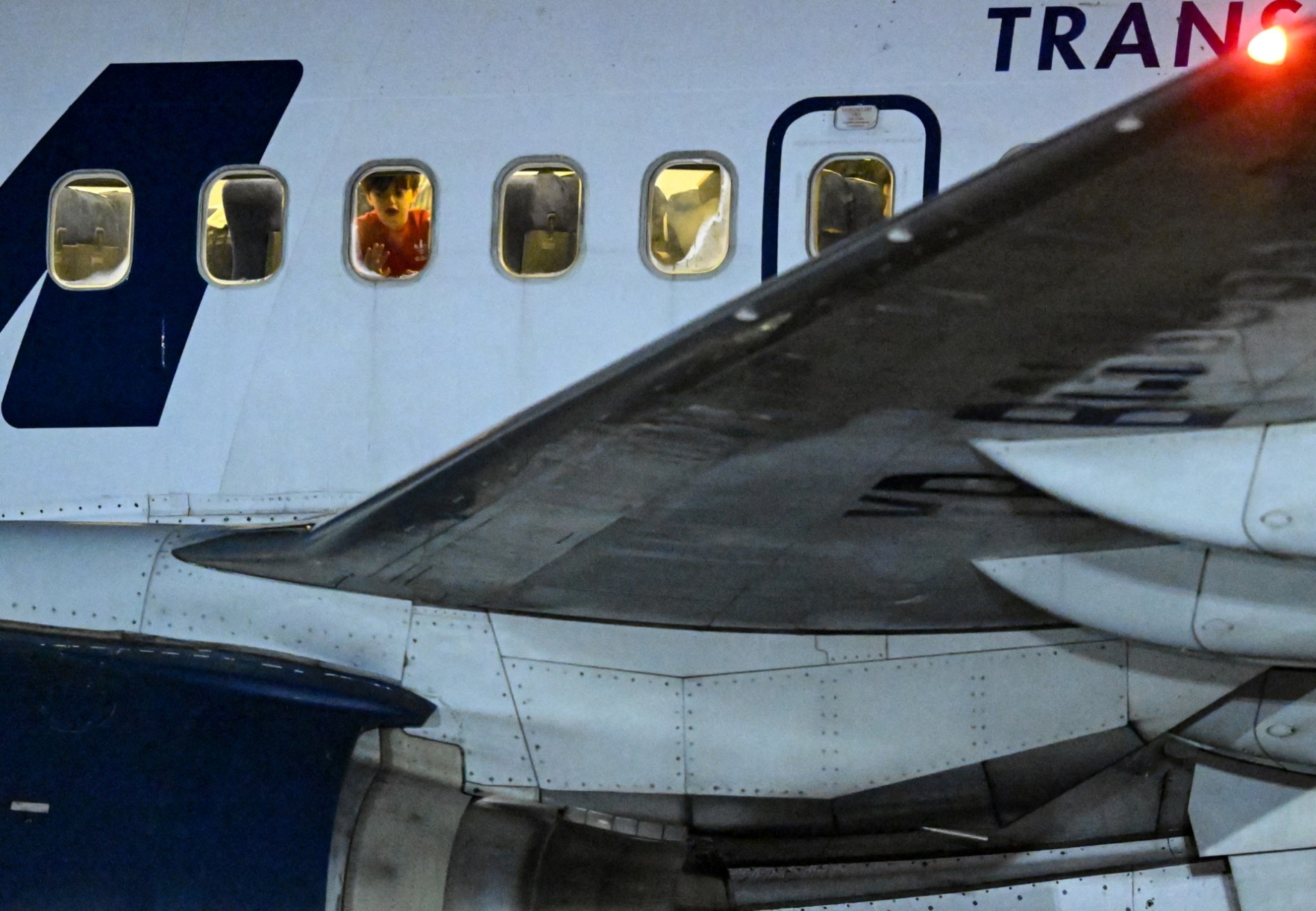
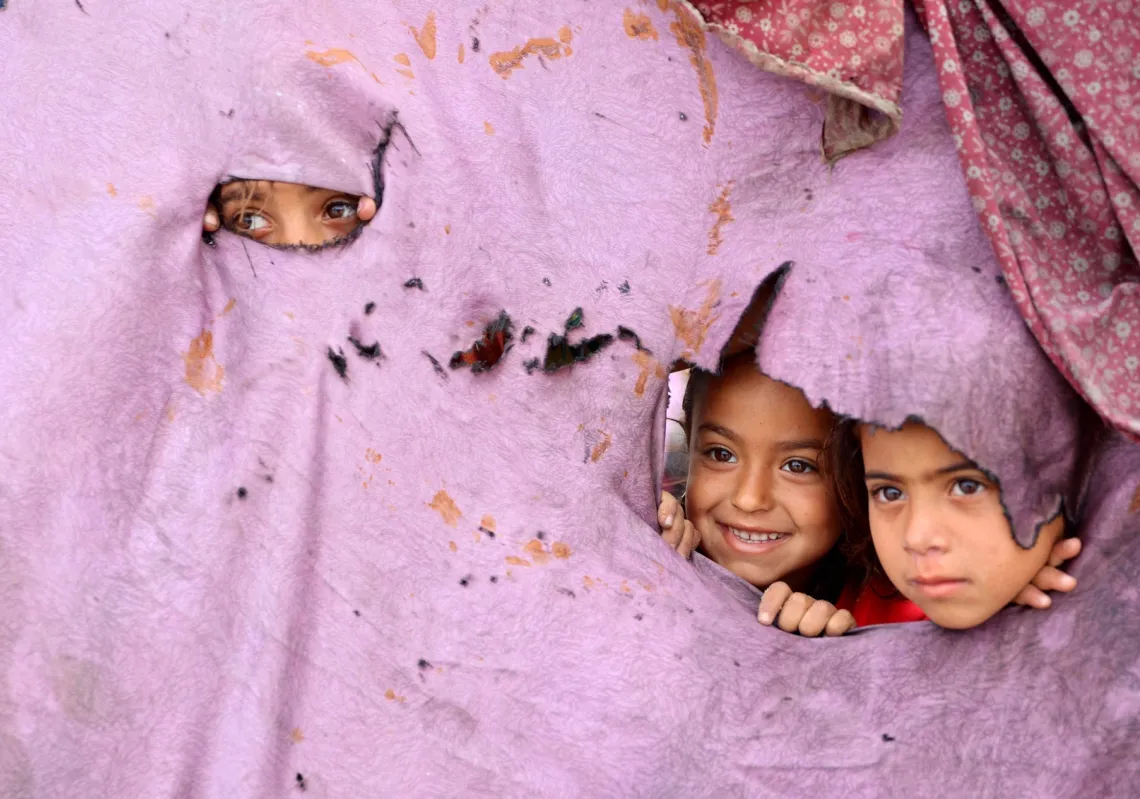
A child evacuated from Gaza looks out the window of a plane near Bucharest on 8 November 2023. Picture for illustrative purposes only.
The moment of departure was the hardest, they said, yet it took different forms for each. Al-Ghazali told of the psychological toll of living far from his family, where longing mingled with guilt. "Being away from my parents and friends, it is as if a part of me were left behind, body and soul; as if all of Gaza were a void inside me that can never be filled."
Reham Al-Sabe felt an even deeper shock when she grasped that this was not a conventional conflict but a genocide threatening every aspect of life. "The moment I found myself outside Gaza, I understood that what we were living through was not merely a war, but an attempt to erase our existence. Everything I left behind seemed to have vanished for ever."
Maisara Baroud's loss was different. The occupation prevented him from taking any of his artworks or personal possessions. The paintings, manuscripts, and objects that had recorded his senses and ideas over the years were left behind. He was unable to carry anything but his phone and two items of clothing when he passed through the Kerem Shalom crossing (Arabic: Karm Abu Salem, or Karam Abu Salem). "I felt that part of me stayed there, as if my artistic self was trapped in the rubble."
For all three, leaving was not simply a geographic move or a personal escape; it was an interwoven experience of loss, guilt, and longing, where the feeling of survival converges with a sense of what has been taken away. Al-Ghazali feels the rupture from his daily life, Al-Sabe lives with a constant dread that the genocide has not ended, and Baroud carries an emptiness, having been forced to abandon so much.
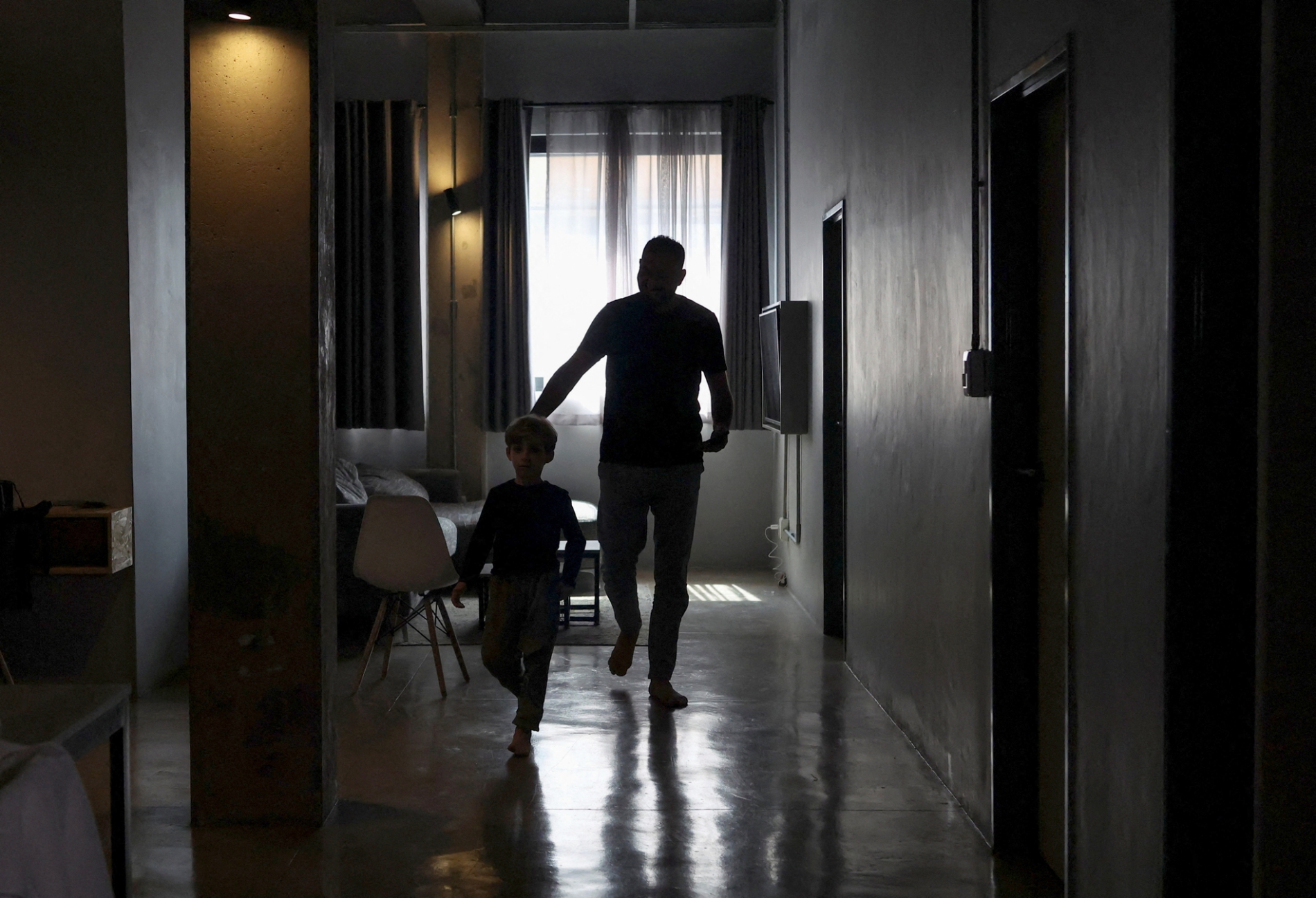
A Palestinian man walks with his child after speaking to Reuters at an undisclosed location in Johannesburg, South Africa after being transfered from Gaza via Israel on 14 November, 2025.
A different discourse
Today, outside Gaza, Palestinian cultural and creative discourse faces a new test unlike anything it has faced before. For Maisara Baroud, leaving means the need to rethink form, language, and style to reach Western audiences, which brings its own worries. "We have to adapt to the language of the new audience, to the societies that now host our voices, but without losing the truth of our experience or its depth," he said. "The essence of Gaza must remain alive in every painting and every text."
Reham Al-Sabe thinks leaving can be a way to protect the Palestinian voice, yet it subjects the intellectual who left to a genuine moral test: can the authenticity of the narrative be preserved from far away, or does separation risk a drift from truth? "Leaving gives us a chance to get our voice out, but it is also a test of integrity," she said. "Will I remain truthful to my experience and to those I left behind?"
Haidar al-Ghazali, in a strange new place, feels both liberation and fear, adding that it is too soon to judge how his departure from Gaza has affected his creative voice. "The new space gives me freedom, but it unsettles me at times. I find myself asking whether the voice I was creating in Gaza can live here in the same way."
Whether in or outside Gaza, the Palestinian artist or writer is caught in a struggle over existence, loyalty, and culture. Displacement and departure are more than a change of place; they are a human and moral test that redraws boundaries. In this light, writing and culture cease to be luxuries and become necessities, efforts to anchor cultural identity amid continuing ruin.