Putin foreshadowed the Ukraine war in 2008 meeting with Bushhttps://en.majalla.com/node/329076/documents-memoirs/putin-foreshadowed-ukraine-war-2008-meeting-bush
Putin foreshadowed the Ukraine war in 2008 meeting with Bush
Recently declassified meeting minutes between the two leaders show how Washington was well aware of Moscow's grievances over NATO expansion, but went ahead anyway
Al Majalla
Putin foreshadowed the Ukraine war in 2008 meeting with Bush
Recently declassified meeting minutes between Russian President Vladimir Putin and US President George W. Bush show how the Russian leader foreshadowed a confrontation between the two countries over Ukraine. They also reveal a shared desire by both countries to have cordial relations and an agreement that Iran must not acquire a nuclear weapon.
The meetings, declassified and published by the National Security Archive, include discussions on counter-terrorism cooperation both before and after the 9/11 attacks, alongside a shared ambition to address questions of strategic balance.
But despite the leaders’ public desire to build cordial relations, Putin’s hopes of establishing ties with the West on new foundations appeared to falter as disputes accumulated over the role of the United States and its allies in igniting the colour revolutions in Ukraine and other former Soviet states, the missile defence shield planned for Poland and the Czech Republic, and the continuing expansion of NATO.
Despite maintaining a tone of mutual respect, the details of the final meeting in June 2008 show that relations between the two countries were deteriorating, with Russia’s last red lines crossed by opening the door to NATO membership for Ukraine and Georgia at the Bucharest summit, held two days before the last Putin-Bush meeting.
The documents give important context and help explain Russia's subsequent conduct when two months later it invaded Georgia, and then went on to seize the Crimea peninsula in 2014, as well as backUkrainian separatists in Donbas. Furthermore, it withdrew from key bilateral arms control agreements that had underpinned a strategic arms balance, and then finally, it invaded Ukraine in February 2022.
Al Majalla pored over these meeting minutes in detail, extracting the most salient exchanges. Below are some of the most noteworthy mentions.
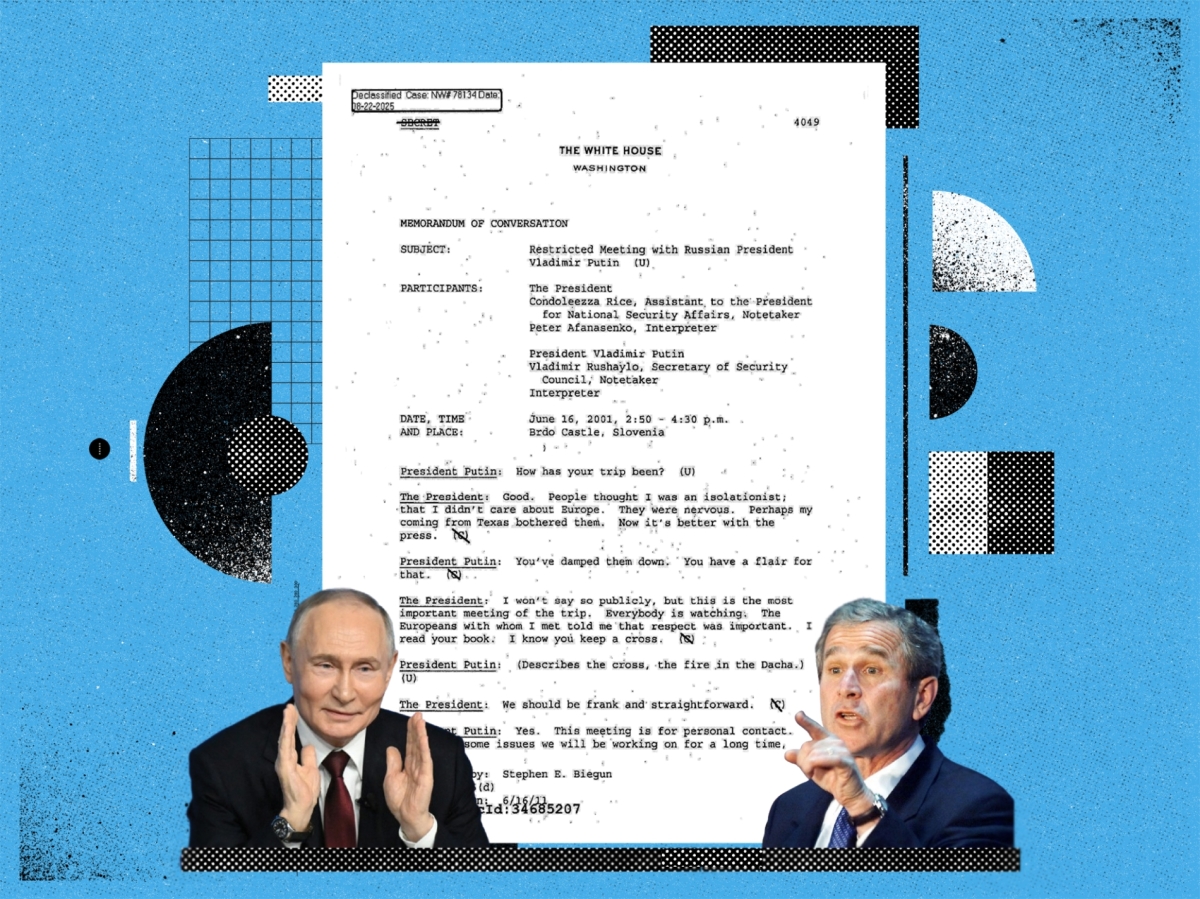
The first meeting took place at Brdo Castle in Slovenia on 16 June 2001. It came only months into George W. Bush’s first term and about 18 months after Vladimir Putin’s rise to power—a period when he was preoccupied with the war in Chechnya and with restoring internal order after the turmoil of the 1990s under Boris Yeltsin. At the time, the two presidents expressed a desire to build close relations.
In the meeting, Bush told Putin that he regarded their encounter as the most important stop on his European tour, despite European apprehension and perceptions that he (Bush) was an isolationist.
The two leaders addressed the core issues in relations between the United States and Russia, including strategic stability, missile defence, non-proliferation, Iran, North Korea, and NATO enlargement. Bush affirmed that “Russia belongs to the West. It is not an enemy.” Seeking to reassure Putin, he said that the relationship between the two countries was broader than strategic stability.
He stressed that “A strong Russia is in our interest,” and he argued that stability does not arise from reliance on each side’s capacity to destroy the other.
I'd like to emphasise that Ukraine's accession into NATO will create a field of conflict for you and us, a long-term confrontation
Vladimir Putin to George W. Bush
For his part, Putin refloated the historical Soviet proposal to join NATO in 1954, noting that Russia remained excluded from the alliance despite the disappearance of the reasons that once precluded its membership, according to the alliance's own assessment.
On the Iranian issue, Putin appeared to share Washington's concerns about Iran's missile programme and Tehran's ambition to build a nuclear capability. In the meeting, he said: "Iranian experts do pose many questions about sensitive matters to our experts. There is no doubt they want a nuclear weapon. I have told our people not to tell them such things." He added: "I will restrict missile technology to Iran."
In a proposal that suggested a willingness to bargain, Putin said that Russia had "a complex history with Iran" and added, "I know of concerns about Russia's relations with rogue states. Do you think I like them?" He went on: "Russia is European and multi ethnic, like the United States. I can imagine us becoming allies. Only dire need could make us allied with others."
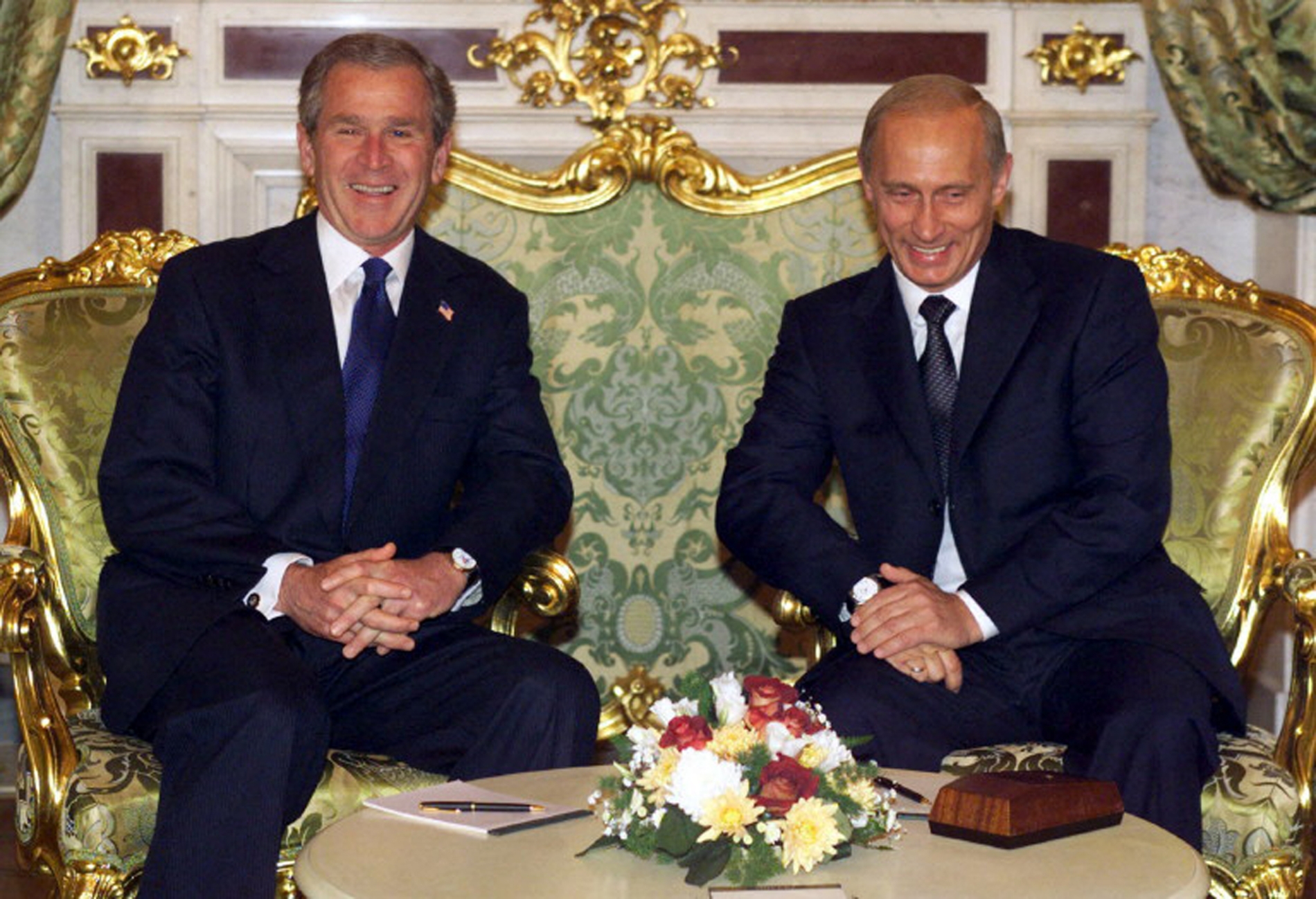
US President George W. Bush (left) and his Russian counterpart Vladimir Putin (right) smile during their meeting at the Kremlin on 24 May 2002.
Putin then explained his view of the collapse of the Soviet Union, expressing dissatisfaction with the loss of vast tracts of Russia's historic lands. After noting that "Soviet goodwill changed the world voluntarily," Putin said he could not believe former Communist Party leaders had relinquished what he viewed as historic Russian lands, "Ukraine, part of Russia for centuries, given away. Kazakhstan, given away. The Caucasus, too."
In a sign of rising anger at Western conduct towards his country, Putin said: "People in Russia feel deceived by large-scale changes that brought more freedom that they cannot enjoy," and that the elite felt frustrated. He explained that the West did not provide Russia with economic assistance and did not treat it as it had other countries, such as Egypt and Poland, regarding debt.
At the second meeting on 16 September 2005 at the White House on the sidelines of the United Nations General Assembly in New York, Putin confided to Bush: "I believed in the ideas of communism. I was prepared to die for them."
The minutes revealed that the bilateral meeting between the two foreign ministers, Condoleezza Rice and Sergey Lavrov, was limited to discussing the Iranian nuclear file. Both sides agreed on the need to prevent Iran from acquiring nuclear weapons, but disagreed on how to go about doing so.
For its part, Russia wasn't completely sold on bringing the issue to the United Nations Security Council and raised questions about the effectiveness of military strikes to end the nuclear project.
In the meeting, Rice summarised her discussions with Lavrov, saying, "We agree that no one wants Iran to have nuclear weapons and that we need to do everything to avoid nuclear weapons in Iran." She also noted that "The Russians believe the time for referral hasn't come" and instead "had some creative ideas on how to prevent the Iranians from developing an indigenous enrichment or reprocessing capability."
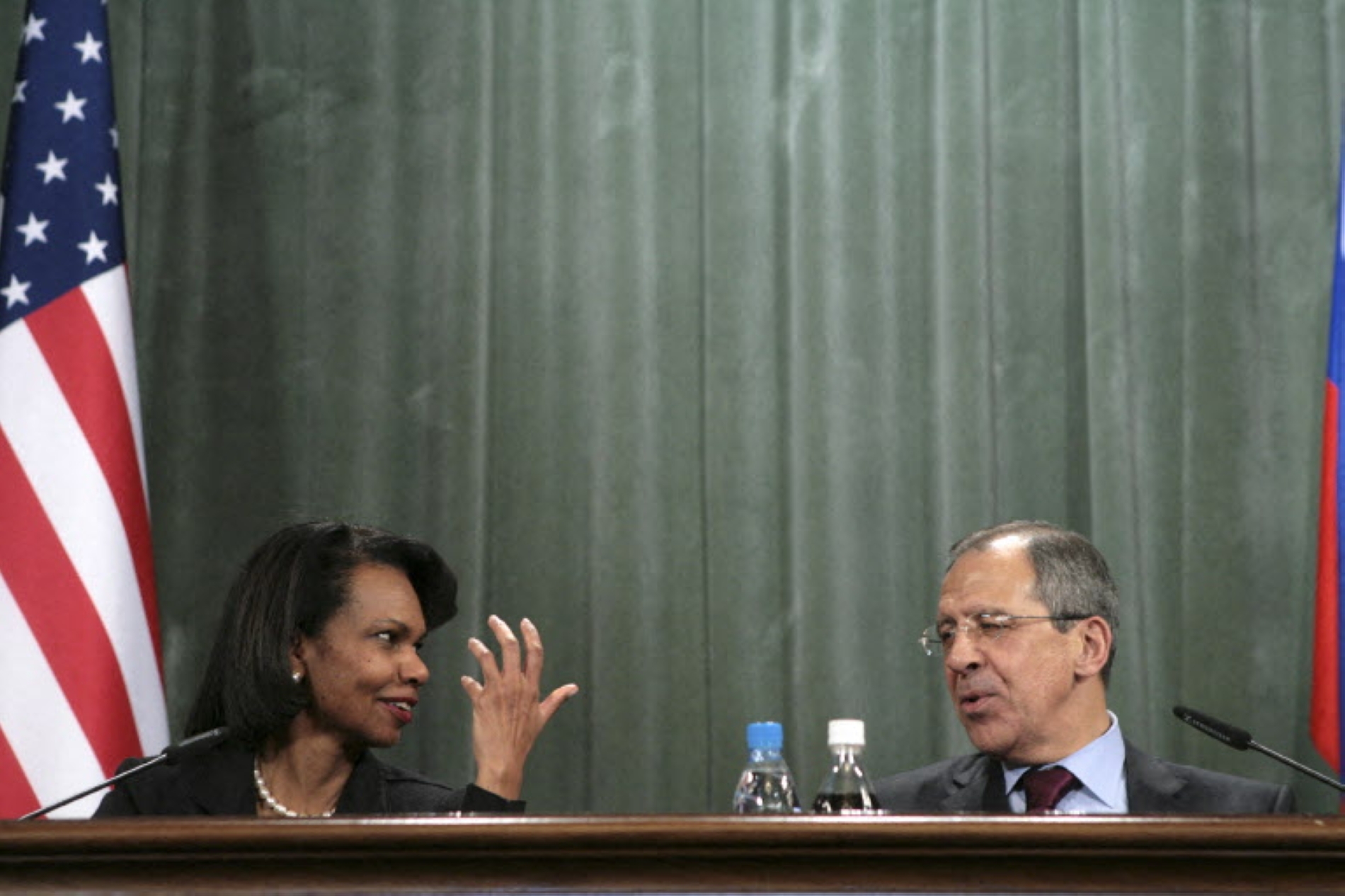
US Secretary of State Condoleezza Rice (L) and Russian Foreign minister Sergey Lavrov (R) hold a press conference in Moscow on 18 March 2008.
Putin said, "Our concern is that immediate referral (to the UNSC) will lead Iran to take the North Korean route. If they are indeed striving for nuclear weapons, then we will have lost control over what is happening in Iran." He warned that action would be required if Iran chose the North Korean path, but questioned the effectiveness of a strike without specifying who would carry it out and what its targets would be.
"Are you sure of the information you have? " he asked. He concluded that: "It's important that we build a basis for our position. But I agree with George. If Iran violates international law, as just formulated here, then we have the right to bring this matter to the Security Council."
On North Korea, Putin noted that the two countries' positions were aligned. "People are limited to the cubicle they live in. And many are sincere in what they believe," Putin said, adding "The North Koreans live in more seclusion than we lived in. They are more isolated than the Soviet Union was under Stalin. The overwhelming number are prepared to die," and he concluded that "for any serious change in mindset, there needs to be rapprochement between the North and South."
Although the Commonwealth of Independent States (CIS), formed after the collapse of the Soviet Union, received only brief remarks from the two presidents at the start of the meeting, what became known as the "Colour Revolutions" and US support for them emerged as a major point of contention that continues to shape Russia's relations with the United States and the wider West today.
Bush said: "On the CIS, we agreed we should have a dialogue, a strategic dialogue, so everyone can understand what everyone wants, dispel rumours, and understand strategies and intentions." Putin replied: "Precisely. We need better coordination."
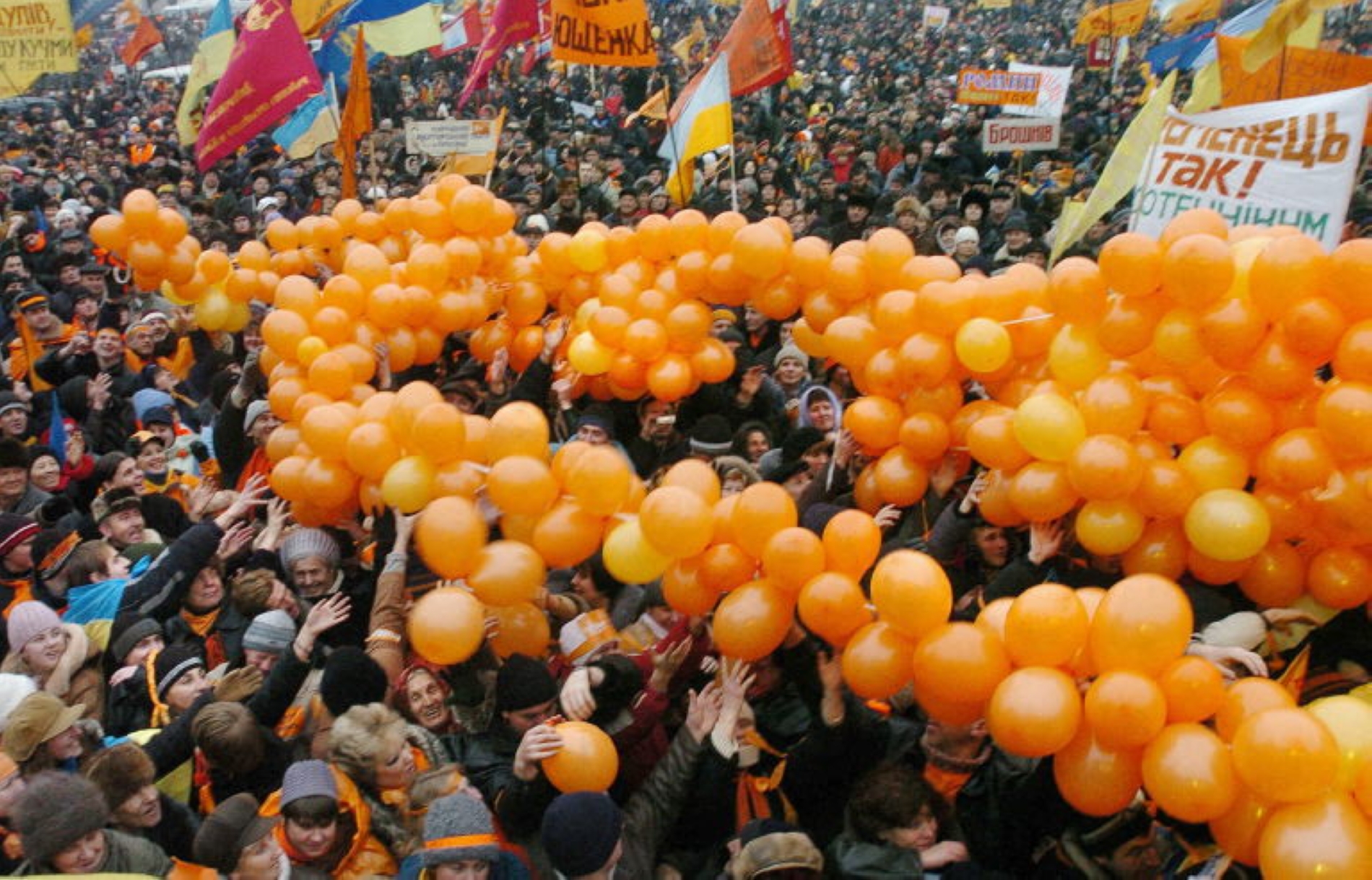
At that time, Moscow accused Washington of backing the "Orange Revolution" in Ukraine in late November 2004. Before that, in November 2003, a velvet revolution in Georgia, the "Rose Revolution", had brought to power pro-West President Mikheil Saakashvili.
Supporters of the Ukraine's pro-western oriented presidential candidate Viktor Yushchenko reach for balloons thrown into the crowd during a rally in Kyiv's Central Square on 2 December 2004.
It was notable that the subject of NATO expansion was not raised forcefully in the meeting minutes, even though the alliance experienced its largest eastward enlargement on 29 March 2004 with the accession of seven states—Bulgaria, Latvia, Lithuania, Romania, Slovakia, Slovenia and Estonia—drawn from the former Soviet Union's Eastern Bloc.
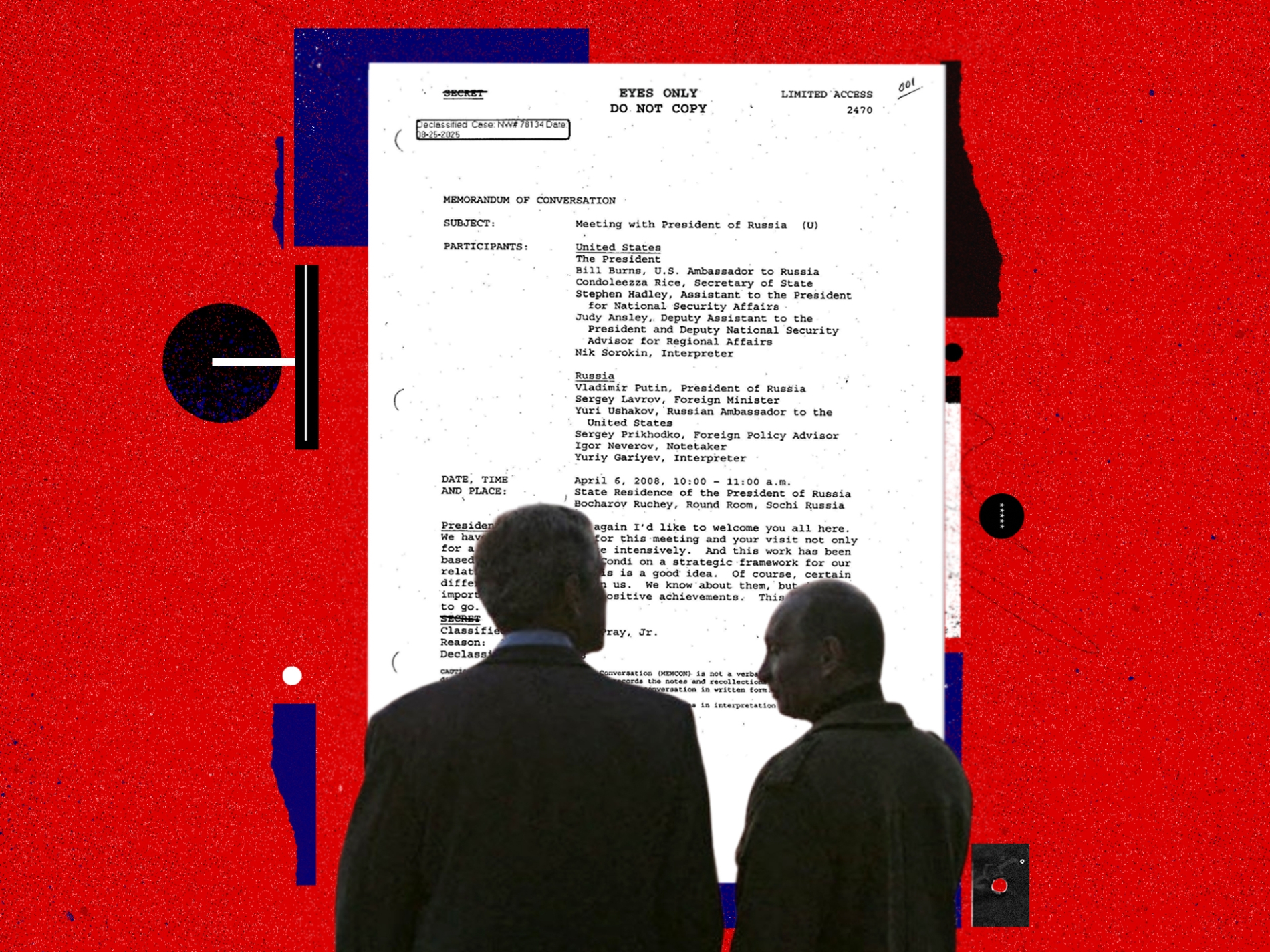
The last meeting took place at the presidential residence of Bocharov Ruchey in Sochi on 6 April 2008. It would be their last encounter, having met more than 20 times during Bush's two terms in office.
The meeting took place two days after the close of the NATO Bucharest summit, where Bush personally led a campaign to invite Ukraine and Georgia to join the alliance. And while the tone of the discussion remained within the bounds of mutual respect, the tension was palpable.
Nonetheless, the two leaders again seemed aligned on Iran. Bush praised Russia's plan to obstruct Iran's nuclear pursuit as "very ingenious." He added, "People say, 'Can you work with Putin?' I say, 'Here's the example. He took the lead on Iran and I followed.'" On the sale of the S-300 missile system, Bush expressed appreciation for Putin's decision to make the sale conditional. After confirming that the contract signed four years earlier hadn't been implemented, he agreed with Bush's characterisation of the Iranians as "nutty."
Apart from consensus on Iran, differences on several issues were clear. These ranged from missile defence to questions of strategic balance, the framing of an updated treaty on the limitation of strategic arms, and coordination between the two militaries to avoid miscalculations that could lead to catastrophe.
Putin also set out in detail the reasons for his rejection of Ukraine and Georgia joining NATO and presented Russia's case against deploying elements of the US missile defence system in Poland and the Czech Republic. He explained at length why Moscow viewed these steps as a threat to its security. For his part, Bush appeared to understand Russia's position and its arguments, but did not commit to changing his stance.
US President George W. Bush (left) and his Russian counterpart Vladimir Putin (right) smile during their meeting at the Kremlin on 24 May 2002.
The released document revealed that the tone of the meeting differed fundamentally from their early talks in the first years of the decade, when the two leaders spoke of comprehensive cooperation and affirmed the importance of personal relations based on trust.
Turning to the results of the Bucharest summit, Putin firmly voiced his opposition to the possible accession of Ukraine and Georgia to NATO. He said: "I'd like to emphasise that Ukraine's accession in to NATO will create a field of conflict for you and us, a long-term confrontation."
In response to Bush's question about the reasons, Putin said that "Ukraine is a very complex state. This is not a nation built in a natural manner. It's an artificial country created back in Soviet times, following World War II." He went on to say that western Ukraine consisted of territories gained from Poland, Romania, and Hungary, while the eastern part was taken from Russia in the 1920s and 1930s, as well as the Crimean Peninsula in 1956, noting that 17 million of 45 million people living in Ukraine were in fact Russian.
Ukraine's potential accession to NATO "creates the threat of military bases and new military systems being deployed in the proximity of Russia and creates uncertainties and threats for us." Putin stressed that if the US was "relying on the anti-NATO forces in Ukraine, Russia would be working on stripping NATO of the possibility of enlarging." He also objected to Georgia's accession, arguing that the leadership in Tbilisi might attempt, under the cover of membership, to wage war on the two separatist regions of Abkhazia and South Ossetia.
One of the things I admire about you is that you weren't afraid to say it to NATO. People listened carefully and had no doubt about your position.
George W. Bush to Vladimir Putin
Bush didn't argue with Putin over the alliance's enlargement. He said, "One of the things I admire about you is that you weren't afraid to say it to NATO. That's very admirable. People listened carefully and had no doubt about your position. It was a good performance."
As a result of the final meeting, it became clear that the failure to resolve outstanding issues during this period was a key reason Russia pursued the military option to defend its interests in its immediate Soviet neighbourhood and to prevent NATO from having a foothold on its doorstep. This was evident in the war in Georgia, less than two months after the last encounter, and in Putin's growing sense that NATO was tightening the noose around Russia, despite being fully aware of its security concerns.
Later, Russia seized the Crimean Peninsula in 2014 and supported separatists in Donetsk and Luhansk in the same year, before launching a full-scale war on Ukraine in February 2022.