When Israel killed a Hezbollah military chief in late November, one GBU-39 bomb failed to detonate, leaving Washington worried that its adversaries could reverse engineer it
On 23 November 2025, an Israeli F-15 launched GBU-39 Small Diameter Bombs at Hezbollah's military commander in Beirut. The strike killed its target, Hezbollah’s military chief, Haytham Ali Tabatabai, but one bomb failed to detonate.
Within days, Washington urgently requested that Lebanon return the unexploded munition, fearing adversaries could exploit its sensitive technology. A single failed bomb had become a potential strategic catastrophe.
This isn't just another unexploded ordnance problem. An intact GBU-39—particularly one that failed to detonate and thus may remain largely preserved— could provide valuable insight into US warhead engineering, guidance technology, and manufacturing practices. The GBU-39 is a fully functional window into how American precision warfare actually works, and the kind of intelligence windfall that keeps defence officials awake at night.
Packing a punch
The GBU-39 weighs just 250 pounds, but it's packed with American technological secrets. Its small size means a single aircraft can carry more of those compact bombs than heavier munitions. The bomb combines a hardened penetrating warhead with GPS-aided inertial navigation accurate to within one meter, using a small wing to travel up to 110 kilometres from release. When the bomb works, it is devastatingly precise, but when it doesn't, it could reveal a great deal about US technology.
The critical technology sits inside: a Honeywell HG1700 ring-laser gyroscope paired with an encrypted GPS designed to resist jamming and spoofing. The system has built-in redundancy—if GPS fails, it falls back on inertial guidance and still delivers. This is precisely what US adversaries want to understand: how does American precision work when you deliberately try to break it?
Inside the GBU-39 lies a Honeywell HG1700 ring-laser gyroscope paired with an encrypted GPS designed to resist jamming and spoofing
Then there's the explosive: 37 pounds of AFX-757, representing years of American energetics research. The specific formula is classified. Reverse-engineer that, and you skip a decade of your own research. Even the hardened steel nosecone, which penetrates three feet of reinforced concrete, and the deployable wings, which give it range while keeping its radar signature low, represent exportable secrets.
Though the weapon is available for foreign export, Washington carefully restricts it, selling only to trusted allies. Yet after the strike, one sits, unexploded, in Lebanon.
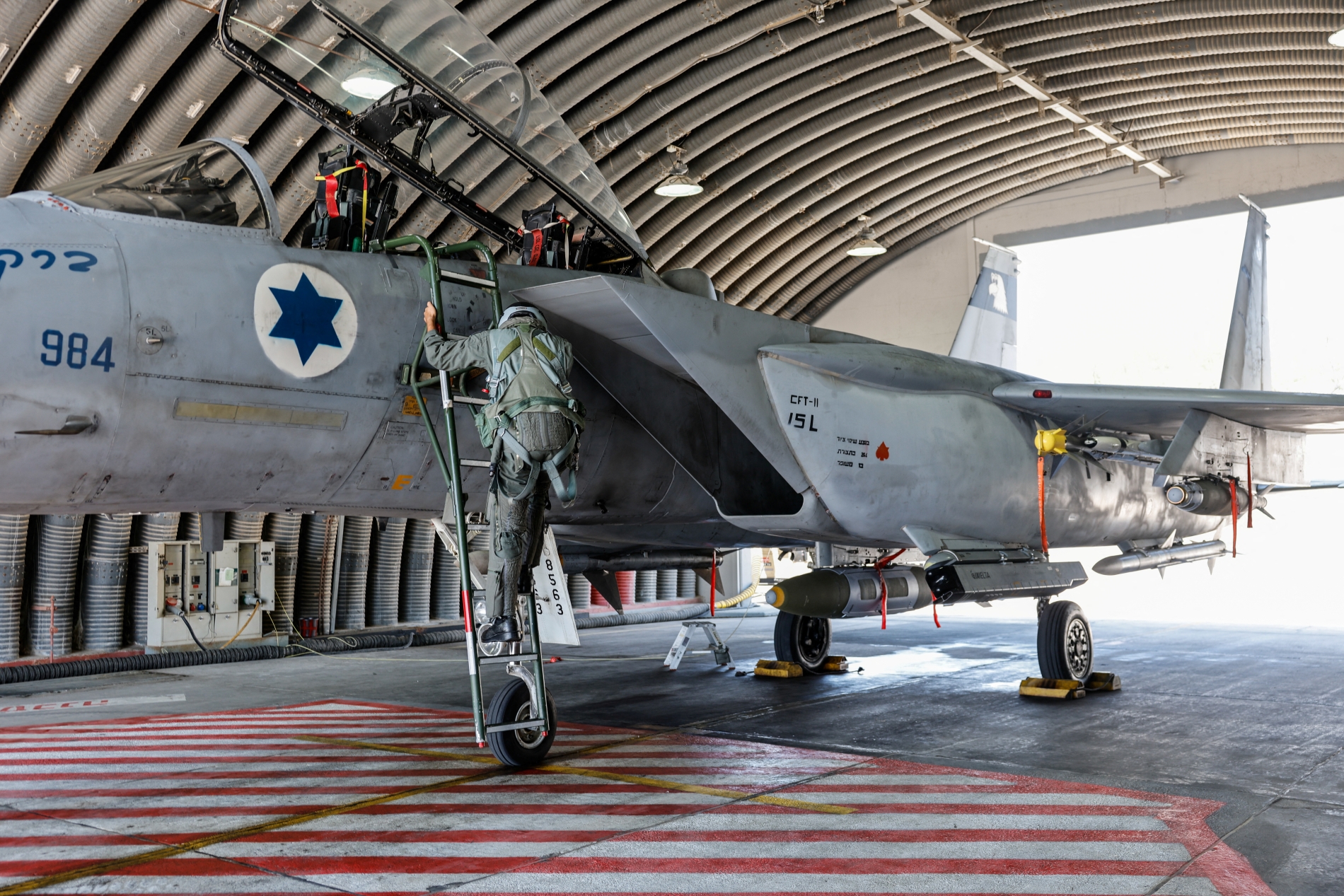
An Israeli fighter pilot climbs a ladder to board an F-15 at Tel Nof Airbase, Israel, 3 July 2025.
From Tehran's perspective, an intact GBU-39 offers both the ability to copy American weapons and insight into how to defend against them. Iran has a long track record of learning from captured US technology. After seizing an RQ-170 Sentinel drone in 2011, Iranian engineers claimed to have extracted all its data within months and produced a reverse-engineered copy by 2014.
More recently, Iran claimed to have developed electronic warfare systems specifically designed to jam and spoof GPS-guided weapons. So far, these capabilities have failed the test of combat, as they had little to no mitigating impact on Israel's assault during the 12-day war in June. But one would be wrong to simply discard Iranian technology.
Understanding the GBU-39's anti-jamming features could help Iran develop more effective countermeasures—not just against this bomb, but against the entire family of American precision-guided munitions. Iran's defence industry has invested heavily in electronic warfare precisely because it represents an asymmetric advantage: relatively cheap systems that can neutralise expensive Western weapons.
Iran and its allies have long studied Western weapons in conflict zones where they are used. In 2019, a Houthi official confirmed the group was retrieving US technology and passing it on to Hezbollah and Iranian assets. Incidentally, it may well be that Tabatabai, who was killed in Beirut, was part of this effort, as he himself served as a Hezbollah advisor to the Houthis. In an interview with CNN, one Houthi official explained that "there isn't a single American weapon that they don't try to find out its details, what it's made of, how it works."
There are also fears in Washington that Iran could also share its findings with an even greater US adversary: China. Like Iran, it has used recovered military systems to build its own. In 2001, a US Navy EP-3 crashed in China, where Beijing extracted intelligence despite the crew's efforts to destroy equipment. And in 2011, a stealth helicopter crashed during the US raid on Osama bin Laden. Pakistani forces allowed Chinese engineers to inspect the wreckage, and within a few years, China unveiled a suspiciously similar stealth helicopter.
Meeting between Lebanese President Joseph Aoun and Tom Barrack at the Presidential Palace in Baabda, Lebanon, on 7 July 2025.
Bad timing
The timing couldn't be worse for US-Lebanon relations. Washington has been trying to strengthen Lebanese institutions as a counterweight to Hezbollah, providing over $117mn in security assistance to the Lebanese Armed Forces to help implement the November 2024 ceasefire.
But the Lebanese government straddles an impossible line. Hezbollah maintains its grip on significant territory and political power, and the government has repeatedly failed to fulfill its ceasefire obligations to disarm the group. A bipartisan group of US lawmakers recently warned Lebanese leaders: "Disarm Hezbollah now, including by force if necessary," threatening to withdraw American support if Beirut doesn't change course.
Now Lebanon faces a choice: cooperate with Washington's request to return the bomb, or allow Hezbollah and its Iranian patrons to examine it. Both paths carry costs. Returning the weapon could provoke Hezbollah at a moment when the group has already rejected government disarmament plans as a "grave sin", while keeping silent allows adversaries more time to extract intelligence while further straining ties with Washington.
This is compounded by the fact that Lebanon and Israel held their first direct talks involving civilian representatives in decades, on 3 December. The meeting between diplomats from Israel and Lebanon was organised by the US, just two weeks after the strike that killed Tabatabai in Beirut.
It's not clear how Hezbollah will react, particularly as it is now far weaker than before. Still, the group remains the most potent military force in Lebanon. In the past, it did not hesitate to use force even at the risk of causing friction with the Lebanese government.
US political commentator Tucker Carlson speaks during the last day of the 2024 Republican National Convention at the Fiserv Forum in Milwaukee, Wisconsin, on 18 July 2024.
The incident is also an embarrassment for Israel, which has to rely on the US to retrieve the bomb, and has exposed American secrets. This comes at a time when the "MAGA sphere," which supports Trump, is increasingly split on foreign affairs, with some calling on the US to be more cautious in involving itself in foreign conflicts or supporting foreign partners. This camp, often dubbed the "restrainer," is gaining ground.
The topic of ammunition itself is particularly sensitive, and at the heart of the "restrainers" philosophy, which views US support for conflicts they don't see as top priorities for Washington, as depleting the stockpile of weapons that should only be used against China. The wars in Ukraine, Gaza and the Iran-Israel war (and conflicts that preceded) have exposed the limited scope of Western stockpile, and (more importantly) limited industrial capabilities.
Whether the GBU-39 in Beirut ultimately reaches Iranian, Russian, or Chinese engineers remains unknown. But each incident brings Washington closer to choosing between arming allies and protecting secrets.
In an era where precision and stealth capabilities determine military outcomes, even a single bomb matters. The question now is whether it stays in Lebanon—or becomes a blueprint for weapons used against America.