Saudi shipping firm Bahri charts a steady course

With almost 100 vessels, including 42 large crude carriers, the company is outperforming its competitors. Analysts say this owes something to its diversified structure and links to Saudi oil exports.

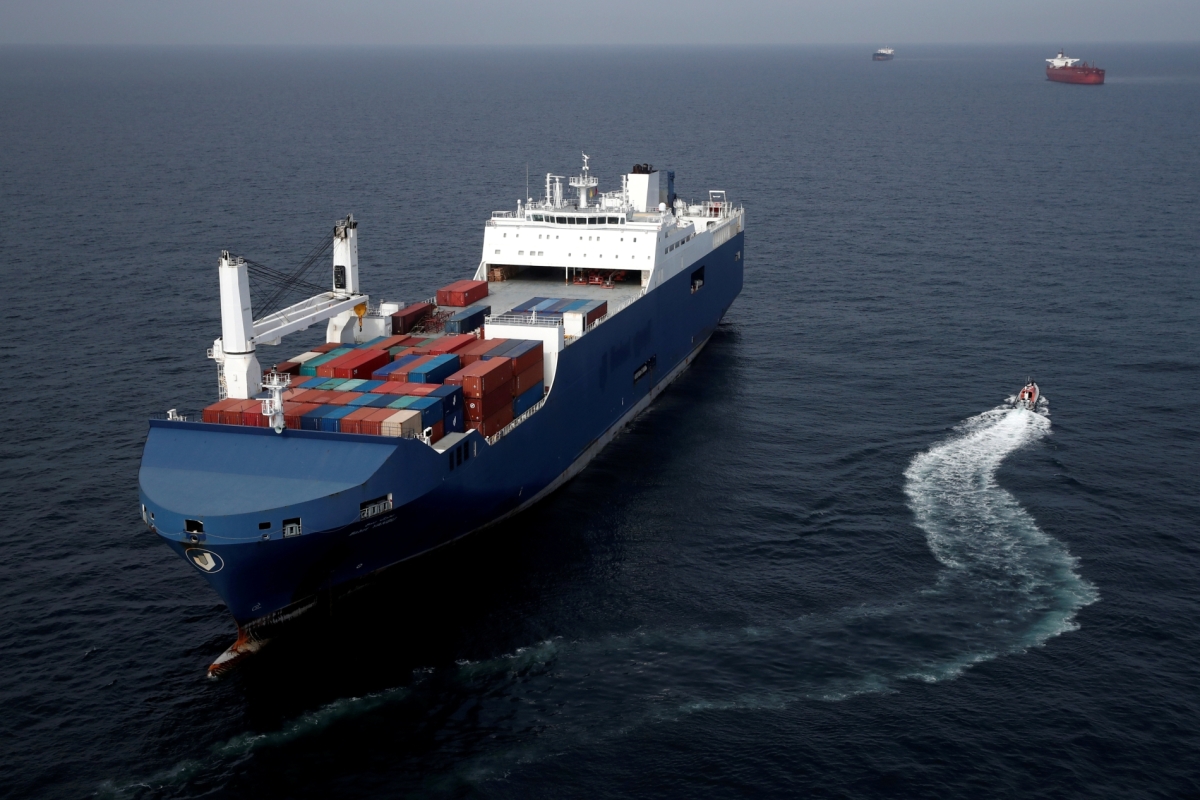
A French patrol boat sails next to the Bahri-Yanbu, a Saudi Arabian cargo ship, that waits to enter the French port of Le Havre on 10 May 2019.
REUTERS/Benoit Tessier
A French patrol boat sails next to the Bahri-Yanbu, a Saudi Arabian cargo ship, that waits to enter the French port of Le Havre on 10 May 2019.

Saudi shipping firm Bahri charts a steady course

The National Shipping Company of Saudi Arabia (Bahri) is a big player in the global maritime and energy logistics landscape. Established in 1978 and listed on the Saudi stock exchange in 1993, the company is a key cog in the country’s energy exports and global supply chains.

Bahri is backed by Saudi Arabia’s sovereign wealth fund, the Public Investment Fund (PIF), which holds approximately 22.55% of the company's shares, and the state oil giant Saudi Aramco, which holds approximately 20% (the remaining shares are publicly traded). This ownership structure reflects Bahri’s importance as a national asset.

According to Bahri Ship Management, the company currently manages 95 vessels, including 42 Very Large Crude Carriers (VLCCs), 38 chemical and product tankers, six multi-purpose vessels, and nine dry bulk carriers. Its latest fleet disclosures indicate an owned fleet of just over 100 vessels, suggesting several recent additions to the portfolio.

Bahri ships carry crude oil, refined products, petrochemicals, dry bulk materials, and industrial equipment to markets worldwide. The company provides end-to-end shipping, supply chain solutions, and integrated maritime services. This combination positions Bahri as a critical pillar of Saudi Arabia’s energy ecosystem. It gives the country global commercial reach.
Bahri
Bahri Sign

Market dynamics

The company’s revenue journey over the past seven years shows adaptation in the face of global market cycles. In 2018, revenues were $1.63bn, rising to $1.75bn in 2019. In 2020, they surged to $2.24bn, amid the global coronavirus outbreak. In 2021, revenues dropped sharply to $1.43bn but rebounded in 2022 to $2.29bn and hit $2.34bn in 2023. Last year, Bahri’s revenues came in at $2.53bn, a historical high. Analysts now wonder whether it can extend its upward momentum.

The contrast between 2020 and 2021 highlights the dynamics of the global tanker market. In 2020, the combination of extreme demand for floating storage, disrupted trade flows, and highly volatile freight cycles created an unusual but extraordinarily profitable environment for very large crude carriers. VLCC earnings reached historic highs, and major global operators such as Frontline, Euronav, VLCC pool members, and large Asian tanker fleets also recorded exceptional charter rates.

Bahri was no exception. It leveraged its sizeable VLCC fleet for one of the strongest financial years in its history. The following year, the situation reversed sharply. The unwinding of floating storage, the normalisation of freight markets, and the rebalancing of global supply chains led to a steep decline in tanker earnings worldwide. Revenues for the big players like Euronav, Frontline, Hafnia, and Scorpio Tankers all dropped materially, as market conditions tightened.

Bahri was no different, its revenues for 2021 reflection a market correction, rather than any company-specific factors, but recovered strongly early in 2022, owing to its diversified structure and strong customer base, whereas many international fleets relied heavily on single segment exposure and remained vulnerable to shifting freight cycles.

The Public Investment Fund (PIF) holds around 22.55% of Bahri's shares, while the state oil giant Saudi Aramco holds around 20%

Relative performance

Comparing the performance of major international tanker operators over time provides insights into their commercial strategies. In 2024, Frontline in Norway—one of the most recognised names in the crude tanker sector—reported total revenues and other operating income of $2.16bn, less than Bahri's $2.53bn. While their business models differ, both operate large crude and product tanker fleets on a global scale.

Unlike many pure crude tanker operators, Bahri combines a large VLCC fleet with product tankers, chemical carriers, dry bulk vessels, general cargo ships, and an integrated logistics arm. This diversified structure helps explain its higher earnings compared to Frontline, even though both companies operate in the same sector.

Hafnia, based in Singapore, operates a much larger fleet of product and chemical tankers. It generated around $2.9bn in revenue last year (next to Bahri's $2.53bn). According to Hafnia's own fleet data, it operates 194 vessels, whereas Bahri manages 95, indicating that Hafnia's fleet is only half as large. Yet Bahri's revenues are far from half that of Hafnia, suggesting stronger commercial performance relative to its fleet size. Likewise, Scorpio Tankers, which operates around 100 product tankers (similar to Bahri's), reported $1.24bn in revenue in 2024, around 50% less than Bahri's.

These benchmarks demonstrate that Bahri outperforms several competitors, including those with substantial scale advantages, with the caveat that direct comparisons in the maritime industry are not possible because each operator has a different business model, cargo mix, and commercial strategy. Still, it shows how a diversified strategy combining crude, products, chemicals, bulk, and logistics lets Bahri deliver a revenue trajectory to that of many specialised tanker operators.

LOIC VENANCE / AFP
A picture taken on 9 May 2019 off the northern port of Le Havre, shows Saudi cargo ship Bahri Yanbu waiting to enter the port of Le Havre.

Market factors

In seeking to understand performance, it is helpful to analyse leading shipbrokers, such as Clarkson's, Braemar, and Simpson Spence Young. These firms do not own vessels, yet their revenues closely reflect global tanker markets because they broker large volumes of crude and product tanker charters.

In 2020, shipbrokers experienced a strong revenue upswing driven by the surge in demand for floating storage and tankers. In 2021, it dipped sharply as freight markets normalised, a pattern that mirrors the trajectory observed by shipowners worldwide. The correlation between shipbroker performance and tanker operator earnings underscores that Bahri's results in 2020 and 2021 were aligned with global market fundamentals.

Clarkson's, the world's largest shipbroker, reported revenues of about $800mn in 2024, while Braemar generated around $200mn (private broking houses such as Simpson Spence Young do not disclose their revenue figures). Although these asset-light intermediaries operate on a very different model, this 2024 snapshot still underscores the Saudi company's revenue performance.

Bahri's diversified business model—spanning crude oil transportation, refined products, chemicals, dry bulk shipping, and general cargo—allows it to cushion the impact of volatility in any single segment. Operators that rely solely on crude or product tankers often experience sharp revenue fluctuations due to cyclical freight market movements.

Bahri benefits from reliable long-term cargo flows linked to Saudi Arabia's energy exports, thereby reducing exposure to market fluctuations

Playing to strengths

Operational efficiency also plays a central role. Bahri benefits from strong vessel utilisation, efficient voyage planning, and reliable long-term cargo flows linked to Saudi Arabia's energy exports, thereby reducing exposure to market fluctuations and enhancing the company's ability to capitalise on profitable trade routes during favourable cycles.

There is no doubt that Bahri is uniquely positioned, as the maritime extension of Saudi Arabia's global energy presence. Its close alignment with Saudi Aramco and access to strategic crude and product flows give it the stability and long-term visibility that are rare in the tanker industry. It therefore exists not only as a commercial shipping operator, but as a strategic asset that supports Saudi Arabia's energy security and export infrastructure.

The company's performance from 2018-24 indicates strength, but the market remains volatile. With the OPEC+ group of oil-producing nations having begun to unwind earlier production cuts and Saudi Arabia increasing crude output in 2025 (providing a supportive backdrop for higher seaborne flows), analysts ask whether Bahri will extend its growth cycle. Its diversified fleet, efficient operations, and strategic alignment with Saudi energy exports mean that it has every chance.

font change