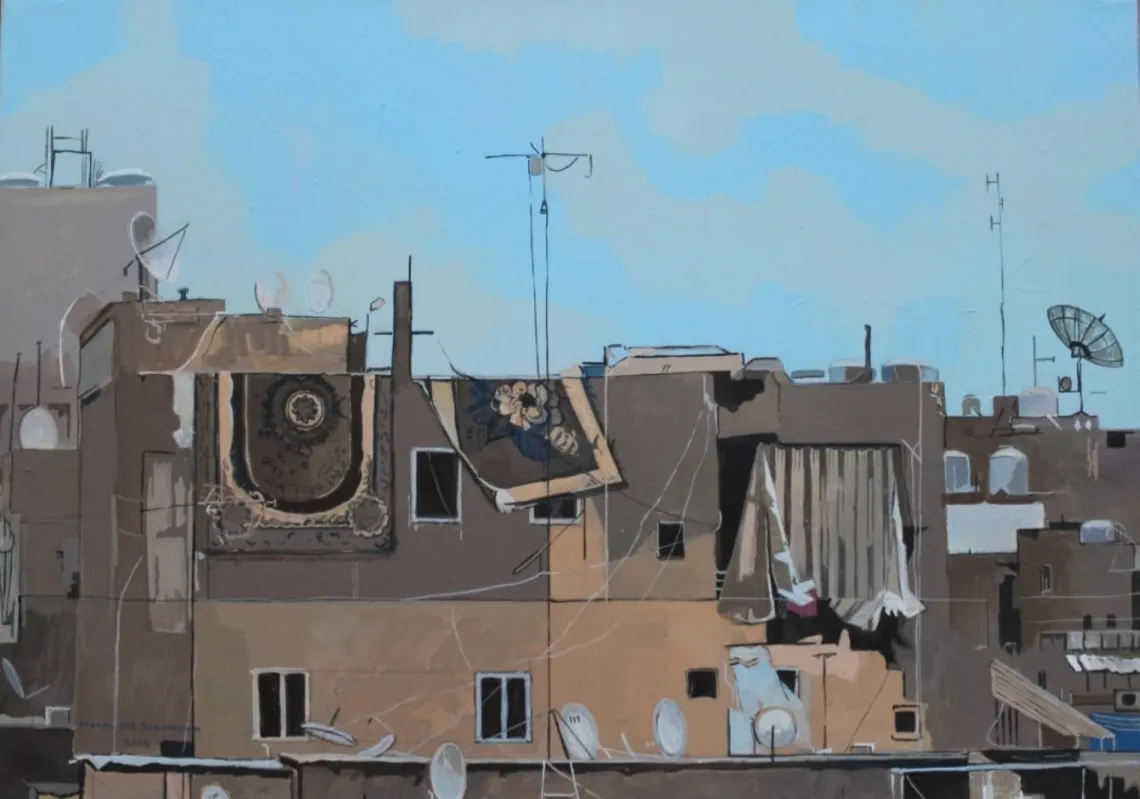

In his latest exhibition, Syrian artist Shadi Abu Saada continues his enduring dialogue with the walls that have shaped his life since childhood—walls he once knew intimately in Syria, from which he was later severed by war.
Over the years, these walls have gone from architectural forms to enchanted and symbolic structures on which he inscribes the fragments of life in exile. As a result, they became vessels of confession, repositories of memory, and metaphysical thresholds. In a sense, they form a parallel existence, a virtual life unfolding on the margins of Syria’s brutal reality.
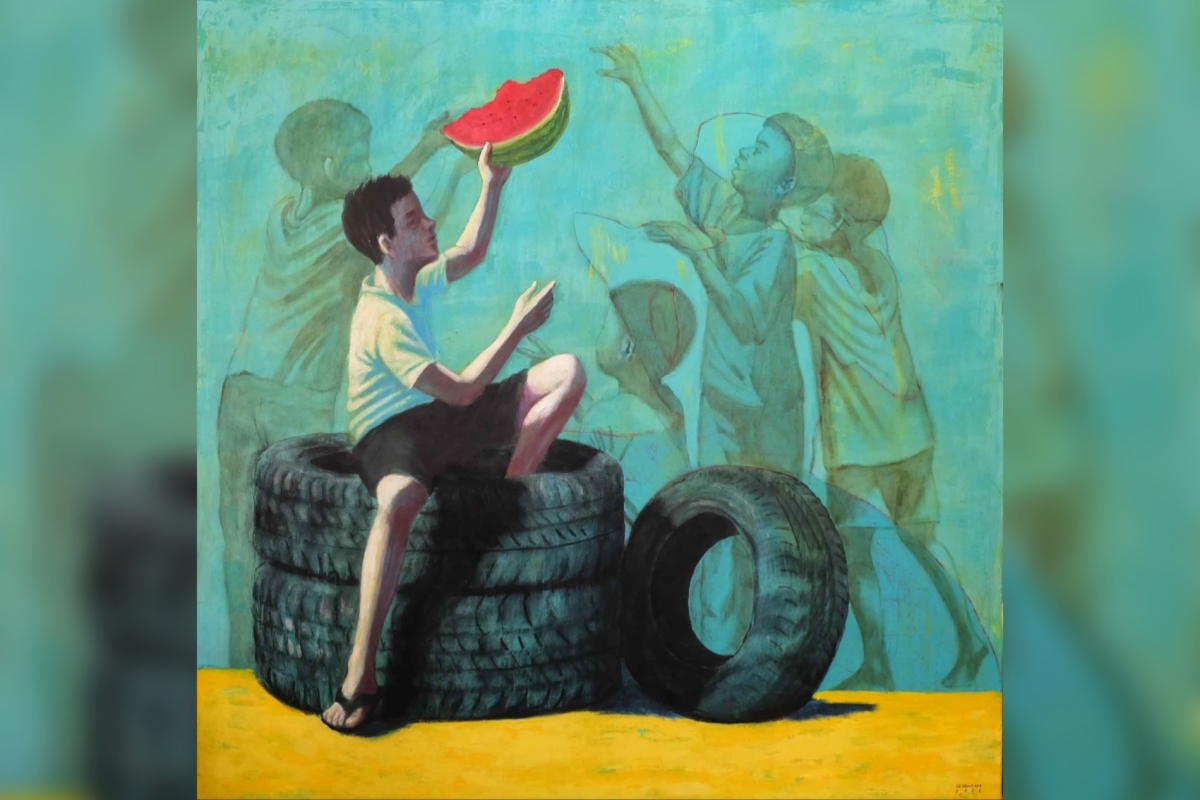
Abu Saada’s earlier works focused on the passage of time and its corrosive imprint on place. He sought to distil joy from the simplest of sources, such as boys immersed in imagined games they could not afford, whether due to war or poverty. These scenes played out against the backdrop of crumbling walls, their surfaces blistered by damp or scarred by shrapnel and bullets.
In Migrants, currently on display at the Mark Hachem Gallery in Beirut, Abu Saada seems to grant those same boys and girls a measure of what they once longed for, prompting the question: what truly moves in these paintings? Is it the children, absorbed in their modest pursuits, or the walls themselves? In fact, the artist deftly orchestrates a union between the mutable and immutable, between constancy and transformation.
Symbolic themes
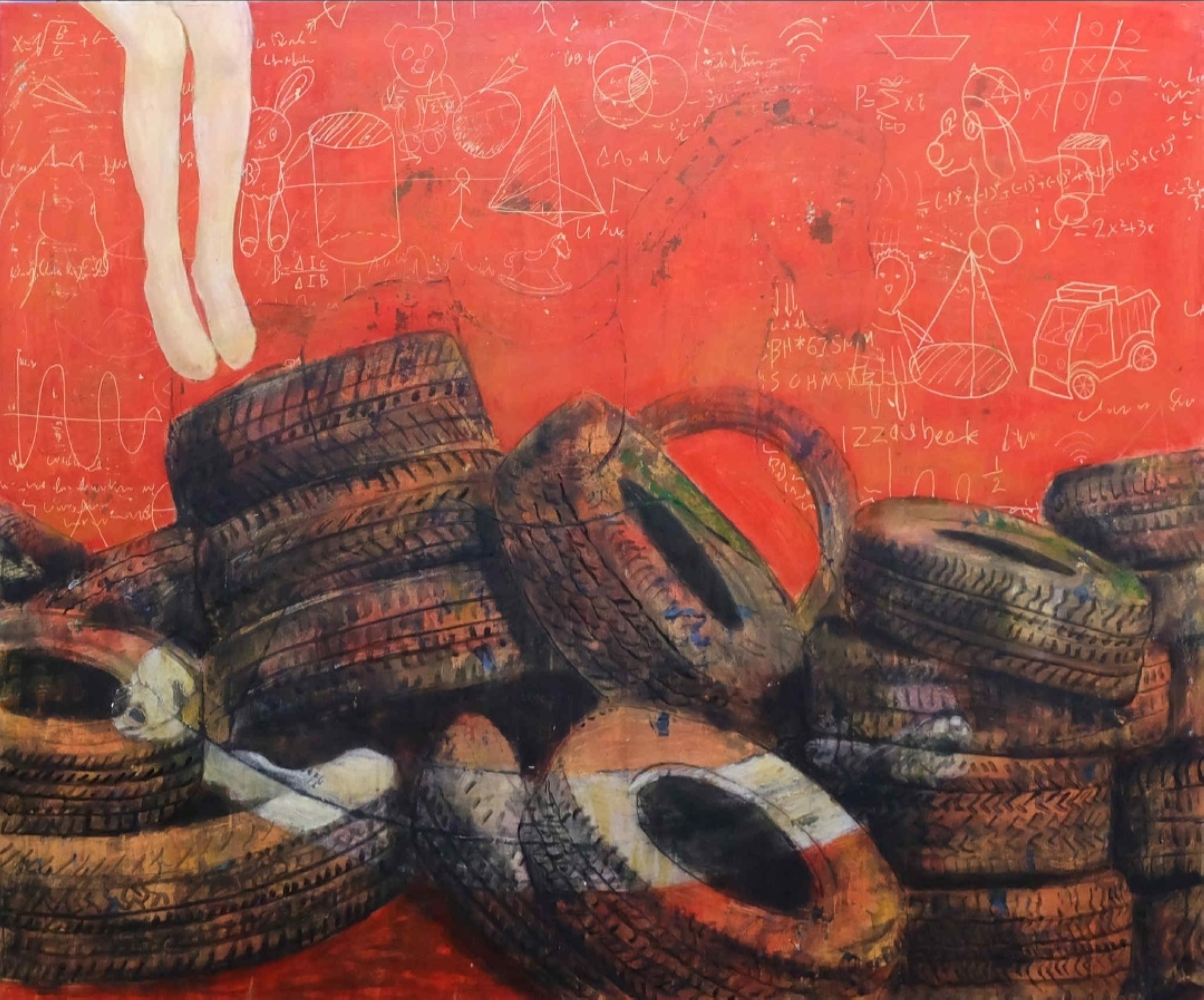
One of the most striking elements in this exhibition is the recurring motif of the tyre. For plenty in both Lebanon and Syria, tyres conjure the acrid stench of burning rubber and the soot that clings to everything it touches. It is the suffocation of space and of spirit. Yet in Migrants, the tyre assumes new resonance in a symbolic evolution. No longer merely a child’s toy, it becomes a bearer of layered meaning.
“In the past, I used the tyre as a disposable object,” Abu Saada tells Al Majalla. “But here, its symbolism has shifted. Its circular form evokes the convergence of beginning and end, a shared point that reminds us of life itself. The tyre’s endless rotation mirrors the migrant’s journey: forcibly uprooted, still questioning who he is, who he might become, and where—if anywhere—he will finally belong.”
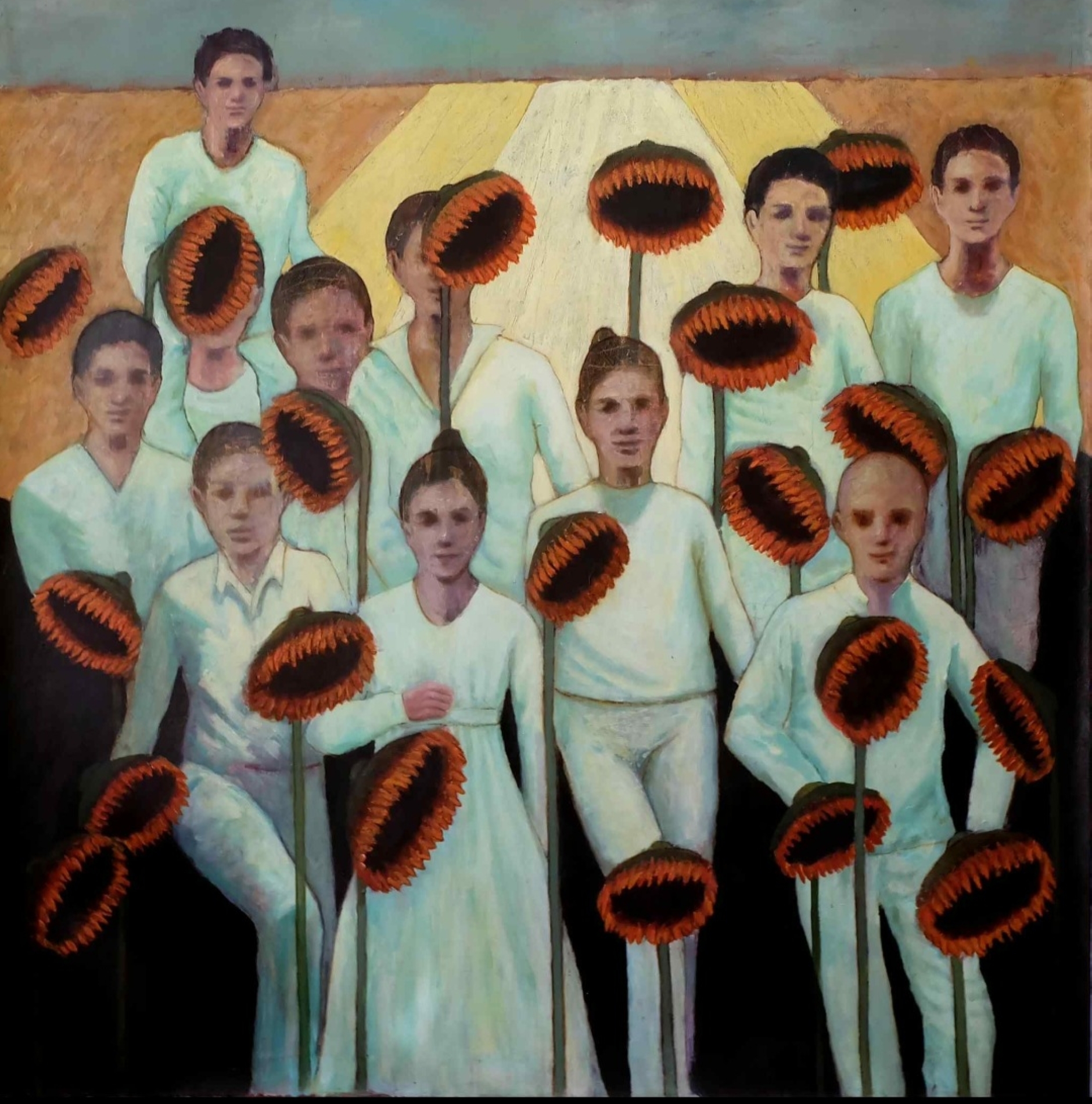
In previous exhibitions, the features of Abu Saada’s figures would shift, reflecting the changing faces in his own life, having moved from Syria to Lebanon to Germany. In Migrants, the figures resemble those in his earlier show—A Dream That Remained on the Wall—where joy, however faint, glimmered in those bound by shared aspirations.
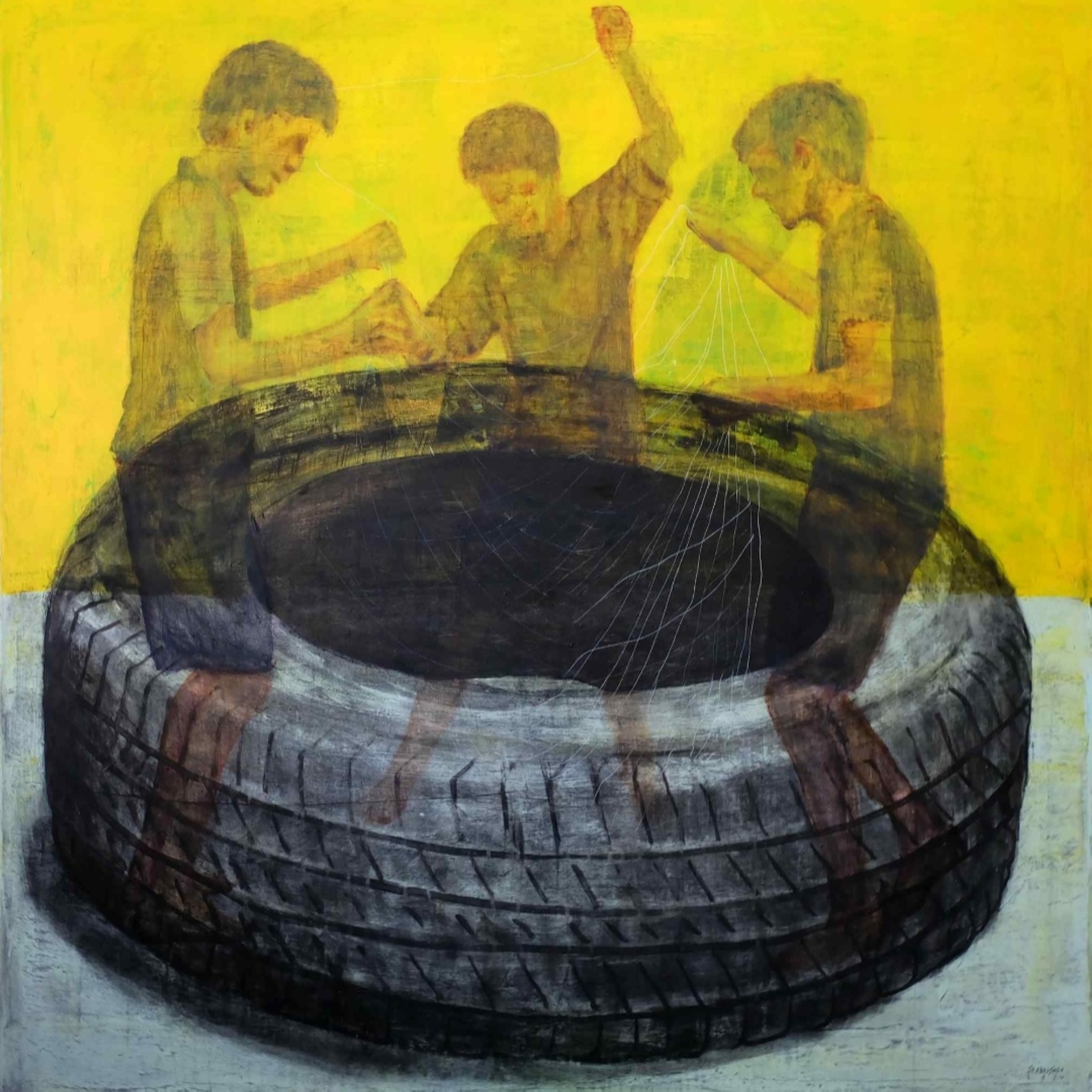
It begs the question: what became of those dreams? Are they truly content and fulfilled, or are they merely performing happiness in mechanical gestures, having lost hope? Did their dreams dissolve? Are they now adrift without a compass?
“I did not choose to leave, nor to stay,” Abu Saada once wrote. “The distance I travelled was not a path between two points, but a passage through the contradictions of this era in which our papers scatter each time we try to gather them, under the weight of merciless politics. I speak not of war and destruction, but of the path of migration—the distance measured not in miles, but in the memories we leave behind on sidewalks and train platforms.”