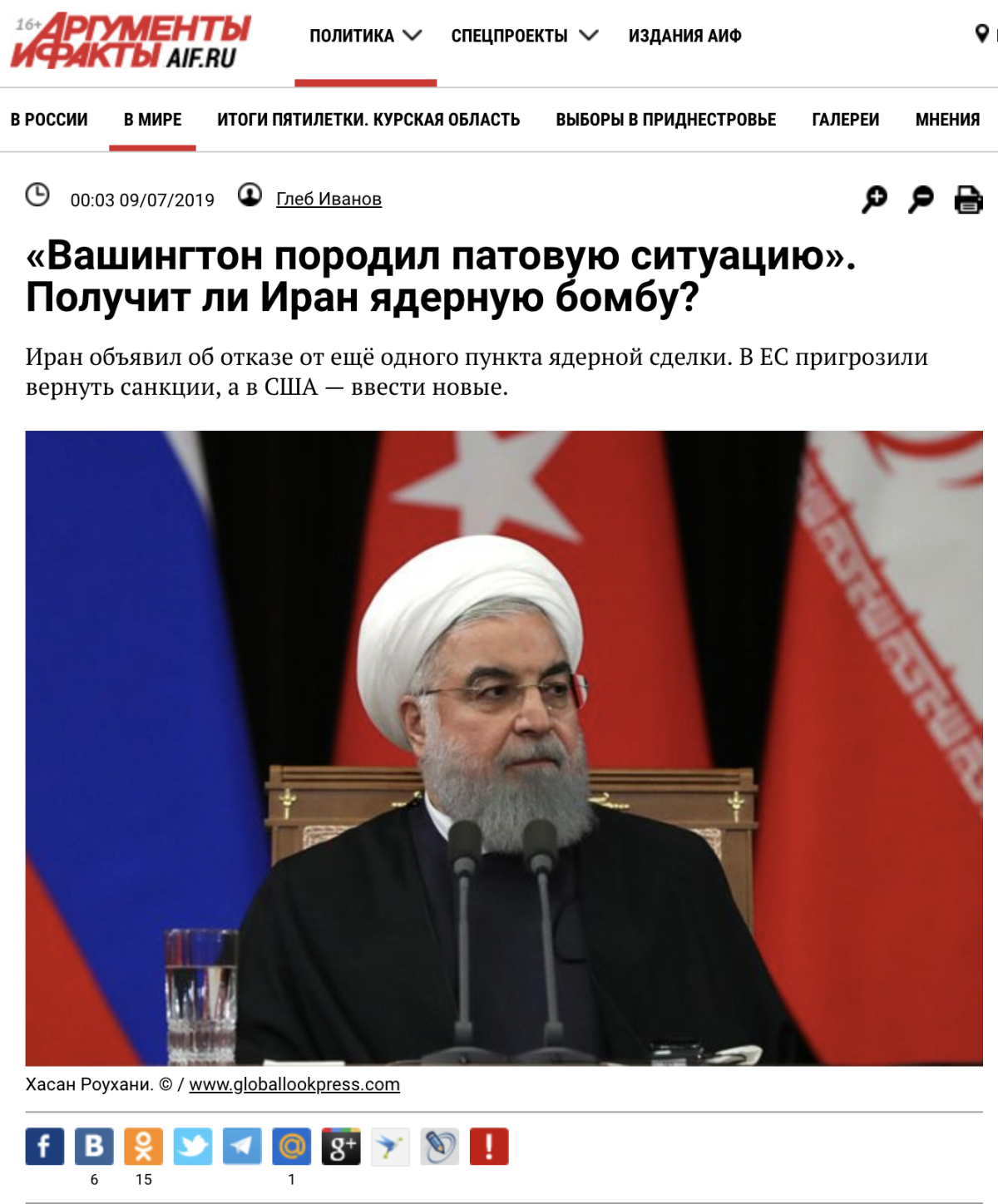

“Washington Has Created a Stalemate”. Will Iran Build a Nuclear Bomb?
This article was published on July 09, 2019 in Argumenty i Fakty, a government-owned Russian newspaper.
On July 7, Iran declared that it would produce enriched uranium beyond the limits set in the “nuclear deal” (a joint comprehensive plan of action approved in 2015 by six countries participating in the negotiations on Iran's nuclear problem: Russia, USA, China, Great Britain, France and Germany). This was announced at a special press conference by the official representative of the government, Ali Rabiyi. Prior to this decision, the Iranians could not exceed the threshold of 3.67%. Now they will enrich uranium "to the required level.”
Earlier Teheran declared that it would not comply with the article of the agreement prescribing the maximum volume of enriched uranium. Iran began withdrawing from the terms of the nuclear deal after the US declared its withdrawal from the agreement back in May 2018. Europe is interested in preserving the status quo. In particular, the French President Emmanuel Macron had a phone conversation with the Iranian President Hassan Rouhani. They agreed to “explore the possibilities of resuming the dialogue”. However, at the same time, France threatened Tehran with renewed sanctions if it completely withdrew from the deal. The US Secretary of State Mike Pompeo confirmed that the US would impose new sanctions on Iran.
These events took place against a backdrop of attacks on oil tankers in the Gulf. The US accuses Iran of being behind these attacks and the Americans are building up a military force in the region. Will there be a new war in the Middle East? We met with an expert from the Russian council for International Affairs Nikita Smagin.
Iran has already withdrawn from two articles of the nuclear deal. How close does this bring Iran to the creation of nuclear weapons?
Nikita Smagin: On July 8, Iran declared its intention to increase its uranium enrichment up to 4.5%. This is not enough for the creation of nuclear weapons. Iran has to undertake many more steps in order to be able to create nuclear weapons in theory.
Europe has supported the nuclear deal. Now we hear threats from France to renew sanctions. Is Iran afraid of European sanctions in addition to the American ones?
European sanctions are already in place. Global companies fear American pressure and do not deal with Iran. People are not investing and in Iran and oil exports decreased 1980s levels (which was the historical minimum). Iran’s economy is deteriorating. Prices are rising and the inflation is high. Iran realises that if it doesn’t take action, the situation will only get worse. The nuclear deal virtually provides Iran with nothing except for political authority. So in effect Iran has nothing to lose.
What could the US respond if Iran continues to withdraw from the deal?
The situation will most likely continue to escalate. Pompeo has already announced the possibility of new sanctions. Iranian’s volleyball team has been detained in the US – it could also be a method of response. They may send more troops to the region to increase military pressure. Especially now that they have a reason: the attacks on oil tankers.
But the main thing that American diplomats are going to do now is to convince their European colleagues that Iran is breaching the terms of the nuclear deal. By all means, they are trying to turn public opinion against Iran and blame Iran for breaching the agreement although in reality Iran waited a year after USA’s withdrawal from the nuclear deal.
In past months the situation in Gulf has escalated. The US accused Tehran if attacking the oil tankers and Iran shot down a US drone. Could this be the start of a war?
No one wants this war, it does not benefit anyone. It will be destructive for Iran. For Trump it could hit his rating in the upcoming elections hard as he had promised to withdraw US troops from the Middle East. The main result we can observe is that the nuclear deal is falling apart. This means that Iran may renew its nuclear program and progress in creating nuclear weapons, i.e., there will be a threat of a nuclear non-proliferation regime.
President Trump wants Iran to stop spreading its influence in Middle East; he wants Iran to leave Syria, Yemen and Iraq. Criticism of the nuclear deal was a pretext for Trump to renew sanctions. The White House is ready to start negotiations only after Iranians make concessions in the region. It is clear that such a scenario is not acceptable for Teheran.
Can anyone influence America’s position?
The whole situation showed that the position of the White House was the key to maintaining the deal. Without the US, this agreement cannot exist. Despite all the promises by the Europeans, they were unable to protect Iran from Washington’s renewed sanctions.
Will There Be a New Big War in the Middle East?
This article was published on May 15, 2019 in Argumenty i Fakty, a government-owned Russian newspaper.

The Pentagon may send 120 thousands soldiers to Middle East if Iran accelerates its nuclear program or attacks American military personnel. The relevant initiative is included in the new plan to contain Iran, developed by acting US Minister for Defense Patrick Shanahan , reported The New York Times. President Donald Trump denied this news and called it “fake”. However, a week earlier, National Security Advisor John Bolton officially announced an increase in American troops in the region.
On May 12, four oil tankers caught on fire in Fujairah (UAE). There were several powerful explosions in the port. Luckily there were no casualties but the ships were heavily damaged. The same day the Ministry of Foreign Affairs of UAE reported announced that this was a sabotage attack.
In the US, the attacks were immediately linked destabilising forces “sympathising with or working for Iran”. Iran denied its connection with the attacks. The Iranian foreign ministry called the attacks an act of vandalism and warned that these acts can be used to undermine peace and security in the region.
Saudi TV channel AlArabiya, which is taking an anti-Iranian position, published comments by several Iranian journalists associated with the Iranian Revolutionary Guard Corps. They called the attacks “a retaliation” and wrote that they were organised by “sons of resistance”.
Who benefits from this situation?
Despite the fact the US is trying to strengthen its military presence in Middle East, in the current situation Donald Trump clearly does not want to attack Iran, says Nikita Smagin, expert from the Council for International Affairs of Russian Federation. “Trump is not going to start a war. However, he is trying to increase the pressure on Iran by demonstrating the military strength of America. Nevertheless, the news that he will send 120 000 military personnel to the region is most likely fake. This would be very costly to maintain and Trump campaigned to reduce the US military presence in the Middle East. It is Lilley that this information was put out by the White House to make Iran feel nervous.”
Donald Trump is not going into the war with Iran because it is too expensive and the results are unpredictable, the expert said. “The memory of the Iraq war is still fresh in the US, which came at a high cost but brought new problems. Iran is a bigger country than Iraq and the Iranian army is stronger. Military action is also more difficult because there are many mountains in Iran while and Iraq is a desert plain.”
However, if the US builds its presence in the region some provocations are possible which may result in a confrontation between American and Iranian troops. Oil tanker attacks could possibly be an example of such provocations, the expert believes.
“It is hard to tell now what exactly happened and who was behind the attacks. There are many forces in the region that would be interested in a conflict between the US and Iran. In Iran there are forces such as the Revolutionary Guard Corps that are against the nuclear deal with the USA and would support the heightening of tensions.”
The government of Iran does not benefit from tension in the region. ”Tehran wants to wait until the end of the Trump’s term as they believe that any negotiations with him are meaningless”. The current US leader demands that Iran surrenders completely on all issues, but promises nothing in return. If Trump gets elected for the new term it may cause serious advances in Iran’s foreign policy, including a complete withdrawal by Iran from the nuclear deal,” the expert says.

Who is Behind the Attacks on the Oil Tankers?
This article was published on June 14, 2019 in Argumenty i Fakty, a government-owned Russian newspaper.
There were four attacks on merchant ships in the Gulf of Oman over a period of a month. It is unknown who is behind the attacks in the region through which 40% of the world’s oil is transported. The US blamed Iran for those attacks but there was no evidence presented. The special report by the United Nations stated that divers could have delivered explosives:“This proves that attacks were part of a sophisticated and well coordinated operation”. The United Nations believe that attacks were planned by some state actors but the report does not name anyone particular country. The price of oil increased immediately after the attacks – the price of Brent Crude increased by 4.5% up to $62 per barrel.
Why does the US blame Iran for attacks?
Immediately after the attacks the deputy head of the Ministry of Foreign Affairs Sergey Ryabkov warned the global community against hasty conclusions and attempts to impose responsibility “on those who are not pleased with a number of states.” “Er have recently witnessed an intensifying campaign of political, physiological and military pressure on Iran. We would bot like the recent tragic events to be speculatively used to further exasperate the situation in an anti-Iranian context,” said the Russian diplomat.
The warnings from the Russian MinForeign Ministry had some grounds. Straight after the attacks, the US Secretary of the State Mike Pompeo blamed Iran. Let us remind you that relations between Washington and Tehran became tense after the White House pulled out of the “nuclear deal”. Now the US has renewed sanctions against Iran including sanctions on Iranian oil. Iran strongly rejected the accusations. Foreign Minister Javad Zarif connected the attacks with the negotiation of the Supreme Leader of Iran Sayyid Ali Hosseini Khamenei with Prime Minister of Japan Shinzo Abe. Iranians announced that they are ready to cooperate to ensure the safety of maritime trade routes.
On June 14, a video was published in the United States, allegedly proving Iran’s involvement in the attack. It shows several people, who the Pentagon call the Iranian military, removing the unused mine from the tanker Kokuka Koreyzhes. It is unclear why this video proves the involvement of Tehran in the incident.
“The situation is very similar to chemical attacks in Syria”.
“The position of the US under Trump is consistently anti-Iranian,” says Nikita Smagin, an expert from the Russian Council for International Affairs. “It is not surprising that the US tries to use every reason to escalate the pressure on Tehran. The situation is similar to the chemical weapons situation in Syria - when something happened there, Western countries, first of all - the United States, would say in advance that Assad was to blame, although it was obvious that they could not know for sure. This is an opportunity to blame Iran for everything, to show that it is an inadequate country that is a threat to security in the region. ”