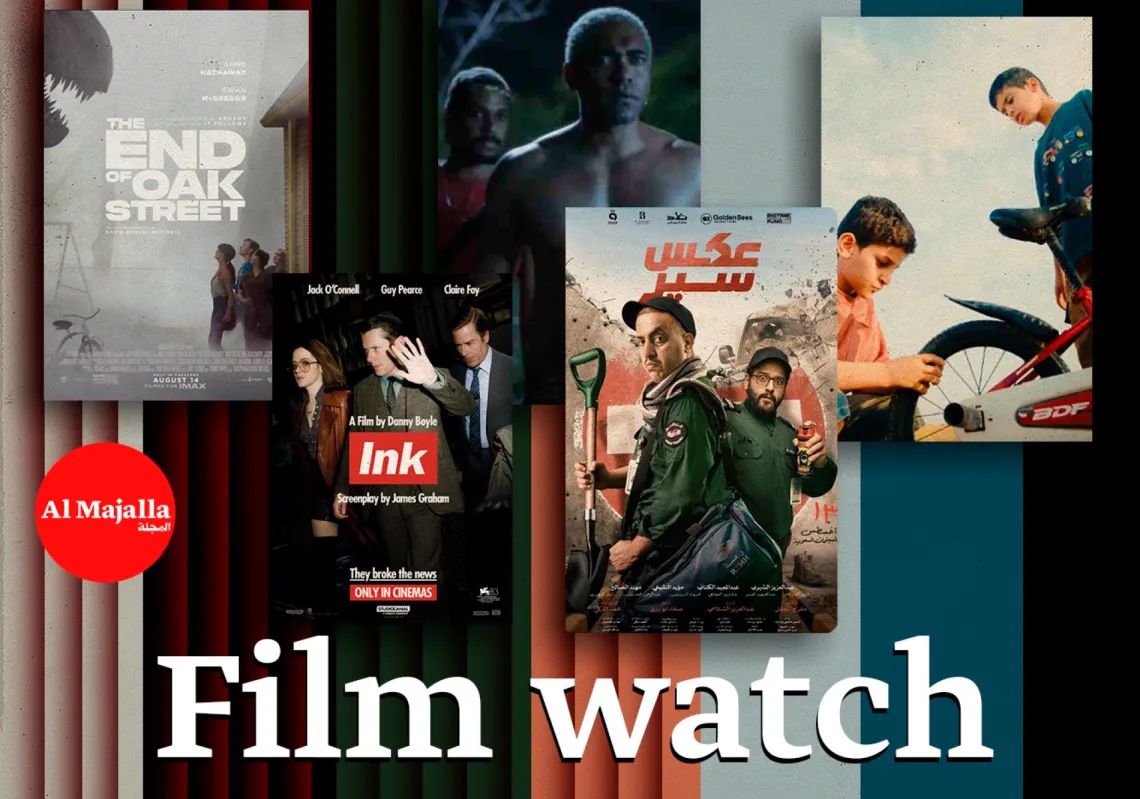
This week, we review a horror film, several situational comedies, and a touching story about an artificial friend, as we move from Britain to Egypt and then to a post-World War III America.
Wicker
Written and directed by: Alex Huston Fischer, Eleanor Wilson
Countries of production: UK, US, Australia, and Hungary
Departures from established conventions often provoke disapproval, particularly in closed or tribal communities. This tension between individual desire and collective conformity lies at the heart of Wicker, inspired by British author Ursula Wills-Jones’s short story The Wicker Husband, previously adapted into a stage musical.
The film follows a fisherwoman (Olivia Colman) living on the outskirts of a coastal village. Weary of being ignored and determined to change her life, she resolves to defy the customs and traditions that govern her community, setting herself on a collision course with its inhabitants.

Alex Huston Fischer and Eleanor Wilson (husband and wife) wrote and directed the film, having previously collaborated on their feature debut, Save Yourselves! (2020). That film likewise blended fantasy with black comedy, isolating its protagonists as they confronted the unknown, before an alien invasion caught a couple unawares after they had digitally disconnected.
In Wicker, another black comedy, the directors focus on the individual’s struggle against the collective, in this case a woman subjected to relentless ridicule by her fellow villagers. Mocked for being single and for the odour of her profession driving away prospective suitors, she rebels and asks a local basket-maker to weave her a husband (Alexander Skarsgård) made of wicker. He does.
They marry, to the astonishment and indignation of the villagers, and even have a vibrant sex life, her new husband having been created well-endowed with supernatural stamina by the weaver. It prompts angry and even jealous reactions in this quiet, conservative village, plunging it into chaos. Fantasy, romance, and satire intertwine in a narrative that casts a wry eye over inherited social conventions and those who unquestioningly submit to their authority.
Much of the appeal comes from how the wicker husband highlights villagers’ assumptions about relationships, acceptance of others, and the consequences of stepping outside the identity society prescribes, with echoes of classic tales such as Pinocchio. The film explores what happens when someone refuses to conform to the image imposed upon them.
A woman long mocked for being single suddenly finds herself in an unconventional relationship with a man whose spirit and nobility of feeling surpass those around her. Starved of genuine affection, she is bewildered by his unexpected tenderness. Yet even as her circumstances change, she comes to believe that “love seems more of a burden than a prize”.
Klara and the Sun
Screenplay: Dahvi Waller
Director: Taika Waititi
Countries of production: US, India and UK
New Zealand director Taika Waititi ventures beyond the exuberant comedy of earlier works to explore a dystopian future governed by genetic engineering and digital class divisions. Klara (Jenna Ortega) is a highly sophisticated robot known as an Artificial Friend. Designed to be available on demand, she has been created to alleviate the loneliness and isolation experienced by adolescents.
Can she, in fact, have a heart and feelings when humans seem to be losing theirs? Waititi explores this through a visual language steeped in fantasy, giving the premise both dramatic and aesthetic force, especially as a bond develops between Klara and a young girl, awakening feelings that exceed her purpose.
The story unfolds in the US after a Third World War has brought about the collapse of the internet and left people confined to their homes. The story is told from Klara’s perspective, so we see the contradictions of human behaviour through her eyes. The sun is her main source of energy, and she regards it with almost religious reverence, investing it with divine power she believes can heal her human friend. Around her, society is divided between genetically enhanced individuals, who enjoy privileged social standing, and the unenhanced, who do not.
The opening scene recalls the musical introduction to Annie (2014), where the celebrated song Tomorrow was stripped of its rosy innocence and recast in the language of capitalism. Standing in a shop window awaiting a buyer, Klara resembles an orphaned girl in a children’s home, her innocence itself artificial, as she gazes upon a distorted world marked by profound class inequalities. Waititi conveys these divisions through a cool, detached visual style well suited to a world inhabited by robots.
The director also shares screenplay credit with Canadian television writer and producer Dahvi Waller, marking her first feature film contribution. The screenplay is adapted from the 2021 novel of the same name by Nobel Prize-winning author Kazuo Ishiguro. In Ishiguro's fiction, characters carry their disappointments and losses as part of the ordinary rhythm of daily life. The film seeks to weave these emotions into a more satirical treatment, tempering their underlying bleakness.
Its exploration of emotions experienced by a robot also recalls the three-part American film series Not Quite Human, which began in the late 1980s. In that story, an advanced robot sent to live among humans as part of a behavioural experiment falls in love with a fellow university student. The surprise comes at the end, when the young woman he loves is revealed to be a robot herself. The idea of a robot falling in love with another robot therefore predates both Ishiguro's novel and its screen adaptation.
Clayface
Screenplay: Mike Flanagan and Hossein Amini
Director: James Watkins
Countries of production: US and UK
Matt Hagen (Tom Rhys Harries) is an aspiring young actor drawn to the glittering promise of Hollywood, but his ambitions are shattered when a brutal assault by a gang leader leaves him disfigured, robbing him of his most valuable professional asset.
Desperate to restore his appearance, he undergoes an extraordinary treatment under Dr Caitlin Corr (Naomi Ackie), whose experiments transform his body into a clay-like substance. As he gradually loses control of himself, he becomes a monster with a limitless thirst for revenge. Clayface thus revives a character from the Batman universe and gives him a film of his own, centred primarily on psychological transformation.
The narrative follows no clear chronology or conventional dramatic structure. Instead, it unfolds through fragmented scenes and encounters that seem to rise from the protagonist's unconscious, drawing the audience into his inner world while offering little distance for reflection or a straightforward path to understanding.
As the treatment takes its toll, Matt's longing to recover his appearance becomes entangled with an increasingly distorted perception of a world that celebrates false identities. The face that should allow him to reclaim his place in society becomes the obstacle separating him from his former self. To realise this vision, the film resorts to violence and horror. After he's injected with mysterious chemicals, Matt gains extraordinary strength, but his face undergoes grotesque transformations, losing an eye or a mouth.
In one disturbing scene, he sits in a bath and wipes away his entire face. Elsewhere, he is shown with an enormous fist, reminiscent of the weapon Clayface used against Batman in DC Comics. Clayface first appeared in 1940, in an issue of Detective Comics. Over the ensuing decades, the character appeared in numerous comic books, animated productions, and television dramas, including Gotham, Pennyworth, Birds of Prey, and Batman: The Brave and the Bold.
Amid the film's breathless visual rhythm, music and lighting combine to create a parallel sensory world that is at times intense. Although Clayface ventures into body horror, it moves away from superhero-cinema conventions to offer a concentrated psychological exploration of the human body and the primordial clay from which it was fashioned. Alongside this runs the scientific ambition to create and transform matter, even in the hope of restoring it to its original form.
Sense and Sensibility
Screenplay: Diana Reid
Director: Georgia Oakley
Countries of production: US and UK
More than two centuries after the publication of Jane Austen's celebrated novel, which has inspired numerous reinterpretations, Sense and Sensibility returns to the screen in a new adaptation that carries the work's feminist perspective forward, adopting a more realistic approach while preserving the romantic atmosphere of the original.
Set in 18th-century England, the story follows two sisters, Elinor and Marianne Dashwood (Daisy Edgar-Jones and Esme Creed-Miles), whose approaches to love differ sharply. Elinor, the elder, embodies sense, approaching her emotions with restraint and an almost excessive rationality. Marianne, the younger, represents sensibility, embracing her feelings with unbridled passion and heightened sensitivity.
This contrast runs through the film, shaping its portrayal of the landscape, the rhythms of everyday life, and even the camera's movement. As Marianne moves through the woods, the camera becomes slightly less steady, reflecting her boldness and vitality. By contrast, the shots accompanying Elinor are noticeably more composed. These contrasting visual approaches reveal the sisters' inner conflicts and psychological tensions. Much of human experience is governed by opposing impulses: good and evil, acceptance and rejection, repression and desire, presence and absence. Such dualities shape the world around us and this film's vision of it.
The sisters' difficulties begin with the upheaval that follows their father's death (Oakley deserves credit for resisting familiar, heavy-handed symbolism in the scene in which the family receives news). The Dashwood women suddenly find themselves in diminished economic and social circumstances, forcing them to reconsider their expectations of love, marriage and the future. The film's outlook here seems closer to that of the elder sister, casting a realistic eye over the hardships endured by rural women under a patriarchal legal order.
The romance is enveloped in the harsher realities of women's lives. The film seldom addresses gender explicitly, yet it rests on close observation of class relations and the restrictions society imposes on women. The screenplay preserves the novel's central narrative and the satirical edge of its dialogue. Several alterations, however, add turbulence to the story, including expanded family conflicts and invented dramatic confrontations absent from Austen's original.
The new adaptation also reverses a familiar emphasis of earlier versions, which tended to centre on finding wealthy husbands who could restore the sisters to their former circumstances. It gives greater prominence to sisterhood and family solidarity in a society where affection is treated as a commodity and marriages are imposed more so than chosen. Oakley thus records another victory for the marginalised, recalling her debut feature, Blue Jean (2022), in which she sought to capture "the unsayable".
Wala Kan Aal Bal
Screenplay: Eyad Saleh
Director: Ahmed Emad
Country of production: Egypt
Wala Kan Aal Bal is a youth-oriented film that opened in cinemas in Egypt, Saudi Arabia, and several other Arab countries in October. It brings together four young performers in their 20s, giving Nour El Nabawy and Yasmina El Abd their first opportunity to share the leading roles in a feature film. Marwan El Moslemany and Saudi actress Joud Al Sufyani also appear in principal roles, alongside Ashraf Abdel Baky. With this youthful cast, the film is targeting teenagers and young adults.
Its choice of romance as the starting point reflects that ambition. The story centres on a relationship between a tour guide (El Nabawy) and a young woman (El Abd), which her father initially encourages and that gradually develops into genuine affection. Much of the comedy arises when the guide finds himself responsible for a multinational tour group whose members he must address in four different languages.
The director adopts a contemporary idiom that resonates with digitally connected audiences, while the cinematography favours vivid colours and bright lighting. Set in Luxor, where everyday life intersects with the constant flow of visitors from around the world, the film finds ample opportunities for romance and humour in encounters between different cultures, customs, and languages, often resulting in misunderstandings, especially in moments that demand genuine feeling.