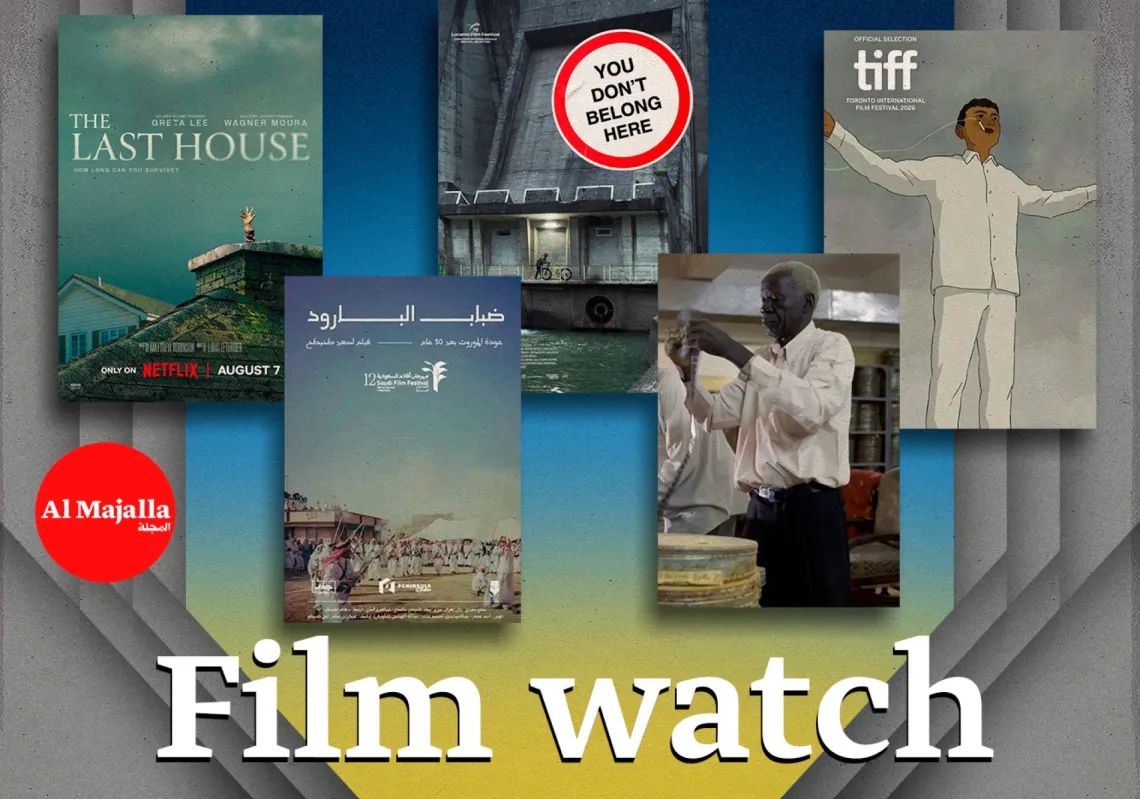

In this monthly column, we explore the latest productions from Arab and international cinema, offering a guide that combines introduction and criticism as it surveys new films on the big screen, from popular entertainment to art-house cinema across every genre.
Aks Sir
Director: Abdulaziz Alshlahei
Screenplay: Mufrej Al-Majfel
Country of production: Saudi Arabia
After three feature films in which Saudi director Abdulaziz Alshlahei ventured into different dramatic worlds, he returns with Aks Sir to new cinematic territory, blending crime, action, and black comedy. The film marks his fourth collaboration with writer Mufrej Al-Majfel, following Zero Distance, The Tambour of Retribution, and Hobal. Across those films, the pair explored place and representations of identity to varying degrees. Their latest work is more dynamic, requiring Alshlahei to control the pace, stage action sequences, and generate comic irony within a story driven primarily by chases and the criminal underworld.
The film follows Naji and Atta, played by AbdulAziz Al Shehri and Abdulmajeed Al Kinani, two friends who work for Razma, a cash-transport company. When Naji plots to save his wife from prison, he turns to his friend for help. Events quickly veer off course, with chaos becoming a central element of the narrative structure, particularly when the duo realises that everything is unfolding contrary to plan.
The cash-in-transit setting provides a fitting backdrop for suspense and pursuit. Naji’s desire to escape a personal predicament propels him into a far greater adventure, with each subsequent decision an attempt to repair the damage caused by the last. The film draws on genre conventions to build a fast-moving world of chases, with locations and situations shifting to meet the story's demands.
Supported by the General Entertainment Authority’s Big Time Fund, the film also marks the cinematic debut of young actor Mishary Al Ajaji, who plays Saad, a security employee at the company. Three of Saudi Arabia’s most prominent social media influencers also make brief guest appearances.
Filming took place at several locations across Riyadh and the Eastern Province, with the local environment remaining clearly present throughout the film’s visual language. The film takes Alshlahei into new territory, as he noted in an earlier interview, yet his attention to place remains firmly embedded in his storytelling despite the project's different nature.
Ink
Director: Danny Boyle
Screenplay: James Graham
Countries of production: US, France, UK
In a world where media and politics are so deeply intertwined that one often becomes a reflection of the other, British director Danny Boyle’s Ink looks back at a pivotal moment that helped shape modern tabloid journalism. The film revisits one of the most consequential newspaper deals of the late 1960s, using the story not simply to document a turning point in British journalism but to examine the less visible relationship between the media industry and the pursuit of power and influence.
Selected to open the 83rd Venice International Film Festival, the screenplay is based on James Graham’s well-known play of the same name. It is the story of ambitious Australian businessman Rupert Murdoch’s acquisition of the British newspaper The Sun and his subsequent recruitment of editor Larry Lamb, played by Jack O’Connell, with Guy Pearce portraying Murdoch. Together, they set about reshaping the newspaper and transforming it from a struggling publication into a paper driven by sensationalism in pursuit of circulation. The newsroom becomes an arena for major ideological and commercial battles, marking a new chapter in modern media history.
As Murdoch’s commercial ambition converges with Lamb’s editorial drive, the drama broadens to explore wider aspects of the industry. The two central characters embark on a different kind of journey, seeking to discover what the public wants and how best to draw readers to the newspaper. Yet the film does not simply chart the conflict between traditional and tabloid journalism. More than half a century after the events it depicts, it raises a question that feels particularly relevant today: what happens when the press no longer merely responds to its audience's desires, but begins to reshape them according to its own agenda?
Graham’s theatrical background is clearly evident in the film. The screenplay retains the centrality of dialogue and conflict between characters while freeing the story from the confines of the stage. The original work centres on the confrontation between Murdoch and Lamb, whereas Boyle expands the world to include the newspaper office, the streets, the printing press, and the society this new media product is meant to reach.
Lamb emerges as the most compelling figure. He is not merely a man carrying out Murdoch’s ideas but someone who gradually discovers how far he is willing to go, crossing boundaries imposed by the established rules of journalism.
The End of Oak Street
Written and directed by: David Robert Mitchell
Countries of production: Australia, Canada, US
Eight years after his last film, Under the Silver Lake, American director David Robert Mitchell returns to the screen with a work that continues to explore fear and alienation, two of the most prominent features of his earlier cinematic worlds. This time, he frames his story as a science fiction adventure about an American family suddenly transported from the safety of their suburban neighbourhood to a primitive world dominated by monstrous creatures. The setting may have changed, but the underlying fear remains, suggesting that Mitchell’s shift from horror to adventure is less a departure than a new way of exploring familiar anxieties.
The story begins in the early 1980s, when the Platt family, comprising father Greg (played by Ewan McGregor), mother Denise (Anne Hathaway), and their two children, Audrey and Brian, live an ordinary life despite mounting financial difficulties and growing tensions between the couple. After a mysterious cosmic event turns the town upside down, the family and the rest of their neighbourhood are transported from the modern world to a primitive environment dating back to the age of the dinosaurs. They must now confront a world in which their homes, fences, and familiar streets can no longer offer protection.
Through the contrast between these two worlds, the screenplay develops several ideas, beginning with the film’s central irony, which challenges one of the most deeply rooted images in the American imagination. The garden, the house, the car, quiet streets, and the nuclear family together represent an idealised vision of suburban life. Yet the film reveals that this supposed protection is little more than a fragile shell when confronted by the forces of nature. The decision not to explain the cosmic phenomenon that transports the neighbourhood into the past is a shrewd one. While this may seem unusual for a science fiction film, it serves the film’s central question particularly well: what happens when people lose their sense of security?
The title The End of Oak Street therefore functions as more than a reference to the end of a particular place. It can also be read as a warning about the collapse of belief in absolute certainty in a world where its inhabitants have assumed social structures and an orderly way of life could protect them forever.
The Riverbank
Written and directed by: Matheus Farias and Enock Carvalho
Countries of production: Brazil, Germany
In their debut feature, The Riverbank, Brazilian directors Matheus Farias and Enock Carvalho turn to the mangrove forests along Recife's rivers, where the nocturnal world takes on the quality of a realm parallel to everyday life. Here, human desires become keys to uncovering darker corners of the social fabric, providing the central thread for a story that unfolds beyond the city’s watchful gaze. The film won the Special Jury Prize at the 79th Locarno Film Festival.
The story begins with Izaquiel, an eccentric young cleaner who lives with a group of transgender women who have become his surrogate family. His life is clearly divided between two opposing worlds. By day, he is bound by work rules and society's customs and traditions. At night, he escapes into the forests in search of emotional release. Yet this escape is not without danger. The directors do not simply tell a story about minorities or oppression. Instead, they place their characters in a suspended realm between reality and myth, where thriller, crime, and romance converge within a framework of magical realism.
From here, the screenplay gradually expands its scope. What initially appears to be a secret refuge for desire becomes a place of danger and fear, particularly after a murder and the threats that follow begin to affect almost everyone. At the same time, Izaquiel finds himself trapped within a conservative religious community where religious rhetoric intersects with displays of power and violence.
His sense of confinement intensifies when he is asked to surrender his freedom to wear certain accessories or paint his nails if he wishes to keep his job. This sets in motion a process of rediscovery, as he becomes increasingly aware of what lies behind the religious facade. The film establishes a direct contrast between the mangrove forests, a place of freedom and refuge from the collective mindset, and the institution's complex world of obedience and control.
Yet the film does not reduce this confrontation to a direct ideological conflict. Instead, it makes the body and desire an arena where intertwined struggles shape a strange and unsettling world. Through its cinematography and lighting, the film reinforces the stark contrast between its two worlds. Deep blue and shades of black dominate the mangrove forests at night, while cold lighting defines the religious community. Despite its darkness and danger, the forest offers those who seek refuge there a measure of freedom, while the place that supposedly embodies safety and order appears far more threatening and suffocating.
Beyond the Neighbourhood
Written and directed by: Abdulmajeed Al-Qahtani
Country of production: Saudi Arabia
The Saudi short film Beyond the Neighbourhood begins with a simple incident as two children set out in search of their lost ball. Yet this brief excursion soon leads them on an adventure beyond the boundaries of the neighbourhood they know, opening up an unfamiliar world filled with surprises and questions. From this premise, director Abdulmajeed Al-Qahtani builds a film about childhood as a continuous journey of discovery, where a passing detail can mark the beginning of knowledge and stepping beyond the safety of the familiar can open up a vast realm of imagination and possibility.
The title itself thus becomes a key to the film’s central idea. The neighbourhood is not merely a setting in which events unfold, or a silent witness to them, but a boundary between knowledge and ignorance, sometimes even of the most basic things. At one point, the two boys begin to regret leaving their safe surroundings when they grow thirsty and discover that they have only one riyal between them, enough for a single small bottle of water, which they share down to the last drop. Here, the film conveys its moral message without becoming didactic. It does not burden the journey with more meaning than it can bear; instead, it draws its human appeal from the spontaneity of its young characters, their relationship with their surroundings, and the details that give their experience the familiar quality of childhood adventure.
The Saudi setting is also integral to the experience. The places the children move through reflect the everyday life from which their journey begins. At the same time, the camera lets us see the familiar from a different perspective, supporting a story that depends less on a complex plot. A rapid progression through the hours of the day reinforces this approach, beginning with scattered scenes of the journey in the early hours and ending as night falls. The score also plays an important role in expressing the children’s mixed and contrasting emotions, beginning with a palpable sense of energy that gradually gives way to exhaustion as the sunlight fades.