Yasmina Nysten and the elusive nature of memory

In Memory Keepers, the Finnish-Lebanese artist explores the fragile boundaries between memory and imagination, presence and disappearance

Yasmina Nysten
Saleh Barakat Gallery
Yasmina Nysten

Yasmina Nysten and the elusive nature of memory

The title of Finnish-Lebanese artist Yasmina Nysten’s exhibition, Memory Keepers, held at the Saleh Barakat Gallery in Beirut in September, suggests that memory can be preserved. It suggests that the past may survive in an image—or a collection of images—that can be revisited, or at least recognised, centuries later.

Yet standing before the works, with their prevailing turquoise hues, unsettles the certainty the title implies. What emerges is a succession of fragments, fleeting images, and scenes suspended between clarity and ambiguity.

Memory inhabits Nysten’s paintings in unconventional ways. The viewer feels as if witnessing something that may have happened, or nearly happened, though the origins of these scenes remain elusive. As Nysten herself has said, this new body of oil portraits in the Upper Gallery explores portraiture beyond literal likeness.

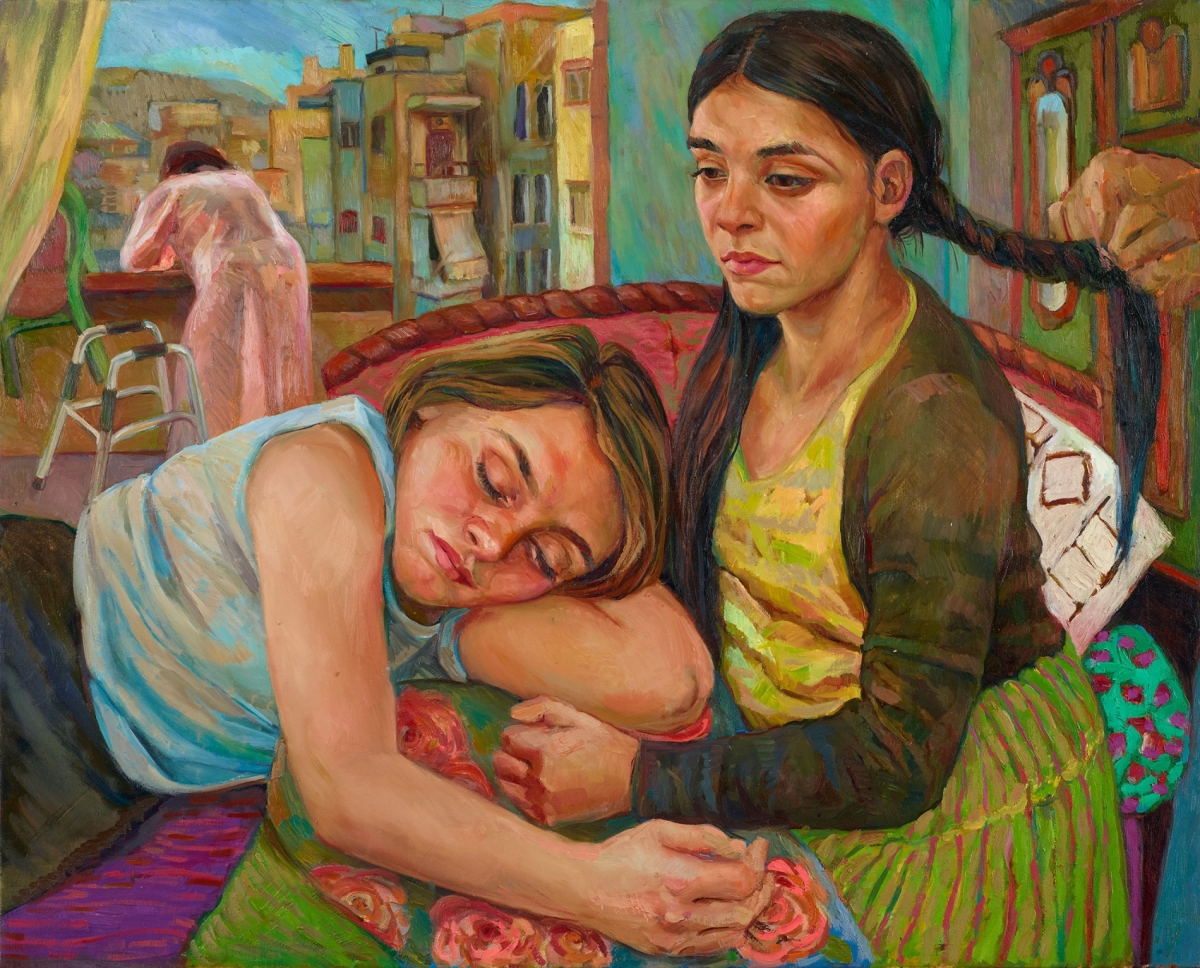
Are the images rooted in an intensely personal experience that has acquired a universal resonance? One painting, for instance, depicts two girls with a woman behind them, perhaps their mother, bending to look through the window of a spacious room. A crutch stands beside her, suggesting that her legs are weakened. Or are the paintings, taken together, fleeting impressions drawn from a collective memory? Could they be images of a present whose very existence remains uncertain, scenes that may have unfolded in reality or emerged entirely from the artist’s imagination?

In several paintings, Nysten seems more concerned with exploring memory as a concept than with recalling vivid life episodes accumulated over time and imprinted on the psyche. One particularly revealing work depicts a girl wearing a blue necklace from which a bird with outstretched wings hangs. She stands with her back to a closed cupboard, painted in the same turquoise blue as the bird. Many of the figures inhabit a kind of theatrical staging imposed by memory, which associates them with ordinary activities: a seated girl, a figure looking on, a couple on their wedding day, a girl dipping her feet into a swimming pool.

The gestures and preoccupations of these figures remain suspended on the threshold of a story. Each painting begins to construct a narrative, only to draw back from it. In one work that inclines towards surrealism, a girl sits in the countryside with a book in her hand, her head resting in her lap, her eyes closed in peaceful slumber. Here, wakefulness cradles memory, or memory lulls wakefulness into an indefinite sleep.

Nysten's inclination towards what might be called open-ended narrative becomes apparent in such works. She favours stories that emerge from a single scene or situation, leaving us with questions the painting never resolves. What matters is preserving the possibility of whatever might happen next.
Saleh Barakat Gallery
Yasmina Nysten

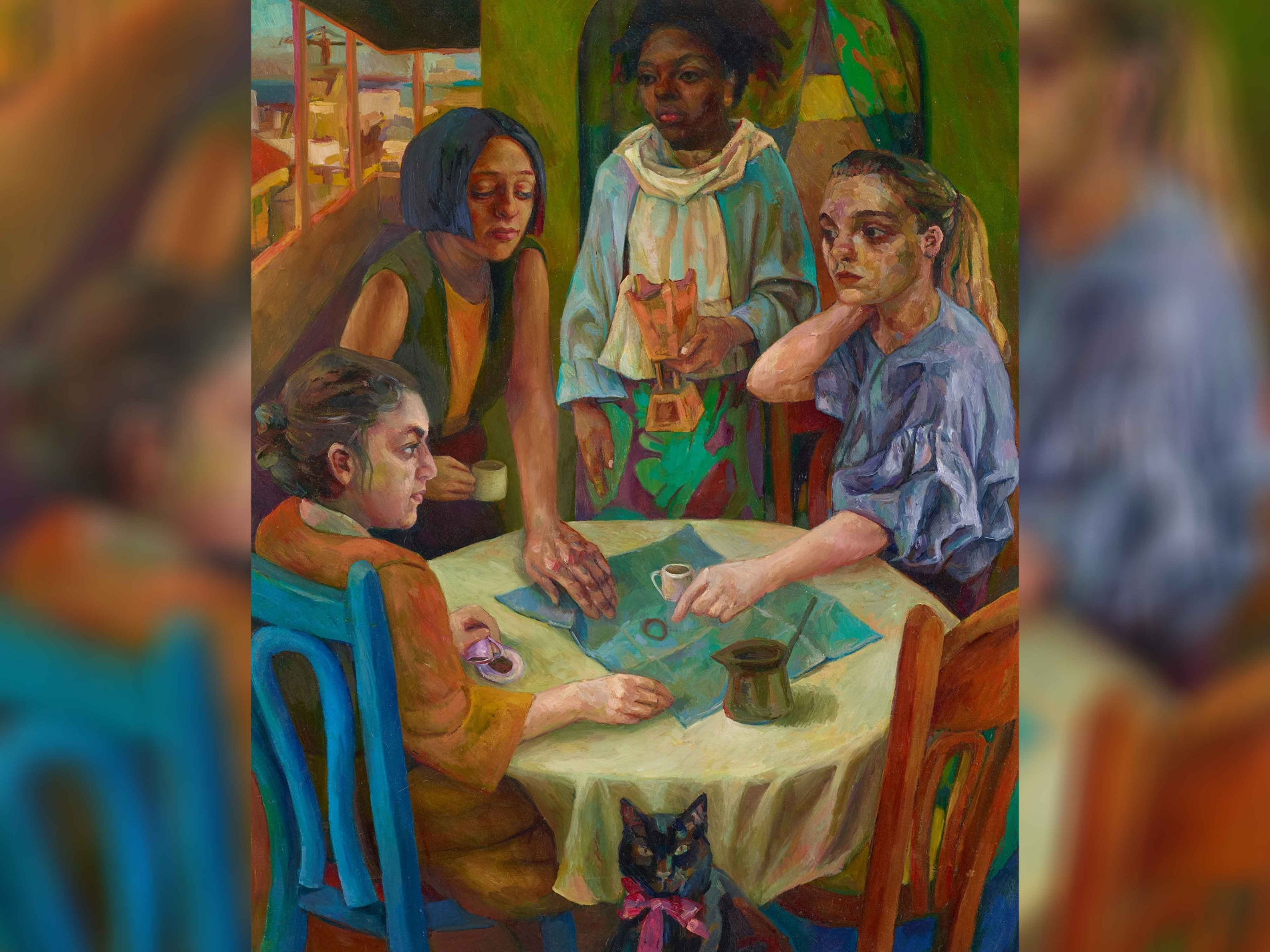
Among the most compelling examples is Secondary Keys, a painting rich in suggestive details: a coffee cup overturned on its saucer, as in the ritual of reading coffee grounds; a map spread across the table; a cat sitting beside the women, staring directly into the viewer's eyes, almost in protest against the intrusion of an inquisitive gaze into the scene.

An empty incense burner, carried by a woman who seems to have arrived from another world, adds to the mystery. She seems to come from a world distinct from the three women seated around the table, absorbed in solving a mystery or deciphering the geographical map before them. Behind them, a window overlooks a city that seems, in some way, connected to their search.
Ambiguity permeates Nysten's paintings, blurring the boundaries between interior and exterior, past and present, revealed and concealed

This elusiveness is one of the defining qualities of Nysten's artistic vision. She gives us too little information to establish who these people are or what has happened to them, yet enough to suggest the presence of something that remains tantalisingly beyond our grasp. The atmosphere evokes the Möbius strip, named after the German mathematician August Ferdinand Möbius, with its single surface and single edge. In it, the familiar distinction between inside and outside dissolves as the two converge along a continuous path.

That same ambiguity permeates Nysten's paintings, blurring the boundaries between interior and exterior, past and present, what has been revealed and what remains concealed.

The moment as it slips away

The longer one contemplates these works, the more their figures seem to search for a place in what is yet to come, a direction to guide them, perhaps even somewhere to belong in a world whose defining characteristic is instability. They also seem intent on recovering what has already passed. The past remains present, though only in the very process of slipping away. Each painting becomes a disquieting, enduring confrontation with a time that will never quite reach completion.

Saleh Barakat Gallery
A work by the Finnish-Lebanese artist Yasmina Nysten

The faces, too, resist easy interpretation. Brushstrokes obscure some; others emerge through faint traces, while still others confront us in bold, vivid colours. Elsewhere, faces acquire a gentler warmth, approaching the romantic. Their elusiveness is deliberate: just as we imagine we have grasped a face, it changes before our eyes. 

Turquoise occupies a central place throughout the exhibition, as it does in Nysten's earlier paintings. The colour holds life open to many possibilities. It leaves what we see open to interpretation, allowing widely divergent meanings to coexist, intermingle, and drift apart. Turquoise thus emerges as the true guardian of all that has yet to come into being.

This quality makes most works feel closer to evoking a fleeting moment or passing thought than to a commemorative image. What we see may elude us the instant we attempt to name or classify it, to decide whether it belongs among life's happier moments or those that will acquire a painful significance in retrospect.

One particularly revealing example is a painting of a bride and groom on their wedding day. This scene initially seems destined to become a cherished memento of a joyous occasion. Yet beneath the apparent celebration lies a record of a haunting estrangement, devoid of the sweet nectar memory might otherwise feed on. The image records a moment that ought to become a beautiful recollection, while also carrying the possibility that the moment itself will slip away and its meaning fade.

What almost went unsaid

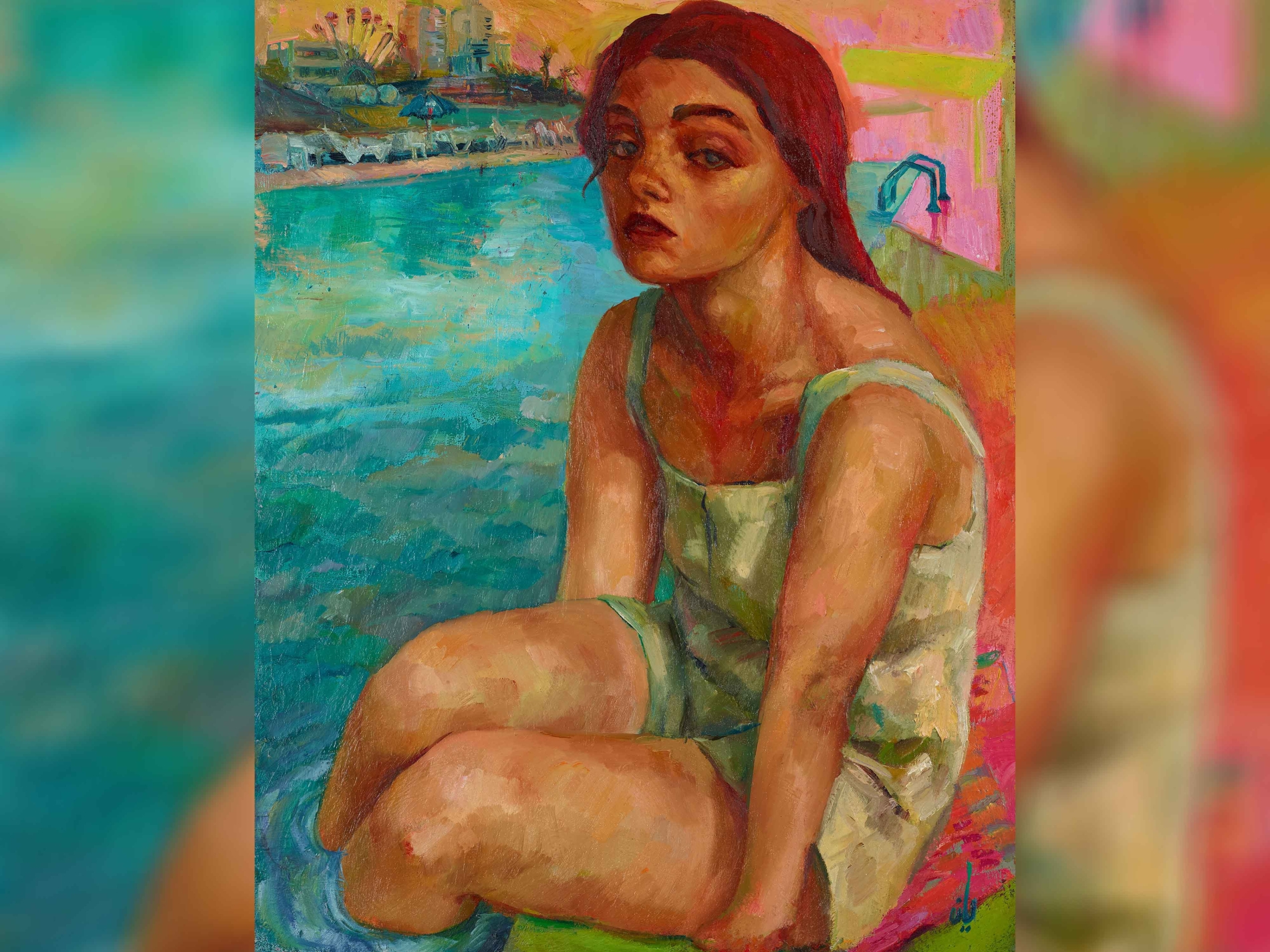
Among Nysten's works, the curator of Memory Keepers has chosen a painting that seems particularly closely attuned to the exhibition's central concerns and deserves careful contemplation. It depicts a girl, appearing to be in her teens, sitting huddled on the edge of a swimming pool, her legs dipping into the water. Her posture conveys no pleasure; instead, it suggests she is acutely cold. She looks toward us with an impatience she doesn't try to hide, anxious for a photograph, presumably taken by a friend or relative, to be over.

Saleh Barakat Gallery
Yasmina Nysten

At that instant, the photographer intrudes on the girl's inner world, and the image captures the telling details of her expression and posture. "Have you finished taking the picture so I can get out of this cold water?" This is most likely what she is saying to herself, her body struggling to endure a moment without quite understanding why it has found itself there.

The painting's close connection to the idea of Memory Keepers lies in its apparent depiction of a passing moment that might one day become a personal recollection. Yet Nysten leaves us without a fully realised moment we can readily preserve. The girl appears neither at ease with the experience nor able to enjoy it. Alongside her physical presence, the image captures a fleeting sense of discomfort, anticipation, and estrangement from the very moment she inhabits. Memory here is tied as much to the feelings that linger after an event has passed as to the event itself.

This striking painting captures the psychological tension characteristic of American artist Alex Gross, whose depictions of ordinary situations carry an emotional charge that extends far beyond their outward appearance. It also recalls the atmosphere of David Hockney's swimming pool paintings, particularly their sense of isolation and the stillness that pervades a psyche so accustomed to boredom that it has become indistinguishable from it.

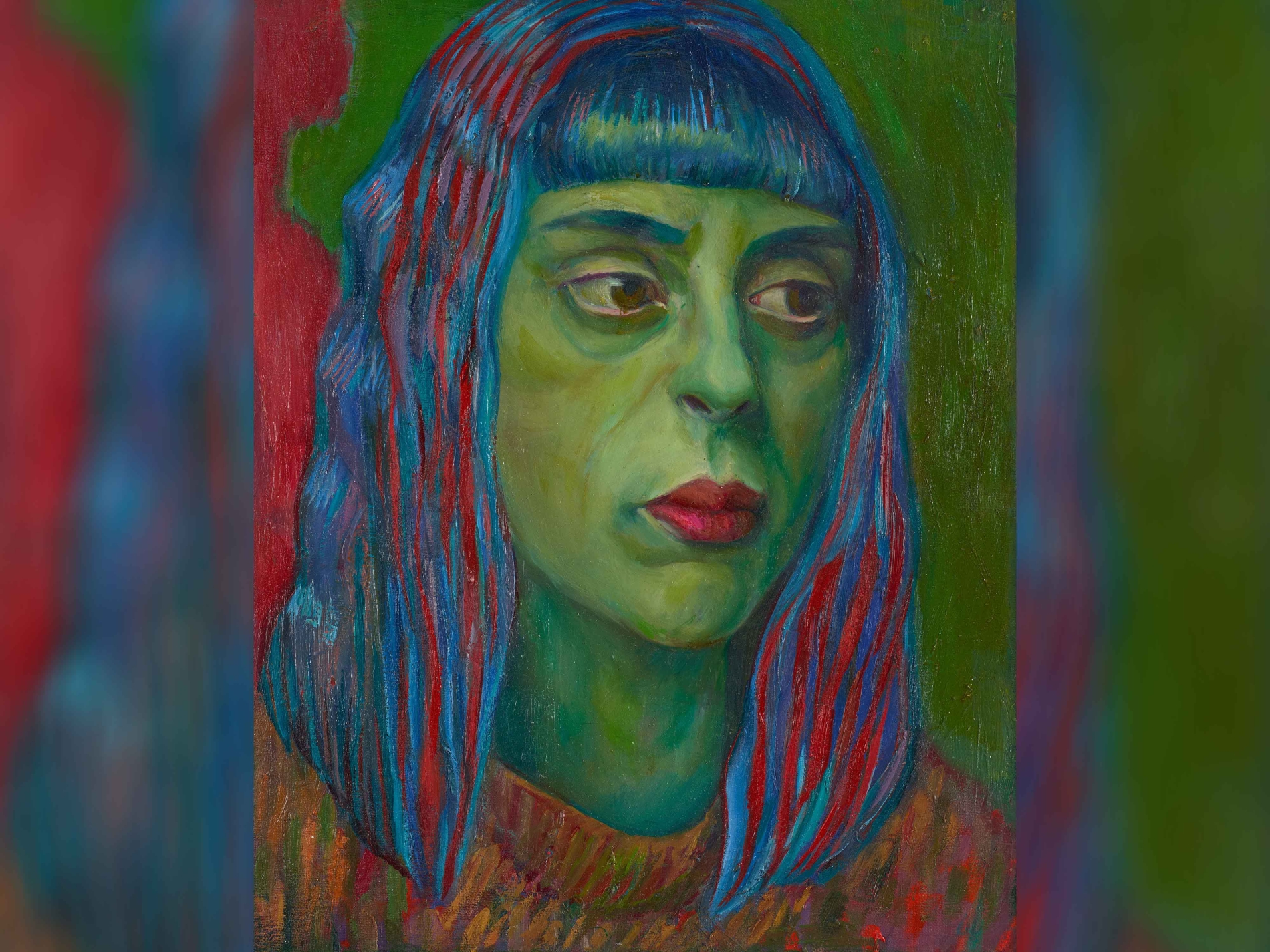
In another painting, a girl looks directly at the viewer, though her gaze is vacant in a different way. While the girl by the pool is alert, as though waiting for something or silently asking a question, this second figure is physically present yet somehow absent from herself. Her gaze expects nothing from whoever stands before her. The distinction between these two gazes is significant, revealing how almost identical gestures or postures can express profoundly different inner states.

Ultimately, the strength of Nysten's work lies in its ability to keep images suspended on the threshold between reality and imagination, life and death, what we know and what remains beyond our understanding. The paintings leave the past in flux, resisting confinement within a fixed, immutable truth. The works in Memory Keepers thus seem less concerned with safeguarding the past than they initially appear, and more preoccupied with that fragile something poised on the threshold of becoming the past, or already slipping beyond the possibility of remaining present.

font change