Data centres: from engines for AI growth to electoral issuehttps://en.majalla.com/node/333621/science-technology/data-centres-engines-ai-growth-electoral-issue
Until recently, data centres in the US were widely seen as lucrative investments and a way to attract technology companies. The artificial intelligence boom has rapidly transformed the industry’s scale. Projects have multiplied, electricity consumption and demand for other resources have risen, and their effects on local communities have become increasingly visible. This expansion has turned data centres from an economic success story into a growing source of political controversy. Residents in several states are objecting to their impact on electricity prices, water supplies, and land use.
More significantly, the issue no longer falls neatly along party lines. Opposition to data centres now comes from Democrats and Republicans alike, though their motivations differ. With the midterm elections approaching, these facilities have emerged as an electoral issue in a number of states. At the same time, President Donald Trump’s administration remains committed to expanding them as a central element of the US’s artificial intelligence strategy.
Data centres house the servers, chips, and storage systems that underpin much of the digital economy. Cloud computing services, search engines, and social media platforms all depend on them. They have also become essential infrastructure for training and operating artificial intelligence models.
The figures illustrate the scale of the US’s lead in the industry. According to the Stanford AI Index, the US had around 5,427 data centres in 2025, compared with 529 in Germany and just 449 in China. This network includes around 580 hyper-scale data centres operated by the largest cloud computing companies, with hundreds of new projects planned in the coming years.
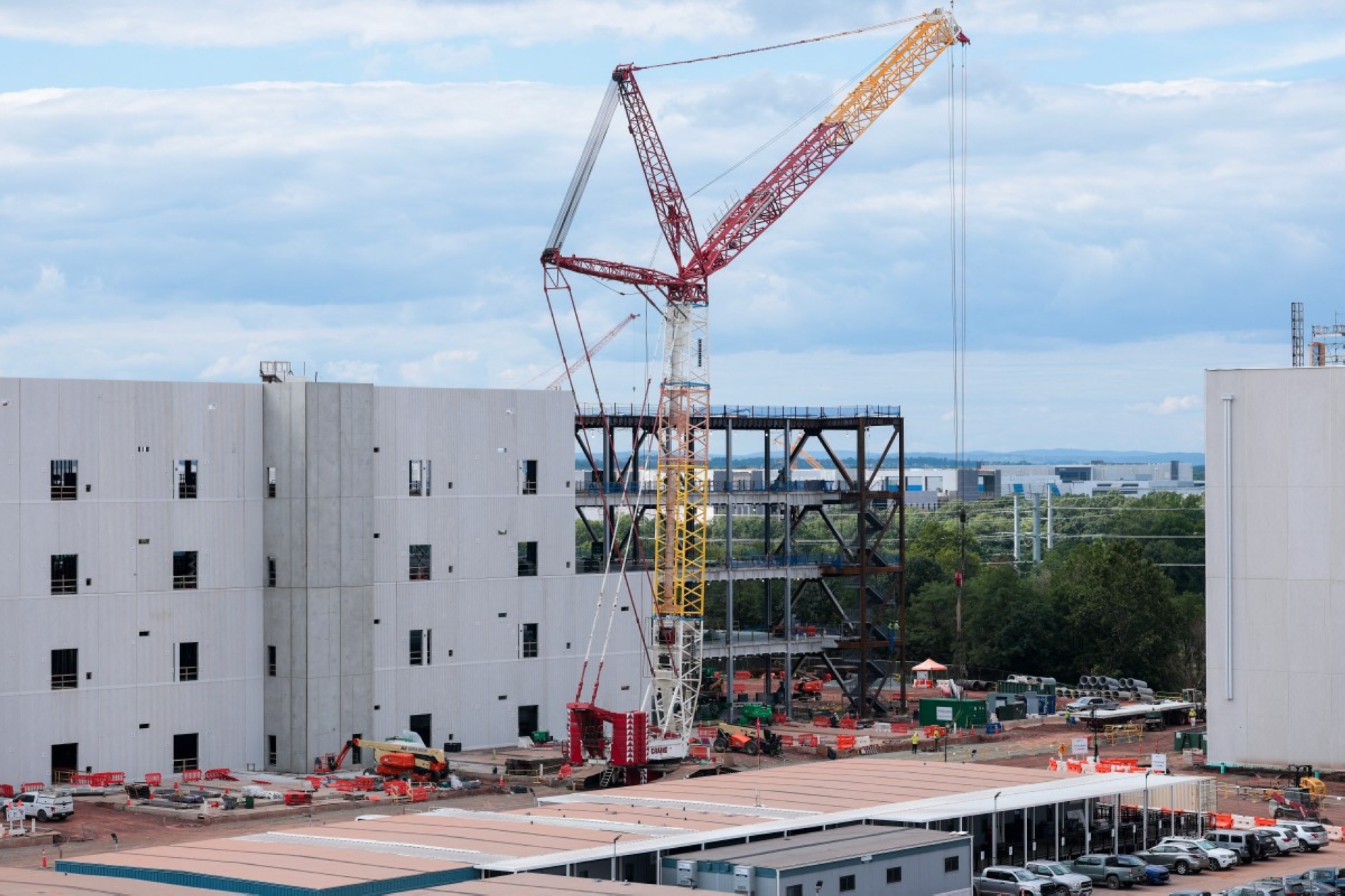
Construction on a new data center from technology and engineering company McDean on 25 August 2026 in Ashburn, Virginia.
The US also commands the largest share of global hyper-scale capacity. It accounts for around 55% of worldwide operational hyper-scale data centre capacity, up from 52% three years earlier. Fourteen American locations are among the world’s 20 largest hyper-scale data centre clusters.
The pace of expansion is equally evident within the US market. Operational capacity across the largest data centre markets exceeded 9.4 gigawatts by the end of 2025. Projects under construction in these markets then reached a record of around 7.5 gigawatts during the first half of 2026. More than 80% of this new capacity had already been pre-leased before completion.
Northern Virginia remains the heart of the industry. Its operational capacity reached around 4.5 gigawatts by mid-2026, more than twice that of Atlanta, its nearest rival. The region benefits from an extensive fibre-optic network, proximity to Washington, and access to major cloud service users.
As data centres grow more important to the artificial intelligence race, attention is turning to the cost of their expansion and who ultimately bears it
The industry's map is beginning to change. Atlanta, Dallas, and Phoenix have emerged as major centres of growth, while new investment is moving towards Texas and the Midwest in search of land and electricity. At the end of 2025, Texas and the Midwest accounted for 33% of US hyper-scale data centre capacity. They represent 53% of the new capacity planned for the years ahead.
This boom has made data centres one of the fastest-growing infrastructure sectors in the US. In 2023, data centres consumed around 4.4% of total US electricity. That share could rise to between 6.7 and 12% by 2028. Their expansion is increasingly raising questions about electricity, land, and local resources.
The political consequences are becoming equally apparent. As data centres grow more important to the artificial intelligence race, attention is turning to the cost of their expansion and who ultimately bears it. The debate is moving beyond investment volumes and the US's ability to compete with China. It is increasingly framed in terms that speak directly to voters: will electricity bills rise? Can power grids absorb the additional demand? Do local communities genuinely benefit from these projects?
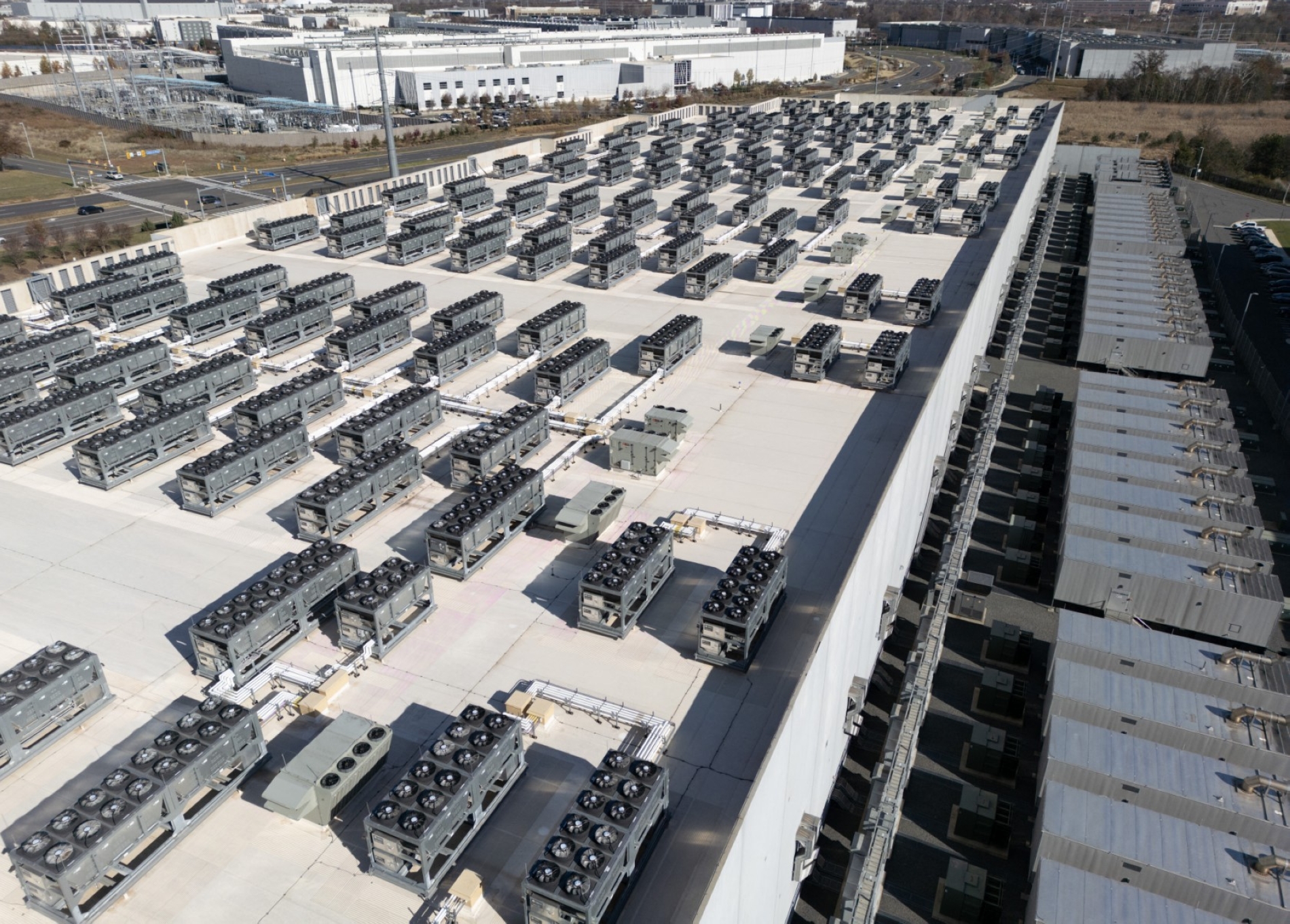
An aerial view shows cooling fans on the roof and generators on the lower level of a Digital Realty data centre in Ashburn, Virginia, on 12 November 2025
Growing backlash
For years, local politicians found it easy to defend data centres. They brought billions of dollars in investment, increased tax revenues, and created construction jobs. The artificial intelligence boom has altered that calculation. Projects have grown larger, electricity demand has risen sharply, and residents are asking a more pointed question: who pays for this expansion?
Electricity lies at the heart of the dispute. Data centres require enormous amounts of power to run servers, chips and cooling systems around the clock. When dozens of projects are built in a single area, the issue extends well beyond the facilities' own consumption. New generating plants, transmission lines, and substations may also be required to supply the electricity they need.
Concerns about higher prices are increasingly supported by the evidence. A 2026 study by the Massachusetts Institute of Technology found that the arrival of data centres in electricity utility service areas between 2010 and 2024 was associated with an average increase of around 2.7% in electricity prices. For residential consumers, the increase was around 2.1%.
The problem is especially visible in Virginia, home to the largest concentration of data centres in the US. As demand has surged, the cost of securing additional power capacity has risen sharply. The price paid by the regional electricity grid to ensure sufficient supply during periods of peak demand climbed from around $29 per megawatt-day in the 2024-2025 season to around $329 in 2026-2027. The market monitor has identified growth in data centre demand as the principal driver of the increase.
Data centres are one of several factors contributing to higher electricity bills. Fuel costs, grid investment, and the retirement of some generating plants also influence prices. The difficulty is that data centres add enormous demand at a time when power stations and transmission lines can take years to build. The political question has therefore widened from how much electricity these facilities consume to who should pay for the new infrastructure required to serve them.
Water has also become part of the controversy. Some data centres use water directly for cooling. They also consume substantial water indirectly through the power plants that generate the electricity on which they depend. A report by Ceres, a US non-profit organisation focused on sustainability, water, and climate issues, found that, in many cases, a substantial share of the water footprint associated with data centres stems from electricity generation.
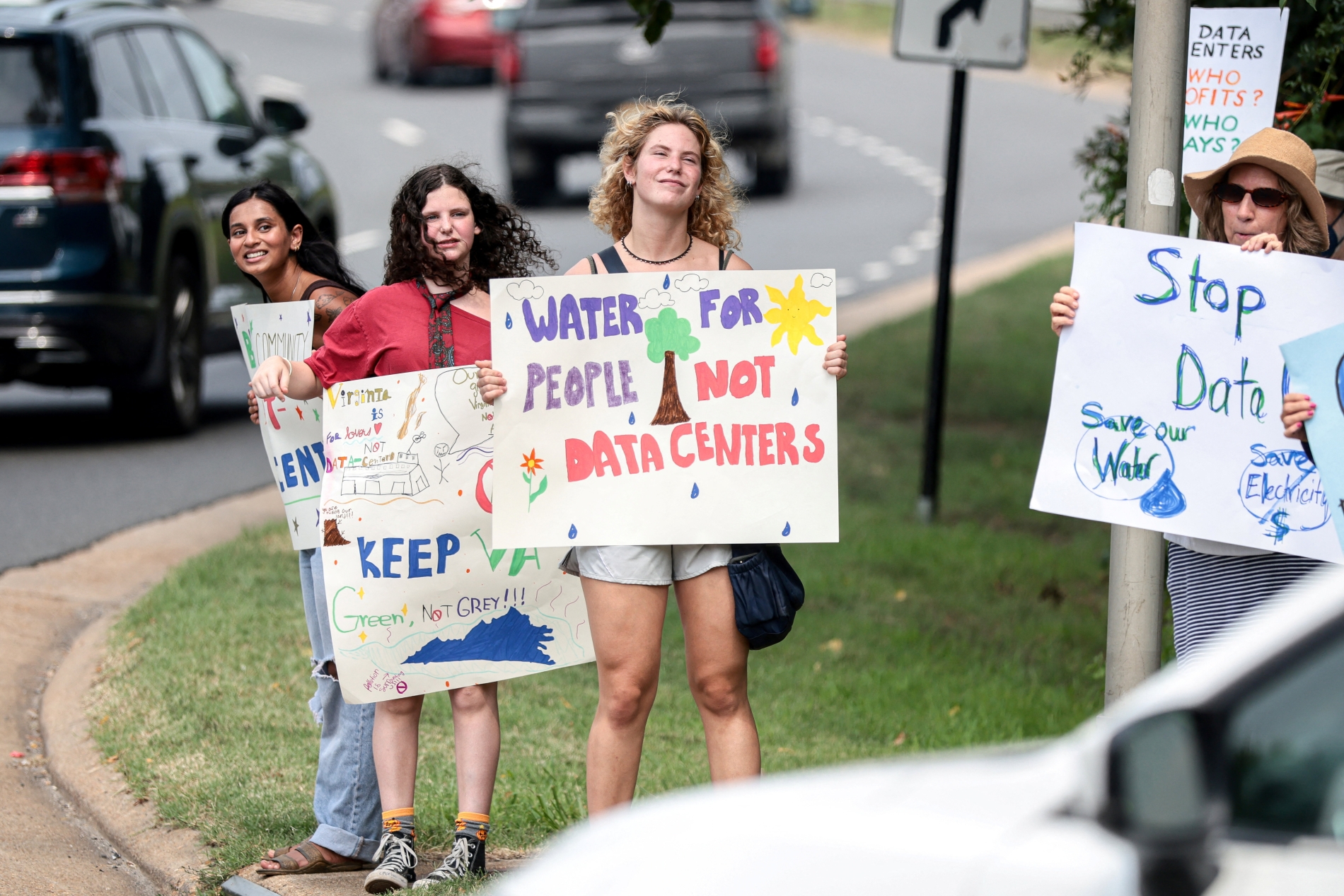
Demonstrators take part in a nationwide protest against data centres in Fredericksburg, Virginia, on 18 July 2026
Their impact on water prices is less clear than their impact on electricity. So far, there is no evidence that data centres are broadly driving up water prices across the US. The issue is more acute in places already facing pressure on water resources, where a large new project becomes another competitor for a scarce supply.
These developments have changed the local mood. A project once presented as an economic opportunity is now seen in some communities as a competitor for electricity, water, and land. The political left tends to focus more heavily on environmental concerns and criticism of large technology companies. Parts of the local right focus on land use, electricity costs, and the effect of major developments on rural communities.
Widening gulf
The Trump administration sees the issue through a different lens. It regards data centres as essential to the US's AI competition with China. In July last year, Trump issued an executive order intended to accelerate their construction. The measures included faster federal permitting, access to government land for some projects, streamlined environmental reviews, and support for building related electricity infrastructure. They also apply to large projects requiring more than 100 megawatts of new load.
The administration's position became even clearer in comments made by Commerce Secretary Howard Lutnick in September. Asked about criticism of data centres' water use, he said the facilities "do not use water", and described claims about their consumption as "propaganda from our adversaries trying to slow us down".
The remark captures the gulf between competing views of the issue. From the administration's perspective, slowing data centre construction risks slowing the US's progress in the AI race. For many residents, the matter is far more immediate: electricity bills, water, land, and infrastructure costs they may ultimately shoulder.
Data centres have therefore become as much a political issue as an economic and technological one. The more important they become to Washington, the greater the pressure on local politicians facing voters increasingly worried about their cost. With the midterm elections approaching, the tension is moving from local council meetings into election campaigns themselves.
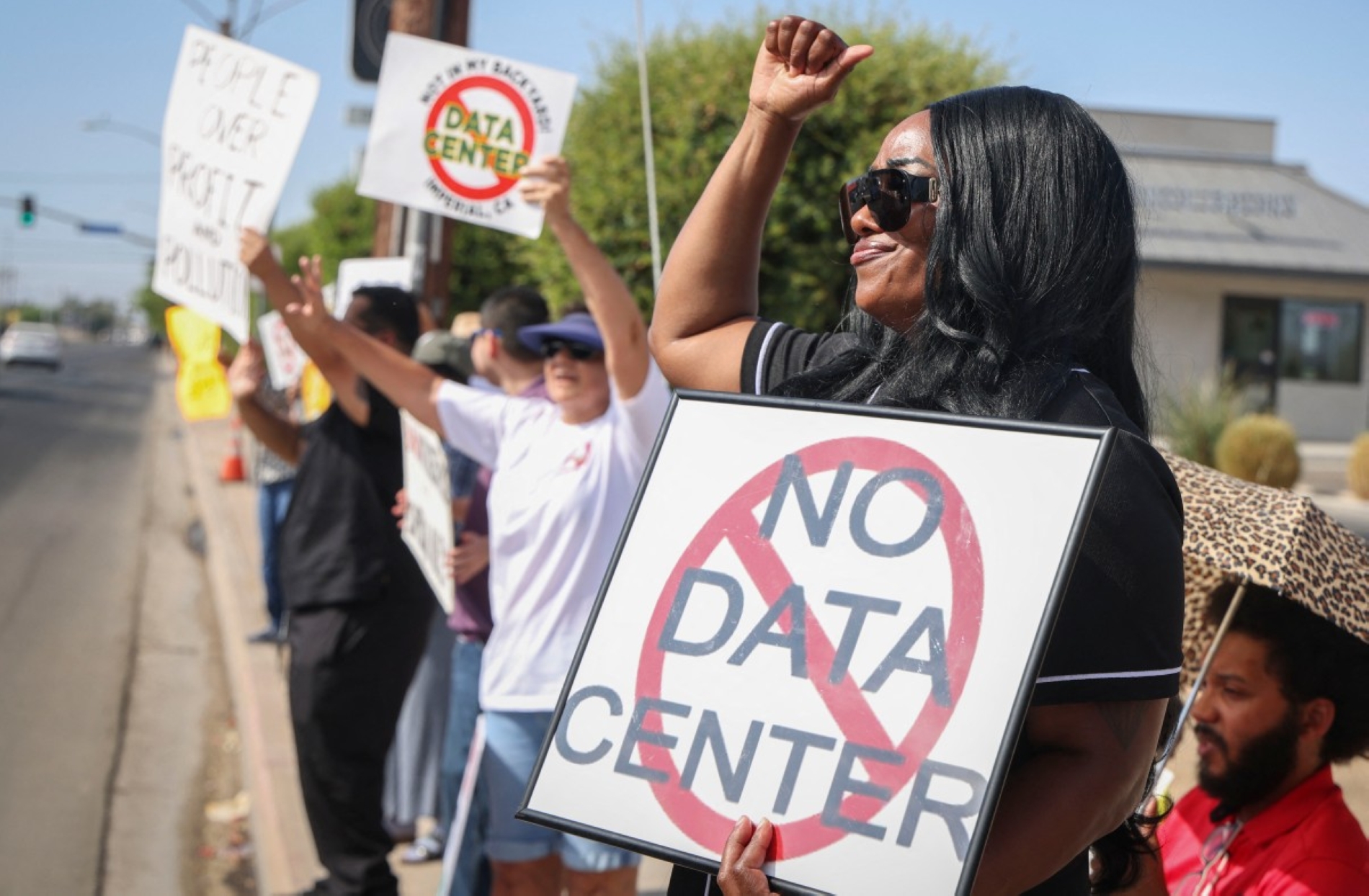
Demonstrators wave signs during a nationwide protest against AI data centre expansion in Imperial, California, on 18 July 2026.
Campaign issue
Opposition to data centres is no longer confined to council meetings and local protests. This year, the issue has moved directly into election campaigns, particularly in states such as Ohio, Texas, Michigan, Wisconsin, and Pennsylvania. It is now tied to concerns that voters feel more acutely than artificial intelligence itself, including electricity bills, the cost of living, and land use.
For Democrats, the political calculation is relatively straightforward. Candidates can criticise large technology companies or demand that they shoulder the cost of electricity infrastructure without placing themselves in direct conflict with their party leadership. Republican candidates face a more complicated dilemma. The Trump administration strongly supports expansion, and openly opposing that policy may make them appear at odds with the president. At the same time, they cannot ignore voters who oppose a project in their community or fear higher electricity bills.
The tension has reached the Republican Party's national campaign apparatus. In August, the National Republican Senatorial Committee warned AI companies that the issue could become an electoral liability, particularly in Ohio. Data centres have thus become a genuine political test. Washington wants more of them and wants them built faster. And as the midterm elections approach, the gap between national ambition and local cost is becoming part of the electoral contest itself.