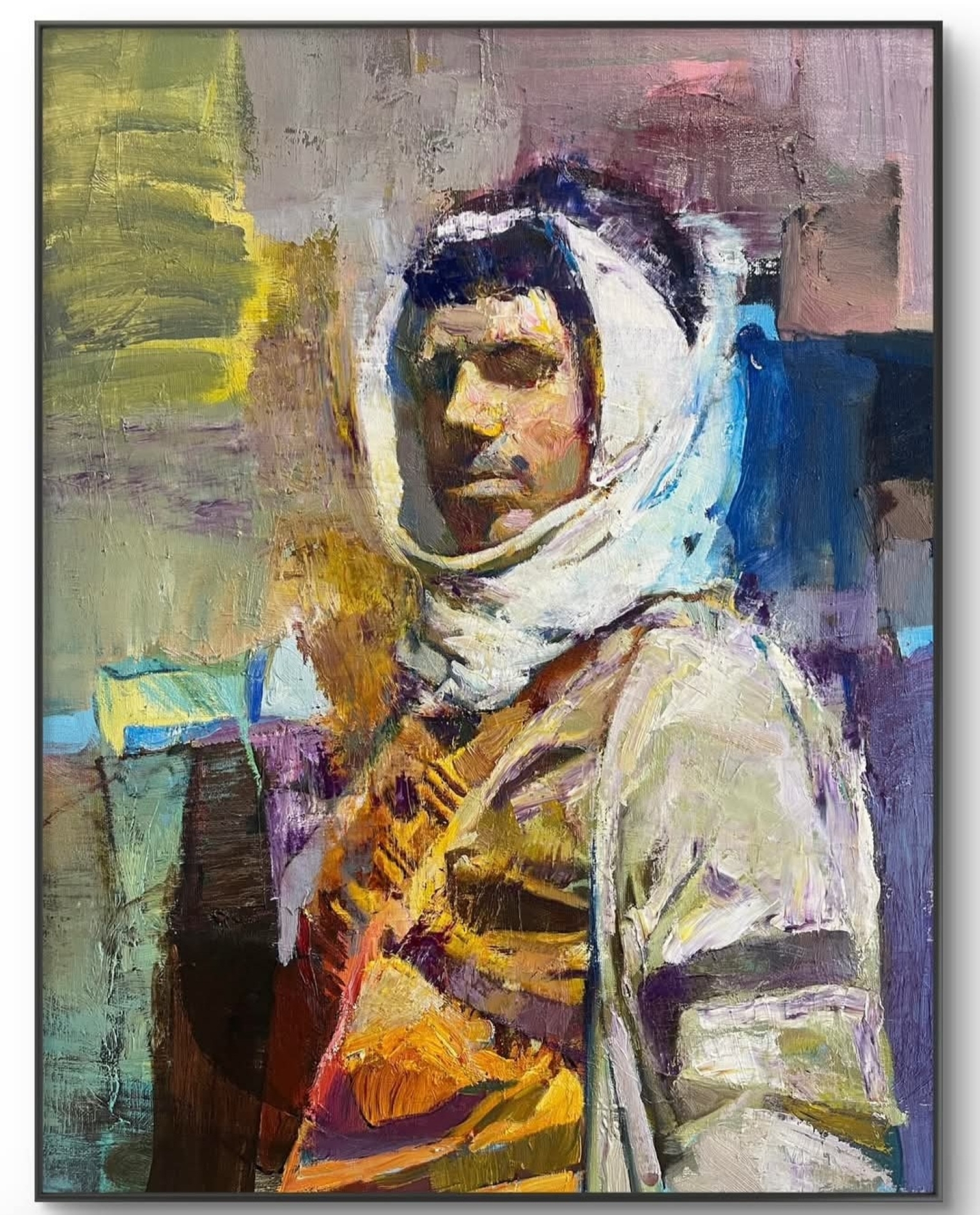
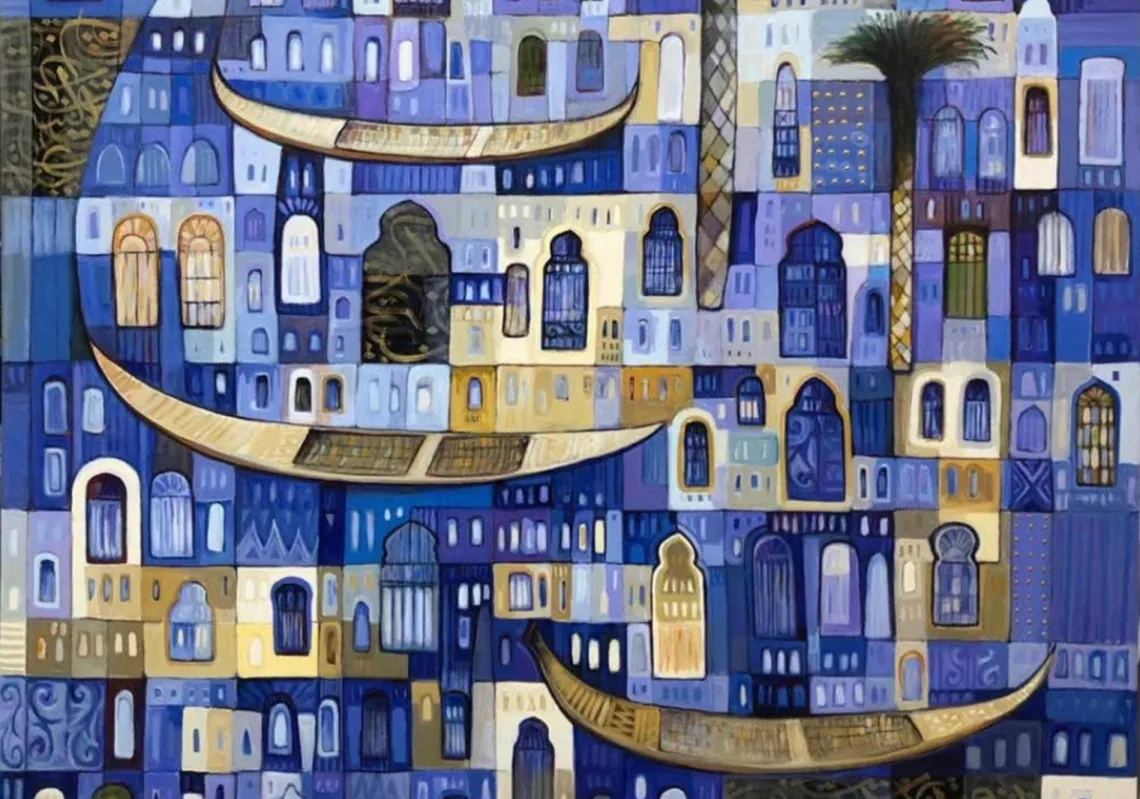
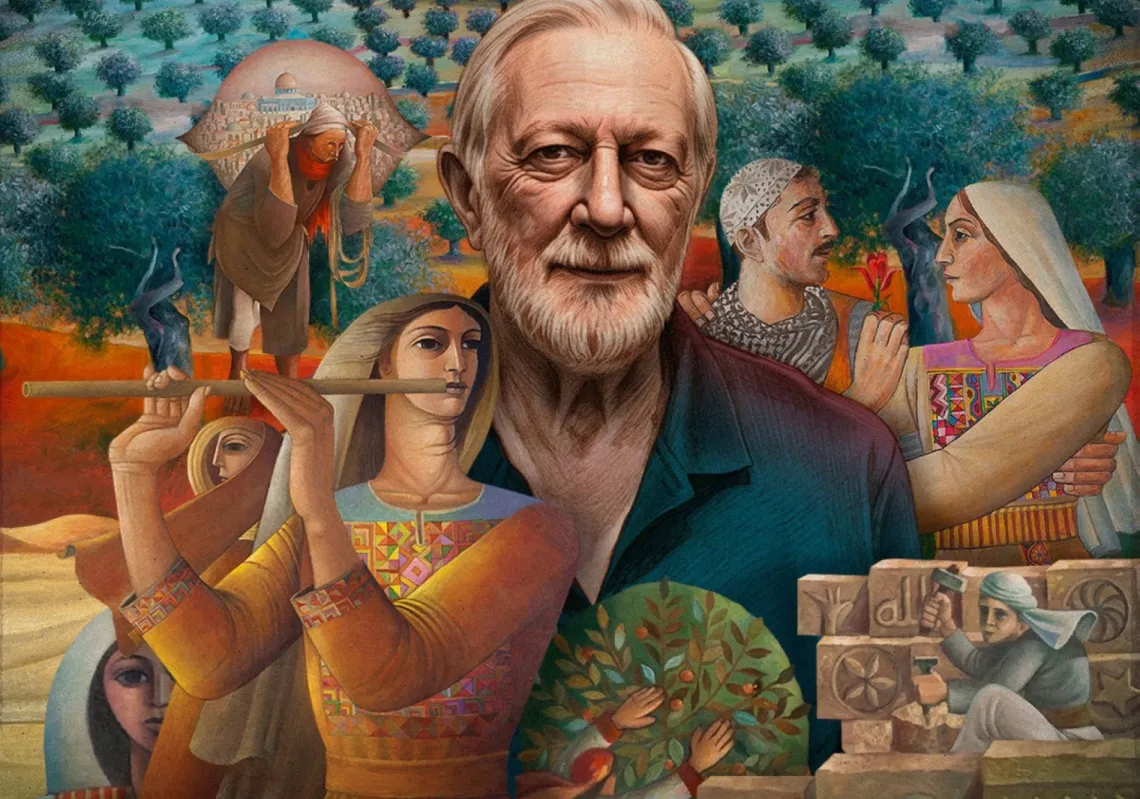
The paintings of Falah Al-Saidi begin with a recognisable Iraqi world: Bedouins, women, ordinary figures, horses, and birds. Yet these subjects never remain in their initial, realistic state. A considerable distance emerges between the figures and their origins, shaped by memory, the force of colour, and the artist’s distinctive approach to constructing form.
Meanings multiply and rise to a higher register of expression, where the interrogation of the visual field becomes a continuous pursuit that moves towards a single meaning without ever settling upon it.
The central question his work raises is what happens to reality when it passes through the memory of an artist who left Iraq in 2004 and moved to the US in 2013. Memory, in this context, becomes a space where images are reshaped while retaining their emotional weight.
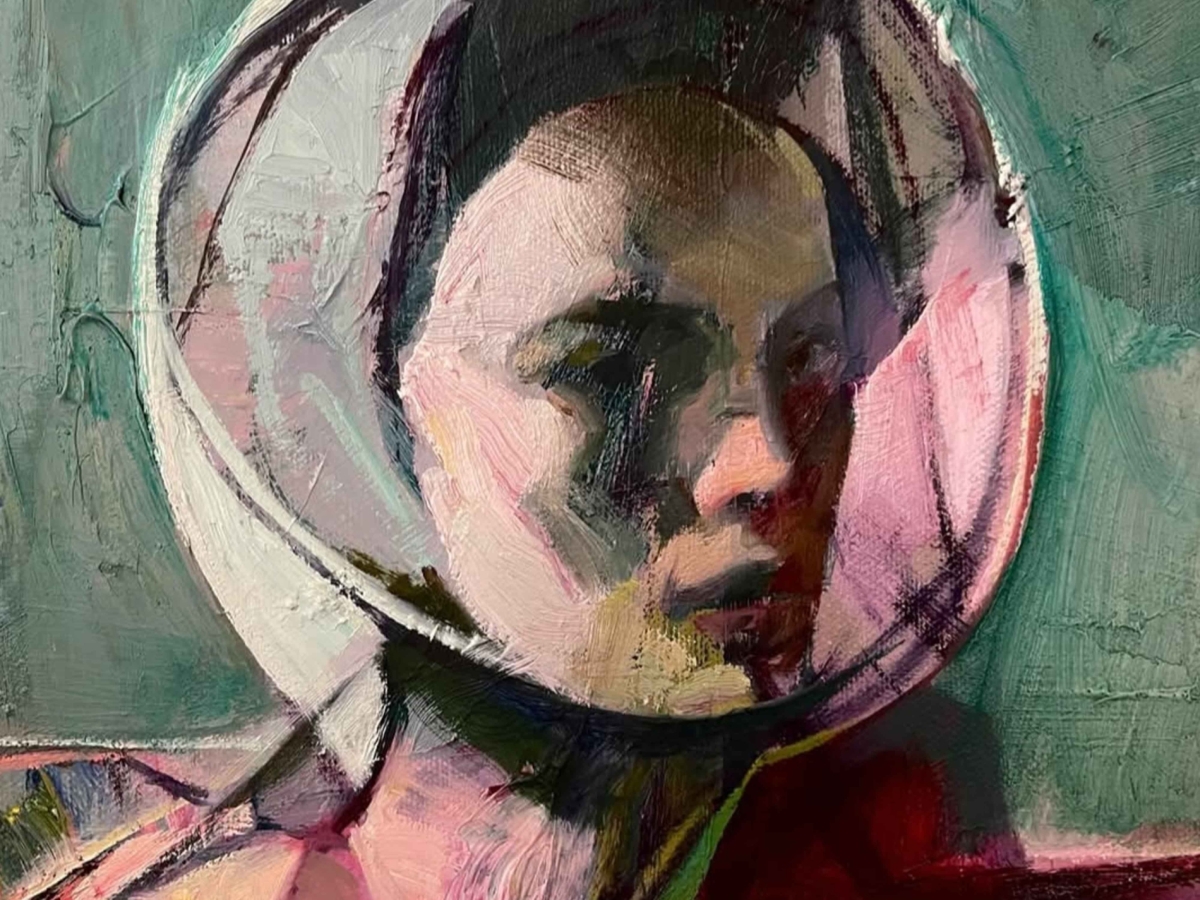
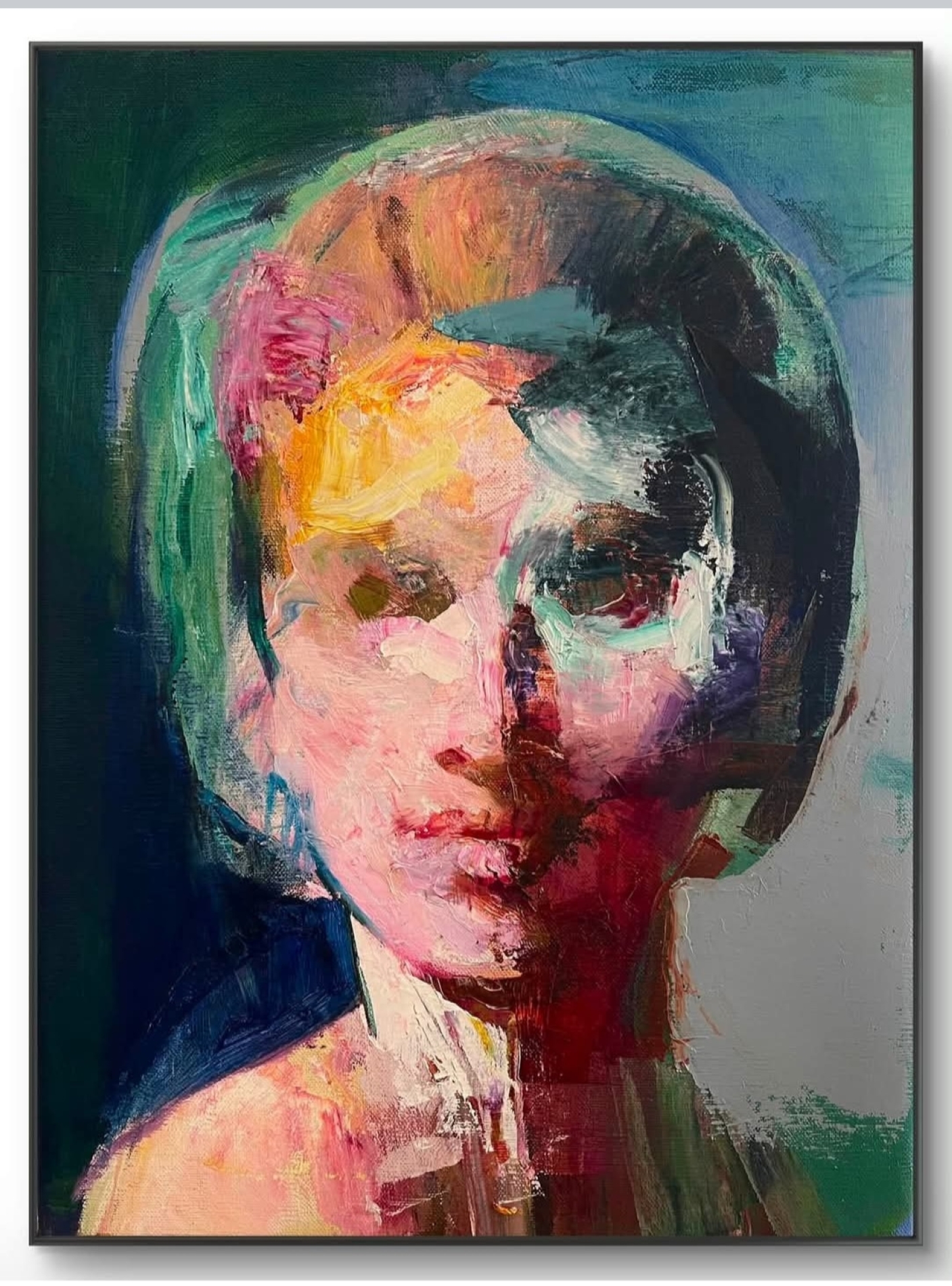
Seen through this lens, the figures encircled by what Al-Saidi calls the ‘frame’ assume particular significance. He regards the frame as an expression of the intellectual confinement experienced by certain social groups, or by individuals who may have no connection with one another. Yet the form itself resists such a straightforward reading.
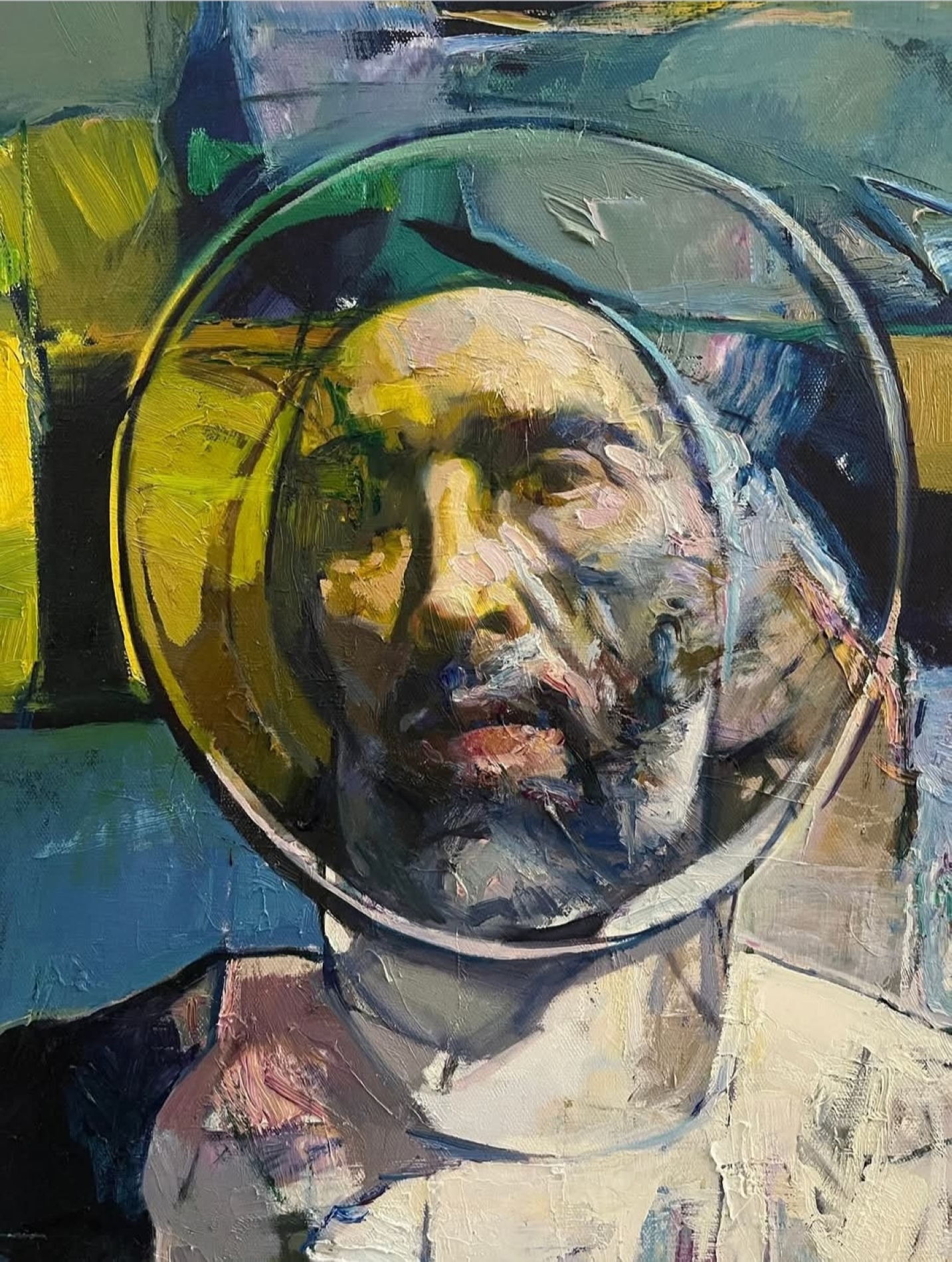
At times it appears as a closed circle, at others as a shape that is only partially enclosed, or even as a firm cushion supporting the head. In many paintings, these forms open outwards and project far enough to reveal the face and its expressions. Even so, the visual impression they leave goes beyond the term ‘frame’. Their contours can evoke the transparent helmet worn by an astronaut.
From the works of Falah Al-Saidi
At that moment, the viewer's perception shifts. A helmet protects its wearer, allowing them to exist in an environment where survival would be impossible without the oxygen it provides, while still allowing the gaze to travel freely into the surrounding distance. It is a transparent barrier that separates without obscuring, protecting without cutting off the possibility of contact.
The 'confinement' described by the artist therefore becomes more ambiguous once these heads are read as enclosed by space helmets. Is the figure imprisoned within its own ideas, or sufficiently protected to look outward without being exposed to danger? Does what surrounds the head prevent the world from reaching it, or give the wearer greater confidence in facing it?
The question grows more intricate when we encounter faces rendered with delicate precision, noble in bearing and arresting in their dramatic gaze, as though they know troubling truths about a harsh reality they have accepted without surrendering to it. At such moments, it becomes difficult to regard Al-Saidi's figures as intellectually closed. Instead, they seem to open onto worlds concealed within them, while remaining in contact with an outer world that leaves sight intact yet awakens insight.
The 'helmet' also does not resemble a glass sphere placed over the head from the outside. The neck appears to extend naturally from its structure, just as that structure extends into the body as a whole. The head is not trapped within an alien object. It inhabits a space that has become part of it. The helmet may therefore shift from a sign of enclosure into an interior realm, a small laboratory within the human figure, where colours embody thought and changing emotion, and where decisive positions take shape.
Falah Al-Saidi's works show what happens to reality when it passes through the memory of an artist who left Iraq in 2004 and moved to the US in 2013
The existential journey
The phrase 'astronauts of the inner world', which might be applied to these figures, amounts to more than a poetic metaphor. They are neither suspended nor drifting in a charged emptiness. They inhabit that space fully, making it the terrain of their existential experience.
This quality is among the most distinctive elements Al-Saidi has introduced into his visual universe, and it may be a motif he continues to develop and transform in future work. Yet the helmet is not the only element in his paintings that calls glass to mind.
Across a broader range of earlier and more recent works, one senses that Al-Saidi, who was born in Babil, Iraq, in 1976, uses glass as a visual principle rather than as a tangible material. His figures appear translucent even when they take on metallic colours. A rich spectrum moves through them, giving them the appearance of intersecting glass edges or damp walls whose surfaces retain a faint glimmer of light.
From the works of Falah Al-Saidi
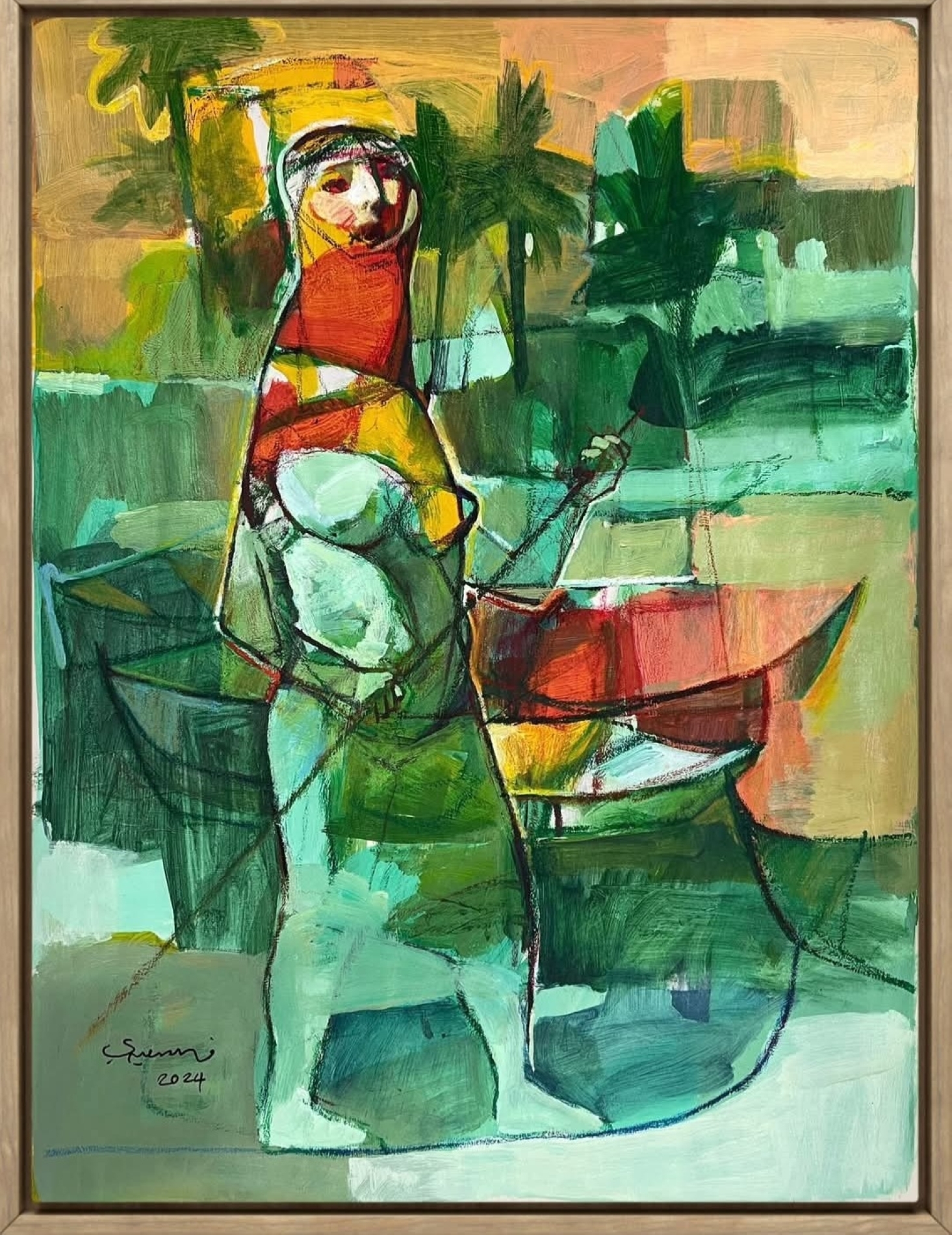
A number of paintings reveal more precisely how glass operates within his visual language. Among them is a series entitled Women of the Marshes. Some of the women resemble tall vessels filled with liquid light drawn from the colours of the earth. The tones of soil, trees in many shades of green, rushing rivers and the late-afternoon sun of a warm summer day all enter these works. Their bodies appear to be made of transparent or semi-transparent water. The impression Al-Saidi creates in the viewer recurs often enough to become one of the defining principles of his visual world.
Alongside the gentle flow of water in the Women of the Marshes are other women of a different character, sharp as the edges of unpolished glass and yet endowed with a remarkable tenderness. It is as though the artist has repeatedly melted raw glass in his studio laboratory, preserving some of its jagged fragments before shaping them into figures that hold softness and severity within the same form.
Creatures in space
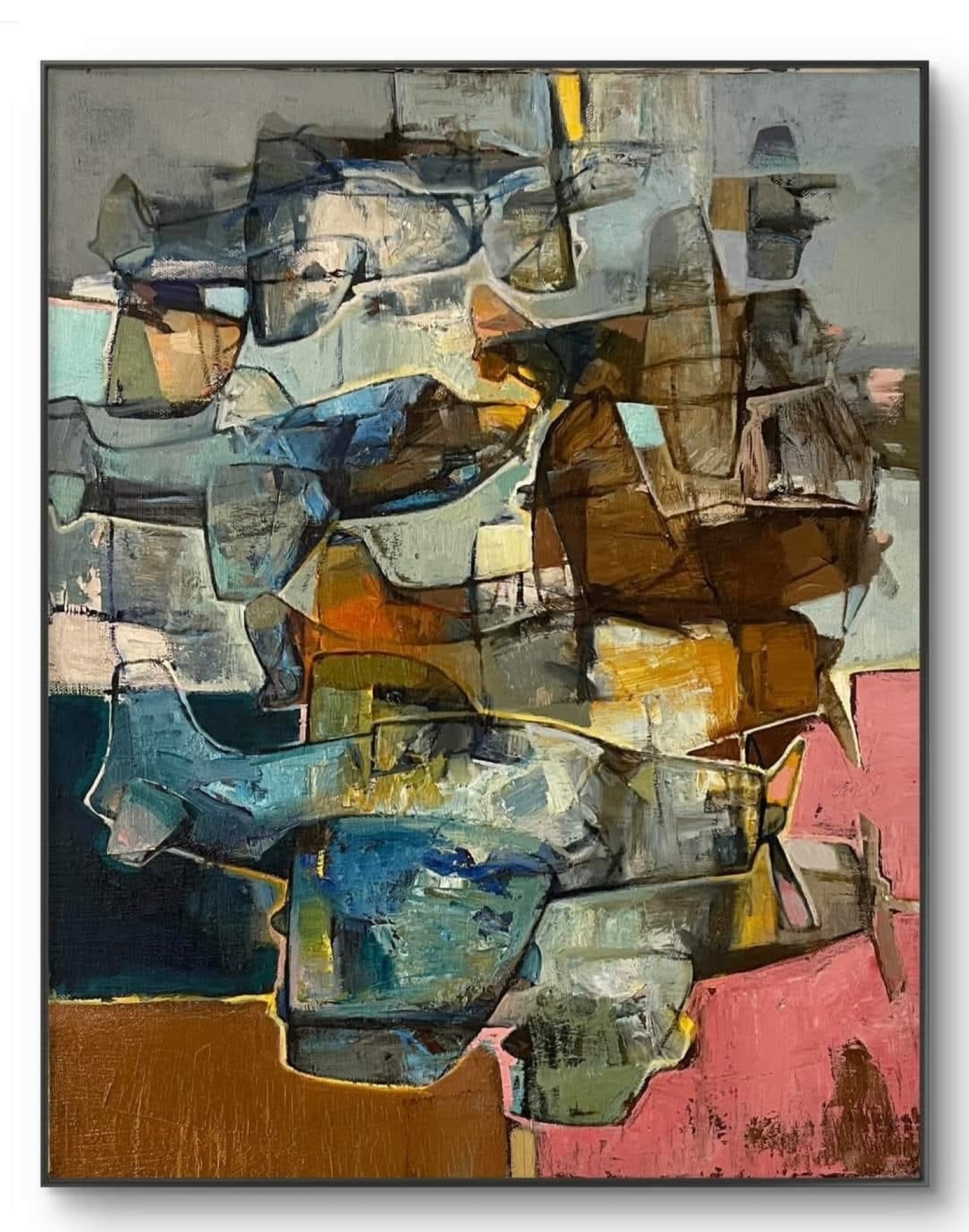
The interplay of softness and sharpness reappears in another group of paintings in which Al-Saidi depicts aircraft crowding the sky. He does not treat these planes as separate objects enclosed within fixed outlines and set against a space outside and distinct from them. They seem fashioned from the same ethereal substance as the atmosphere around them. Their swollen bodies resemble undulating horizontal balloons, lending them an almost animate presence. Even at the height of their convergence and entanglement, they never become images of violent collision or repulsion. No wreckage appears despite their contact, no scattering of fragments to tear them apart or disturb the surrounding space.
This ambiguity is reinforced by our inability to identify the aircraft themselves. Are they military or civilian? Do they carry people or cargo? In these paintings, forms reflect one another and appear within one another, not through copying or repetition, but through a process of extension. One surface flows into another. A single line continues across the canvas, gathering several others into a weave at once strong and delicate. One mass gives rise to another until the artist arrives at the final form he seeks: a world in which collision produces no debris, but instead creates a tension and fragmentation that remain balanced at the edge of danger.
From the works of Falah Al-Saidi
Earlier drawings, meticulously executed in black and white, reveal this ambiguity more clearly. Fine, interwoven lines run abundantly through the compositions. Some separate and break, while others give rise to forms within neighbouring forms, until certain elements resolve into recognisable shapes while others remain as slender, delicate traces. Some forms appear transparent, like overlapping layers of abstraction that coexist without cancelling one another out.
When this process carried over into Al-Saidi's coloured paintings, the paradox became more pronounced. Forms emerged through continuous relationships between lines and other shapes. Even a line that has not yet developed into a complete figure seems like a filament preserving an earlier stage in the formation of the figure.
Seen in this light, the many abstract works in Al-Saidi's career amount to more than independent compositions. They form the raw material from which the figures and elements of his other paintings have emerged. Abstraction in his artistic journey functions almost as a laboratory, a space in which his figures, aircraft, horses, and birds first took shape before assuming their recognisable, or deliberately ambiguous, forms elsewhere in his work.
From the works of Falah Al-Saidi
The force of abstraction remains embedded in his visual language even when he returns to forms whose identities can readily be recognised. In one painting, dominated by the pink light of the moments before sunset, two women ride bicycles while the ground beneath their wheels is unmistakably blue rather than earth-coloured.
That detail reveals much. The women, bicycles, and road remain identifiable, yet the ground has ceased to function as literal terrain. It has become sky. Time itself, embodied in the pink light before sunset, becomes almost a visual substance that turns the wheels. Even this warm, lyrical scene remains rooted in reality, while reshaping the relationship between its elements. We see more than a place. We see the place as memory might reconstruct it, or as it might become after passing through the artist's sensibility.
The trace of the horse
This brings us to the horses, among the most intriguing elements in Al-Saidi's visual vocabulary, especially when considered within the broader world of his imagery and recurring motifs.
The horses he paints do not always conform to the image established in the Arab visual imagination. Some evoke animals depicted on ancient walls, as though they belonged to a deeper stratum of Iraqi heritage. This is especially clear in a painting of a white horse, where the influence of Cubism is unmistakable even as the animal retains an echo of the Arab imaginary.
From the works of Falah Al-Saidi
Even here, the horse never fully separates from its background. Its form is distinct, yet it is not an object simply placed against a neutral field. Elements of the background seem to enter the horse, while aspects of the horse extend into the surrounding space. Once again, form never entirely detaches itself from the material from which it emerged.
This may offer one of the keys to understanding memory in Al-Saidi's work. Memory retrieves the object together with its layers, its earlier images, and the traces of times and experiences that have accumulated around it. A modern aircraft, a horse emerging from the depths of history, an Iraqi woman, a bird, and the figure enclosed by the 'frame' can therefore inhabit the same visual space. They are bound together less by subject than by the manner in which they are each transformed and reshaped.
Here lies one of the distinctive qualities of Al-Saidi's practice: his subjects retain within themselves the traces of transformation. Perhaps this is why his paintings remain remarkably coherent even at their most fractured. There are no shards, because whatever has broken never becomes fully detached. Whatever has moved away from its source remains connected to it through a line, a colour, a shadow, or one form extending from another.