Across Central and South America, a raft of right-wingers borrow from each other’s playbooks and ride on the US president's coattails to win elections and power. Is it ideology or practicality?
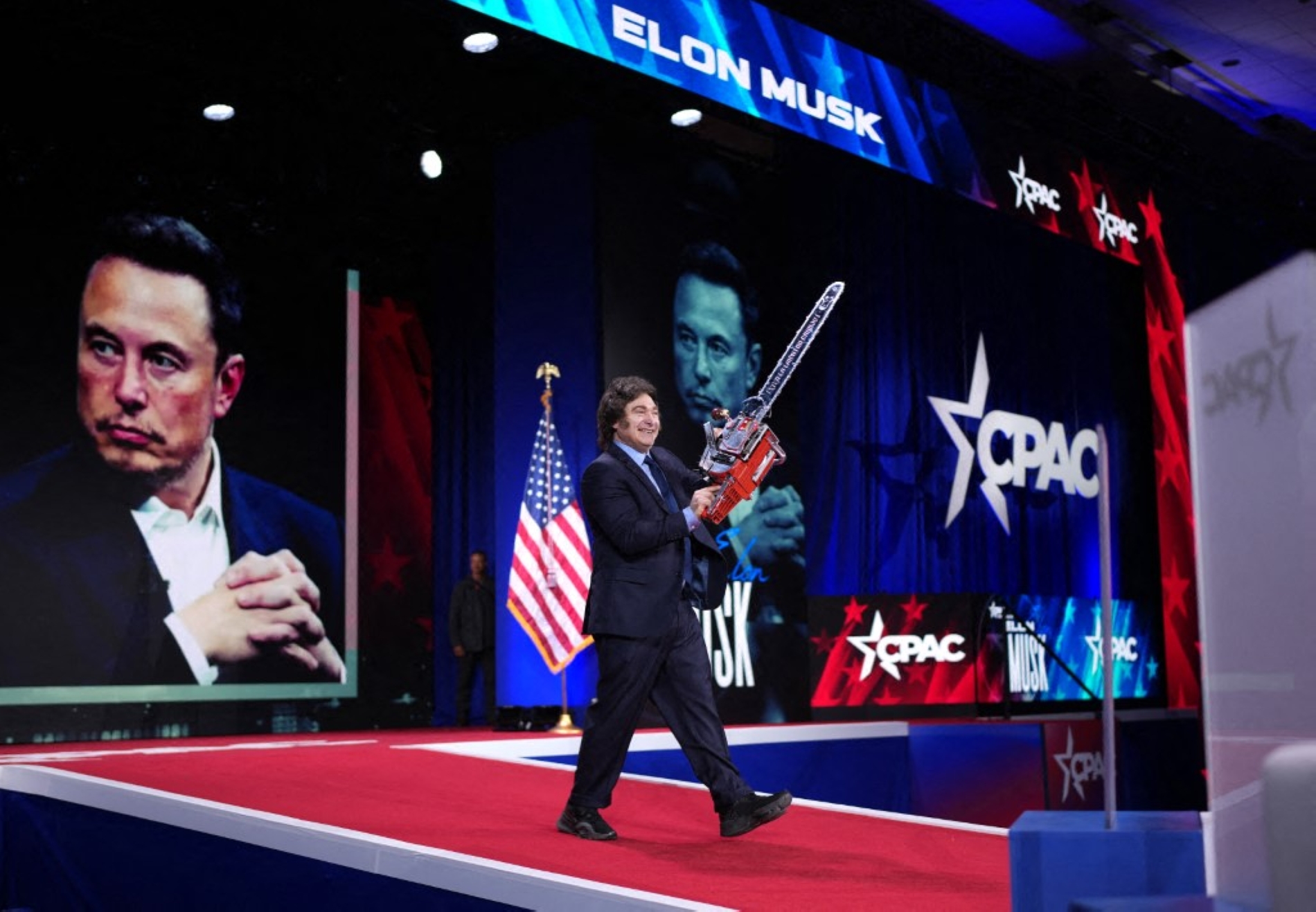
In February 2025, Argentinian President Javier Milei presented American tech entrepreneur Elon Musk with a chainsaw at the Conservative Political Action Conference (CPAC) near Washington. Milei had famously wielded a chainsaw in his election campaign, promising to use it to cut spending and political privilege.
It entered the visual language of Trump’s second administration (which began a month earlier) through Musk’s new remit: to cut the size of the federal government, both in terms of staff and programmes. Its journey exemplified the two-way circulation of ideas, methods, and performances through a transnational conservative network, one that once included former Brazilian president Jair Bolsonaro, whose style of governance from 2019-22 resembled Trump’s own. The ‘Bolsonarismo’ movement remains influential today, even under the presidency of the left-leaning Luiz Inácio Lula da Silva.
Strength works. In El Salvador, President Nayib Bukele turned mass imprisonment into a security model studied throughout the region. In Chile, José Antonio Kast converted anxieties over crime, migration, and national identity into electoral victory before winning the presidency in March 2026. In Ecuador, Daniel Noboa secured a full term after militarising the state’s response to criminal groups. These trajectories seem to illustrate a rightward shift, but does it constitute a lasting realignment or an adaptation of familiar conservative ideas to current crises?
Tracing the shift
If Latin America is shifting to the right politically, this has emerged from overlapping pressures, rather than a single ideological transformation. Rising violence and extortion have disrupted everyday life, while weak economic growth has limited governments’ capacity to meet public expectations. Traditional parties have struggled to offer convincing remedies, creating demand for ‘strong’ leaders who promise immediate action.
Economic grievances, cultural disputes, and fears over public safety now compound one another. Politicians intensify divisions by identifying ‘enemies’ and presenting institutional restraints as obstacles to effective government. Latinobarómetro, an independent survey of 19,214 people in 17 countries in 2024, captures the tension between attachment to democracy and the demand for results.
Security is the new measure of competence in Latin American countries, where the 'politics of order' wins votes
Support for democracy stood at 75% in Argentina, 61% in Chile, 47% in El Salvador, 45% in Brazil, and 42% in Ecuador. More tellingly, 53% of regional respondents felt that a non-democratic government was acceptable if it resolved their problems. In El Salvador, that proportion reached 62%, where 70% believe the country is defeating organised crime. In Ecuador, 61% share that tolerance of non-democratic rule, yet only 19% believe their country is winning the same battle.
Authority acquires legitimacy when it appears to deliver results, so in a continent plagued with drug-related crime, credibility over security and executive competence seem to be more of a vote-driver than adherence to right-wing ideologies.
Argentinian President Javier Milei wields a chainsaw as he arrives on stage at the Conservative Political Action Conference (CPAC) at the Gaylord National Resort Hotel and Convention Centre on 20 February 2025, in Maryland.
50 shades of right
Divergent views of the state make clear why these leaders cannot be placed within a single ideological project. Milei represents the most radical economic revolt against the prevailing order, portraying public institutions as mechanisms through which a privileged political caste exploits productive society. Studies have found that opposition to this elite and identification with Milei's rebellious image matter more to voters than his libertarian programme or social positions.
This emphasis sets him apart from leaders who expand presidential authority in the name of public protection, since Milei promises deregulation, spending cuts, and a far smaller government. Their relationships with older conservative traditions also vary considerably. Bolsonaro combined neoliberal economics with militarism and evangelism, forging a political identity that survived his presidency. 'Bolsonarismo' has garnered religious and business support. It recasts courts, media, and electoral authorities as impediments to popular sovereignty.
Drawing on a Chilean conservative legacy shaped partly by the Augusto Pinochet dictatorship (1974-90), Kast established firmer boundaries between citizens presented as legitimate members of the national community and groups depicted as threats to its security and identity. A focus on crime, immigrants, and national renewal let him outflank the centre-right. His supporters liked his authoritarianism and nativism, with his moral conservatism less important.
In El Salvador and Ecuador, the circumstances are different once again. El Salvador's Bukele communicates well online, uses religious imagery, and wields an expansive security apparatus (without an equally developed economic programme), with perceived improvements in public order generating consent for his concentrated presidential authority.
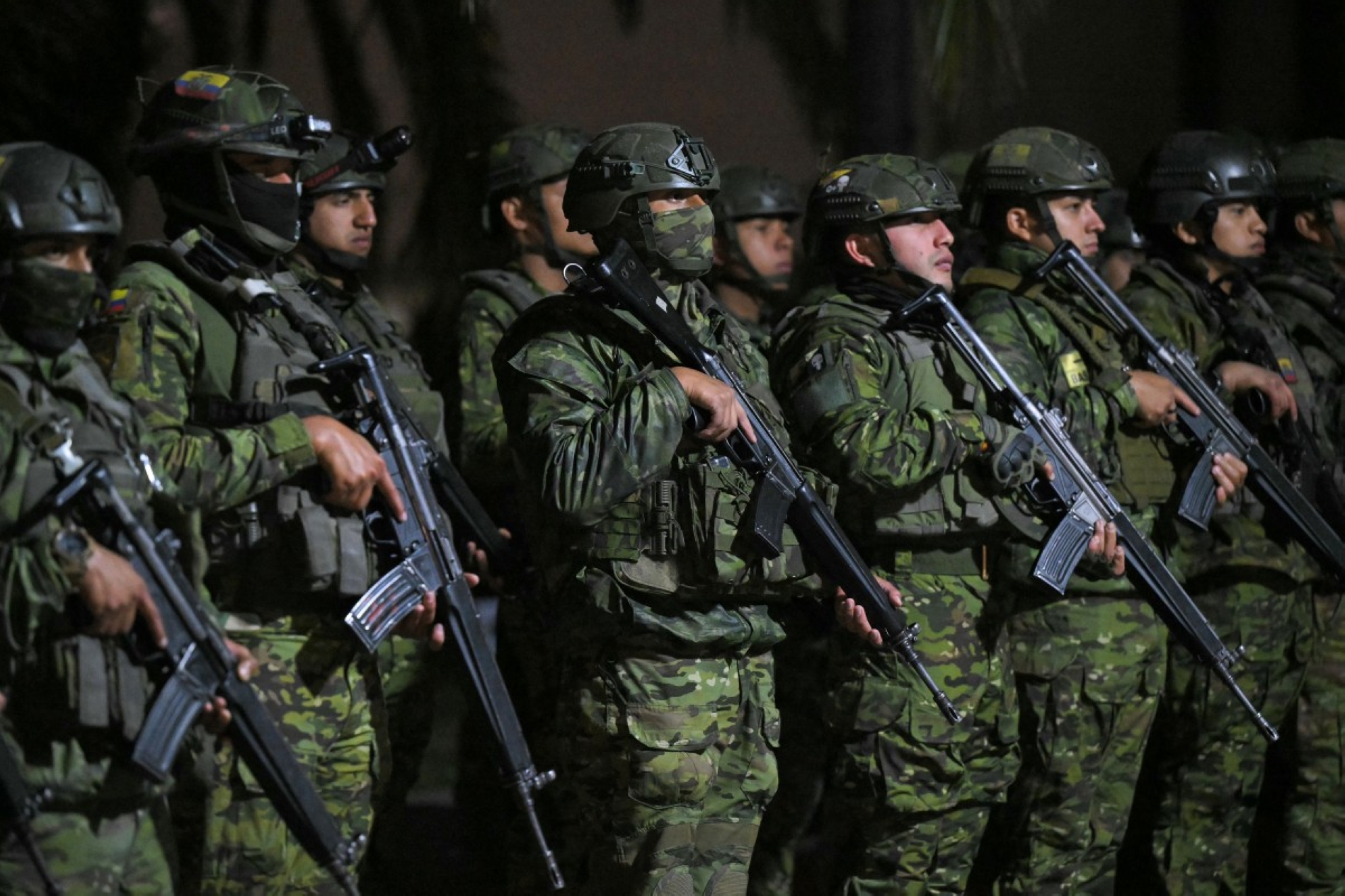
Meanwhile, Ecuador's Noboa presents military deployment and exceptional measures as necessities in a national war against organised crime. His characterisation of security forces as 'defenders of an endangered nation' and gangs as 'enemies beyond ordinary politics' illustrates how demands for decisive action can push parties and candidates from across the political spectrum towards militarisation and greater executive control.
Members of the Ecuadorian military form up following a curfew imposed by Ecuador's President Daniel Noboa, at Fuerte Militar Ruminahui, north of Quito, on 3 May 2026.
The politics of order
Despite the differences, forceful executive action is a common denominator. Security is the new measure of competence in Latin American countries, where the 'politics of order' wins votes from the visibility of punitive measures, soldiers on city streets, emergency decrees, prison searches, and mass arrests. These elements create an impression of action, while the relatively unglamorous aspects of judicial reform, police professionalisation, and social prevention are slower and less visible.
As a result, leaders who equate competence with imposing order and suggest that procedural safeguards favour criminals over citizens are winning the argument. Under Bukele, mass imprisonment embodied this approach, allowing his government to claim that it had restored state control even as emergency rule weakened constitutional protections.
Its influence then reached Argentina, where security minister Patricia Bullrich visited El Salvador's Terrorism Confinement Centre, known as CECOT, to study its methods. Authorities in the Argentine province of Santa Fe later reproduced elements of Salvadoran penal policy and staged prison searches in their response to violence linked to drug trafficking in Rosario, the province's largest city.
Noboa also invoked Bukele's prison strategy as he deployed the armed forces against gangs and defined them as terrorists. Yet Ecuador's experience exposes the limits of direct policy transfer, since its arrests, drug seizures, and military operations have not yet had the desired effect. Homicides have risen after a temporary dip, prison massacres continue, and the capture of gang leaders only triggers violent succession struggles. Argentina's robust judiciary, active civil society, and lower overall levels of violence also limit the transferability of Salvadoran methods.
US President Trump was asked what his message to Colombian President Gustavo Petro would be after "capturing" Venezuelan President Nicolas Maduro during an operation in Caracas early on Saturday morning. #Venezuela#DonaldTrump#Maduro#Colombia#BBCNews
The relationship with Trump encompasses political language, organisational infrastructure, and access to power. His attacks on mainstream media and elites, alongside his promises of national restoration ('Make America Great Again'), supply a vocabulary for right-wing Latin American politicians to adapt to local discontent.
Milei, Bolsonaro, and Bukele each described scrutiny (from judges, journalists, or regulators) as 'persecution', framing the resulting disputes as confirmation that they are challenging institutions that have lost public trust. Digital platforms and campaign performances amplify these messages, giving ideologically different movements a recognisable political idiom.
The organisational dimension offers forums for exchanging strategies and signalling solidarity. Originally a US gathering, CPAC has expanded internationally. At its Brazilian edition in June 2022, Milei, Kast, and Bolsonaro's son Eduardo appeared on-stage together (before Milei or Kast became presidents). The Bolsonaro family also developed ties with Steve Bannon, Trump's former chief strategist who promotes cooperation among nationalist movements.
Brazilian courts and electoral authorities have barred Bolsonaro from seeking office after his conviction for plotting a military coup to remain in power after losing the 2022 election, so his other son, Flávio (a far-right senator), is taking on Brazilian President Luiz Inácio Lula da Silva (known as Lula) in the country's election next month.
US meddling?
Trump and US Secretary of State Marco Rubio have been accused of meddling to help the young Bolsonaro win by applying 25% tariffs on Brazilian goods and by designating a Brazilian gang as terrorists, to make Lula look soft on crime. This is a high-risk strategy, however, as it exposes Bolsonarismo to accusations that its nationalism relies on foreign intervention, rather than homegrown support.
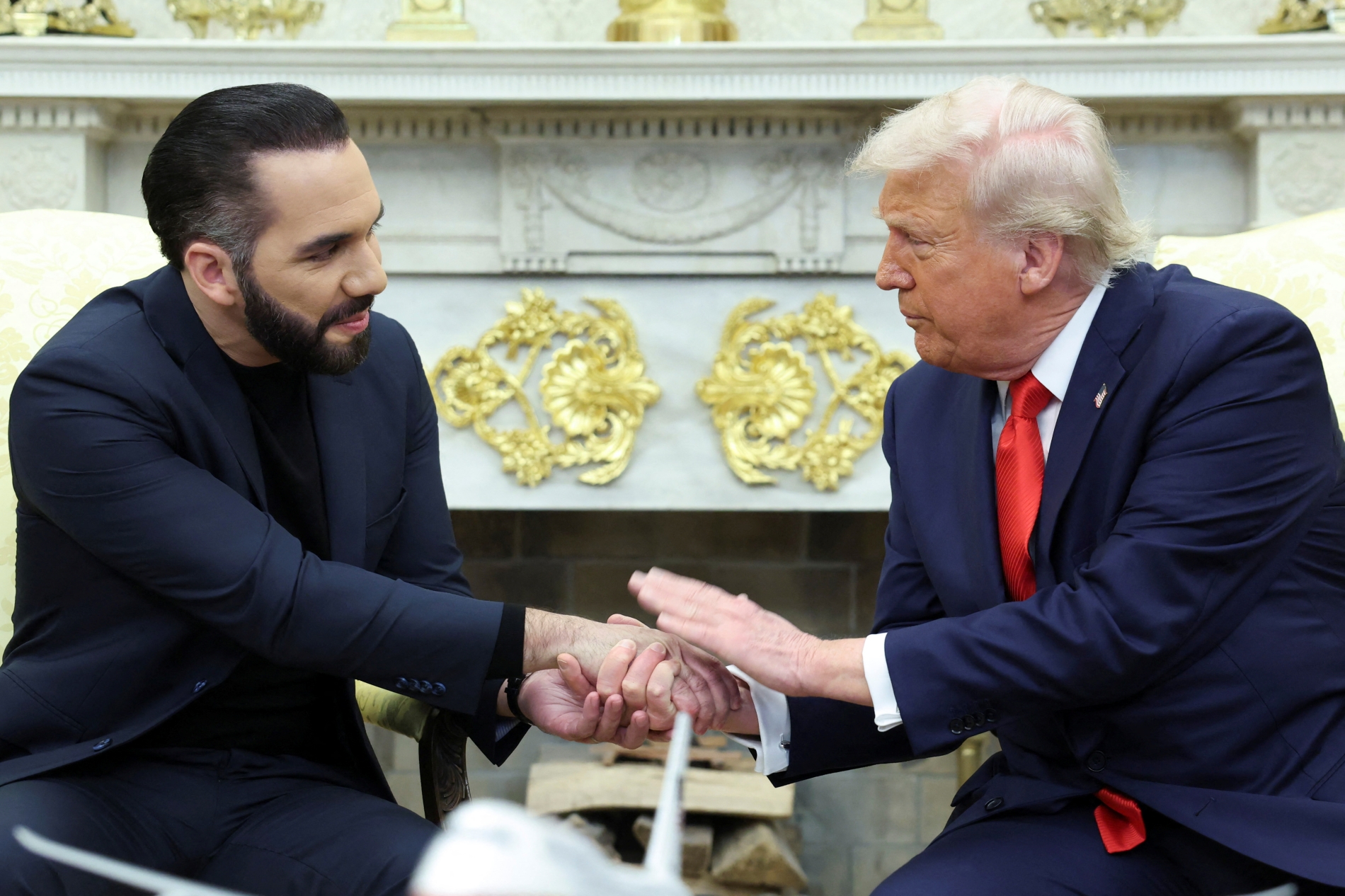
Lula has further escalated the issue by denying visas to two Trump officials who he accused of preparing to sow doubt on the credibility of Brazil's voting system. Yet to Latin America's right-wingers, Trump can confer recognition and access. Milei won elections last year in part because Trump approved a $20bn credit lifeline to help Argentina weather a currency crisis. Bukele, meanwhile, went from CPAC to the White House in April 2025, and Trump publicly welcomed Kast's victory in Chile.
US President Donald Trump shakes hands with El Salvador President Nayib Bukele in the Oval Office at the White House in Washington, DC, on 14 April 2025.
The purpose of these connections differs in each case: Bolsonaro relies on familial networks; Milei on ideological affinity and public persona; Bukele on strategic cooperation; Kast on symbolism and regional coordination; and Noboa on transactional ties centred on security. For all their breadth, these affinities fall short of geopolitical alignment. Milei still depends on Chinese trade and finance, for example, while US economic pressure has only moved Brazil closer to Beijing.
No common doctrine
Trump can provide a shared political reference without generating foreign-policy alignment. Still, the continent's rightward shift may endure because the conditions that have lifted it are unlikely to recede any time soon. Organised crime, weak growth, fragmented party systems, polarisation, and distrust of institutions are all increasingly endemic.
While these right-wing leaders and governments may change, the international alliances they have built can survive elections. The result is a reordered hierarchy of priorities, giving greater weight to security, executive capacity, and cultural conflict (at the expense of any collectivist programme). This change affects how Latin American voters judge political competence in leadership.
Although Trump has reinforced the idea and drawn its regional advocates together, the 'new right' derives its electoral force from local insecurity and disappointment with established institutions. It cannot be reduced to 'imported Trumpism' or old conservatism in modern dress. Rather, each national version is tailored to its own circumstances, but personalised authority provides the connecting thread.