New front in race for rare earths opens under the sea

New front in race for rare earths opens under the sea

In the Pacific, the US and Japan are looking to exploit deep-sea mineral resources to counter China’s dominance of rare-earth supply chains, amid environmental concerns and unresolved international rules. Nearly 6,000 metres beneath the Pacific, a new race for critical minerals is taking shape. The United States and Japan plan to cooperate on what could become the world’s deepest seabed-mining project, targeting rare-earth-rich deposits around Japan’s remote Minamitorishima Island.

Japan has already shown that material can be recovered from such depths: in early 2026, its research vessel Chikyu brought about 50 tonnes of rare-earth-bearing mud to the surface. A larger trial planned for 2027 aims to dredge about 350 tonnes a day, testing whether the resource can ultimately be produced on an industrial scale.

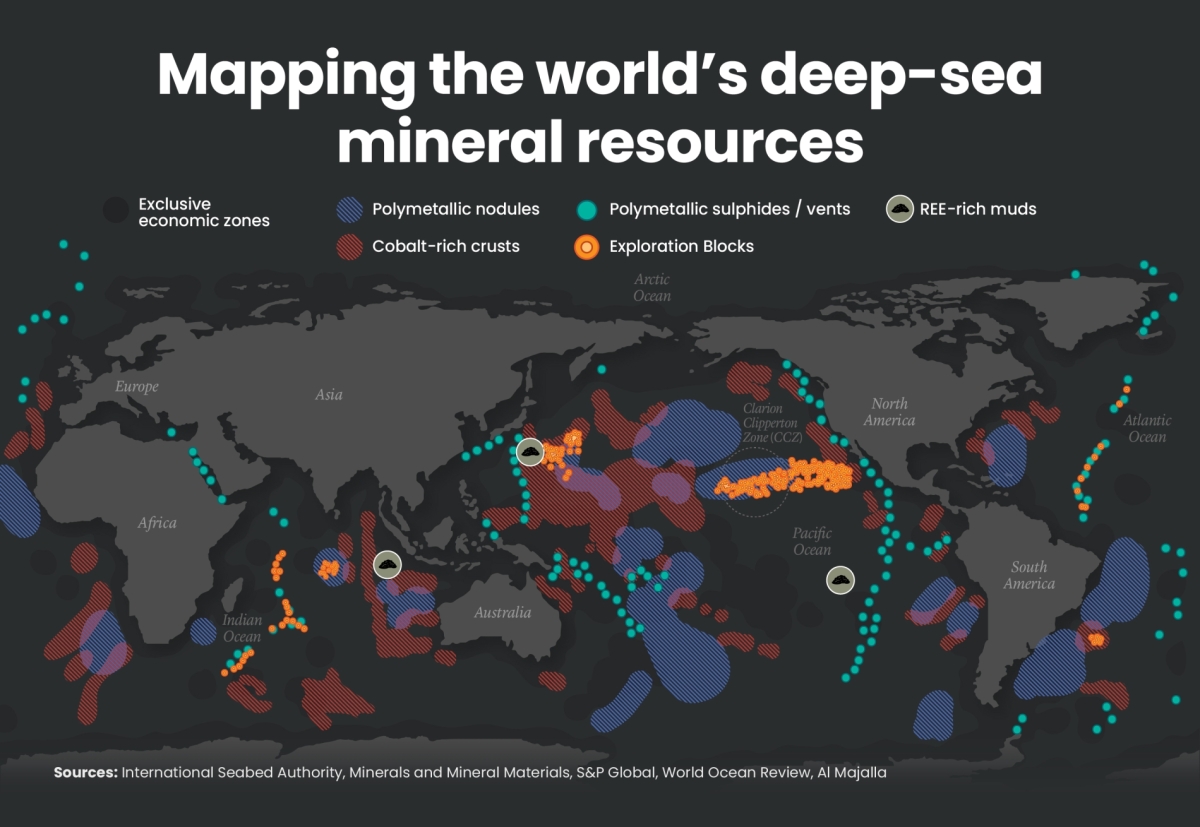
The attraction is strategic: deep-sea deposits contain manganese, nickel, cobalt, copper and rare-earth elements, essential to batteries, electric vehicles, high-performance magnets, electronics, renewable-energy technologies, robotics, aerospace and defence systems. Some of the richest nodule fields lie in the Pacific’s Clarion-Clipperton Zone (CCZ), while crusts occur on submarine mountains and sulphides around hydrothermal vents.

But possessing the resources is one thing; reaching them is another. Mining several kilometres below the surface requires specialised vessels, remotely operated machinery, collection systems and pipelines capable of withstanding extreme pressure—capabilities currently held by only a small number of companies in Japan, Canada, Switzerland and the US. Also, finding new deposits is not enough: countries also need the capacity to separate, refine and process these materials into usable components.


Bloomberg reported that the proposed Japan-US operation could cost roughly three times as much as comparable land-based extraction in China.

Extraction barriers

This technological barrier translates directly into a financial one. Bloomberg reported that the proposed Japan-US operation could cost roughly three times as much as comparable land-based extraction in China. Yet economics may no longer be the only consideration. Washington and Tokyo increasingly view seabed minerals as a matter of strategic security, amid China's dominance of global rare-earth mining and, particularly, processing.

According to the International Energy Agency (IEA), China accounted for about 60% of global mined production of magnet rare earths in 2024, 91% of refined output, and 94% of sintered permanent-magnet production. The US is therefore moving ahead with seabed initiatives beyond the Japanese partnership despite the high costs: in August 2026, Washington proposed a lease auction covering federal seabed waters around the Northern Mariana Islands, adding another potential front to its Pacific mining push.

The race, however, is entering largely uncharted environmental and legal territory. Deep-ocean ecosystems remain poorly understood, and mining could destroy habitats, generate sediment plumes and disrupt species whose ability to recover may be limited or unknown. And beyond national waters, the question of who owns and has the right to exploit these resources remains unresolved.

In international waters, the deep ocean floor is designated under the UN Convention on the Law of the Sea as the "common heritage of humankind." The International Seabed Authority is still negotiating detailed rules governing commercial exploitation and benefit-sharing.

font change