Estrangement and the trial of the soul in Abdullah AlArfaj’s Camphor Leaveshttps://en.majalla.com/node/332152/culture-social-affairs/estrangement-and-trial-soul-abdullah-alarfaj%E2%80%99s-camphor-leaves
The Saudi novelist and academic Abdullah AlArfaj, whose fiction is deeply rooted in Najdi history, migration, memory, and social change, has a storyteller’s instinct and a scholar’s attentive eye. His grounding in the sociology of literature and cultural sociology has shaped a way of seeing that reaches into the inner layers of the worlds he portrays.
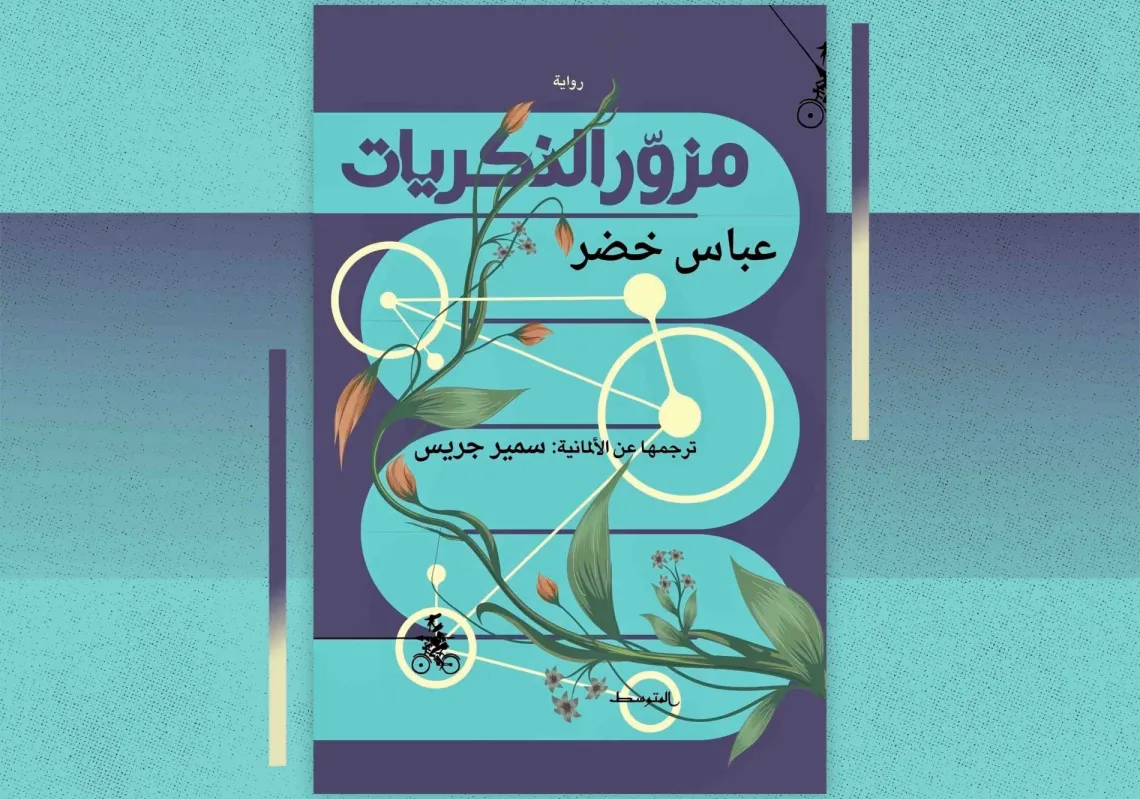
In his novel Camphor Leaves, published in Beirut by Dar Naufal/Hachette Antoine, he returns to one of the most resonant periods in Najdi memory: a time when epidemic disease and hardship drove people from their homes, only for them to return years later altered by distance and experience.
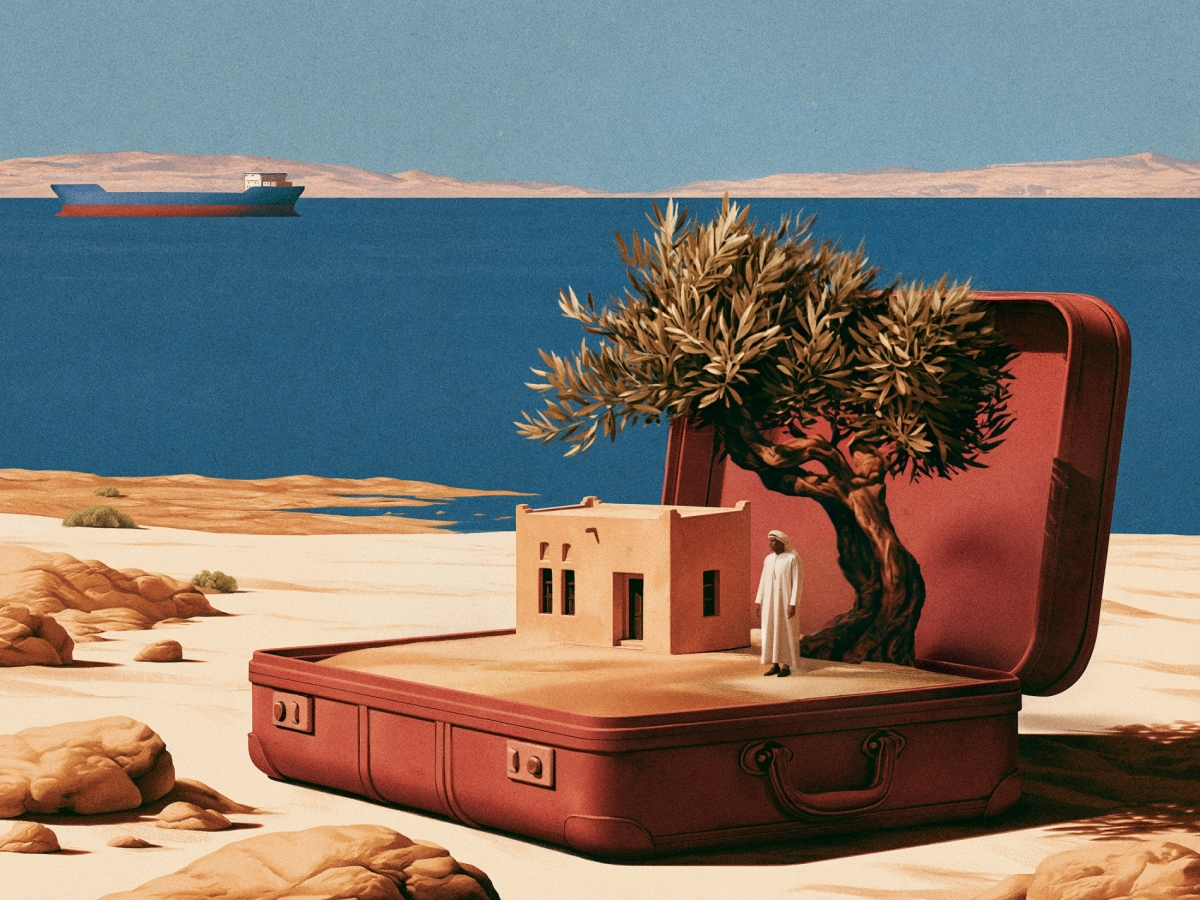
The novel asks what becomes of a person who must uproot part of themself in order to preserve what remains. Its narrative moves beyond historical reconstruction to become a meditation on how the search for livelihood turns into an existential journey, and how the homeland grows more vividly in memory than in reality.
AlArfaj draws on his sociological insight to build the novel’s world. He reads society from within, allowing his characters to move according to the logic of their environment rather than the visible will of the author. They seem to have stepped out of everyday life and onto the page.
Camphor becomes a cultural, moral, and psychological symbol. Its leaves carry a fragrance associated with preservation, accompany the dead in rites of farewell, and evoke purification and protection. It represents the human effort to shield the self from the injuries of the road, to keep memory from decay, and to preserve one’s values amid shifting surroundings.
Camphor becomes a cultural, moral, and psychological symbol. Its leaves carry a fragrance associated with preservation, accompany the dead in rites of farewell, and evoke purification and protection
Sayl, the novel's protagonist, stands at the centre of the story, yet Buraidah—its houses, markets, gathering places, neighbourhoods, women, Aqilat merchants, pearl divers, and travellers—also shapes the movement of events. AlArfaj portrays a society in motion, where the destiny of the individual remains bound to that of the community.
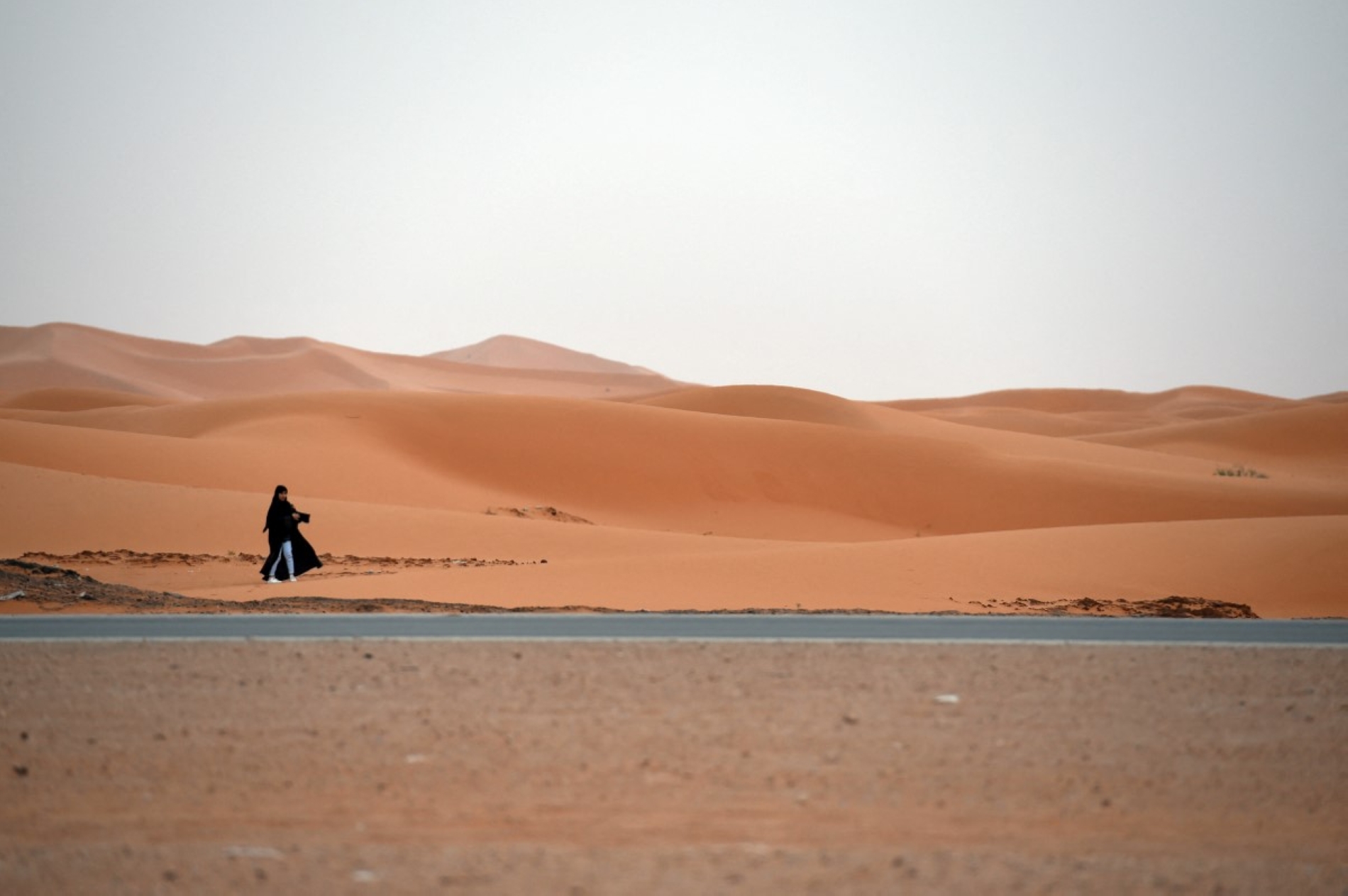
A Saudi girl plays in the sand dunes near Buraidah, 400km northwest of Riyadh, 11 March, 2016
The novel opens during the plague years that swept across the Arabian Peninsula at the beginning of the 20th century. AlArfaj evokes everyday life before the epidemic strikes, allowing the reader to sense the contrast between stability and collapse. The plague becomes more than a disease. It forms a decisive rupture that rearranges society, alters relationships, and pushes people towards choices they had never imagined making. At this stage, AlArfaj adopts a quiet, measured prose that captures the smallest details.
In the time of plague
The novel traces the plague's imprint upon Buraidah, showing how fear seeped into daily life and how houses, roads, and mosques took on a different rhythm. AlArfaj shows how society interpreted the epidemic, confronted it, and searched for deliverance. Popular beliefs mingle with religious consciousness, while stories intertwine with events to reflect the intellectual climate of the age.
AlArfaj presents Najdi society as a society in motion, undergoing major economic and cultural transformations. Trade opens new horizons, migration becomes increasingly common, and coastal cities emerge as destinations for people from the interior. The sea becomes an extension of the desert, as human needs reshape the map.
Sayl remains far from conventional heroism. He is an ordinary man carrying the dreams of those around him. He faces their obstacles, shares their moments of weakness and hesitation, and matures gradually through experience. Throughout the novel, he passes through a succession of symbolic births. First, he is a child discovering the world within a small community. Later, he becomes a husband seeking stability, then a migrant who leaves everything behind. Afterwards, he becomes a diver facing the ordeal of the sea, a merchant who prospers in India, and finally a man returning home only to discover that the official records have counted him among the dead.
AlArfaj avoids presenting Sayl's economic success as a triumphant conclusion. The wealth he acquires after moving from Kuwait to India never feels complete, for his memory remains suspended between Buraidah, his wife Alanoud, the sand, the dialect, and the old gathering places. Money is a means, belonging remains the destination.
This idea reaches its clearest expression in a conversation between Sayl and Abu Qasim. Abu Qasim opens a small box containing soil from Najd and confides that, in his heart, its worth surpasses gold.
Narrative structure
The structure of Camphor Leaves rests on continuous geographical movement, yet serves as more than a backdrop. The desert, Kuwait, the sea, India, and the eventual return to Najd mark successive stages in Sayl's transformation. Each change of place corresponds to a shift within him.
The story begins in a relatively enclosed Najdi world shaped by family ties, deeply rooted customs, and shared memory. It then moves to Kuwait, where Sayl encounters a more dynamic society in which languages, trades, merchants, divers, sailors, and travellers converge. His true transformation begins here. The desert teaches patience; the sea confronts him with risk. One grants stillness, the other demands movement.
The world of pearl diving becomes an ethical testing ground. Pearls yield themselves to no one freely. They demand bodies capable of enduring thirst, exhaustion, and danger. The diver descends into the depths knowing that the prospect of return is shadowed by the prospect of loss.
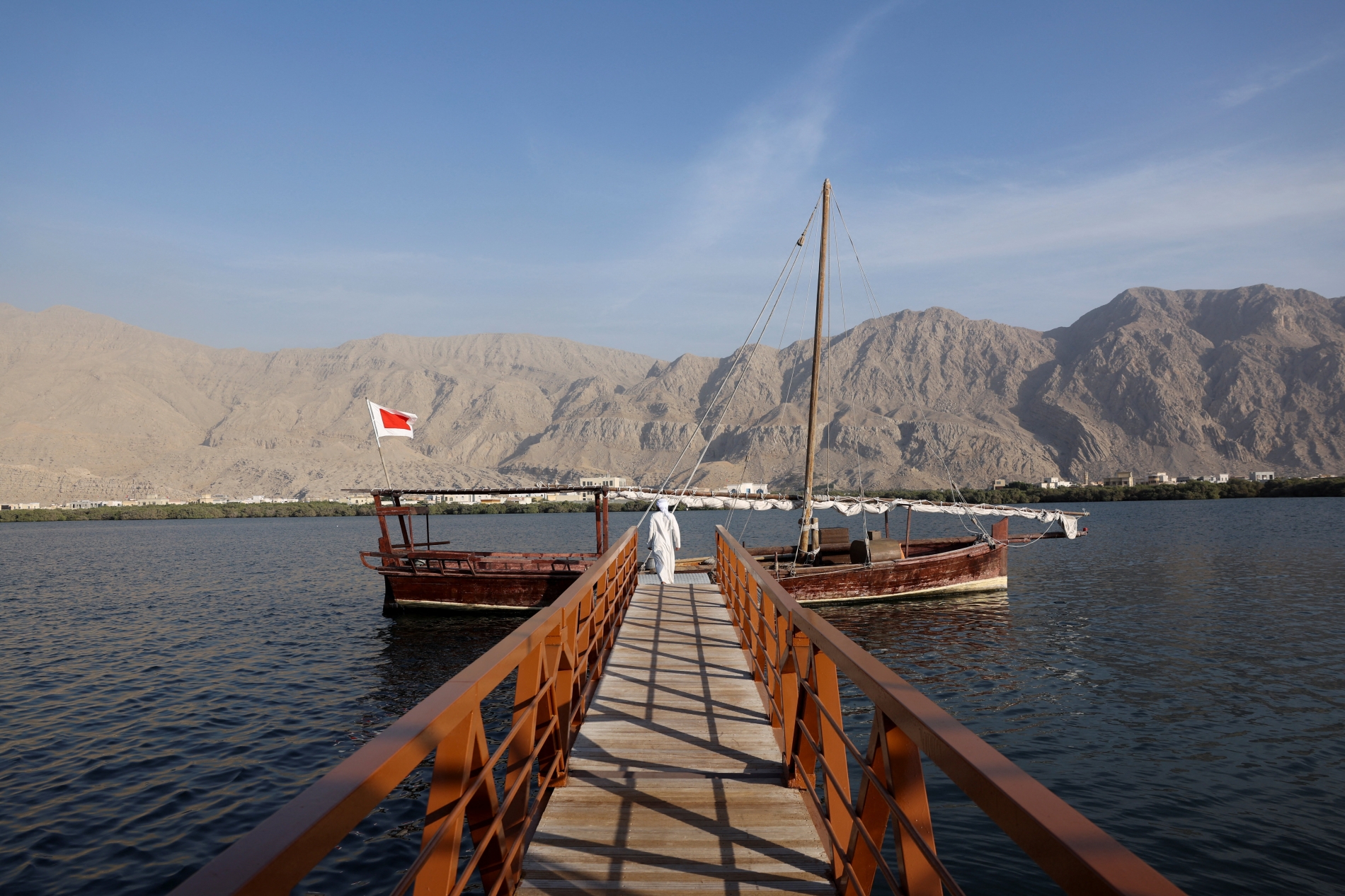
A tour guide boards a traditional boat used for pearl diving at the Suwaidi Pearls floating farm in Ras Al Khaimah, UAE, 12 November, 2025
When the narrative moves to India, its rhythm changes again. India appears as a vast commercial realm where trade brings together a multitude of cultures. Yet AlArfaj does not linger over cities and markets. His attention remains fixed on its effect upon Sayl's inner life. Commercial success arrives quickly, and Sayl's fortune grows year after year. Yet the greater his wealth becomes, the more sharply he feels the emptiness within.
Among the most memorable scenes in this section is a conversation between Abu Basim and Sayl. He urges him to make use of his experience and wealth, then warns him against remaining abroad for too long. Estrangement, once prolonged, may harden into a substitute homeland capable of swallowing a person whole.
The return emerges as the natural outcome of maturity rather than a simple change of place. Sayl has become more experienced, more capable of understanding the world, and more deeply attached to Najd than he was before his departure. The commercial journey becomes a search for the meaning of belonging.
Triumph over absence
The narrative reaches its height with Sayl's return to Najd. Yet this homecoming bears little resemblance to the familiar scene of embraces, celebration, and the easy hope of reclaiming a past imagined to have remained unchanged. AlArfaj understands that time possesses a sovereignty of its own, that the intervening years have fashioned a new reality, and that the returning man carries within him an image of the homeland unlike the homeland now before him. His return becomes a reckoning with personal history rather than the simple end of a journey.
The most affecting irony lies in Sayl's reappearance as a living man after official documents, society, and collective memory have long consigned him to the dead. Death here appears as a social condition as much as a biological one. Once the news of his drowning was accepted, life constructed a new order. His wife rebuilt her life, relationships shifted, and the years left their mark on everything. Proving that he is alive becomes more difficult than surviving the ordeal that led others to believe him dead.
Death here appears as a social condition as much as a biological one. Once the news of his drowning was accepted, life constructed a new order
Although Sayl stands at the centre of the narrative, the novel is, at heart, the biography of a generation of Najdi men who carried their hopes first on the backs of camels, then aboard ships, and finally into distant marketplaces, seeking a better life.
Sayl comes to embody the thousands shaped by migration, while his wife Alanoud reflects the thousands of women who endured years of waiting. Ibn Hudayyan carries the popular wisdom that travelled with the caravans, and Abu Basim and Abu Qasim personify the memory that continued to bind migrants to the soil they had left behind.
Beyond the boundaries of place
For all its grounding in the world of Najd, the novel's questions reach far beyond the local. Anyone who has left home in search of a livelihood, any family that has endured years of separation, and any migrant who has returned only to discover that time has moved on may find part of their own story in these pages.
The novel moves beyond geography and touches universal themes: the value of home, the meaning of absence, the force of rumour, the difficulty of recovering what time has altered, the relationship between material success and emotional loss, and the importance of roots in shaping identity.
It also offers a measured reflection on estrangement without reducing it to something wholly destructive or wholly enriching. Life away from home grants Sayl knowledge, experience, wealth, and confidence. It also brings loss, solitude, severance, and longing.
Camphor Leaves sustains a delicate balance between history and imagination, document and narrative. Through Sayl's journey, AlArfaj writes the story of a man who leaves his land hoping for a better life, then returns burdened with questions that transcend wealth and the conviction that homelands dwell in the soul before they find their place on maps.