
The Eastern Mediterranean has emerged as one of the world’s most contested geopolitical arenas, where energy resources, maritime boundaries, and connectivity corridors collide with neighbouring states’ competing interests.
At the centre of this evolving landscape are Türkiye and Israel, two former partners whose relations have undergone a profound transformation over disagreements on Gaza and foreign intervention in Syria. Both countries seek regional influence, positioning themselves as key hubs linking Europe, the Middle East, and Asia through energy networks, infrastructure projects and trade corridors.
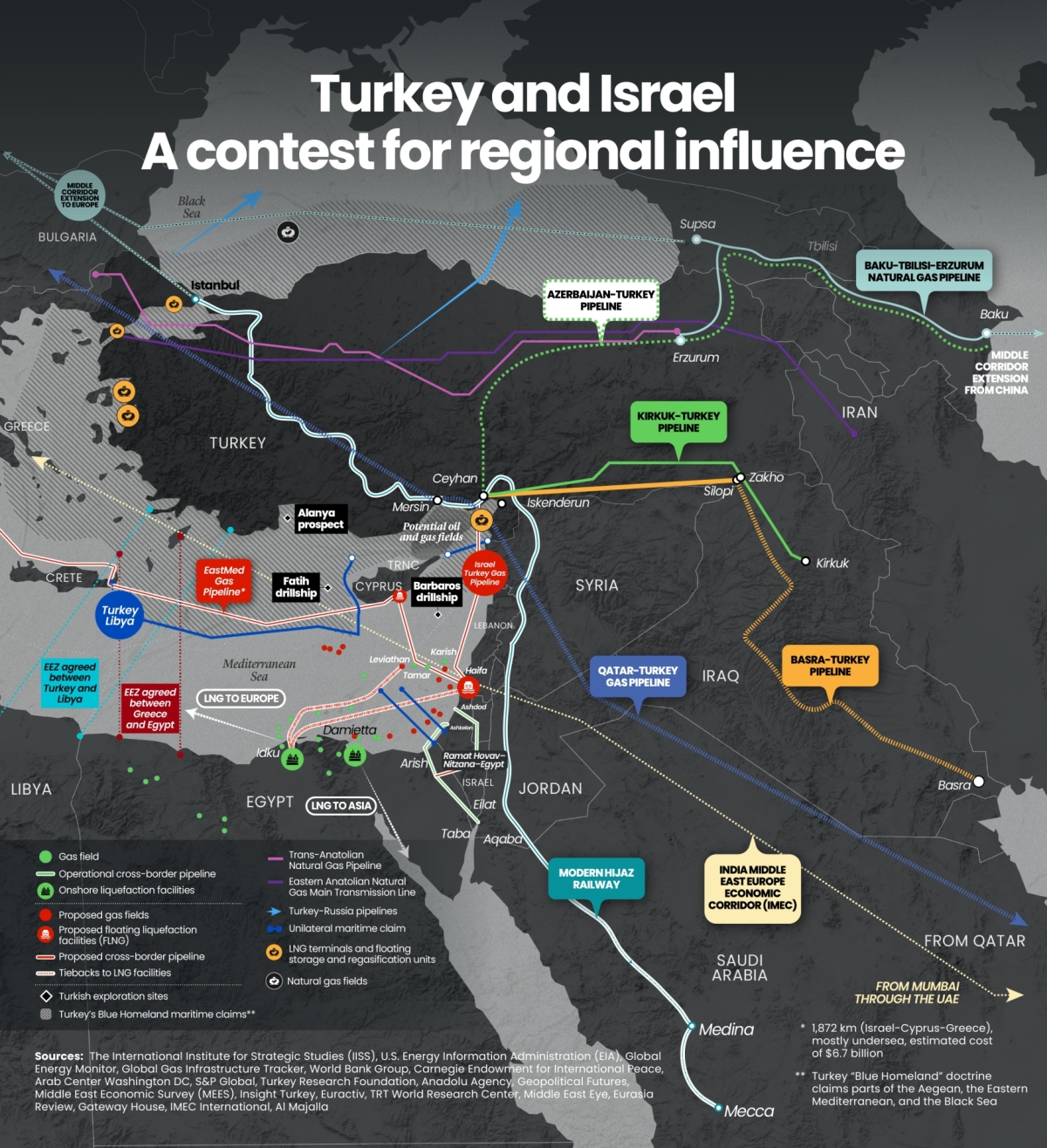
Türkiye is the principal land bridge linking Europe with the Caucasus, Central Asia, and the Gulf. Its strategy combines the Blue Homeland (Mavi Vatan) doctrine, asserting extensive maritime interests in the Eastern Mediterranean, with investments in cross-regional connectivity. The Southern Gas Corridor, the Baku-Tbilisi-Ceyhan oil pipeline, the Trans-Anatolian Natural Gas Pipeline (TANAP), the Middle Corridor extending from China, the Iraq-Turkey pipeline, and proposals such as the Qatar-Turkey gas pipeline and the modern Hijaz Railway all reinforce Ankara’s ambition.
Türkiye views these projects as reinforcing its importance within NATO and for European energy security, which may explain Washington’s renewed willingness to sell Ankara advanced F-35 fighter jets despite opposition from Israel, which fears it may lose aerial superiority if it does.
Meanwhile, Israel is now an energy exporter thanks to the Tamar, Leviathan, and Karish offshore gas fields which hold more than 900 billion cubic metres (bcm), raising annual gas production above 25 bcm. Israel exports natural gas through Egypt and Jordan, expanding its offshore infrastructure and integrating with broader regional connectivity initiatives, including the India-Middle East-Europe Economic Corridor (IMEC).
Maritime infrastructure, pipelines to Egypt’s El-Arish, and proposals linking Israeli ports with Gulf and European markets all illustrate Israel’s efforts to convert energy resources into long-term geopolitical influence, as it continues to expand export capacity.
Maritime disputes are therefore central to the Türkiye-Israel rivalry. Türkiye’s Blue Homeland (Mavi Vatan) doctrine challenges the Exclusive Economic Zone (EEZ) arrangements supported by Greece, Cyprus, and Israel, arguing that they do not adequately reflect Turkey’s maritime rights and those of Turkish Cypriots. Competing claims complicate offshore exploration, affect pipeline proposals, and constrain regional energy cooperation, contributing to delays in projects such as the EastMed pipeline.