How Egypt lost two of its most dynamic communitieshttps://en.majalla.com/node/332044/culture-social-affairs/how-egypt-lost-two-its-most-dynamic-communities
“Egypt is my homeland, the land of my birth. There I grew up and was raised. She is my teacher and the source of my livelihood, the place where I wake and where I sleep. I have no other country to love.”
With these words by the Cairo-born Jewish poet Mourad Farag, Naglaa Abdel Haq opens her book, Jews and Greeks in Egypt and Their Economic Role until 1960. Tracing the careers of entrepreneurs from ethnic and religious minorities, the book focuses on the country’s two largest minorities at the time—its Jewish and Greek communities.
Translated from English and published in Arabic by Dar Al Karma, the book grew out of a doctoral dissertation for which the Palestinian-German researcher received her PhD in Middle Eastern Studies from Friedrich Alexander University Erlangen-Nuremberg.
Although scholars and historians have devoted considerable attention to minorities in modern Egyptian history, their economic legacy has received far less scrutiny. “I have long been fascinated by communities whose economic influence far exceeds their demographic weight,” explains Abdel Haq to Al Majalla. “This phenomenon is often associated with Jews, although it is by no means unique to them.”
Spanning roughly 500 pages, the book examines the period from 1885 to 1960, when Egypt’s Jewish and Greek communities experienced economic ascent before their presence gradually declined. Abdel Haq drew on documents held by the Central Zionist Archives and the Central Archives for the History of the Jewish People, both in Jerusalem, and Egypt’s National Archives, as well as interviews with Jewish and Greek figures who lived through the period.
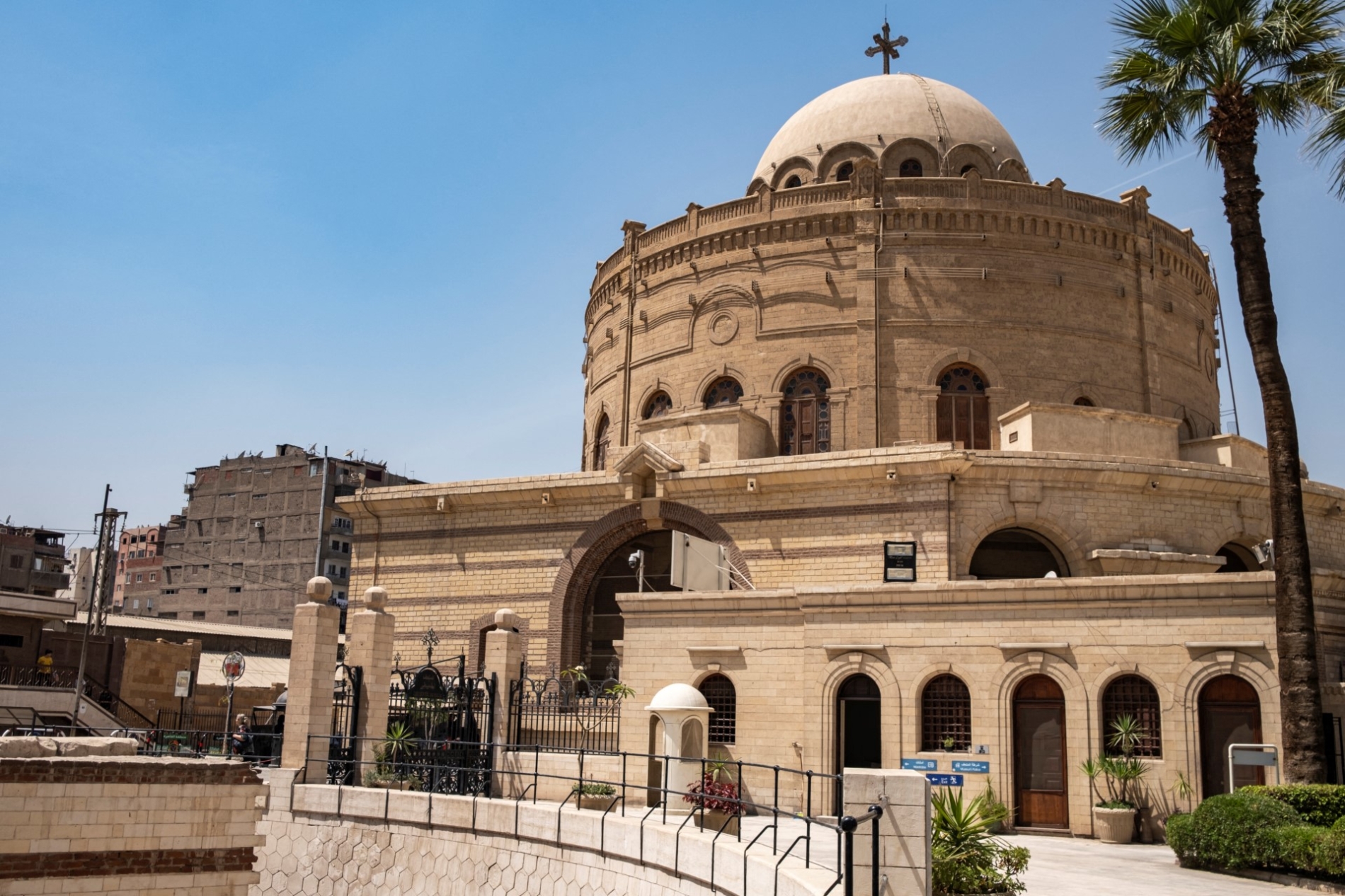
The interior of the newly restored Ben Ezra Synagogue, one of Egypt’s oldest Jewish places of worship, in Old Cairo, 1 September 2023
“The Jewish and Greek experiences share a number of similarities, which prompted me to undertake a comparative study,” says the author. “I was troubled by the widespread myth of an innate Jewish aptitude for commerce. The explanation lies in no supposed Jewish gene. It lies in factors such as social and economic networks, education, and the accumulated experience of successive generations.”
The Arab-Israeli conflict has cast a long shadow over the work of historians and researchers, and discussion of Egypt's Jews has often been shaped by competing nationalist interpretations
Despite these parallels, the literature on Egypt's Greek community differs markedly from that devoted to Egyptian Jews. The Arab-Israeli conflict has cast a long shadow over the work of historians and researchers, and discussion of Egypt's Jews has often been shaped by competing nationalist interpretations. They found themselves caught between two ideological narratives, both of which stripped them of their Egyptian identity.
The first, rooted in Egyptian and Arab nationalism, maintained that Jews had lived comfortably in Egypt while remaining somehow outside the fabric of Egyptian society. It also held that most were sympathetic to the Zionist movement. The second, Zionist in orientation, portrayed Egyptian Jews as inherently drawn to the Zionist project and eager to emigrate to Israel.
Egypt's Greeks, by contrast, were not entangled in a comparable political or national conflict, although they too left the country in large numbers between 1956 and 1967. Relations between modern Greece and Egypt also never descended into the hostility and tension that came to define Egypt's relationship with Israel.
The rise of the two communities
The book begins by surveying the legal and historical status of Jews and Greeks in 19th-century Egypt. Jews had traditionally been recognised as a religious minority under the Ottoman millet system, which was abolished after the First World War. The Greeks, meanwhile, benefited from their position within the wider Ottoman realm, which allowed them considerable freedom of movement across its provinces. Alexandria emerged as the principal centre of Greek life in Egypt.
Abdel Haq attributes the economic ascent of both communities to entrepreneurial innovation and the extensive use of social networks as a commercial strategy. Marriage often served to strengthen ties within established networks or forge new ones, a practice common among Egyptian Jews and Greeks alike. Education, fluency in foreign languages, and the accumulation of expertise across generations also enabled members of both communities to access international markets and secure influential positions in government administration and the private sector.
Drawing on company records and information about their founders, Abdel Haq found that Egyptian Jews participated in the establishment of 34.5% of new companies founded between 1885 and 1960, while Greeks accounted for approximately 22.7%. Contemporary statistics put Egypt's Jewish population at around 100,000 in 1947 and its Greek population at 57,000, out of a total population of 19 million.
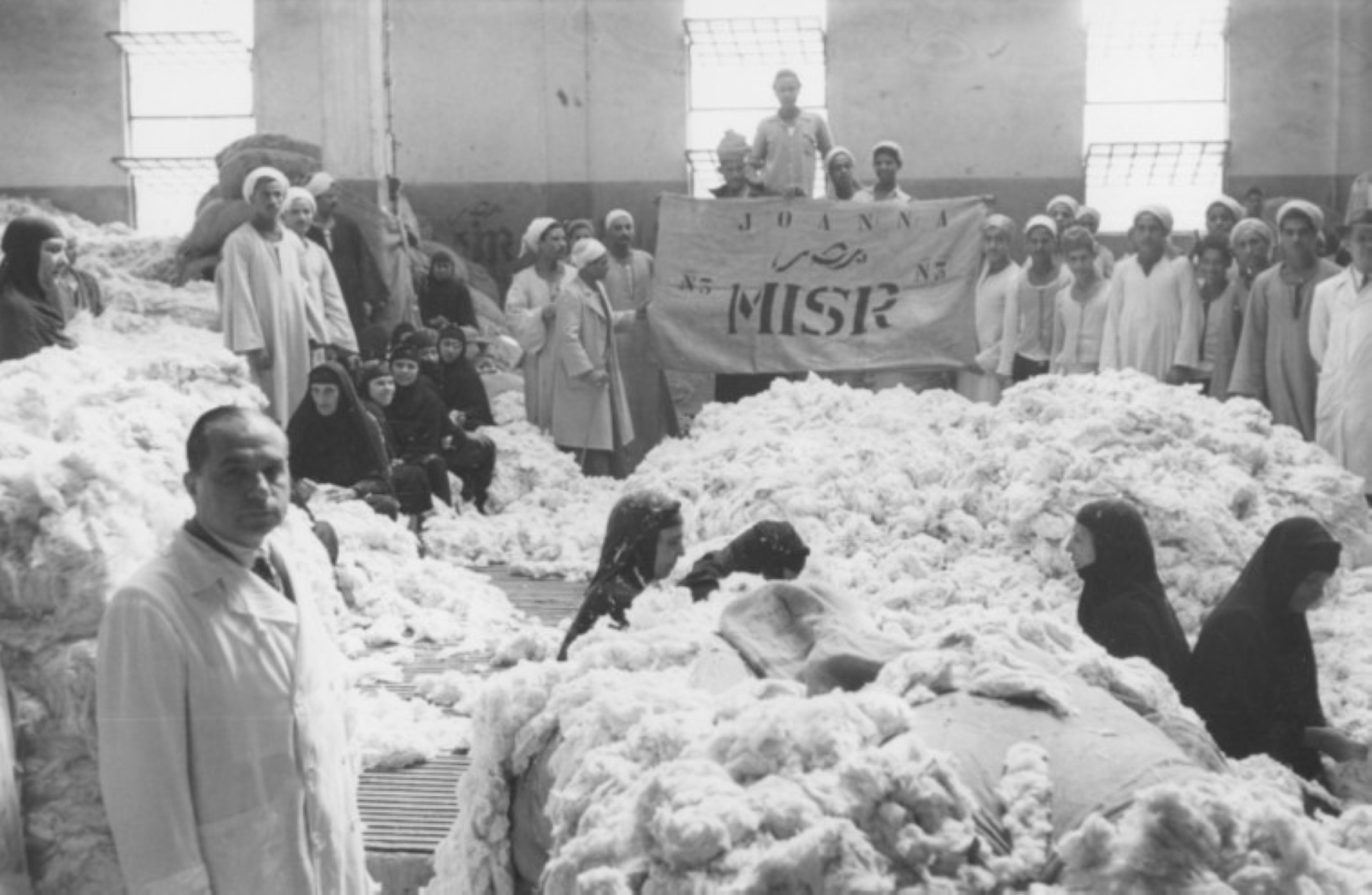
The cotton trade, for which Egypt had been renowned since the reign of Muhammad Ali Pasha, formed the principal arena of Greek economic activity. "They were present at almost every stage of the cotton industry, from the hybridisation and cultivation of long-staple cotton to the management of estates and agricultural land, and ultimately its export," Abdel Haq explains.
Several Greek entrepreneurs made direct contributions to the development of the industry. Theodoros Vallis introduced mechanised, steam-powered cotton gins to Egypt and later became one of Alexandria's wealthiest businessmen. Nestor Gianaclis founded Egypt's first cigarette factory in 1871. He is also credited with pioneering grape cultivation for industrial purposes and with establishing the Egyptian Vineyards and Distilleries Company.
Christos Angelis (left), an Egyptian government cotton classification expert, at a ginning factory, 1950s
Greek financiers such as Swansea Synadinos contributed to the development of Egypt's banking system and helped establish the country's first privately owned commercial bank in 1864. Jewish bankers entered the financial sector in greater numbers at a later stage.
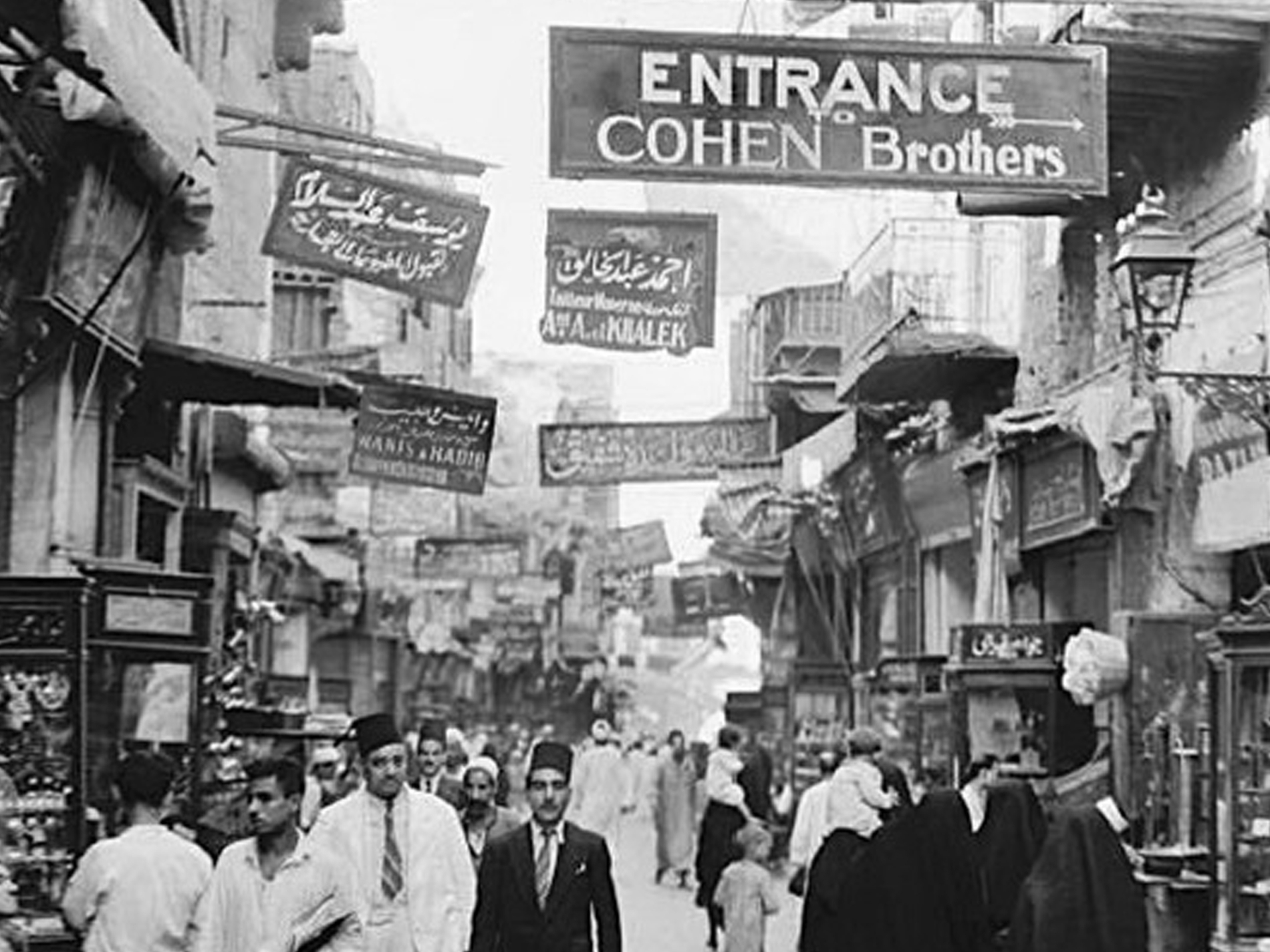
Jews also helped finance the cotton trade and were active in tourism and the trade in antiques and souvenirs. It was through money changing, however, that they first became major participants in the Egyptian economy. Yaqub Cattaui, a member of the prominent Jewish Cattaui family of Giza, was among Egypt's leading money changers during the reign of Said Pasha.
By the early 20th century, Jewish businessmen and statesmen were also helping to build Egypt's national economy. Talaat Harb is widely remembered as the architect of Egyptian economic nationalism during the interwar years. The role of the Jewish statesman and businessman Youssef Aslan Cattaui Pasha (1861–1942), however, occupies a far less prominent place in Egypt's collective memory.
Abdel Haq notes that Cattaui and Harb met around 1905 or 1906, when both were working for the Kom Ombo Company. There, they developed a shared vision for economic development and for creating a national industrial base. Before the First World War, they travelled to Germany, where they were impressed by the German banking system and the model of the universal bank. These ideas later informed their economic ventures and helped shape the establishment of Banque Misr and the wider Misr Group in 1920.
The twilight decade
After the Second World War, Egypt's minorities entered what Abdel Haq describes as a "twilight decade". The political and economic transformations that began with Law No. 138 of 1947, commonly known as the Egyptianisation of Companies Law, accelerated after the Revolution of 23 July 1952 and the nationalisation policies that followed. Together, these developments steadily eroded trust between the state and its minority communities.
The years between 1952 and 1954 brought a measure of relative stability. President Mohamed Naguib maintained cordial relations with the Jewish community. The scandal surrounding Israel's failed Lavon Affair in 1954, however, deepened suspicions of Egyptian Jews and cast a shadow over their place in the national economy. The Lavon Affair was a planned false flag operation intended to sabotage Egypt's relations with Britain and the US by bombing Western targets in Egypt and blaming the attacks on Egyptian nationalists. Its exposure heightened official suspicion of Egypt's Jewish community, despite the involvement of only a small clandestine network.
At the same time, Abdel Haq argues, the rise of the socialist nationalist state left the political system progressively less able to accommodate the social and cultural diversity that had distinguished Egyptian society for generations.
Responsibility for managing the British and French companies seized following the 1956 Suez Crisis was placed in the hands of officials with military backgrounds. This reinforced the drive to build a powerful public sector and bring foreign capital under Egyptian control. It also represented a decisive retreat from the liberal economic order in which minority communities had prospered.
By 1960, the break with that liberal economic order had become unmistakable. "The period before 1960 was fundamentally different from the years that followed," says Abdel Haq. "The private sector no longer had the same room to operate, as economic and political conditions changed radically. An entire chapter in Egypt's economic and social history came to an end."
Ultimately, Egypt paid a lasting economic price for the departure of both communities. Abdel Haq puts it: "Some of these people were undoubtedly subjected to injustice, yet Egypt itself sustained the greater loss. Nasser's industrial experiment could not have succeeded without the economic and industrial foundations built over decades through accumulated experience, knowledge and capital."
The departure of the minorities
Waves of Greek emigration from Egypt began before the mid-1950s. Many left for Australia and countries in Africa and Latin America through organised migration programmes. By the mid-1960s, most had departed. Today, only a small community remains in Cairo and Alexandria, the majority of whom hold both Egyptian and Greek citizenship.
The circumstances surrounding the departure of Egyptian Jews were more complex, and interpretations of their exodus remain contested. Abdel Haq argues that they were caught between two ideological narratives, both of which stripped them of their Egyptian identity. From the late 19th century onwards, the Zionist movement sought to attract Egypt's Jews, although it achieved little widespread success. Youssef Aslan Cattaui Pasha, the head of Egypt's Jewish community, for example, declined a request to meet Theodor Herzl, the founder of political Zionism.
Some Egyptian Jews nevertheless expressed sympathy for Zionism and concern about the persecution of Jews in Europe. They saw themselves as advocates of peace and as potential mediators, capable of building a bridge between Jews arriving from Europe and the Arab Jews of the region.
In this context, Abdel Haq cites a speech delivered by Maurice Faragoun following a lecture given by Taha Hussein, the Dean of Arabic Literature, to Alexandria's Jewish community in November 1943 on Jewish-Arab relations. Speaking in Hussein's presence, Faragoun declared: "We have always hoped that the Jews of Egypt would initiate a movement of rapprochement between Jews and Arabs (…)"
Zionism achieved considerable success among the Jews of Iraq and Morocco, while its influence in Egypt remained limited
In the early 1940s, David Ben-Gurion, who would later become Israel's first prime minister, devised a plan to bring one million Jews from the Arab world to Palestine to further advance the Zionist project. As Abdel Haq says: "It was a long-term plan that continued for nearly a decade, although its success varied considerably from one country to another."
Zionism achieved considerable success among the Jews of Iraq and Morocco, while its influence in Egypt remained limited. Most wealthy Jewish families showed little interest in emigrating to Israel and instead chose Europe or the Americas. Those who moved to Israel generally came from less affluent backgrounds or were ideologically committed to Zionism.
The Jews who remained in Egypt until after the 1967 war paid the heaviest price. Some were arrested or imprisoned before eventually leaving for Israel. Today, only a tiny Jewish community remains in Egypt.
In Israel, Ashkenazi elites of European origin dominated political, social, and institutional life. Jews arriving from Arab countries were classified as Mizrahim, or 'Easterners'—a designation that often carried discriminatory connotations.
A renewed curiosity
Despite the decades that have passed since their departure, cultural ties to the Arab world remain strong among many Mizrahi Jews. "Their attachment to Umm Kulthum and Farid al-Atrash remains striking," says Abdel Haq. "Some Sephardi Jews of Iraqi origin continue to listen to Umm Kulthum at their social gatherings."
In Egypt, interest in Jewish history has grown, particularly since the revolution of 25 January 2011. Egyptian Jewish figures such as Magda Haroun and Albert Arie have also become more visible in public life.
Abdel Haq notes that around 25 novels and books exploring the history of Egypt's Jews have appeared over the past decade. "What happened unsettled many long-held assumptions. Subsequent developments, particularly the Gaza war, have intensified interest in Israel and the Palestinian question and revived longstanding debates about history and relations between Jews and Arabs."