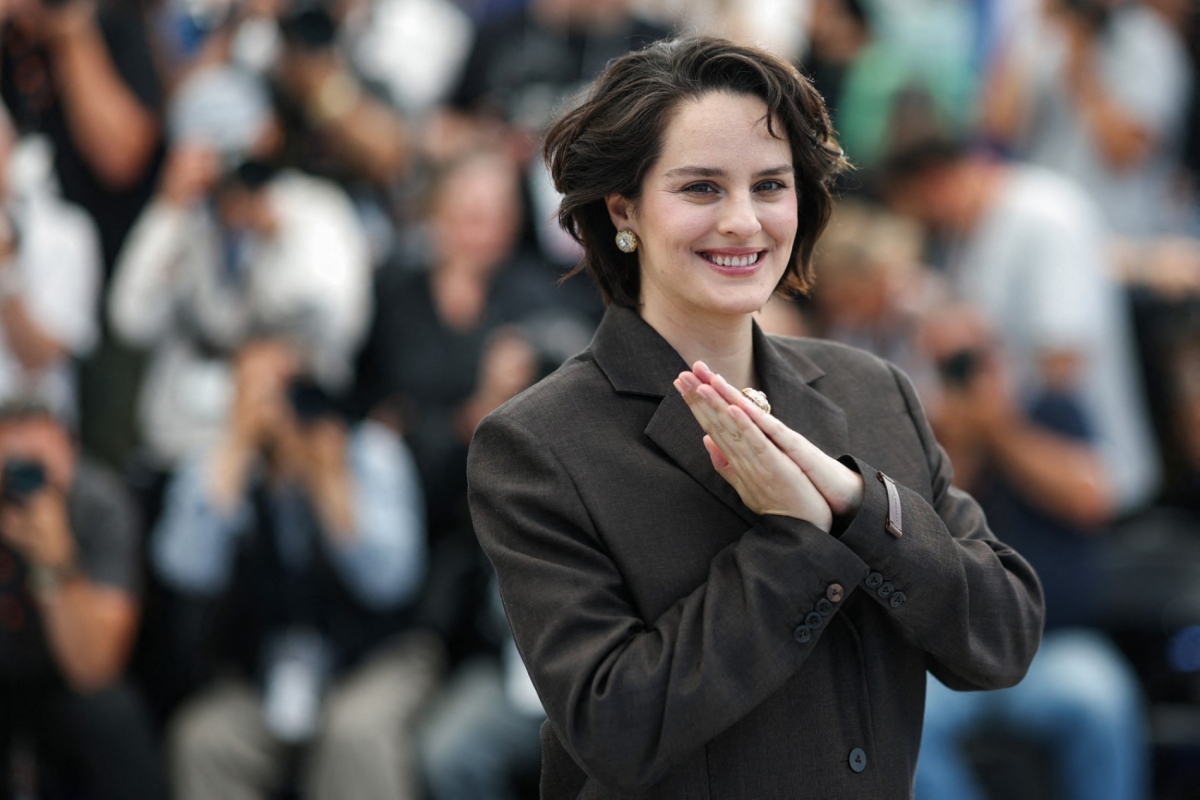

This year, actress and filmmaker Noémie Merlant returned to Cannes with Roma Elastica, Bertrand Mandico’s fourth feature film, presented in the Midnight Screenings section alongside Marion Cotillard. Just a stone’s throw from the Croisette, Al Majalla met the French director and actress in a setting worlds apart from the frenzy of the festival.
Madonna Valentinas
In this baroque sci-fi fable set in a decaying Cinecittà, Merlant plays Valentina, the devoted assistant and make-up artist to Eddie, an ageing movie star portrayed by Marion Cotillard. Valentina also happens to be the name of Merlant’s 2-month-old daughter, peacefully asleep in her mother’s arms during the interview.
“I didn’t have any name in mind at all,” Merlant recalls. “When my partner and I were looking for one, we thought, ‘Valentina would be beautiful.’ Then I realised my character in Roma Elastica was also called Valentina. I think the film must have stayed somewhere in my subconscious.”
For Merlant, the shoot was as exhilarating as it was joyful.
“There was a crazy sense of freedom,” she says. “The shoot was actually very fast, but incredibly enjoyable. Fast, intense, yet completely free of pressure. It was all about play, experimentation, character work. We were allowed to spill over the edges.”
That freedom perfectly aligns with her attraction to characters who refuse convention.
“I love it when you can go really far, when you can embrace something vulgar or trivial. When women are allowed to be more than just an image.”
Merlant accepted the project without hesitation, partly because of her long-standing admiration for French filmmaker Bertrand Mandico.
“My agent didn’t even know I was a huge fan of his films,” she laughs. “To me, that’s cinema. There are very few filmmakers like him, Almodovar maybe? He’s completely outside the system. He doesn’t care about fitting in. He’s searching for sincerity and authenticity.”
She speaks about Mandico with almost childlike enthusiasm.
“I could never be as free as he is, and I’m already pretty free myself. He’s a pure, pure, pure artist. You can stumble upon one of his films without knowing it’s his and immediately recognise his signature.”
What fascinates her most is the way he builds his worlds.
“He draws everything: the costumes, the sets, the shots. Everything is prepared. Yet paradoxically, that gives actors enormous freedom. You’re working within a very strong framework, and that’s precisely what allows you to go much further. As an actress, it’s incredibly reassuring.”
Merlant admits she initially imagined someone far closer to the extravagant energy of his films.
“I thought he would be quite wild, maybe even harsh. In reality, he’s incredibly gentle and remarkably balanced. It makes me think there’s something cathartic in his work. He pours all his madness, violence and obsessions into his films, and in life he’s completely at peace.”
Roma Elastica
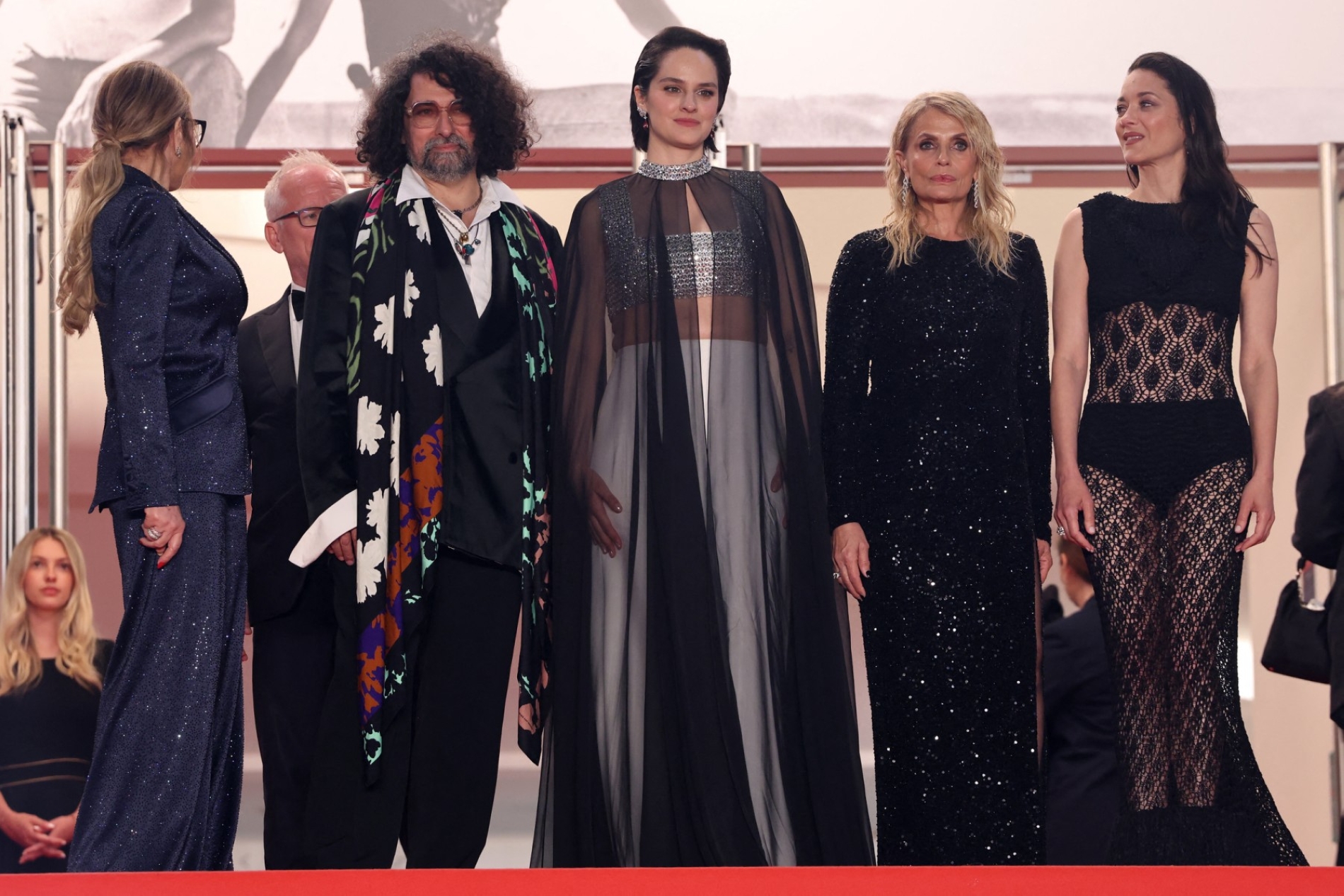
Roma Elastica also reunited Merlant with French actress Marion Cotillard, whom she had first met while working on Lee. Their relationship quickly evolved beyond a simple professional collaboration.
“We spent 15 days together in a place where there was nowhere else to go. We saw each other constantly. We had dinners by the water. It felt magical, she is magical.”
The two actresses quickly developed a deep bond.
“We shared our live stories very naturally and spontaneously. She’s incredibly approachable, very simple in everyday life, and an amazing listener. She loves actresses and gives wonderful advice.”
Similar sentiments were echoed by several French and international actresses, suggesting that Cotillard’s reputation for generosity extends far beyond her performances.
Merlant does not hesitate to describe just how important that encounter became.
“When I met her, I was going through a very difficult period. I kind of held on to her. She was my oxygen mask when I was suffocating.”
In Roma Elastica, where she plays a woman deeply devoted to a legendary actress, the line between fiction and reality occasionally blurs.
“I was playing someone who admires her, loves her, and is devoted to her. In the end, it came quite naturally.”
From the Croisette to Hollywood
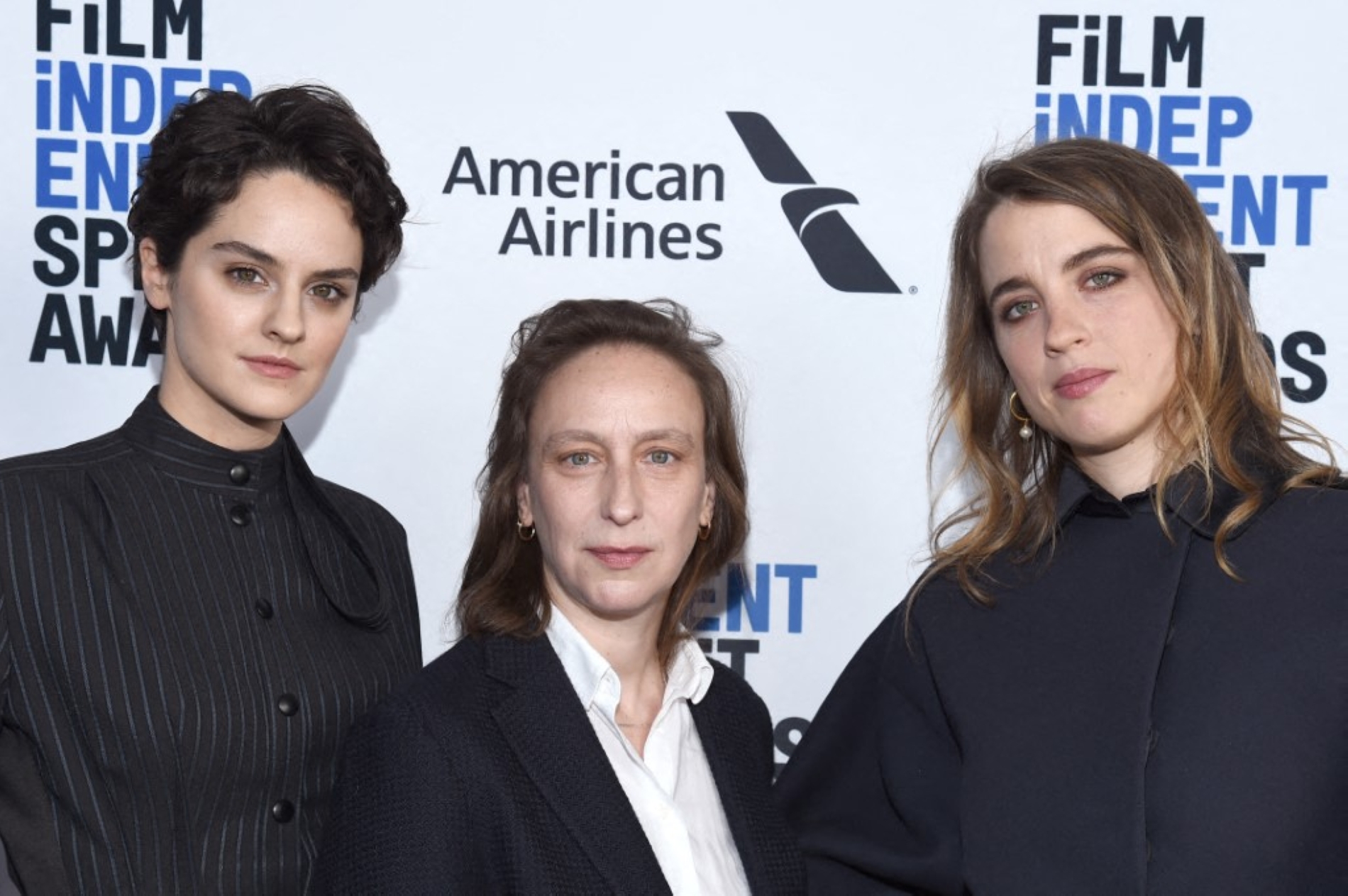
This latest Cannes appearance is part of a long and fruitful relationship with the festival. From Céline Sciamma’s Portrait of a Lady on Fire to Jacques Audiard’s Paris, 13th District and her own directorial effort The Balconettes, Merlant has become one of Cannes’ most familiar faces.
Now equally sought-after as an actress and recognised as a filmmaker in her own right, she continues to build a career that defies boundaries between genres, formats, and artistic disciplines.
While Cannes remains her home base, Merlant’s career has increasingly taken on an international dimension. Having worked in France, Italy, the United Kingdom and the United States, she has become particularly attentive to the different cultures of filmmaking.
“There’s something universal about cinema,” she says. “What changes is the way people approach it.”
She points out that American productions are significantly more structured.
“In the United States, everything is tightly controlled. Nobody goes beyond the framework. The schedules, the preparation, the organisation—everything is highly structured.”
Italy, on the other hand, represents “the complete opposite,” with a more instinctive and flexible approach.
Yet she refuses to rank one system above another.
“Every country has its own charm when it comes to cinema,” she says. “The differences are mostly cultural—working habits, schedules, human relationships on set. There are things we consider normal in France that would be shocking elsewhere, and vice versa.”
Her observations often return to the place of women within these working environments.
“The way people talk to women is not the same from one country to another.”
A reflection that naturally connects with the feminist concerns running through much of her work, both in front of and behind the camera.
Defying the patriarchy
From her early short films—including Shakira, back in 2021—to The Balconettes, Merlant has consistently defended a cinema capable of, in her own words, “cutting the patriarchy into little pieces.”
She is encouraged to see these issues resonating throughout many of the films presented at Cannes this year.
“It feels like people are finally listening. We’re less afraid now.”
Her feminism, however, is never theoretical. It is expressed through characters, bodies, desires, contradictions and imperfections. Through giving women the freedom to be excessive, flawed, sensual, vulgar, poetic—or all of these things at once.
It is also something she recognises in Mandico’s cinema.
“I love the way he portrays women. Vulgar, poetic, elegant, contradictory. Everything at the same time.”
Alongside her acting career, Merlant has been developing a documentary about her family for several years. A deeply personal project focusing on disability, caregiving and her mother’s experience as a caregiver.
“My father is disabled, and my mother is his caregiver. It’s a huge subject. I still don’t know what shape the project will eventually take—a feature film, something else—but it has been with me for years.”