Growing insecurity has states eyeing their own nukes

With China’s nuclear expansion, Russia’s sabre-rattling, North Korea’s new warheads, and America’s future security commitments in serious doubt, Washington’s allies ask: should we get our own?

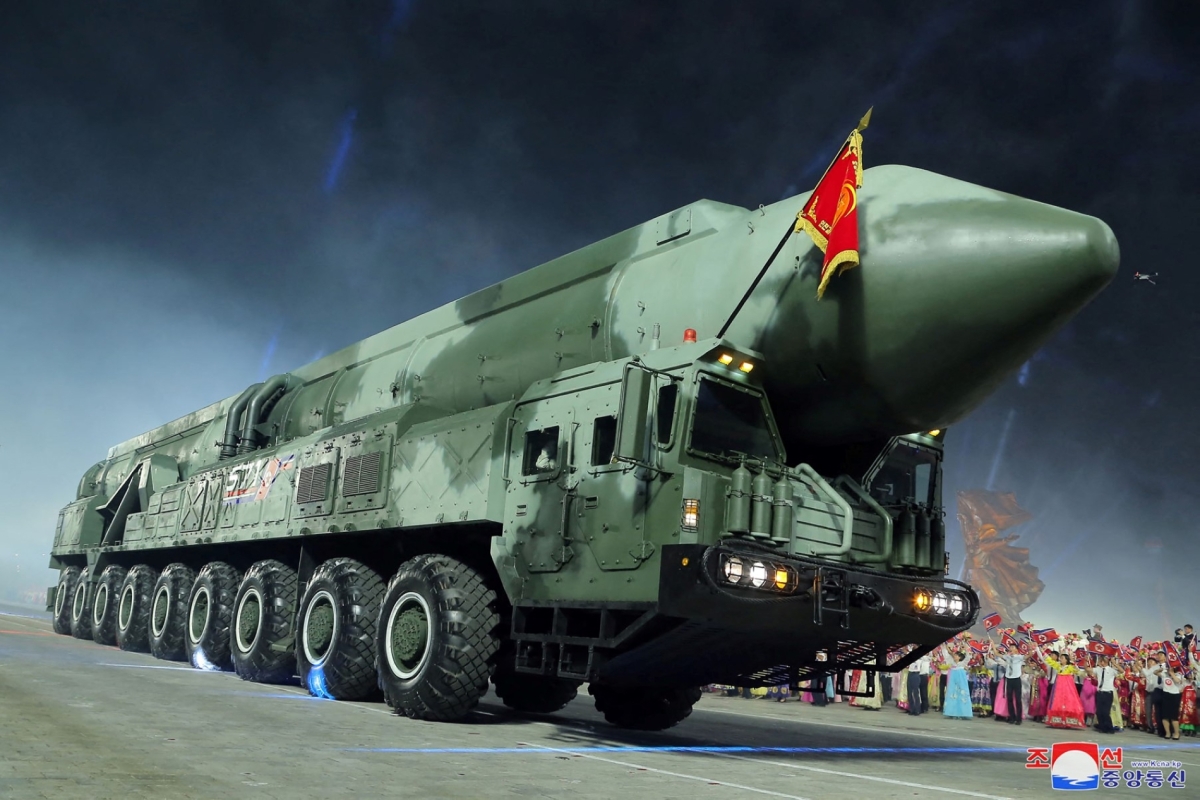
A new model of intercontinental ballistic missile (ICBM), the solid-fuel Hwasong-18, is paraded at Kim Il Sung Square in Pyongyang to mark a key anniversary of the Korean War on 27 July, 2023.
KNS / AFP
A new model of intercontinental ballistic missile (ICBM), the solid-fuel Hwasong-18, is paraded at Kim Il Sung Square in Pyongyang to mark a key anniversary of the Korean War on 27 July, 2023.

Growing insecurity has states eyeing their own nukes

With US-Israeli strikes against Iran earlier this year aimed in part at curtailing Iran’s nuclear ambitions, the subject of atomic weapons has once again risen to the fore in global policy discussions, not least because North Korea is now a nuclear-armed state.

In Europe, states that once counted America as an ally now wonder whether Washington would be there if needed. Few think it would, so there is growing talk of an independent European Union nuclear deterrent, building on the weapons that Britain and France already possess. Likewise, across the Korean peninsula, the South Korean public now supports Seoul having its own arsenal, given Pyongyang’s new capabilities and temperament. Even in Japan, some mainstream politicians have begun to raise a subject long considered taboo in a country where the scars of Hiroshima and Nagasaki are still raw.

Much of this movement stems from doubts over the credibility of the American nuclear umbrella, which for decades meant that states chose not to pursue nuclear weapons of their own. The anxiety comes from the strategic direction of the Trump administration, which has withheld support for Ukraine against Russia, and which has cast public doubt over its commitments to NATO, a transatlantic alliance bound by a mutual defence pact. As a result, states are now examining the development of national nuclear programmes or seeking alternative deterrence guarantees.

In early March, Polish Prime Minister Donald Tusk told the country’s parliament that Poland “must reach for the most modern capabilities, including nuclear weapons”. Similar debates have intensified among current and former officials in East Asia. In Japan, which pledged in 1967 to neither produce, possess, nor allow nuclear weapons on its territory, talk of acquiring such weapons is moving from the margins to the centre of national political debate.

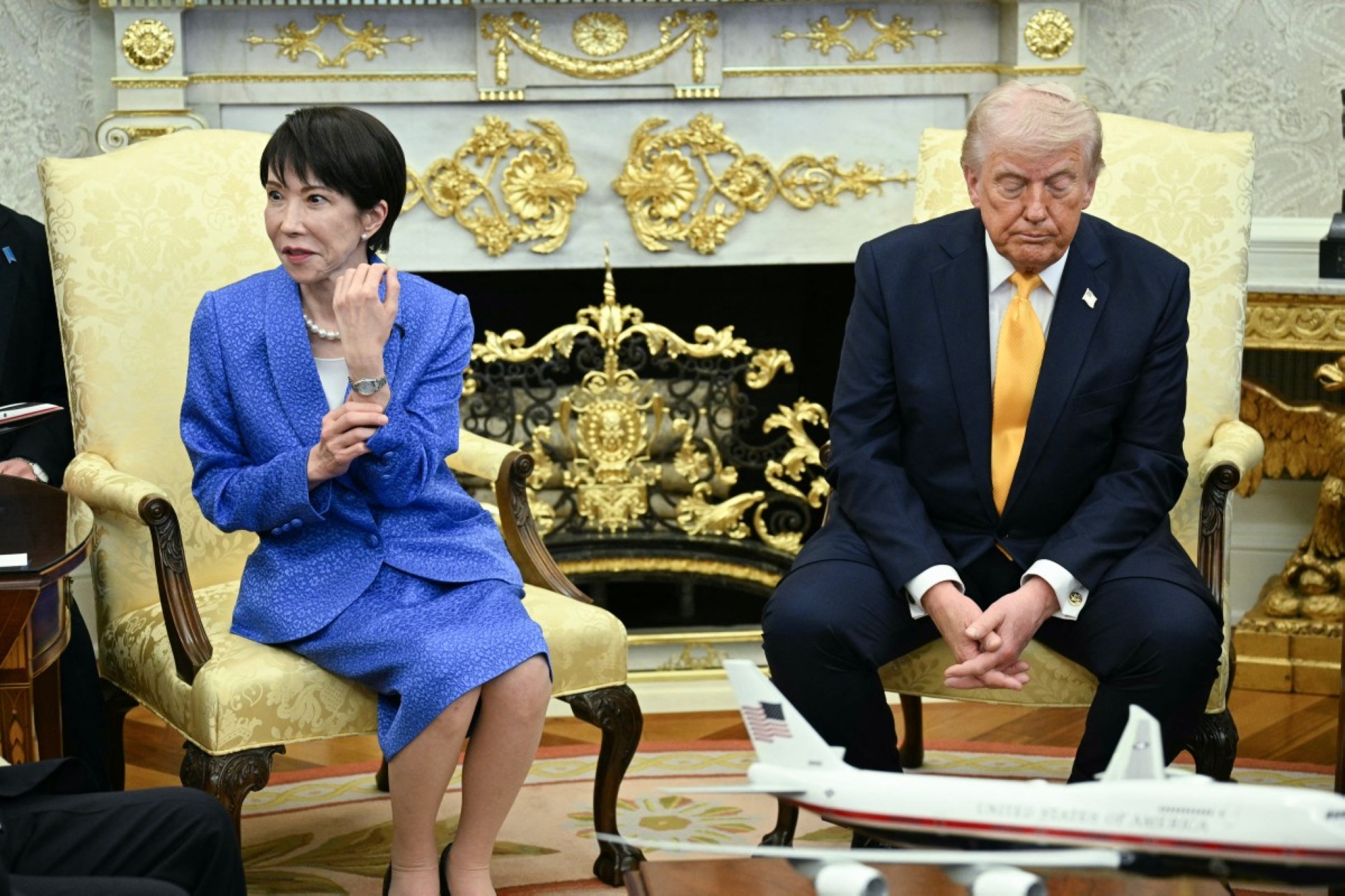
It is no longer a forbidden topic in Tokyo’s corridors of power, and in December 2025, Japanese media reported that a senior government official close to Prime Minister Sanae Takaichi had told journalists that Tokyo should have nuclear weapons. Given Japan is the only country ever to have suffered nuclear attacks in wartime, the statement shocked Japanese society.

Two years earlier, in 2023, South Korea’s then President Yoon Suk Yeol said Seoul might need to “deploy tactical nuclear weapons or develop them” through its own capabilities. His successor, Lee Jae Myung, adopted a more cautious tone, but South Korean society supports such a course—a poll conducted by the Asan Institute in April 2025 showed that 76.2% of South Koreans want homegrown nuclear weapons.
Jim WATSON / AFP
US President Donald Trump meets with Japan's Prime Minister Sanae Takaichi in the Oval Office of the White House in Washington on 19 March 2026.

Growing insecurity

Bilateral alliances with the United States have long formed the cornerstone of security for both Japan and South Korea, but the American security guarantee no longer commands the confidence it once did. US military power in the region has declined relative to China’s, and Trump’s disdain for alliances—evident in his recent threats to withdraw from NATO—raise fears that the US might abandon its Asian allies, too.

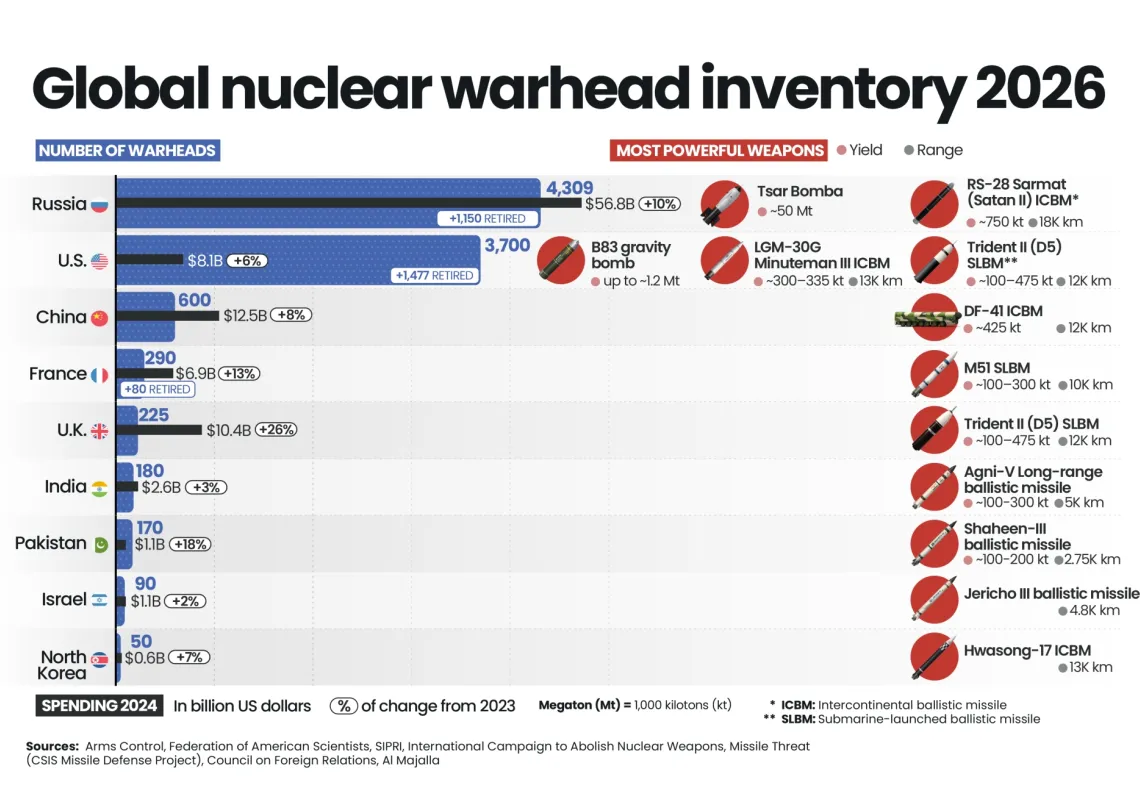
China has deepened this sense of insecurity by expanding its military capabilities, including its nuclear forces. The US Department of Defence estimates that China has more than 600 operational nuclear warheads and could exceed 1,000 by 2030. After Prime Minister Takaichi said in November that a crisis over Taiwan might require the deployment of Japan’s Self-Defence Forces, Chinese officials responded with hostile rhetoric, export restrictions, and a reduction in Chinese tourism.

Russia has helped to undermine regional security. Its full-scale war on Ukraine in 2022 showed that nuclear-armed states can attack non-nuclear neighbours and use the threat of nuclear escalation to deter third-party intervention. The consolidation of ties between Russia and North Korea, embodied in the 2024 Comprehensive Strategic Partnership Treaty, led Tokyo and Seoul to assume that Russia is providing technical assistance to Pyongyang. In April, the International Atomic Energy Agency (IAEA) noted a “very serious increase in North Korea’s nuclear weapons production capabilities”.

Despite having all the technology needed to produce them, Japan is unlikely to seek nuclear weapons soon, given the sensitivity of the past. South Korea presents a different case, however. Its earlier nuclear legacy, together with strong public support, creates a real possibility that it may acquire nuclear weapons in the future, despite the current centre-left government’s adherence to a policy of nuclear abstention.

Despite decades of warnings from nuclear non-proliferation experts, the entry of new members into the nuclear club now looks plausible. With an alignment emerging between Russia, China, and North Korea, and with American security commitments receding, Japan and South Korea may seek admittance, especially since last month’s media reports that North Korea had amended its constitution to require a retaliatory nuclear strike if its leader, Kim Jong Un, is killed. The Telegraph reported that the amendment came against the backdrop of the killing of Iran’s Ali Khamenei.

According to South Korea’s National Intelligence Service, the updated North Korean clause states that “if the command-and-control system of the state’s nuclear forces is endangered by attacks from hostile forces... a nuclear strike shall be launched automatically and immediately”. This replaces the nuclear doctrine adopted in 2013, which stipulated that North Korea’s nuclear weapons “may only be used by a final order from the Supreme Commander of the Korean People’s Army (Kim) to repel an invasion or attack by a hostile nuclear-armed state and to carry out retaliatory strikes”.
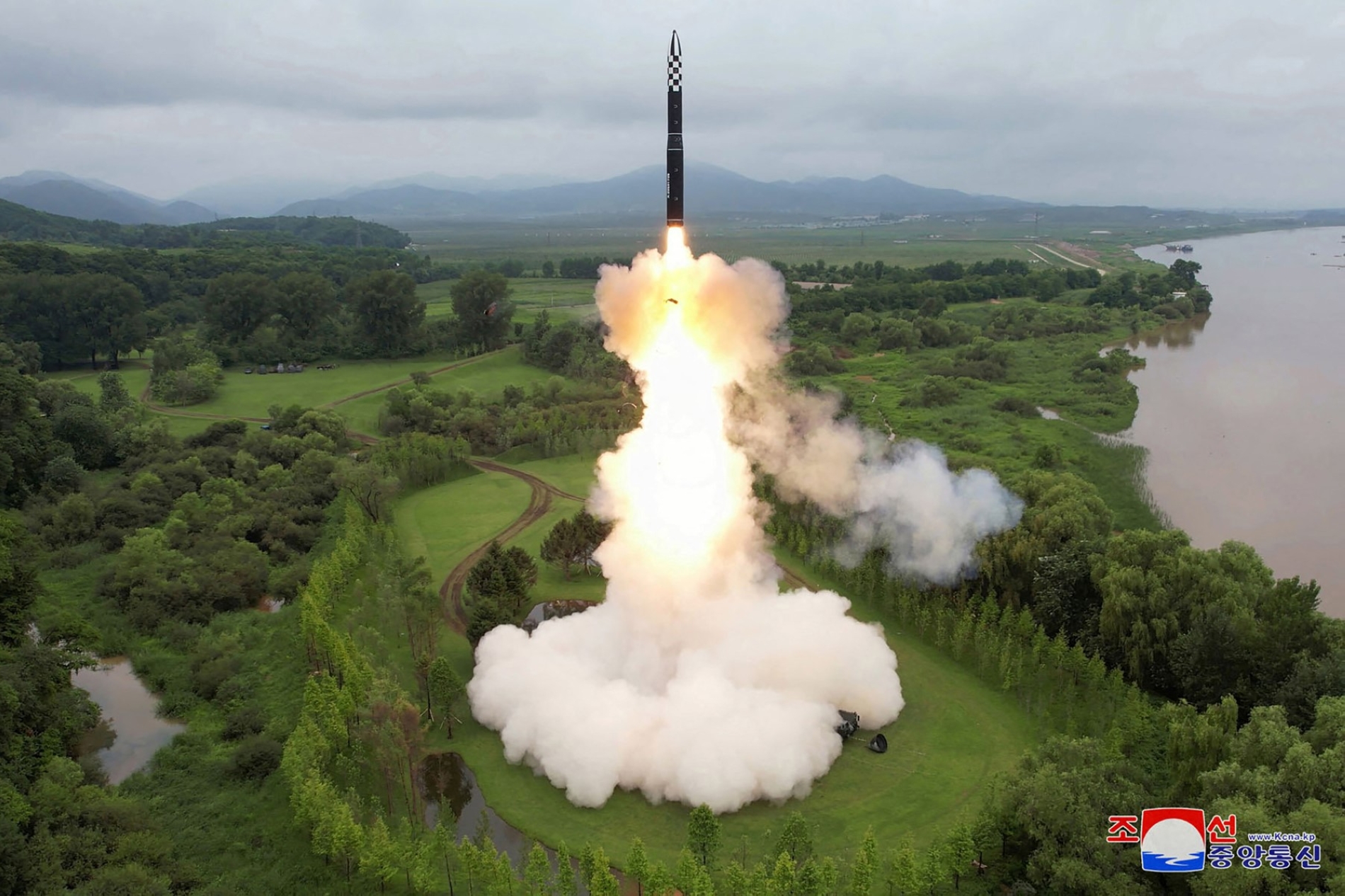
KNS / AFP
The intercontinental ballistic missile (ICBM) "Hwasong-18" is fired at an undisclosed location in North Korea in this picture released on 13 July 2023.

Last month, Kim pledged to further strengthen his country’s nuclear capabilities while maintaining a hardline posture towards South Korea, which he described as “the most hostile state”. Pyongyang withdrew from the Nuclear Non-Proliferation Treaty in 2003 and conducted its first nuclear test in 2006. Ever since, it has sought to develop advanced nuclear weapons and ballistic missiles and describes its nuclear-armed status as “irreversible”.

According to the US intelligence community's 2026 Annual Threat Assessment, North Korea has around 50 nuclear warheads and long-range missiles like the Hwasong-18, with a 15,000km range. In April 2026, a US defence official told a hearing that North Korea's nuclear forces are "increasingly capable of targeting the US homeland", and that its missile forces are "capable of striking South Korea and Japan with nuclear or conventional warheads".
US security guarantees no longer command the confidence of allies they once did

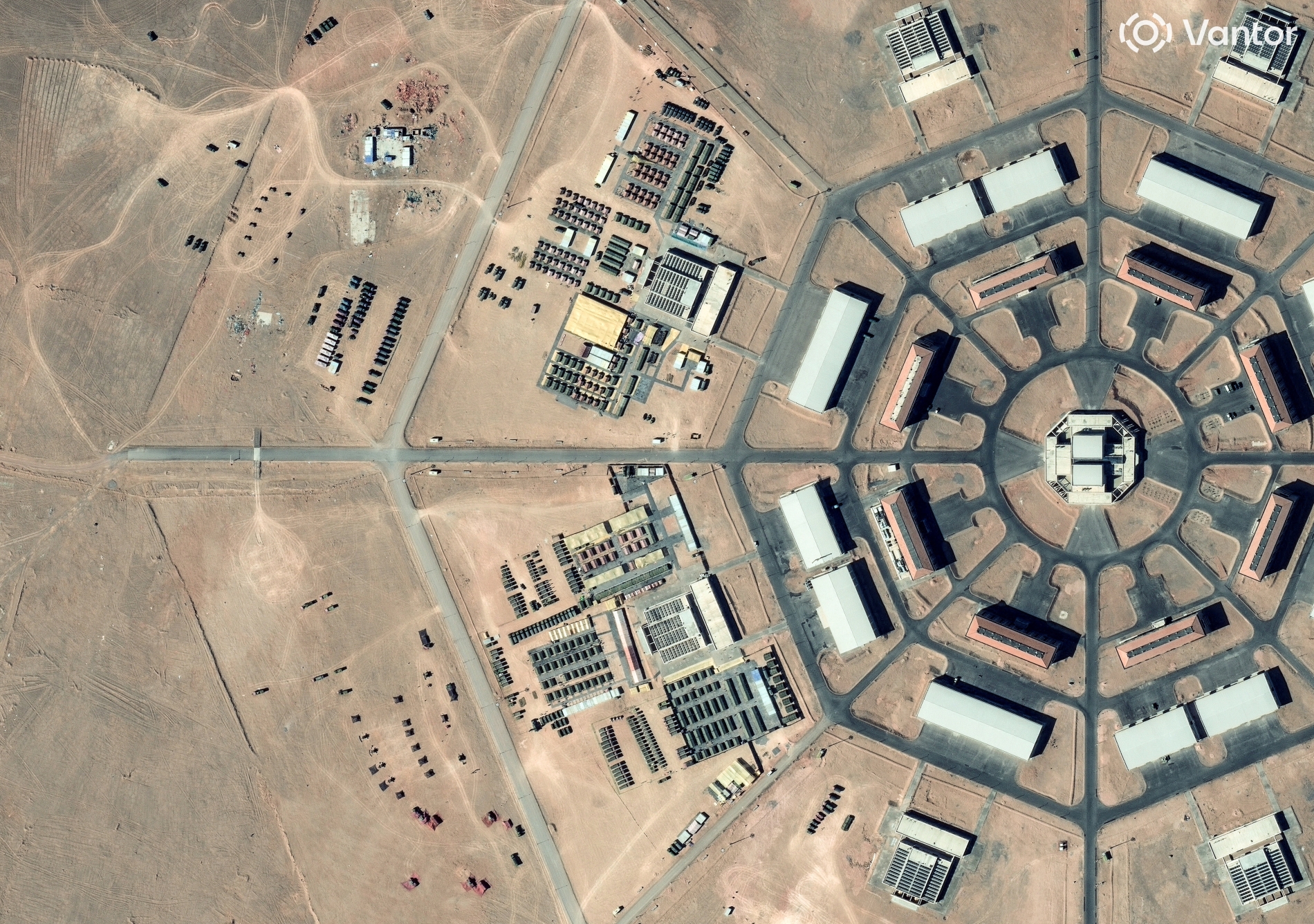
Adding to the unease is China's nuclear expansion, which is yet more cause to unnerve Japan and South Korea, neither of whom enjoys easy relations with Beijing. On 29 May, Reuters reported that China was building launch pads near its remote nuclear missile silos in north-western desert areas, citing satellite images showing more than 80 such pads that could be used by China's expanding fleet of mobile missile launchers and air-defence batteries.

The images also showed facilities that may be used for electronic warfare, satellite communications, and command operations, according to three security analysts who assessed them for Reuters. The scale of the project points to a vast expansion of infrastructure for China's land-based nuclear forces that would allow Beijing to launch a nuclear retaliatory strike in response to any attack. Although the Chinese military can launch nuclear weapons from submarines and aircraft, the silo fields in north-western Xinjiang and Gansu province form the core of its nuclear land forces.

Vantor/REUTERS
A satellite image shows military activity underway at the Xinjiang octagon-shaped installation, with large tents and a range of military vehicles, in the Xinjiang Uyghur Autonomous Region, China, on 30 April 2026.

Chinese warning

The intensifying nuclear competition between the US and China comes as the latter raises tensions over Taiwan, which Washington considers to be an independent state, but which Beijing considers to be a breakaway province. Last month, Xi warned Trump that mismanaging their differences over Taiwan could lead to "a dangerous situation". Western diplomats and analysts think that China could threaten to use a nuclear weapon as a deterrent to keep America and others out of any conflict over Taiwan.

China's declared policy has long been to maintain a limited yet credible nuclear deterrent, grounded in the capacity to retaliate if subjected to a pre-emptive strike. The principle of 'no first use' remains the cornerstone of Chinese nuclear doctrine, however, and China also commits itself not to launch a nuclear strike against states that do not possess such weapons. On 22 August, China's Ministry of Defence said that "a nuclear war cannot be won and must not be fought". It added that China adheres to "a self-defensive nuclear strategy and adopts a policy of no first use of nuclear weapons".

China became the world's fifth nuclear-armed state in 1964. In recent years, it has increased the number of its nuclear warheads while modernising its strategic missile forces and fleet of nuclear submarines, making its arsenal the third largest in the world. It possesses a full nuclear triad (meaning that missiles can be launched from the land, air, and sea) comprising nuclear-capable strategic bombers, intercontinental ballistic missiles and submarine-launched ballistic missiles.

Macron said France would increase its nuclear arsenal without giving specifics

Russian sabre-rattling

After the New Strategic Arms Reduction Treaty (known as New START, the last binding nuclear arms-control agreement between Russia and the US) expired on 5 February, US President Donald Trump proposed an "improved" agreement to include China, but Beijing has little incentive to limit its nuclear arsenal, especially given America's actions in Venezuela and Iran, and its rhetoric towards Greenland and Cuba.

The joint Russian-Belarusian manoeuvres held in Belarus from 19-21 May offered the Kremlin another opportunity to display its nuclear capabilities. The exercises involved the land, air and naval components of Russia's nuclear triad and included the launch of missiles capable of carrying nuclear warheads. They coincided with Ukraine's largest drone attacks on targets inside Russia and with rising tensions in the Baltic region.

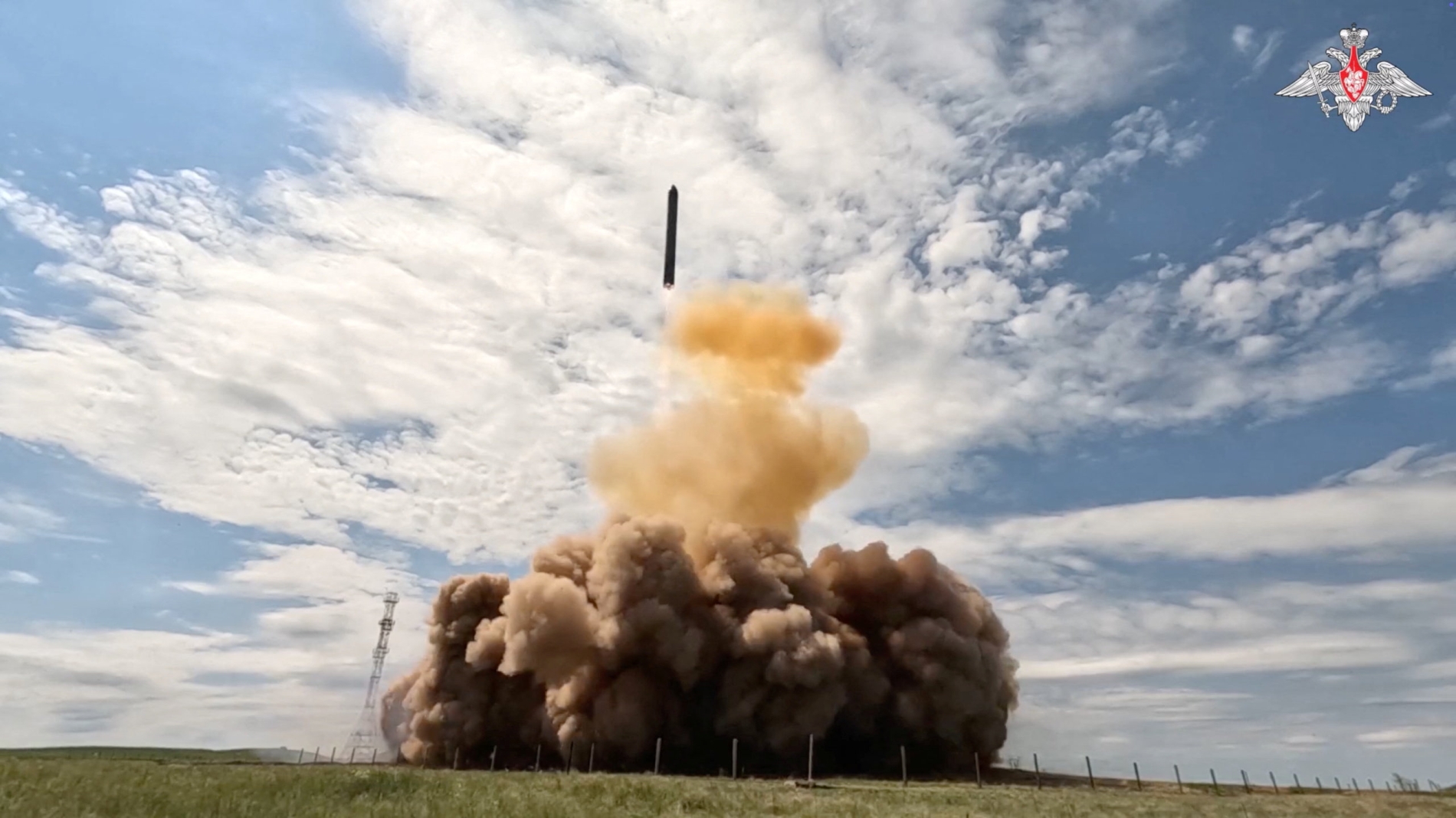
Although these manoeuvres were not exceptional in themselves (Russia regularly conducts exercises involving its nuclear forces), the Kremlin used them to increase political pressure on Ukraine and its allies by announcing drills involving tactical nuclear weapons and transferring nuclear warheads to field storage sites in Belarus. Ahead of the exercises, Russia carried out another test of the Sarmat intercontinental ballistic missile, which can carry ten or more nuclear warheads. The Kremlin intends to put it into service by the end of 2026.

Russian Defence Ministry/REUTERS
A test launch of Russia's Sarmat intercontinental ballistic missile at an unidentified location, in this still image taken from a video released on 12 May 2026.

Some in Russia still advocate a limited nuclear strike against Ukraine to end the war on Moscow's terms. Since the 2022 invasion, Russia has repeatedly threatened to do so whenever it has suffered military setbacks or international support for Ukraine has grown, with Putin ordering Russia's nuclear deterrent forces to be placed on high alert as Russian troops first crossed the border.

Months later, as Ukraine fought back, Putin declared that Russia was prepared to use "all available means," adding: "This is not a bluff." Although the threats did not halt support for Ukraine, it made Kyiv's allies more cautious by raising the political cost of expanding military assistance.

Potent and poised

Russia has significantly reduced its stockpiles compared with the peak of the Cold War, but it still has one of the largest and most dangerous nuclear forces in the world. Poor relations with the US have hindered arms-control diplomacy. According to US estimates, Russia has around 1,710 deployed nuclear warheads ready for launch from land-based missile platforms, strategic bombers, and nuclear submarines.

Moscow has modernised its nuclear triad by introducing new missiles and submarines, while working on new bombers. In parallel, it has developed medium-range missiles capable of carrying nuclear warheads to offset the West's superiority in conventional weapons. Among these is the Oreshnik missile, which has been used in Ukraine.

Russia also possesses the world's largest stockpile of non-strategic, or tactical, nuclear weapons, and has dual-capable systems, able to carry either conventional or nuclear warheads, including precision-guided missiles not constrained by arms-control agreements. These systems can be fitted with nuclear warheads for use as non-strategic nuclear weapons. Moscow has rejected US attempts to limit these weapons, regarding them as a means of balancing the conventional superiority of the US/NATO.

Reuters
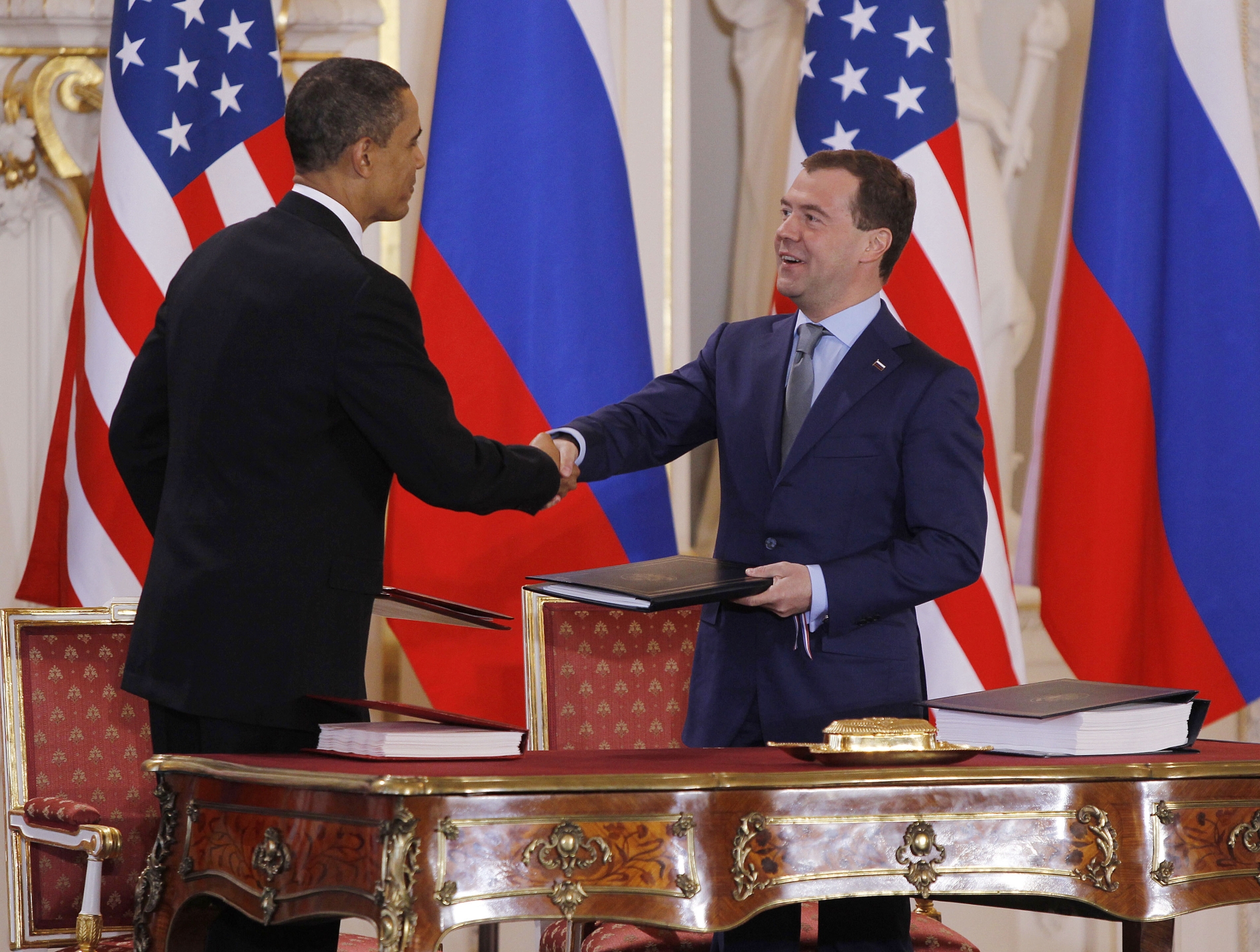
US President Barack Obama and Russian President Dmitry Medvedev shake hands after signing the new Strategic Arms Reduction Treaty (START II) at Prague Castle, Prague, on 8 April 2010.

The risks of sliding into an arms race, or even a nuclear confrontation, increased further when Trump rejected Putin's one-year extension to New START in 2025. At the time, he also announced that the US would resume nuclear testing for the first time in nearly 30 years, although he appeared to confuse the testing of missiles capable of carrying nuclear warheads with the testing of the warheads themselves. The last US nuclear warhead detonation took place in 1992.

Pushing the nuclear envelope

Amid growing European fears over declining American engagement in the defence of the continent, French President Emmanuel Macron said in early March that France would strengthen its nuclear arsenal and revealed a significant shift in French deterrence doctrine, allowing the temporary deployment of French nuclear-capable aircraft in allied European states for the first time.

France has one aircraft carrier, the Charles de Gaulle, which can carry nuclear weapons delivered by Rafale fighter jets using catapult-assisted take-off. It also has four nuclear-armed submarines, each capable of carrying 16 ballistic missiles fitted with multiple nuclear warheads. France has 290 nuclear warheads, according to the latest estimates by the Stockholm International Peace Research Institute and the Federation of American Scientists. Macron said this would increase, without giving specifics.


"The next 50 years will be the age of nuclear weapons," he said, adding that eight European states would take part in what he referred to as 'advanced deterrence'. The new French nuclear strategy extends the policy of French strategic independence launched by former President Charles de Gaulle, rooted in the conviction that "the Americans are, of course, closer to France than the Russians, but the US also has its own interests, and one day those interests may conflict with France's".

In the 1960s, de Gaulle formulated the idea of sovereign French nuclear deterrence, which now lies at the centre of Europe's security debate. Some countries, including Norway, Poland and the Baltic states, welcome the French initiative, but question how it would work with fewer than 290 French nuclear warheads, even if this was supplemented by the roughly 250 nuclear warheads held by Britain.

Since the French commitment offers no guarantee that France would use nuclear weapons in the defence of its allies, and rests instead on the use of France's nuclear deterrent to protect its "vital interests," the harder question is whether Macron's offer will reassure European allies or push them to seek solutions of their own. This all adds to the atmosphere of instability, increasing the risks of a nuclear arms race and raising the possibility that nuclear weapons will be used for a second time.

font change