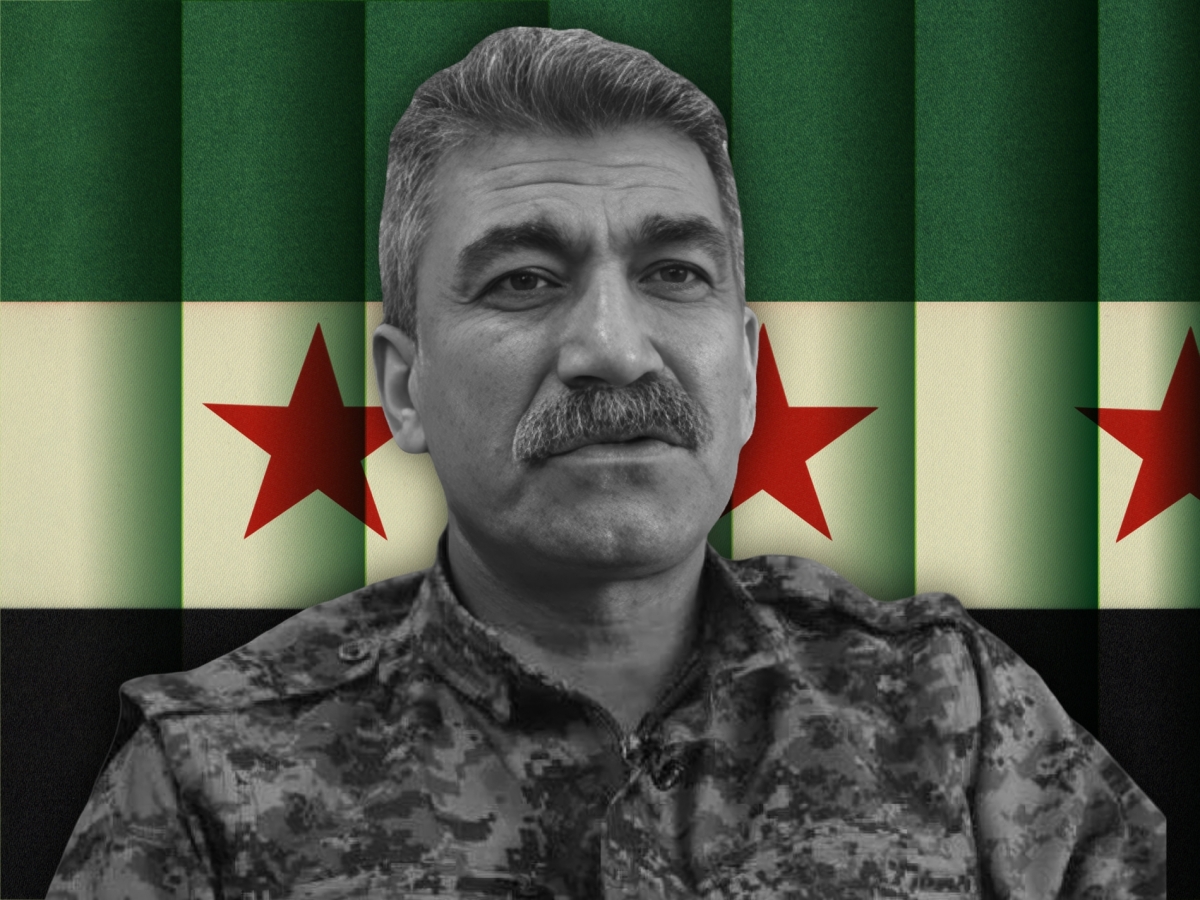
Sipan Hamo on integrating Kurdish units into the army

In Part 2 of a two-part interview, the newly appointed deputy defence minister outlines the mistakes made by the SDF and gives his outlook on Syria's future.

Al Majalla

Sipan Hamo on integrating Kurdish units into the army

In Part 1, the Kurdish-Syrian leader Sipan Hamo spoke of his upbringing, politicisation, and participation in armed struggle, which led him to found the Kurdish People’s Protection Units (YPG), and to several periods of detention, both in Syria and abroad.

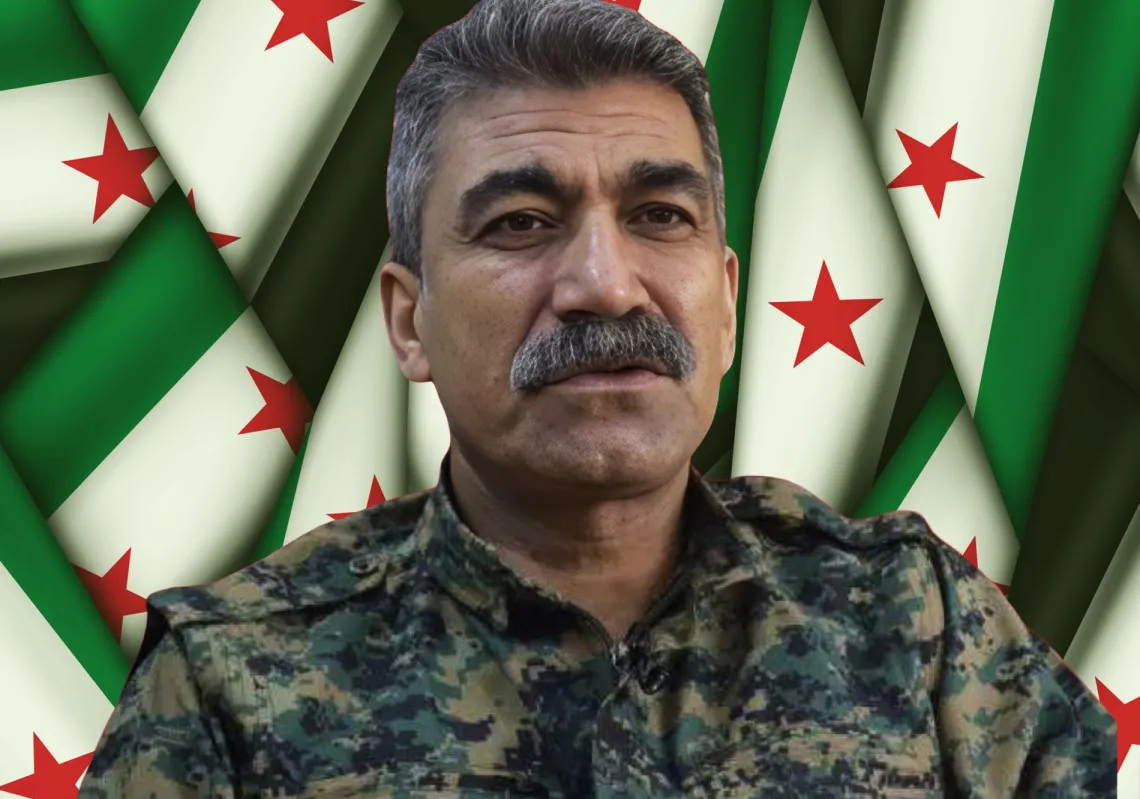
Recognised as a hardliner and known as a former member of the PKK (globally recognised as a terrorist organisation), he was the surprising choice to become Syria’s new Deputy Minister of Defence for the Eastern Regions, a post he took up in recent days. One of his main tasks now is to integrate armed Kurdish brigades into Syria’s new national army, at a time of tension and clashes in the north.

In this second instalment of a fascinating and wide-ranging interview, he speaks about the history of Kurds in Syria, both how they played a part in the foundation of the modern state and how they will play a part in the rebuilding work required today. A realist and pragmatist, he shares his hope that better days lie ahead.

Hamo told Al Majalla why he has been impressed with Syria’s President Ahmed al-Sharaa so far, but warns that there are those who seek to pull Syrians apart. He also addresses the idea that there is an inherent conflict between Arabs and Kurds, an idea he dismisses as nonsense. They have been partners in the past, he says, and can be partners again. As long as the Arab majority does not seek to marginalise the Kurdish minority, the Kurds will defend Syria until their dying breath.

It is a fascinating conversation with someone who could be pivotal in the task of integrating a well-armed minority in Syria’s north-east, a process that is now underway. Success in this would have a big impact on Syria’s territorial integrity and internal cohesion, at a time when there are also problems with its Druze minority in the south.

Below is the second and final part of the interview, conducted by phone on 21 March.
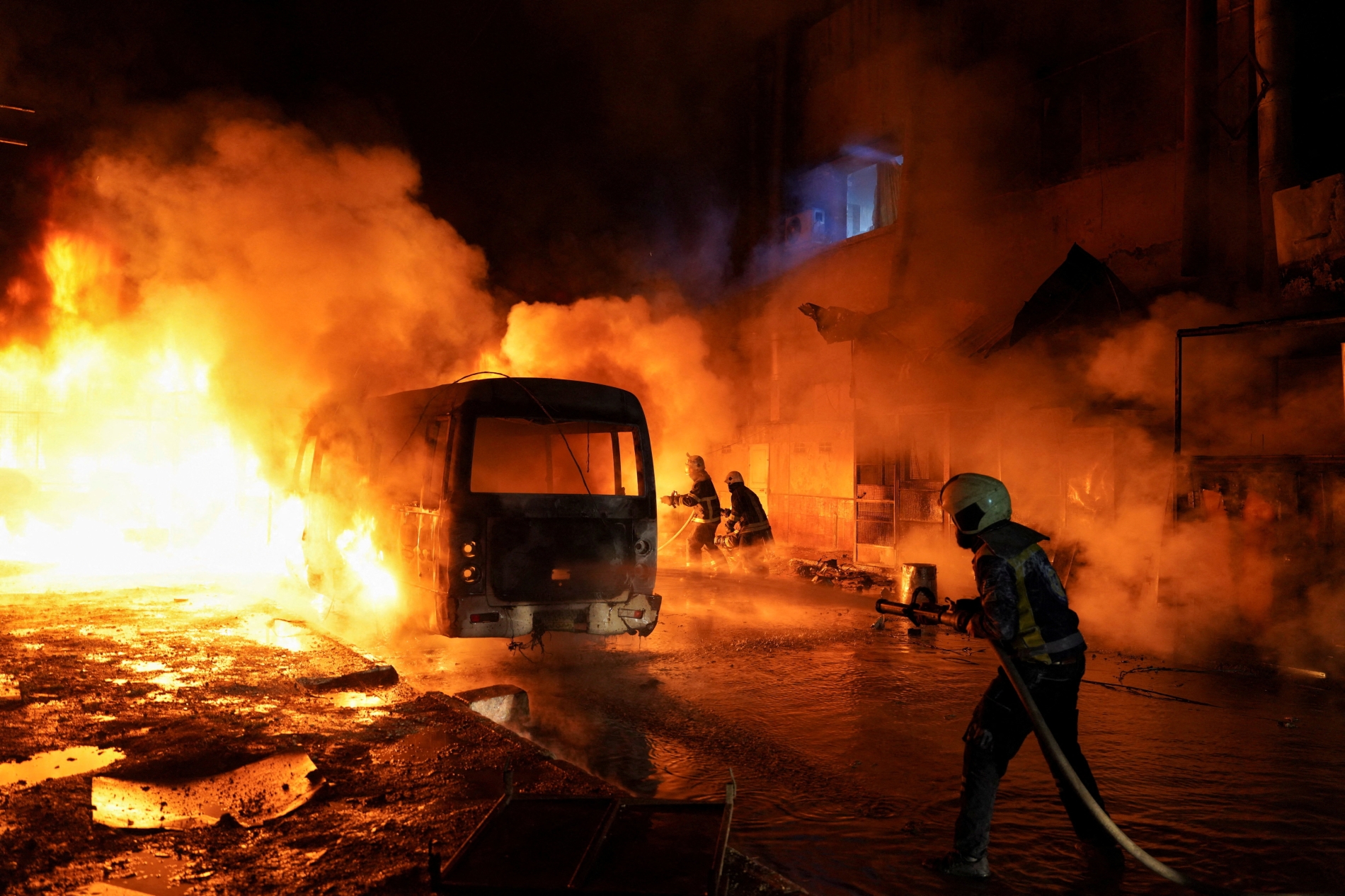

REUTERS/Karam al‑Masri
Members of the Syrian Civil Defence work to extinguish a fire after shelling amid renewed clashes between the Syrian army and the Syrian Democratic Forces in Aleppo, Syria, on 8 January 2026.

Clashes broke out in January (between the government and the SDF). What was your take on that?

Frankly, mistakes were made on our side. We assumed that the international community was with us, and that if any dispute arose, it would stand by us. That proved mistaken. The Syrian situation had changed, and the fall of the regime amounted to the complete end of the Sykes-Picot order. We are entering a new phase and should have read the situation more carefully.

We assumed certain parties would not abandon us, given that we had fought the Islamic State together, but their interests drew them towards Damascus, and international opinion stood with Damascus across the board. Had we understood that, we could have negotiated more effectively. The latest clashes were unnecessary.

Were some betting on Israel intervening on the SDF’s behalf? Did Washington's abandonment come as a shock?

Yes, perhaps there was a wager on Israel or America, on the grounds that we fought alongside them. It is even said that we helped Trump get re-elected because of the victories against IS. But popular sentiment is one thing; policy is another. Europeans and Americans may feel sympathy for the Kurdish people or appreciate the Kurdish position, but politics differs from public emotion. Some misread the situation. It is now clear that Israel is focused on southern Syria, where it is almost in full control. It does not want the theatre to expand further in ways that might slip beyond its control.

Do you feel that the Americans betrayed the Kurds?

I would not use the word betrayal. I see it as a matter of interests.
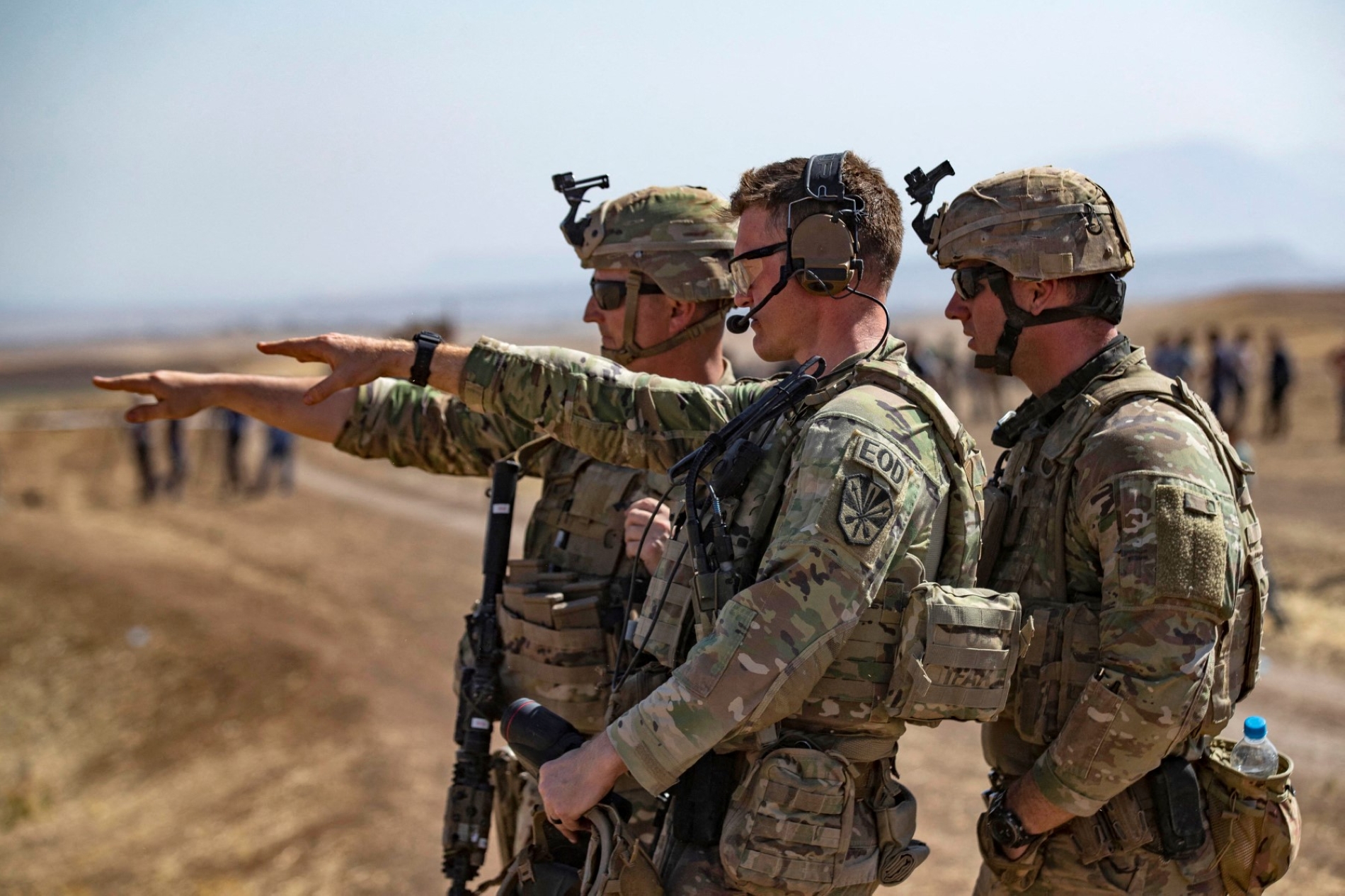
Delil Souleiman/AFP
Troops from the US-led coalition against Islamic State (IS) training SDF fighters in Syria's north-eastern Hasakah province on 7 September 2022.

The agreement was reached on 29 January. The last person anyone expected to be appointed deputy minister of defence was you, because you are seen as the hardline figure. Is that an unfair impression of you?

Honestly, I don’t consider myself especially hardline.

The perception is that you are the representative of Mount Qandil, the man who wanted to fight the Syrian army. Are you a military man, or a man of peace?

I support conciliation and peace. True, I am a military man, but understanding cannot be achieved by military means. No one can reach civilisation, development, or progress in that way. Countries that emerged from conflict later went on to develop. I came only to build very good, positive relations between us and the new state on that basis, but that image (of me) spread. Perhaps the world wanted to take its precautions until matters reached this point.
I don't think there are any ties between the SDF and Iran now. When Iran was in Syria, there was some contact, but in my view, that has now ended.

Sipan Hamo, Syrian deputy defence minister

On 28 January, how many SDF forces were there?

Around 70,000.

And after, once the tribes withdrew?

We were incorporated into the army as brigades. Each is formally set at 1,300 fighters. Our actual numbers, however, are considerably higher. If we decided to, we could probably field another eight.

What of those who did not join the brigades?

We are studying with the Ministry of Defence how to organise their affairs, how to incorporate them into the army, and how they will retire if they are to be demobilised. We are also looking at the disabled and the families of the martyrs.

How many Asayish (domestic security personnel) are there?

I don't have a precise figure, but their numbers were significant. In Jazira, there are around 8,000 at present.

So four brigades—three in Hasakah, one in Kobani. The earlier agreement (on 4 January) was to form three separate divisions, along with a women's brigade and a counterterrorism brigade...

The female component was rejected. We're still trying.

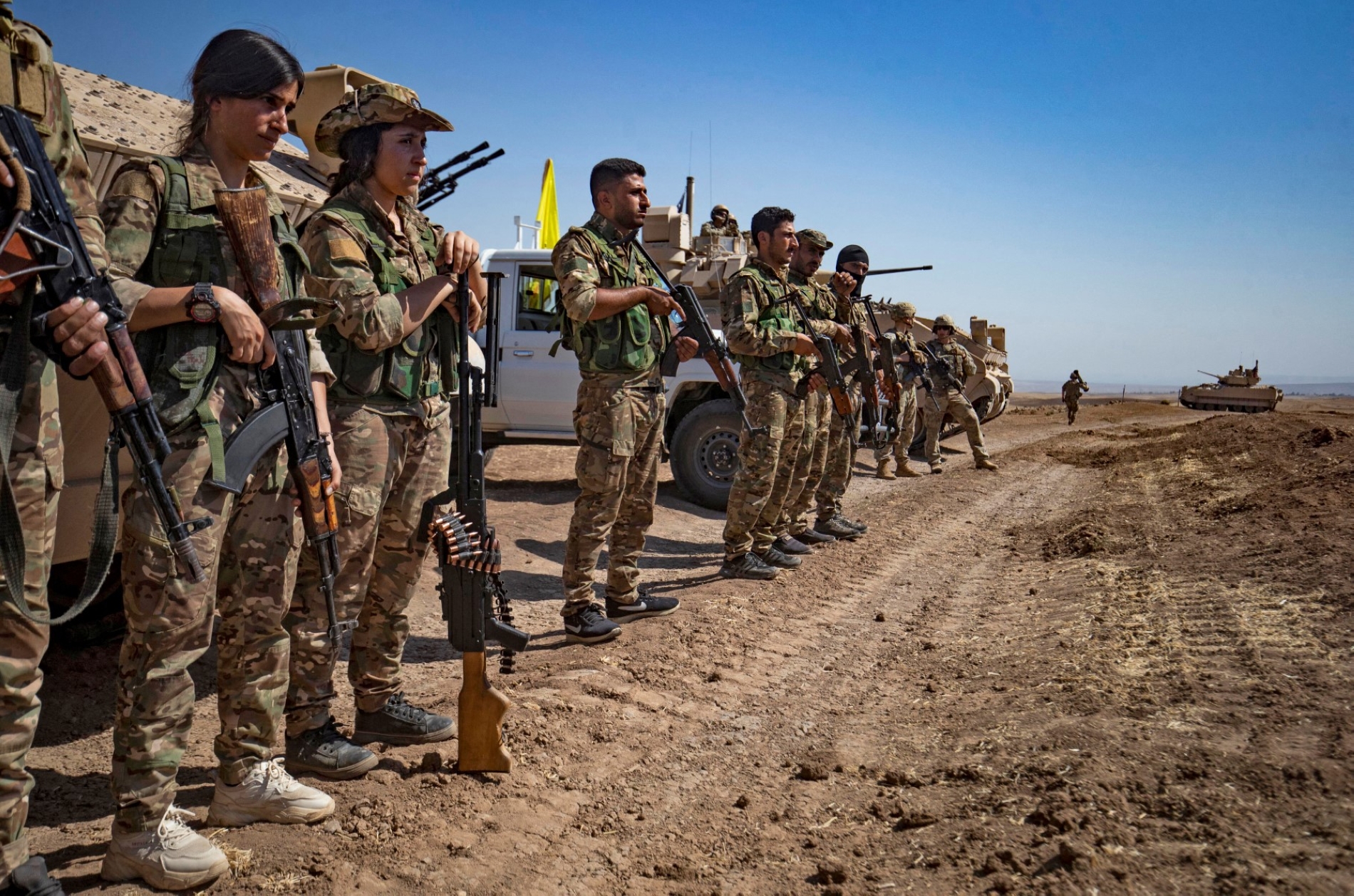
Delil SOULEIMAN / AFP
SDF forces participate in a joint military exercise with the US-led Operation Inherent Resolve coalition against the Islamic State (IS) in Syria's northeastern Hasakah province on 7 September 2022.

Is the arrangement not for women to remain in place, with a women's battalion attached to each brigade?

Women are not being incorporated into the formal army structure. In our areas, women already serve in these roles. They (the government) simply do not recognise them (women) as part of the military establishment.

In Hasakah, there is a division called the Hasakah Division...

Yes. Its commander is Ahmad al-Ayed.

Does he report to you?

No. Ahmad al-Ayed is a known figure. He is the commander of the 60th Division.

Has the deployment area of the three brigades been determined?

Hasakah, Qamishli, and Derik.

The agreement was that the Syrian army would not enter Kurdish-majority areas...

Correct.

Is that still being implemented?

Of course.

The agreement included the nomination of a person for the post of Deputy Minister of Defence. More than one person was nominated...

There were two candidates: I was one of them, and the other was Jiya Kobani.

There are four other deputy ministers: three from Idlib and one Turkmen. The defence minister is from Hama, and you are Kurdish. How do you understand that?

I learned of the composition only after my appointment. I hope the institutions of the state will be open to all components, without exclusion or marginalisation.

Syrian Foreign Ministry
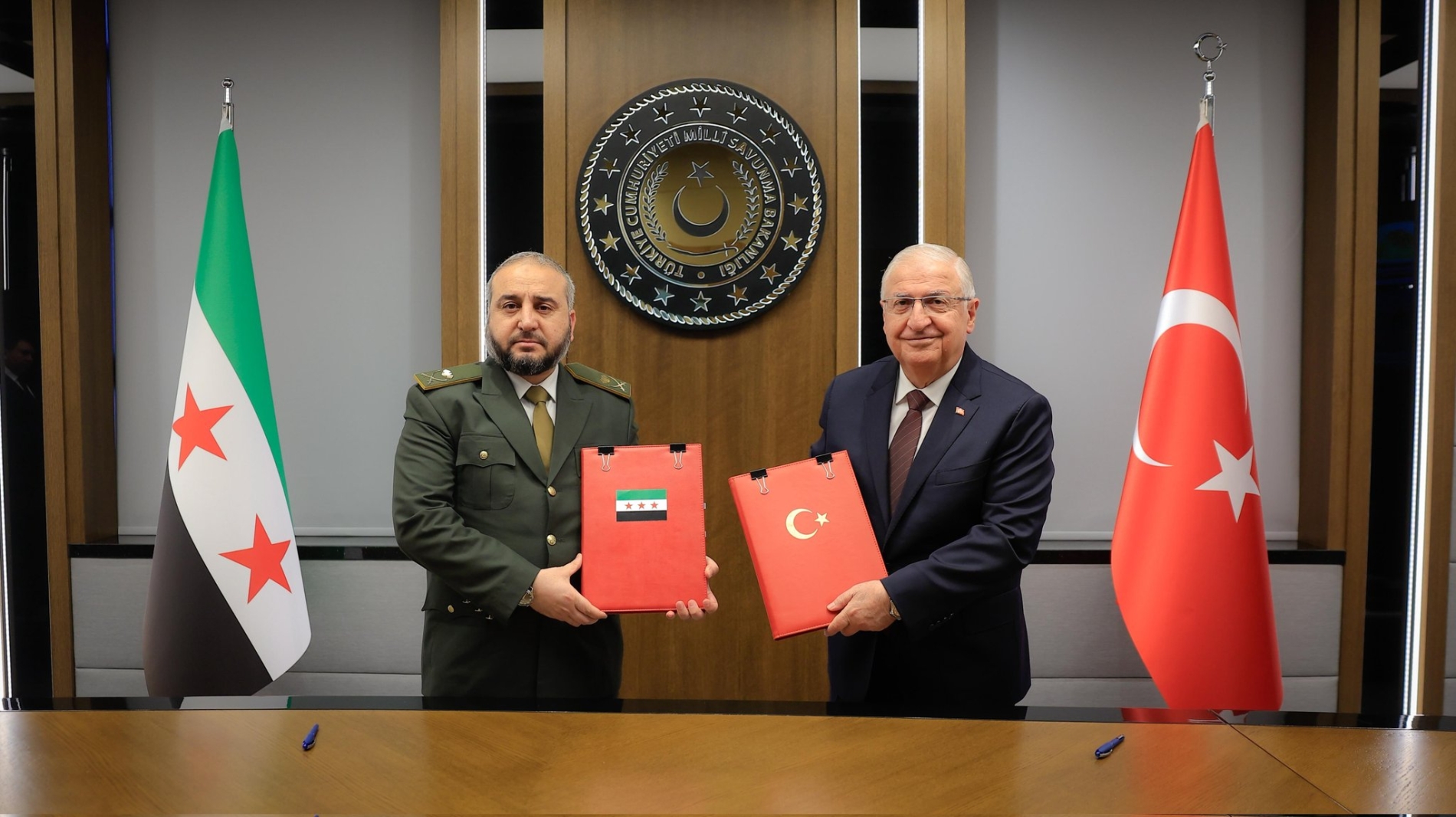
Syrian Defence Minister Murhaf Abu Qasra and Turkish Defence Minister Yaşar Güler hold up an MOU on security cooperation in Ankara on 13 August 2025.

Have you met Defence Minister Maj. Gen. Murhaf Abu Qasra?

Yes. Once my appointment was formally confirmed, he wished me success. I submitted the official paperwork, we took a photograph with the minister, and that concluded the matter. I then returned to the region.

In principle, responsibility for the Eastern Region is meant to rest with me, and the military forces stationed there are supposed to come under the Ministry of Defence through that arrangement. But the situation on the ground still requires time and effort to address. Managing these complexities, calming tensions, and preparing society to accept the new reality all require sustained work.

I have a network of relationships and am trying to expand and strengthen it, but in practice, my direct channels of communication remain focused mainly on our own forces. As for other forces, coordination with them remains in place. Our own forces, of course, remain disciplined, under control, and still with us.

When your appointment was announced, were your powers clearly defined?

Yes. They were set out through an assignment, or through an appointment issued by the Ministry of Defence, relating to duties in the eastern region under the ministry.

At present, are the military forces under your authority or under Gen. Mazloum Abdi's?

They are certainly under my authority. Abdi is still there. His main role now is supervisory. He signed the integration agreement and is overseeing the process. For many years, Abdi was the commander of the SDF. That designation still formally stands, because we have not yet officially announced the end of the SDF. In due course, we will. For now, he remains in place as the signatory. Once the process is complete, Abdi will formally announce that the integration has been concluded, and at that point, he will no longer have any connection to the army.

AFP
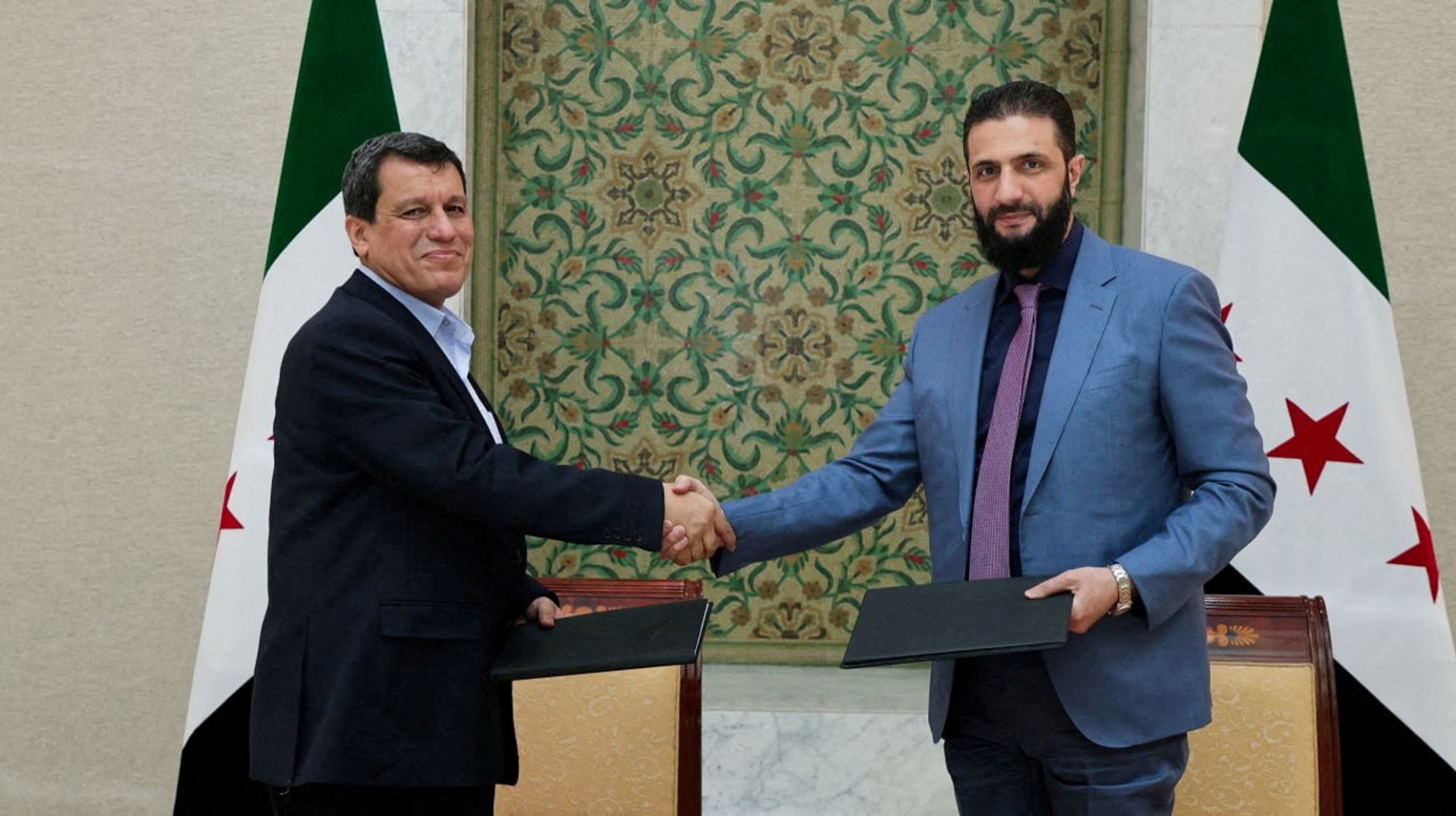
Ahmed al-Sharaa and Mazloum Abdi during the signing of the agreement to integrate the SDF into state institutions, Damascus, on 10 March 2025.

What happens then?

It would be better to ask Abdi.

President Sharaa has issued a decree granting rights to the Kurds, and he received Kurds in their traditional dress during the Nowruz celebrations. How do you see the Kurds' position in Syria today?

Syria as a whole still needs to be stabilised. The overall situation remains unsettled, though I view it broadly positively. I see the Kurds as a fundamental component of Syria, alongside all other Syrians. The country's situation demands serious effort from everyone, and we must all show patience until conditions of calm and stability return. The Kurdish question, therefore, cannot be separated from the wider Syrian context.

Where do you see Syria in relation to the US-Israeli war against Iran, given that there were supposedly some ties between the SDF and Iran?

I don't think there are any ties between the SDF and Iran now. When Iran was in Syria, there was some contact, but in my view, that has now ended. There are now no organic ties with Iran. In the past, there were relations with all the forces on the ground, including Iran.

Syria lies in an exceptionally sensitive and strategic region. It is impossible for a crisis of this scale (war with Iran) to pass without affecting it. 

Sipan Hamo, Syrian deputy defence minister

How do you see the war against Iran, and what is Syria's place in it?

In Syria, there are certainly understandings that have not been made public. The Americans helped Syria open a new chapter and helped the new government come to power, giving Syria an alternative on which it could rely. On the ground, however, there is nothing serious at present.

As for the interventions some people speak of, nothing may come of them. It is difficult for Syria to intervene in Iraq or Lebanon, since these are Arab states. Unless alliances are formed and Syria takes part in such a coalition, Syria will not move on its own against Arab states.

I understand that the Americans will withdraw completely from Syria by the end of the month from all areas, including their two bases in the Kurdish regions.

Yes, that is the information I have. They have already withdrawn, in fact. Only the Qasrak base remains. For the moment, they are still there, but they told us that they will withdraw from Qasrak in due course.

How do you see Syria's future?

I hope it will be a country in which all can live in harmony, a beacon of civilisation in the region, and a place where people live together in peace. For me personally, it is enough that Syria should be well. I want nothing more than that. If it is, I can sit quietly in a corner and involve myself in nothing. I make no distinction between Kurd, Arab, or any other. To me, every Syrian is dear. Every Syrian who cares for his country deserves respect. Syria deserves every good thing.

DELIL SOULEIMAN / AFP
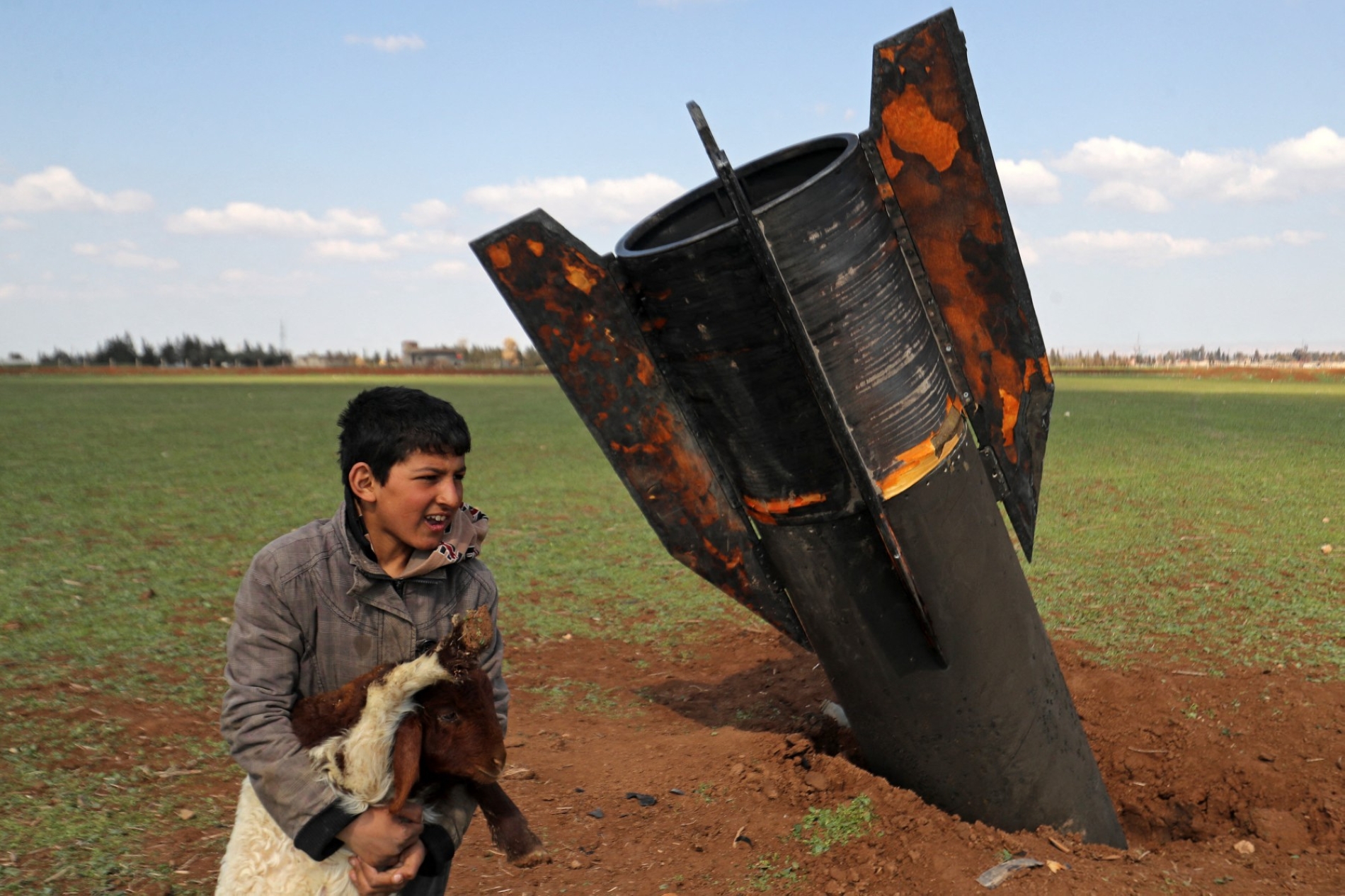
A boy plays with his sheep next to an unexploded missile that landed in an open field on the outskirts of Qamishli, eastern Syria, on 5 March 2026.

Syria lies in an exceptionally sensitive and strategic region. It is impossible for a crisis of this scale (war with Iran) to pass without affecting it. Much depends on reason and collective wisdom. The question is how to prevent the crisis engulfing the region and spilling into Syria, how to spare its effects or at least stay shielded from the worst of them.

So far, President Sharaa has succeeded in sparing Syria. Syria lies between Lebanon, Iraq, and Iran. Up to now, al-Sharaa has kept Syria out of these flames, which is no easy task. He is performing his role successfully. He has been very positive, but the region is on a knife-edge. I wish him every success.

Do you see yourself one day as vice-president, speaker of parliament, or prime minister?

I had hoped that a path might open for me in political or internal affairs. Perhaps its time will come, but this is what was offered, and I regard it as a duty. I ask God not to let us be found wanting, and to be equal to the responsibility.

Is there apprehension over the Kurdish presence in Syria?

For the Arabs, there is no threat or danger. Kurds in Syria helped make the modern state a century ago. They played a deeply positive role. In building a new Syria, we believe the Kurds will play another positive role. They will protect themselves and defend the country as they would defend what is dearest to them; no one should harbour any doubts about that. I would particularly stress the Arab dimension and the brotherhood that binds Kurds and Arabs.

REUTERS/Orhan Qereman
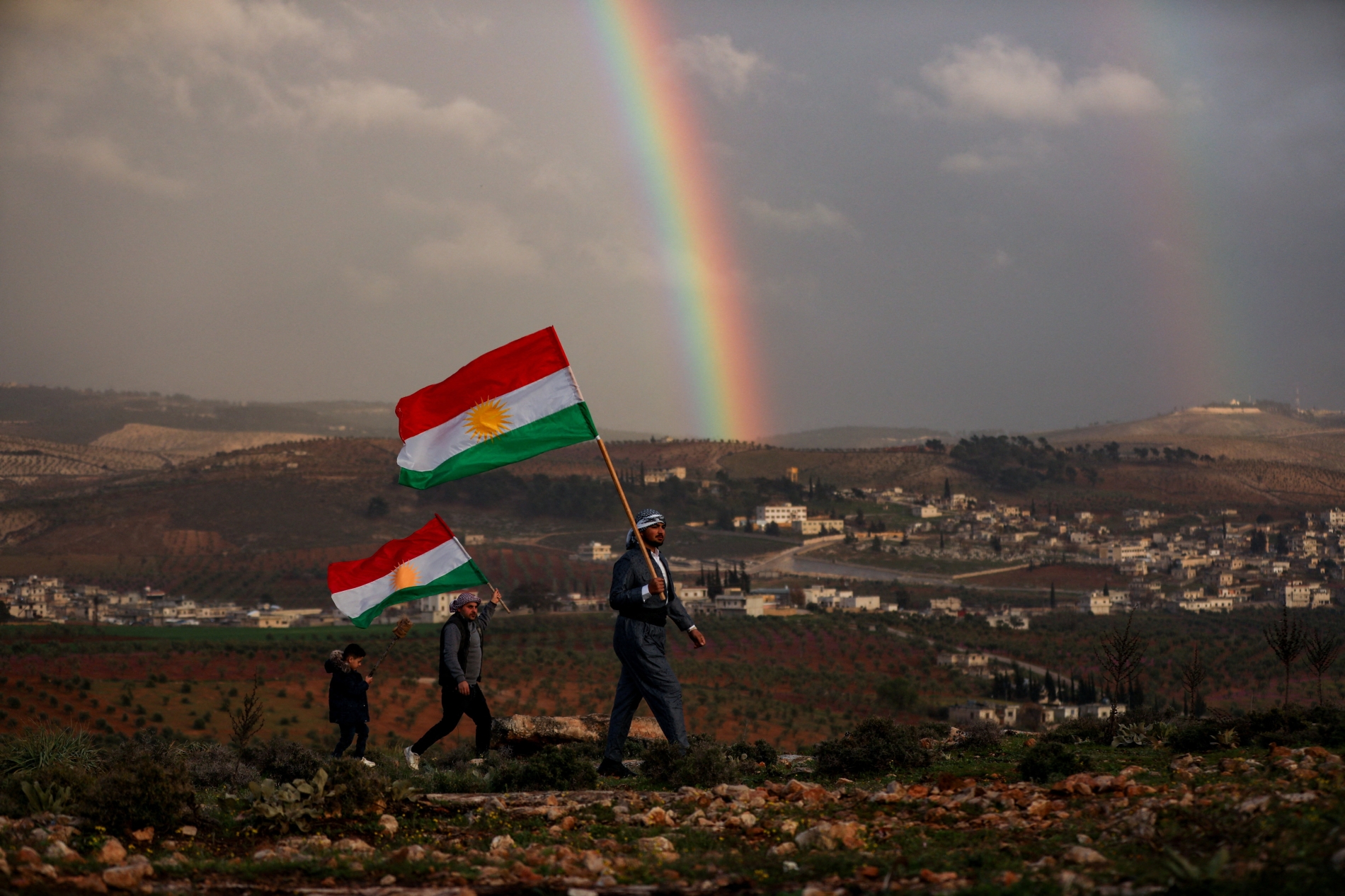
Syrian Kurds walk while carrying Kurdistan flags, with rainbows visible in the background, as they prepare to celebrate the spring festival of Nowruz, in Afrin, Syria, on 20 March 2026.

How do you connect the present to the past and the future?

History records no inherent Arab-Kurdish conflict. On the contrary, it is a history of shared achievements. After the Arabs, the Kurds were the first to embrace Islam. Alongside the Islamic commander Khalid ibn al-Walid, they took part in the conquests of Mesopotamia and Persia.

When there was infighting among Arab schools and factions, the Kurds kept their distance and repelled the assaults of the enemy targeting the region and the lands of Islam. More broadly, the Kurds were exemplary in that Islamic expansion. The Islamic identity that brought Kurds and Arabs together was the force that carried the Islamic nation across the region's countries, from east to west. But there were clashes and disagreements, which arose when the Kurds felt oppressed or marginalised.

We believe in an inclusive Syrian identity. Syria belongs to all. If we look at it from that angle, and ask what place the Kurds hold in Islamic history, then the same applies today: if the unifying identity is a Syrian one that embraces all components, the Kurds will play the same role they played at the time of the early Islamic conquests, at the beginning of Islam's spread in the region.

What matters is to send a clear message to the Arabs: the Kurds are not enemies. They are brothers in faith and in country, bound together by religion and the homeland. There are parties trying to pull us in different directions. The Baathists tried to complicate matters through Arab nationalism and chauvinism, while the Turks are trying to pull them elsewhere. If Syria becomes the unifying identity, the Kurds will sacrifice, contribute, and stand at the centre of service to the country, just as they did in Islamic history during the conquests of Mesopotamia and Persia.

Are you optimistic that things will move in the right direction despite the obstacles and difficulties?

I pray that God will not let us down.

font change