Hezbollah's fate likely linked to US-Iran war outcome
Amid mounting international, regional and domestic pressure, the group's fate hangs in the balance. A defeat of the Islamic Republic, therefore, could spell the end of Hezbollah.
Aliaa Abou Khaddour
Hezbollah's fate likely linked to US-Iran war outcome
Two days into the US-Israeli war on Iran, Tehran adopted a strategy of widening the geographical scope of its retaliation to maximise its chances of survival against a militarily superior opponent. As a result, it summoned Hezbollah, its Lebanese proxy, to join the battle. But could its entry into the fray finally seal the embattled group’s fate?
Last year, Hezbollah stayed out of the June 2025 12-day war at Iran’s request. The fight between Iran and Israel at the time was ultimately limited and didn't constitute an existential threat to the Iranian regime, so Tehran calculated that its interests would be better served by preserving what remained of Hezbollah’s military capacity for a future, larger battle.
In preparation for this scenario, right after the November 2024 ceasefire between Hezbollah and Israel and into February 2026, Iran sent more Islamic Revolutionary Guard Corps (IRGC) officers to Lebanon to directly run Hezbollah’s affairs, filling in some of the gaps left by Israel’s assassinations of the top tiers of Hezbollah’s leadership.
During this time, Hezbollah continued to move and train its fighters inside Lebanon and to try to smuggle weapons into Lebanon from Syria. It began to refurbish long-range missiles that had been damaged by Israeli strikes earlier in the year. According to the Israeli Alma Research and Education Centre, Hezbollah’s stockpile of missiles fell from 150,000 in 2023 to only 25,000 at the beginning of 2026, with most of the remaining missiles being short- and medium-range.
The US and Israel have made it explicit that the goals of their current joint campaign against Iran are maximalist, aiming to neutralise the threat they perceive from Iran. The scale and intensity of their attacks on Iran confirm this heavy-handed approach. To be sure, Iran has mounted a fierce and sweeping retaliation, but it remains unclear how long this military effort can be sustained against a global and regional superpower, which is why it called upon its regional proxies for assistance.
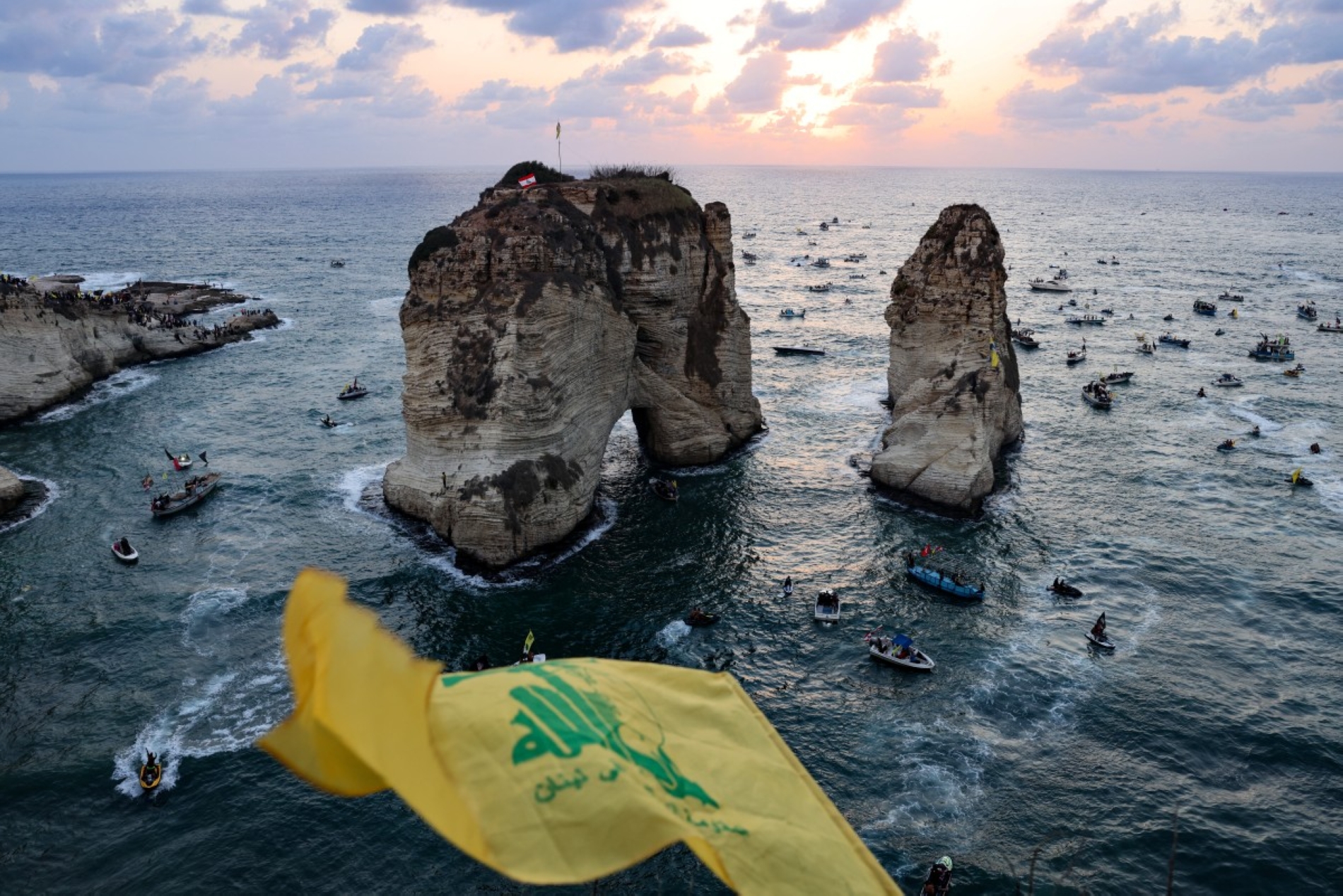
Hezbollah supporters sail in small boats around the landmark Raouche rocks (Pigeon Rock) to mark the first anniversary of the killing of the party's leader Hassan Nasrallah in Beirut on 25 September 2025.
Hezbollah's framing
For his part, Hezbollah Secretary General Naim Qassem frames Hezbollah's ongoing attacks on Israel as defending Lebanon. The group’s supporters say Israel was already planning to invade the south in a bid to root out the Hezbollah threat.
Indeed, throughout 2025, and despite a so-called ceasefire with the group, Israel struck Lebanon almost daily, with attacks targeting Hezbollah's personnel, weapons stockpiles, and sites of operation. Although Hezbollah and Iran could clearly see that Israel had deep intelligence about the group's whereabouts, they calculated that Hezbollah could withstand Israel's attacks.
Diminished domestic support, dwindling military and financial capacity, a degraded leadership, and an embattled external patron put Hezbollah on a suicidal path of Iran's making
Hezbollah and Iran sought to buy time by paying lip service to the Lebanese government's persistent calls for the group to disarm. As anticipation of a renewed US-Israeli military campaign on Iran rose in early 2026, Hezbollah escalated its rhetoric about refusing to give up its weapons.
Its intervention in March spurred the Lebanese government to take the unprecedented step of banning Hezbollah's military and security activities, though the government has not been able to enforce this ban. This is due to both the limited capacity of the Lebanese Armed Forces and concerns that any confrontation with Hezbollah could spark sectarian strife, which could be framed as an attack on the Shiite community in Lebanon.
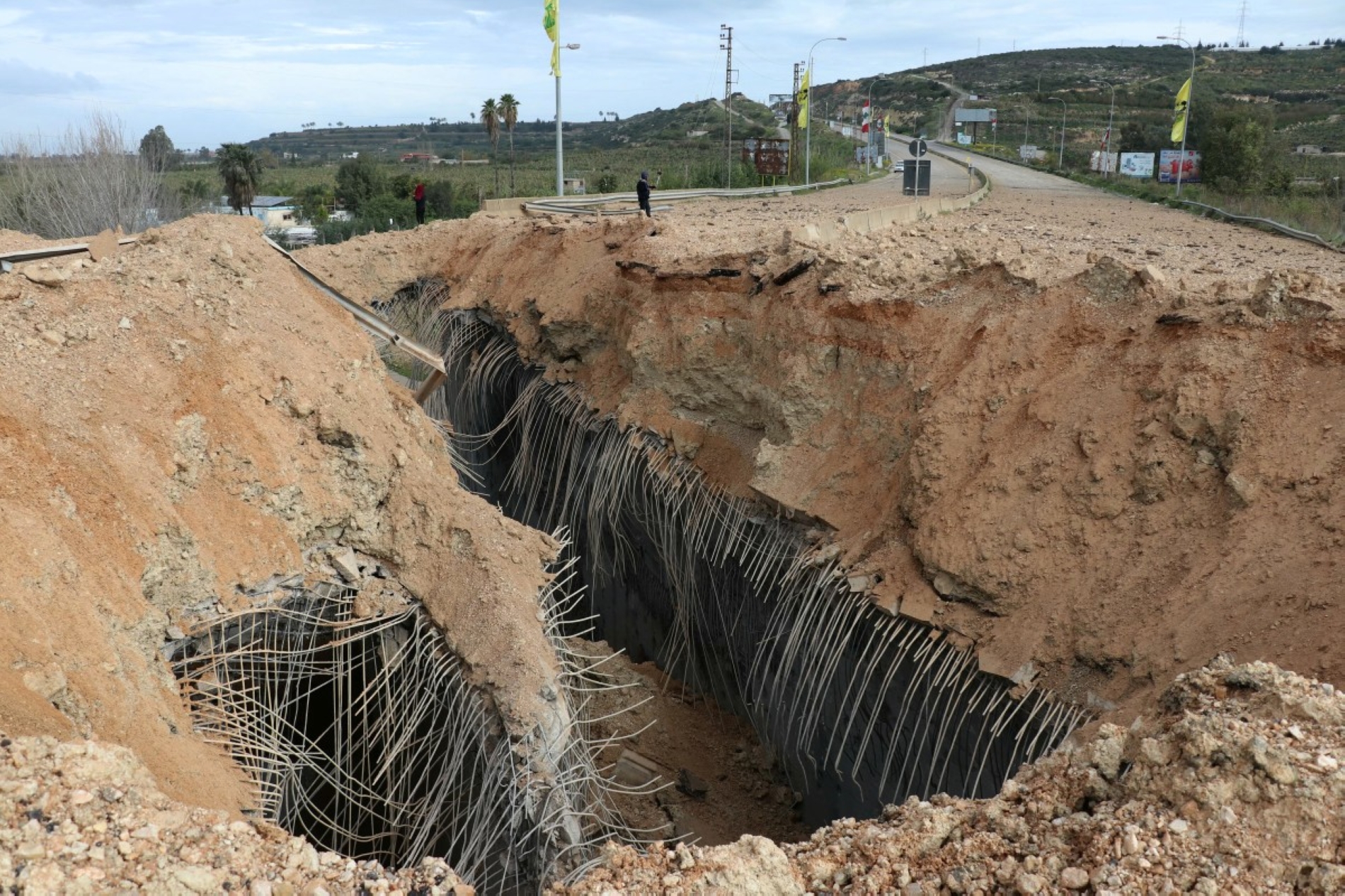
A man stands near the crater the day after an Israeli airstrike targeted the Qasmiyeh Bridge that links Tyre to the rest of Lebanon on 23 March 2026.
Not-so-veiled threats
On 16 March, the deputy head of Hezbollah's political council, Mahmoud Qamati, threatened the Lebanese government by saying that "we are capable of turning the country and the government upside down, and our patience has limits". He used the example of the French resistance having revenge on the Vichy government by overthrowing it and executing its "traitors" to send a thinly veiled warning that harks back to Hezbollah's series of assassinations of its opponents in Lebanon.
This was followed on 22 March with a similar threatening statement by Wafiq Safa, who until January was head of Hezbollah's Liaison and Coordination Unit. During his almost three decades in that role, Safa was Hezbollah's Beirut liaison. Safa was meant to have handed over his role to another figure as part of an internal reshuffle, while staying on as an advisor. Safa's return to his original role is seen by some as a deliberate attempt by Hezbollah to intimidate Lebanese politicians. There have even been whispers that some politicians have already received indirect threats if the ban on Hezbollah's military activities isn't reversed.
In doing this, Hezbollah could be trying to repeat the scenario of 2005-2008 when it assassinated many of its opponents in Lebanon, provoked a war with Israel, and paralysed the Lebanese government, forcing it to recognise Hezbollah for the first time as one of the country's official pillars of defence but without any accountability to or oversight by the Lebanese state. But if the Lebanese government lifts the ban on Hezbollah's military activities, Israel is likely to further escalate its attacks on Lebanon on the basis that the whole country is now complicit in supporting the group.
For their part, Hezbollah's detractors say the group puts Iran's interests above Lebanon's, despite the heavy toll the country has incurred due to its adventurism. And with Lebanese Shiites in the country's south having borne the brunt of Israel's wrath, Hezbollah's own community of supporters has begun expressing frustration with the huge losses to their property and livelihoods in Israeli bombardment.
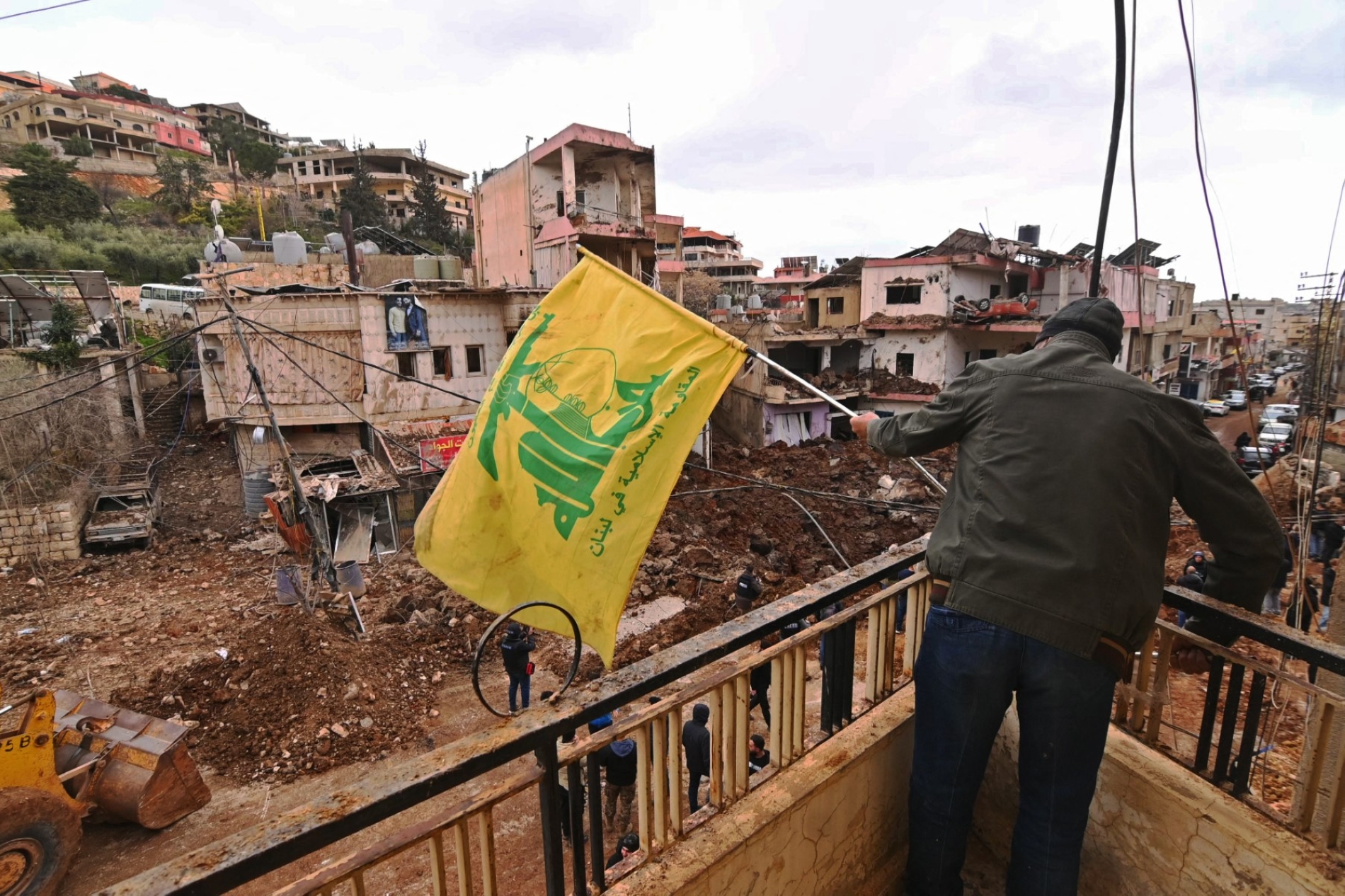
A man fixes a Hezbollah flag on the balcony of a damaged building at Nabi Sheet town after an Israeli military operation in the Bekaa Valley of Lebanon, on 7 March 2026.
Military priorities
Ahead of parliamentary elections in May 2026, Iran and Hezbollah had planned to placate their followers by offering minimal compensation, so that the political status quo would be maintained and Hezbollah would retain its parliamentary representation.
And indeed, Iran managed to funnel about $1bn to Hezbollah despite a raft of Western sanctions that have battered its economy, according to John Hurley, the US undersecretary for terrorism and financial intelligence. However, an unnamed source speaking to Arab media said the majority of those funds went to the recovery of Hezbollah's military infrastructure, including fighter salaries and compensation for the families of killed and injured fighters. This not only shows the financial constraints Iran and Hezbollah are facing, but also where their priorities lie.
The estimated 1.2 million people—almost a third of the Lebanese population—who fled south Lebanon after Israeli warnings to evacuate, has added yet another layer of pressure on Hezbollah. The displaced (mostly Shiites) have been pushed into areas inhabited by other sects. Israel's targeting of Hezbollah-linked figures wherever they are in Lebanon has created a sense of paranoia in host communities who fear ending up as collateral damage. This is heightening sectarian tensions and fomenting civil strife, piling additional pressure on Hezbollah.
Against this backdrop, Hezbollah's March 2026 intervention happened with little domestic popular buy-in, against the orders of the Lebanese government, and contrary to Hezbollah's internationally brokered and monitored ceasefire agreement.
Meanwhile, Israel's defence minister said on Tuesday that Israel plans to expand the territory under its control in southern Lebanon, suggesting it was ramping up its ground offensive against the Iranian-backed militia Hezbollah. In a statement, Israel Katz said Israel will retain control of the land south of the Litani River.
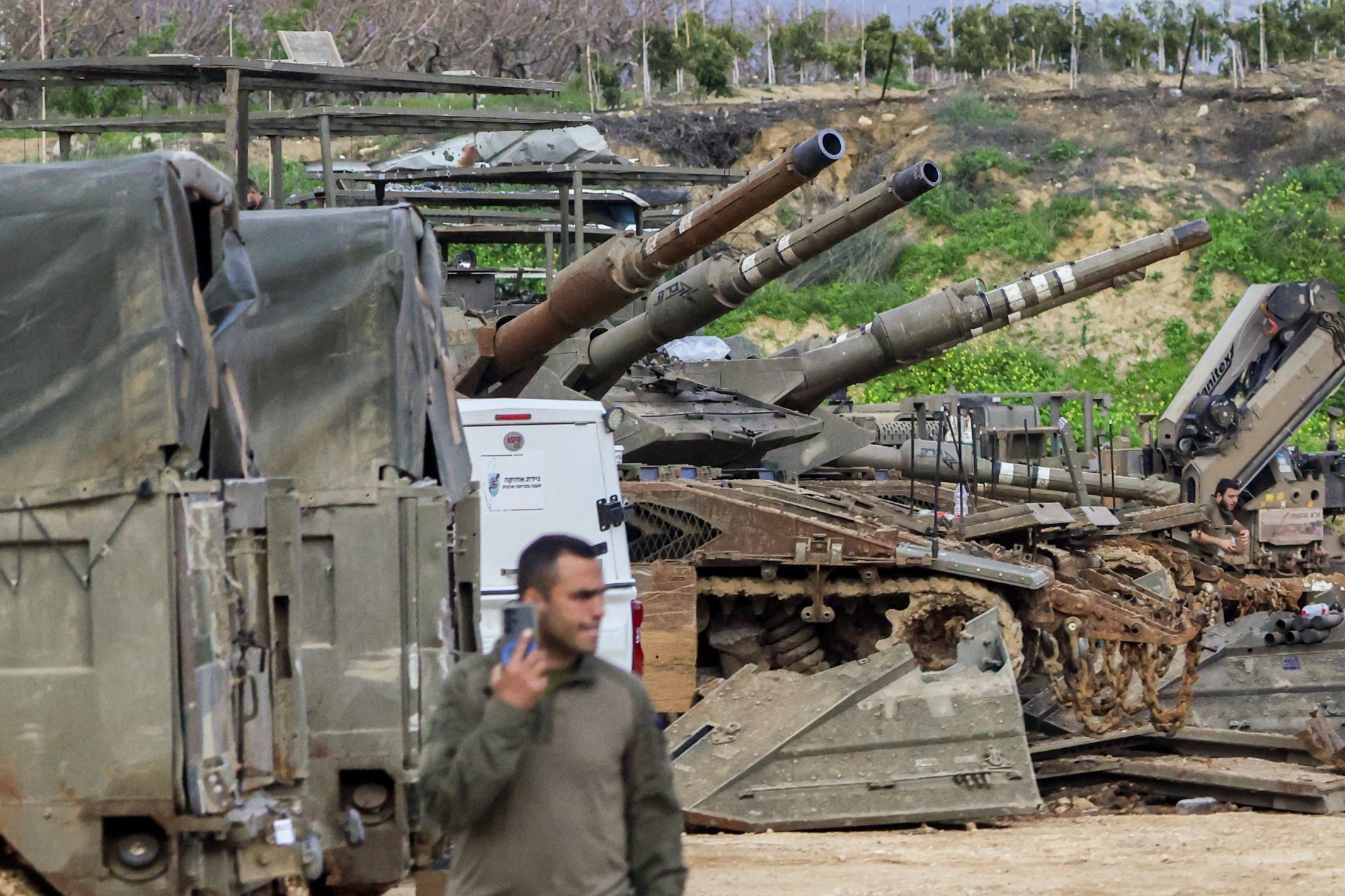
Israeli tanks are seen near the Israeli side of the border with Lebanon as the US-Israeli war on Iran continues, in northern Israel, on 24 March 2026.
Calls for annexation
For his part, Israel's far-right minister of finance, Bezalel Smotrich, says Israel should annex southern Lebanon. In an Israeli radio interview on Monday, Smotrich said that the bombardment of Lebanon "needs to end with a different reality entirely", which includes a change of Israel's borders. "I say here definitively, the new Israeli border must be the Litani," he said, referring to the Litani River, a critical waterway that cuts through southern Lebanon, about 30km from the border with Israel.
With diminished domestic support, dwindling military and financial capacity, a degraded leadership, and an embattled external patron, Hezbollah looks to be on a suicidal path of Iran's making. To be clear, it has several off-ramps to avoid the prospect of its complete destruction, including disarming and surviving in a different form, but Iran has no use for such an iteration of Hezbollah.
As a result, the group's fate looks to be closely linked to the outcome of the US-Iran war. A defeat of the Islamic Republic, therefore, could spell the end of Hezbollah.