Buying a brain: US approves Saudi purchase of advanced chips

Riyadh wants the powerful NVIDIA processors to help it develop an Arabic large language model. With the US reassured over technology transfer risks, an export licence is forthcoming.

The processors are core to Saudi Arabia's AI strategy, as are the giant data centres being built. Among the Saudi aims is to develop an Arabic large language model.
Phil Wheeler
The processors are core to Saudi Arabia's AI strategy, as are the giant data centres being built. Among the Saudi aims is to develop an Arabic large language model.

Buying a brain: US approves Saudi purchase of advanced chips

After Saudi Crown Prince Mohammed bin Salman’s visit to Washington last month, negotiations between the US and Saudi Arabia over the supply of advanced NVIDIA processors have advanced, the White House granting preliminary approval for the dispatch of the first shipment to Riyadh.

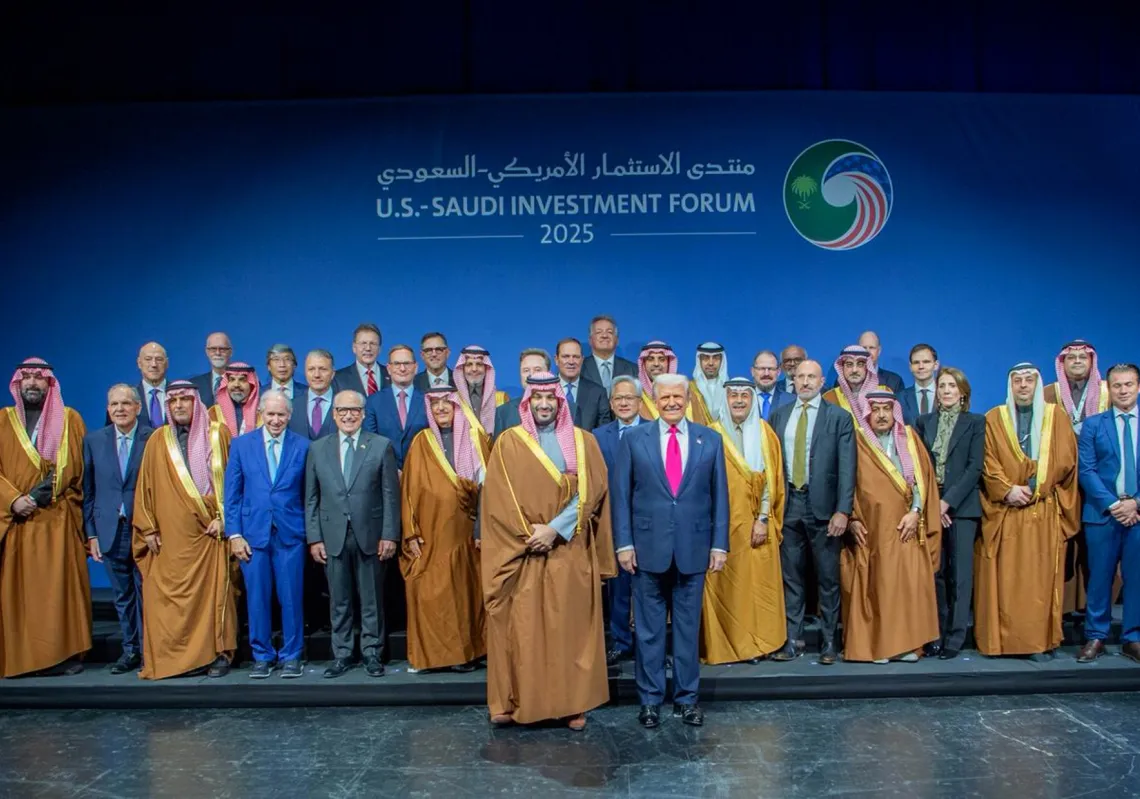
This was announced during the Saudi-American Investment Conference attended by technology entrepreneur and world’s richest man Elon Musk, Saudi Minister of Communications and Information Technology Abdullah bin Amer Al-Sawaha, and NVIDIA’s chief executive Jensen Huang. The agreement lets Saudi Arabia buy nearly 18,000 units of NVIDIA’s new Blackwell GB300 processors, among the most powerful chips in the world, engineered to power vast artificial intelligence (AI) models and process immense volumes of data.

These chips are needed to train large language models (LLMs) on a scale used by leading American technology firms, including OpenAI, the creator of ChatGPT, but due to their strategic importance, this category of processors is subject to some of Washington’s most stringent export controls. Riyadh and Washington have been negotiating the purchase for months, the former seeking to assure the latter that the chips will not find their way to China. The agreement seeks to prevent any transfer of technology by ensuring the chips’ use is confined to pre-approved domains.

Maturity and detail

Washington may now expedite licence approvals after Riyadh submitted a comprehensive operational plan for deploying the chips at the facilities of Saudi AI company HUMAIN. This confers a degree of maturity and detail previously lacking. The talks also addressed mechanisms for Washington’s oversight of the chips’ operation within Saudi installations, allowing the US a degree of supervision and monitoring. These arrangements reflect an American willingness to equip allies with cutting-edge technology while preserving its own strategic edge.

Saudi Arabia is now building a vast infrastructure to support the country’s AI industry. Led by HUMAIN, construction has begun on huge data centres. The first is due to become operational early next year, to support Riyadh’s aim of becoming a regional hub for the development and deployment of advanced AI models. These centres are expected to use NVIDIA’s new processors to deliver exceptional computational capacity, enabling the training of a new Arabic LLM, alongside AI solutions for sectors such as healthcare and education.

Due to their strategic importance, this category of processors is subject to some of Washington's most stringent export controls

As the final contours of the NVIDIA chip agreement become apparent, it is evident that this is deal is about more than just the procurement of processors or the expansion of data centre capacity. Rather, it signifies a broader strategic shift in the Middle East, marking Saudi Arabia's formal entry into the global AI race. Riyadh is transitioning from a consumer of imported technology to regional epicentre of AI innovation, with the deal expected to stimulate wider research, investment, and development partnerships.

Computational capacity

The agreement to buy the NVIDIA processors was not merely a commercial transaction involving hardware, but a contest in the global AI race, whose winners and losers will be determined in part by those who possess the computational capacity to drive the next technological revolution. The Crown Prince's visit to Washington added urgency, given that the chips are central to US-Saudi technological partnership.

These chips are the foundational infrastructure upon which firms such as OpenAI and Anthropic have built their world-leading LLMs, and their strategic significance is rivalled only by advanced military technologies, so the Crown Prince's visit mean that he could pledge to prevent any technology leaks by demonstrating operational preparedness within the facilities that will host the processors.

As the authority empowered to grant export licences, the US Department of Commerce took a keen interest, as did the US National Security Council, whose job is to assess strategic risks. NVIDIA itself provided technical specifications regarding permissible uses and operational procedures. From the Saudi side, the Ministry of Communications, the Saudi Data and Artificial Intelligence Authority, and HUMAIN all engaged.

Tech sovereignty

Negotiations covered issues such as the chips' storage, access authorisation levels, chip deployment, and the network into which they would be integrated. The US explicitly prohibited Chinese equipment in the data centres, and while Saudi Arabia understood the US concerns and was willing to implement safeguards, it rejected any arrangements that compromised its technological sovereignty.

For Saudi Arabia, these processors are not an end in themselves, but a means of building autonomous national capacity. They are not infrastructure to be externally managed, but tools for developing indigenous AI models in Arabic, tailored to the needs of the region. They are also intended to let universities, enterprises, and public institutions benefit from a technological base that—until recently—had been the preserve of the world's leading powers.

Washington has now begun issuing licences for the export of NVIDIA processors to the Gulf, albeit within an operational framework that preserves American oversight. Contracts are awarded to US companies which, in turn, manage the Gulf data centres. Thus, while computational power is transferred to the Gulf, operational control remains under American regulatory standards. In this way, the US supplies its allies with the processing power they require, while ensuring no transfer of sensitive technology.

Progress in the negotiations stemmed from the strategic nature of the Riyadh–Washington relationship and their deep coordination on regional security and files such as Gaza, Iran, and Syria helped allay American concerns and build trust.

National synthetic brain

The NVIDIA Blackwell GB300 processors are akin to synthetic brains. Each houses more than 200 billion transistors and is supported by a staggering 288 gigabytes of the world's fastest memory, a scale hundreds of times greater than even the most advanced personal computers. This lets each chip perform hundreds of billions of calculations per second, offering unprecedented capabilities in data processing, deep learning, and the analysis of language and imagery.

When integrated into a full-scale platform such as the NVIDIA GB300 NVL72—which links 72 GB300 processors with 36 Grace CPUs via an ultra-high-speed network—the system becomes a vast AI production engine. The resulting computational power is equivalent to that of thousands of supercomputers combined. This is how firms like OpenAI and Anthropic have built their LLMs. For Saudi Arabia, having such platforms within its new data centres allows for the creation of 'a national synthetic brain'. It forms a cornerstone of the country's AI ambitions under Vision 2030.

More broadly, the US-Saudi relationship is shifting from a partnership built on energy and security to an alliance grounded in algorithms and data. This evolution was underscored by comments from the Crown Prince, Huang, and Musk at the conference. The processors will give Saudi Arabia what some have called 'computational sovereignty,' which is the ability to control and process data domestically, ensuring privacy, security, and technological independence.

font change