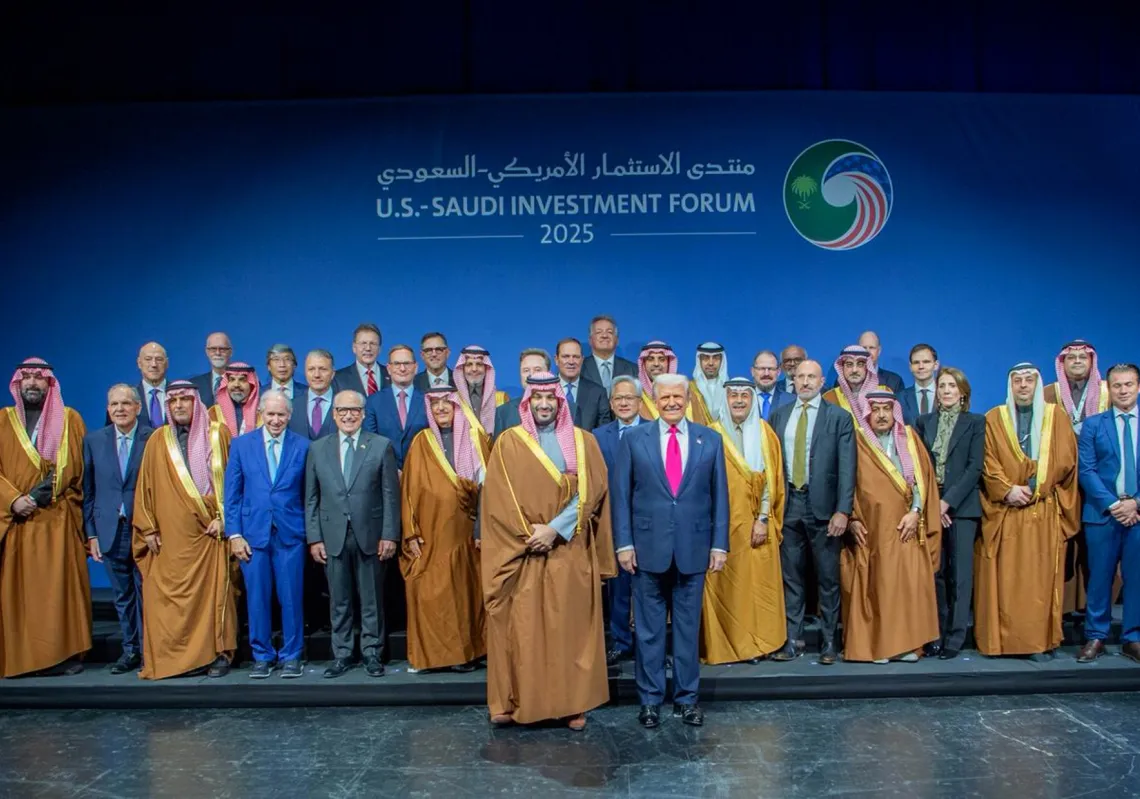

After Saudi Crown Prince Mohammed bin Salman’s visit to Washington last month, negotiations between the US and Saudi Arabia over the supply of advanced NVIDIA processors have advanced, the White House granting preliminary approval for the dispatch of the first shipment to Riyadh.
This was announced during the Saudi-American Investment Conference attended by technology entrepreneur and world’s richest man Elon Musk, Saudi Minister of Communications and Information Technology Abdullah bin Amer Al-Sawaha, and NVIDIA’s chief executive Jensen Huang. The agreement lets Saudi Arabia buy nearly 18,000 units of NVIDIA’s new Blackwell GB300 processors, among the most powerful chips in the world, engineered to power vast artificial intelligence (AI) models and process immense volumes of data.
These chips are needed to train large language models (LLMs) on a scale used by leading American technology firms, including OpenAI, the creator of ChatGPT, but due to their strategic importance, this category of processors is subject to some of Washington’s most stringent export controls. Riyadh and Washington have been negotiating the purchase for months, the former seeking to assure the latter that the chips will not find their way to China. The agreement seeks to prevent any transfer of technology by ensuring the chips’ use is confined to pre-approved domains.
Maturity and detail
Washington may now expedite licence approvals after Riyadh submitted a comprehensive operational plan for deploying the chips at the facilities of Saudi AI company HUMAIN. This confers a degree of maturity and detail previously lacking. The talks also addressed mechanisms for Washington’s oversight of the chips’ operation within Saudi installations, allowing the US a degree of supervision and monitoring. These arrangements reflect an American willingness to equip allies with cutting-edge technology while preserving its own strategic edge.
Saudi Arabia is now building a vast infrastructure to support the country’s AI industry. Led by HUMAIN, construction has begun on huge data centres. The first is due to become operational early next year, to support Riyadh’s aim of becoming a regional hub for the development and deployment of advanced AI models. These centres are expected to use NVIDIA’s new processors to deliver exceptional computational capacity, enabling the training of a new Arabic LLM, alongside AI solutions for sectors such as healthcare and education.