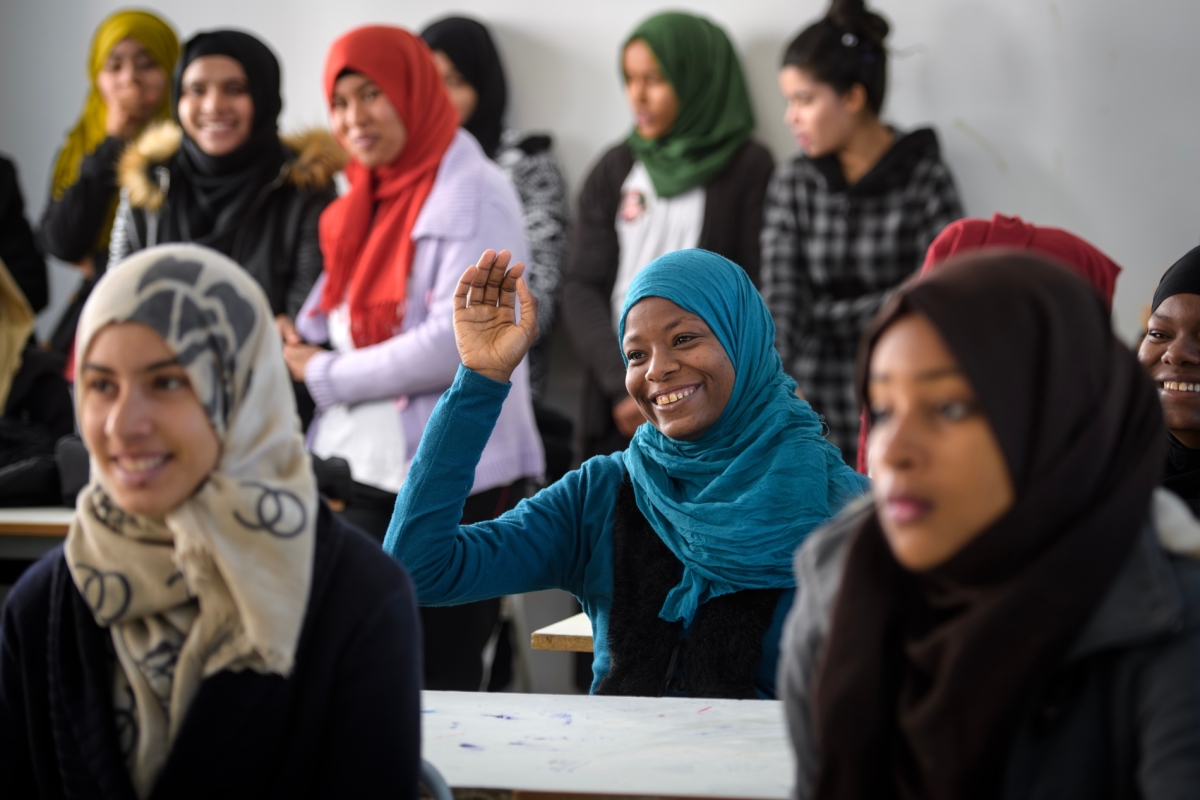

In much of the developing world, the lack of girls in education has long been a problem that has vexed policymakers. But in one north African country, the opposite problem is currently true. The presence of Tunisian boys in higher education has shrunk to a remarkable degree. Tunisian women now account for 70% of all university graduates in the country, and 62% of those awarded doctoral degrees.
Tunisia now ranks first globally in the proportion of female students in STEM (science, technology, engineering, and mathematics) fields, comprising 49.45%. This marks near gender parity in disciplines traditionally dominated by men. The trend is not limited to higher education; results from the baccalaureate exam (the secondary school leaving qualification) also show a clear lead for girls. In 2025, the pass rate was 63% for girls and 37% for boys. Although girls have outperformed boys for years, the gap now seems to be growing. Between 2008 and 2010, pass rates averaged 61% for girls, 39% for boys, a pattern that remained stable until 2022.
Working for the future
There are reasons for this disparity, according to experts such as Moncef Khemiri, a former director at the Ministry of Higher Education and Scientific Research. Boys often struggle with a lack of focus, largely due to the prevalence of distractions and leisure activities, especially in an era dominated by digital content, he told Al Majalla. While boys are tempted to drop out of school early, girls in education often have a stronger sense of purpose. They recognise that, in a largely patriarchal and unequal society, academic success and financial independence will protect themselves and their families.
Tunisia’s most recent population census, conducted in 2024, shows that school attendance rates between girls and boys remain nearly identical up to the age of 11 (98.3% for girls, 98.1% for boys), but by the age of 14, a gender gap begins to emerge (97.9% for girls, 96.9% for boys). This gap widens significantly by age 18, with 83.4% of girls still in school compared to only 75.1% of boys. From the age of 19 to 24, 52.3% of girls are still enrolled in education, compared to just 33.6% of boys.
These figures suggest that adolescence is a particularly critical and vulnerable stage for Tunisian boys, during which they appear to lack the necessary support to remain in education. Khemiri also pointed to shifting attitudes within Tunisian families as a contributing factor. Marriage is no longer seen as an overriding priority for girls, particularly when they have a degree of personal choice.
He added that young women enrol in large numbers at university seeking strong employment prospects in fields such as medicine and business. Women now represent 75% of medical school students and 68% of business studies students. In contrast, boys are more commonly found in academic fields with weaker job prospects, which can lead them to long-term unemployment despite getting good grades.

Breaking the glass ceiling
Despite the clear educational advantage held by young women in Tunisia, unemployment remains significantly higher among them at 21.1%, compared with just 13.2% for men. There is a similar disparity in academic career progression, where women hit a glass ceiling. According to the 2023-24 report by Tunisia’s Ministry of Higher Education, women account for 36.5% of senior lecturers but just 24.7% of professors.
Prof. Nahla Ben Omar, a senior lecturer in business computing at the Higher Institute of Management at the University of Tunis, says the picture is more promising in the field of Information and Communication Technologies. Women are increasingly represented at senior academic levels in ICT, she says, with a growing number of all-female thesis and dissertation committees at undergraduate, master’s, and doctoral levels, as well as recruitment panels in IT-related disciplines where women now form the majority.