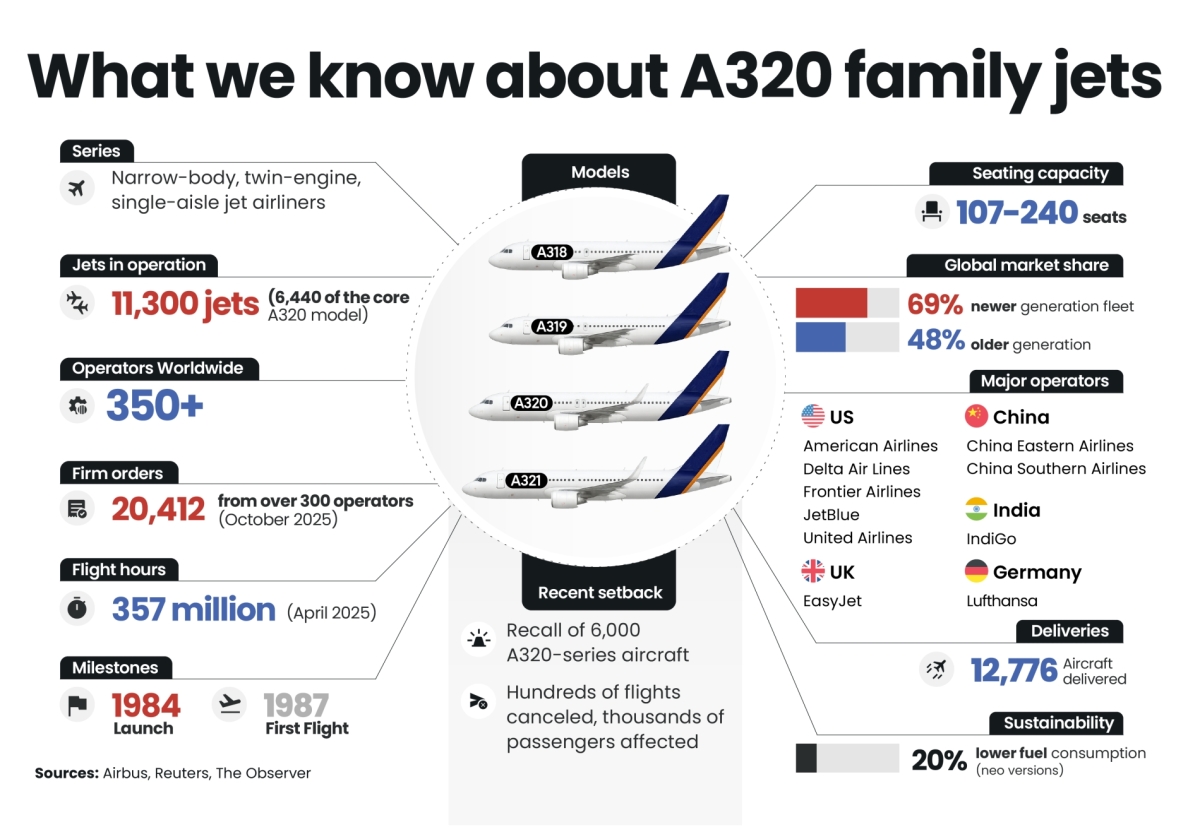

The Airbus A320 has long been a cornerstone of the global airline industry, driving efficiency and growth in short-to-medium-haul air travel. With some 11,300 A320-family jets in operation, including 6,440 of the core A320 model, which first took flight in 1987, the aircraft now accounts for 48% of the world’s single-aisle fleet and 69% of the newer-generation narrow-body segment. Its widespread adoption by more than 350 airlines across the United States, China, India, and Europe highlights its reliability and versatility across diverse markets.
Yet the recent recall of 6,000 A320-series jets marks a major disruption for airlines worldwide. Beyond operational delays and logistical challenges, the move raises potential safety concerns and could undermine passenger confidence. At the time Airbus issued its safety bulletin, roughly 3,000 A320-family jets were in the air.
The recall was triggered by an incident involving a JetBlue flight from Cancun to Newark on 30 October, during which several passengers sustained injuries following a sudden loss of altitude. Investigations suggest that solar flares may have interfered with data critical to the aircraft’s flight controls, prompting the unprecedented repair action.
The recall represents one of the largest in Airbus’s 55-year history. The A320, long a workhorse for the global fleet and a favourite among low-cost carriers, recently became the world’s best-selling passenger aircraft, surpassing the Boeing 737. The incident underscores the challenges of balancing technological innovation with operational safety in the modern aviation industry.