Gulf states haven't stopped investing in their neighbours, but resilience now weighs alongside returns and influence. Syria and Lebanon show what that means in practice
Reuters
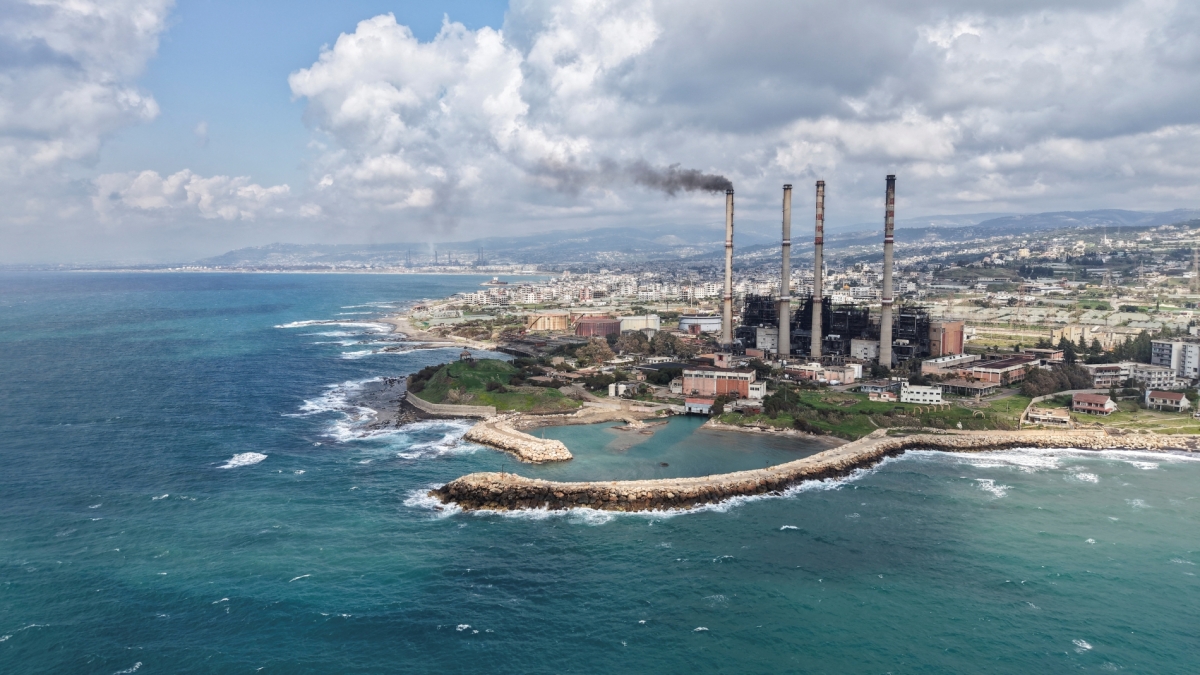
Smoke rises from an industrial facility near the city of Baniyas, Syria, on 8 April 2026.
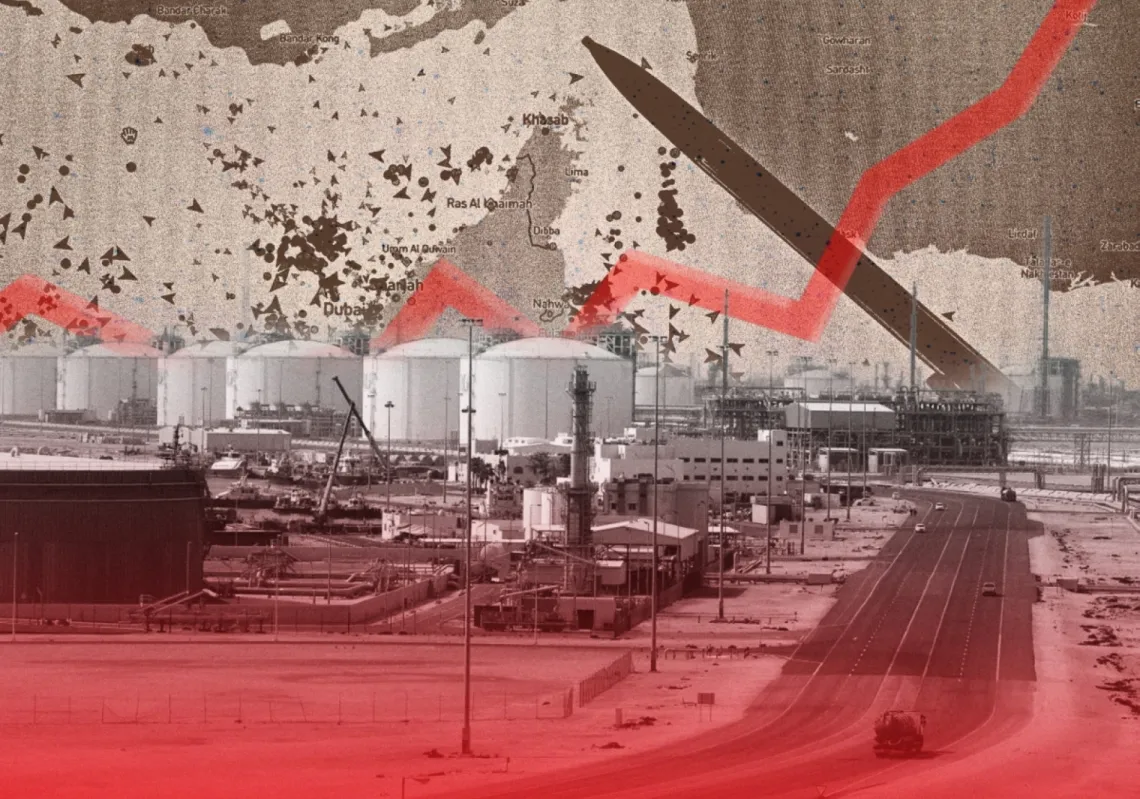
The US-Israel war on Iran is recalibrating how Gulf states invest abroad. Attacks on critical infrastructure and the disruption of the Strait of Hormuz imposed severe costs on Gulf economies and forced governments to reconsider their spending priorities. In the immediate shock, funds were redirected towards defence and redundant infrastructure, and it was unclear whether the Gulf would scale back its reconstruction investments abroad.
Several months into the war, the evidence points less to a halt in Gulf overseas investment than to a shift in the priorities guiding capital allocation. Gulf investors are still pursuing projects and announcing new major ones in electricity, telecommunications, ports, transport, real estate and digital infrastructure. Yet, the rationale behind these investments might be shifting. Financial returns and political influence are still major priorities, but a third consideration is emerging: whether an investment strengthens the Gulf's own economic resilience through regional integration and supply chain protection.
A form of “redundancy diplomacy” seems to be emerging, in which overseas infrastructure is valued partly for the alternative supply chains it creates, and the costs it mitigates in the case of disruption. Ports, pipelines, railways, roads, fibre-optic networks and power infrastructure carry strategic value beyond revenues.
Syria and Lebanon offer two very different tests of this recalculation. Both are counting on Gulf capital to rebuild and grow. Yet, the Gulf's revised priorities are shaping where that capital goes.
Recalculating investments
The Gulf is going through a tough test of economic resilience. The region has been hit by its biggest shock: military attacks, lower export volumes and narrowing fiscal space, coupled with higher national security spending needs. Losses are steep, but revenues keep flowing, with wide disparities across Gulf states.
Saudi Arabia’s Red Sea export route has been vital in offsetting the disruption of the Strait of Hormuz, though the Houthis blockaded Saudi tankers at Bab al-Mandab in July. Even with this route, the Saudi economy contracted by 4.8% in Q2 2026, its sharpest fall since covid-19. The UAE’s route through Fujairah, outside the Strait, has been similarly important, but the economic prospects depend largely on how long the conflict lasts and on sentiment, as the economy relies on tourism and trade as well as hydrocarbons.
Both have nonetheless fared better than Qatar, which supplies about 20% of the global LNG market and has no alternative export route. Its LNG shipments fell by more than 90% in the second quarter of 2026 compared with a year earlier, contributing to a $5.8bn quarterly budget deficit, the country's largest since 2016. The IMF projects its economy to contract by more than 8% in 2026. For those still able to export, higher hydrocarbon prices have offset some of the volume losses, keeping oil and gas revenues substantial. The states with a route around Hormuz have weathered the shock best.
A form of "redundancy diplomacy" seems to be emerging, in which overseas infrastructure is valued partly for the alternative supply chains it creates, and the costs it mitigates in the case of disruption
The reassessment of overseas investment began almost immediately. Within two weeks of the start of the conflict, three of the largest Gulf economies were reviewing their sovereign wealth funds' investments, Reuters reported, which may have led to a temporary investment freeze. By spring, reports spread that some financial commitments had not materialised. The clearest indication came from Syria, where an official said the pledged flow of funds had been frozen since the outbreak of the war, while insisting it would resume because Syria offers "strategic depth for the Arabian Peninsula"
The reassessment did not translate into a full retreat. The UAE maintained that its investment priorities were intact, and there is no evidence that any major Gulf-financed project in neighbouring countries such as Syria or Lebanon was cancelled as a direct result of the war. Gulf funds also kept investing globally. Middle Eastern sovereign investors committed about $102bn in the first nine months of 2026 -constituting around 40% of global dealmaking-, led by the UAE's Mubadala with $26bn, the Saudi Public Investment Fund, the Abu Dhabi Investment Authority, and the Qatar Investment Authority.
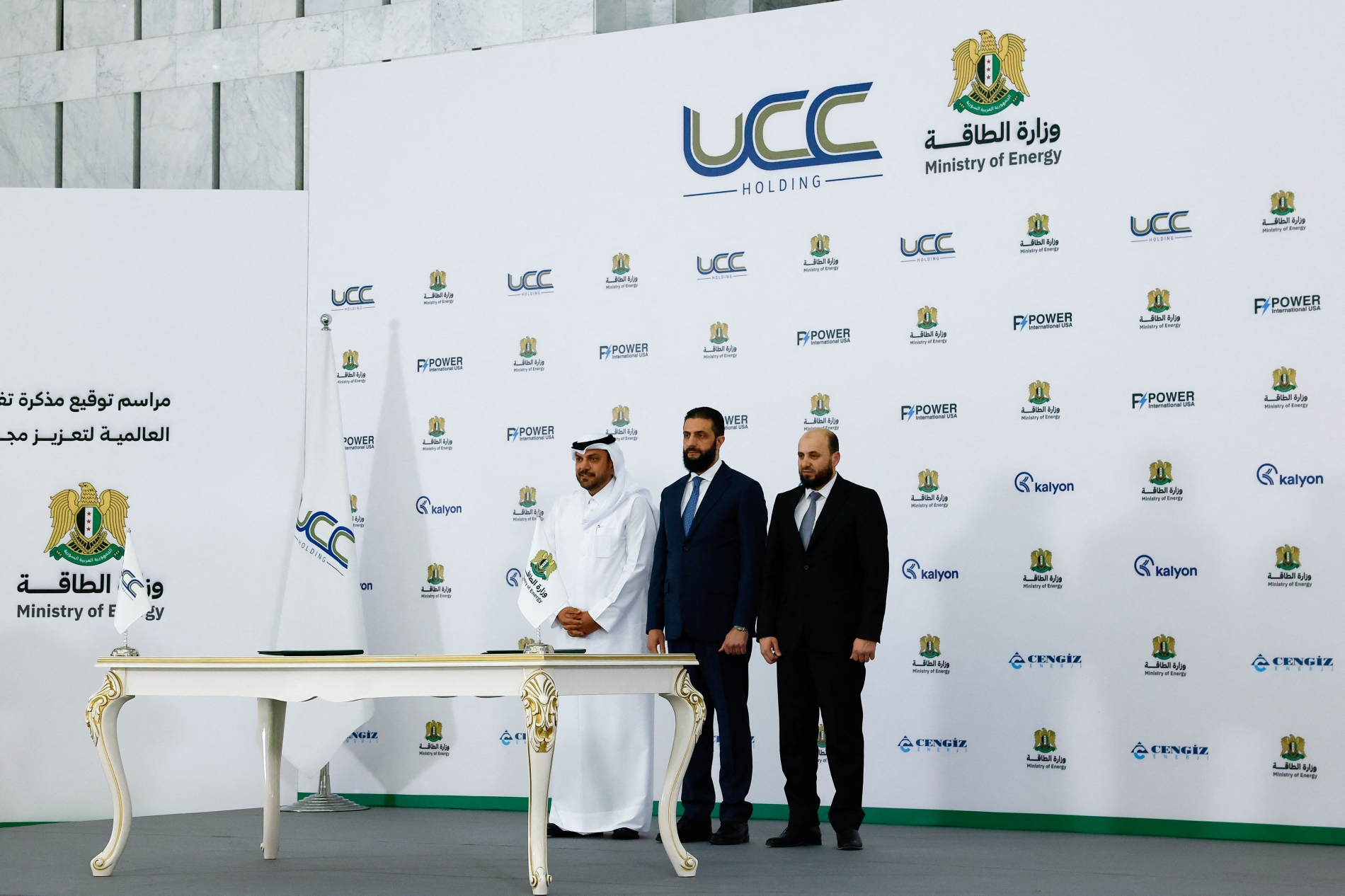
Syrian President Ahmad al-Sharaa at the signing of an agreement with QatarEnergy for investment in Syria in Damascus, 29 May 2025.
Syria: from reconstruction to strategic corridor
Syria is where the new purpose is most visible. Since the disruption of Hormuz, President Ahmed al-Sharaa has positioned Syria as the Gulf's corridor to the Mediterranean, and Gulf capital is responding with projects in electricity, transport, and data that have kept moving, and new ones that have been announced. The war did not create most of these projects, but it has raised their strategic value. Most of the corridor, however, still exists only on paper.
Syria boasts the strategic geographic location to support this. The country lies between Iraq and the Gulf on one side and the Mediterranean and Türkiye on the other, with ports in Tartus, Latakia and Baniyas and a pipeline route from Iraq to its coast. The same passage could carry data from the Gulf to Europe while avoiding the Red Sea, where most cables between Europe and Asia are concentrated.
Gulf countries had pledged billions of dollars towards Syria's reconstruction before the Iran war, and several major projects have continued to progress despite the conflict. Electricity is the clearest example. A Qatari-led consortium headed by UCC Holding signed a memorandum in May 2025, and later concession agreements, for a programme valued at $7bn, comprising 4 GW of gas-fired generation and 1 GW of solar capacity. In early April, approximately a month into the war, it reserved manufacturing slots with Siemens Energy for the Zayzoun and Deir Ezzor plants, and days later Syria announced the start of work on the Zayzoun plant.
The projects advancing since then align with the corridor positioning in energy transit, transport and data. In July, Iraq and Syria signed a memorandum to restore the pipeline from Haditha to Baniyas, a route the US has backed as a way around Hormuz. In late August, the Saudi transport minister signed four memoranda in Damascus covering roads, railways, aviation and postal services.
Saudi involvement extends to telecommunications. In February, Saudi Telecom Company (STC) was awarded the $800mn Silklink project, taking a 75% stake alongside the Syrian Sovereign Fund. The network comprises more than 4,500 kilometres of fibre optic cable network and international cable landing stations, positioning Syria as a potential digital link between Arab, Asian, and European markets.
Not all of this was triggered by the war: Silklink was awarded in February, and Emirati DP World's 30-year, $800mn concession at Tartus port dates from July 2025.
Redundancy, however, does not equate to replacement. Syrian routes' potential value lies in reducing dependence on a single route and limiting losses during disruptions, such as in Hormuz. Syria also remains unstable: government forces and Druze armed groups were still clashing in Sweida at the end of August, and parts of the province lie outside Damascus's control. Redundancy routed through a fragile state creates a new risk that needs to be mitigated.
Nor is every new deal about corridors. In September, the UAE's Arada announced a mixed-use development outside Damascus with Syria's sovereign fund, valued at $7bn, and in early October Abu Dhabi's Eagle Hills signed a framework agreement for housing in Damascus and tourism in Latakia. These are commercial bets on housing demand, and a reminder that returns and influence still drive much Gulf capital.
The key question is how much of this will materialise. Gulf states have announced roughly $28bn in memoranda with Syria since mid-2025. Until those memoranda reach financial close, the Gulf is still exploring Syria's corridor role.
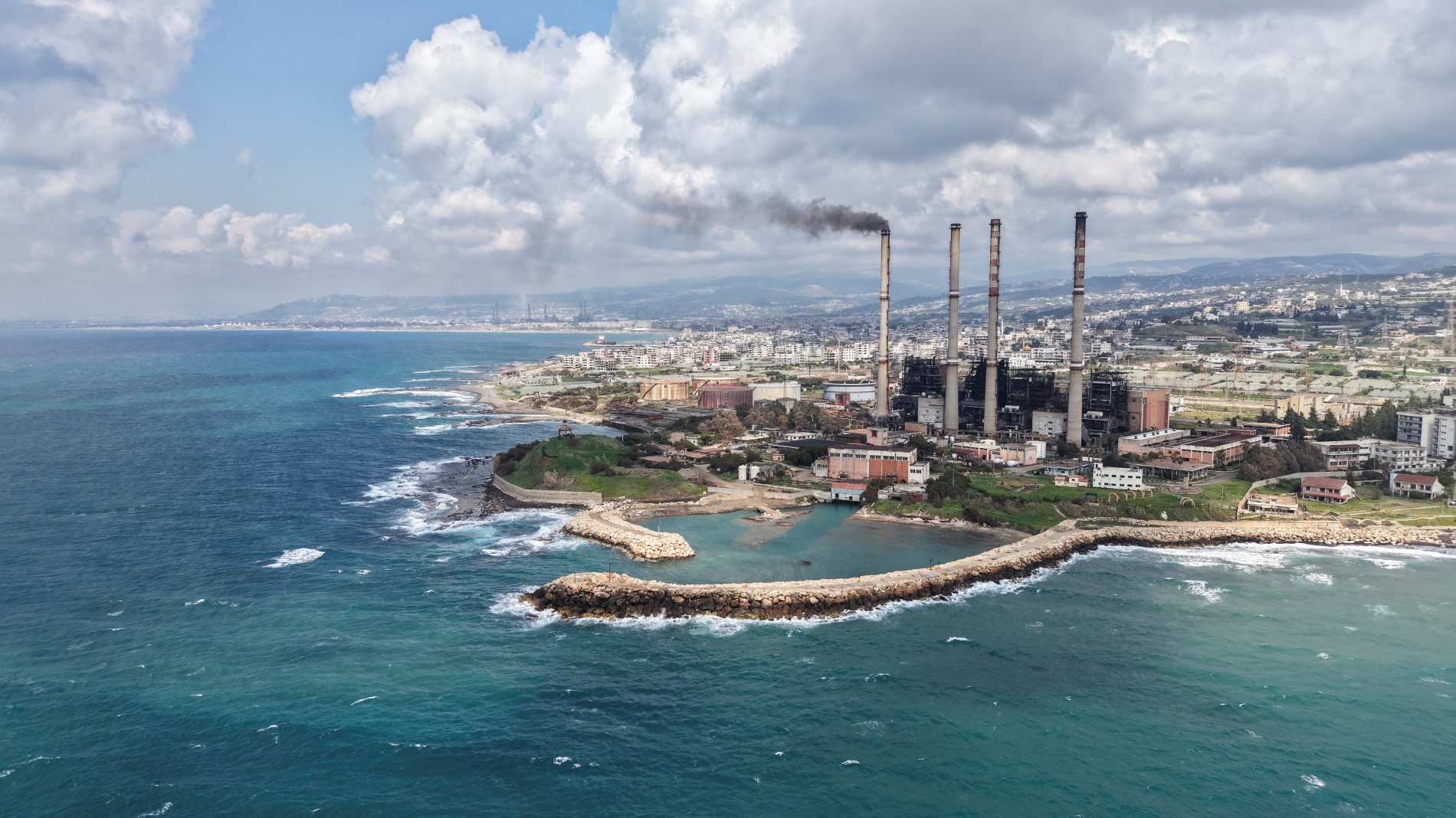
Smoke rises from an industrial facility near the city of Baniyas, Syria, on 8 April 2026.
Lebanon: renewed interest, limited deployment
In Lebanon, Gulf interest has returned, but Gulf capital has not yet. Syria spent the war positioning itself as part of the solution to the Gulf's problem. Lebanon was pulled into the conflict itself, and is still working to restore the conditions that would turn that interest into committed capital.
Hezbollah's entry into the war in March 2026 brought Israeli strikes and a ground invasion. A US-sponsored framework agreement followed in June, but its implementation has stalled, with Israeli forces still inside southern Lebanon and Hezbollah refusing to disarm. In early October, Prime Minister Nawaf Salam said reconstruction was beyond the state's capacity.
The Gulf is still present in the country, but not at the scale of the projects announced in Syria. In January 2026, Qatar announced a $434mn support package, of which up to $400mn goes to the energy sector. In June, the UAE lifted its travel ban, and in late August it sent an 80-person delegation to Beirut, which established a joint business council and signed several memoranda, with interest in logistics, energy, aviation and tourism.
A closer look at these commitments, however, points to a weaker investment appetite. Qatar's package is development support, with 10% of the energy component as a grant, and it predates the war. The Emirati visit produced a business council and memoranda, with no project commitments reported so far. While Syria is attracting large infrastructure investment, Lebanon is so far receiving support and expressions of interest. This reflects Lebanon's structural problems more than the Gulf's capacity to invest.
Gulf states, Saudi Arabia above all, have long tied reconstruction funding to Hezbollah's disarmament, and that condition has not yet been met. The banking crisis is unresolved, deposits remain trapped, and investors have little protection. These obstacles predate the Iran war.
Lebanon has strategic assets to offer: ports in Beirut and Tripoli, subsea cable landings, planned fibre-optic links to Syria and Iraq, and a connection to the Arab Gas Pipeline, through which Jordan approved gas supplies in September. In each case, though, it sits at the end of a route that runs through Syria rather than offering an alternative to it. Lebanon therefore risks being bypassed by the corridors built next door, unless it resolves its internal constraints and makes a different value proposition, centred on talent and technology rather than transit.
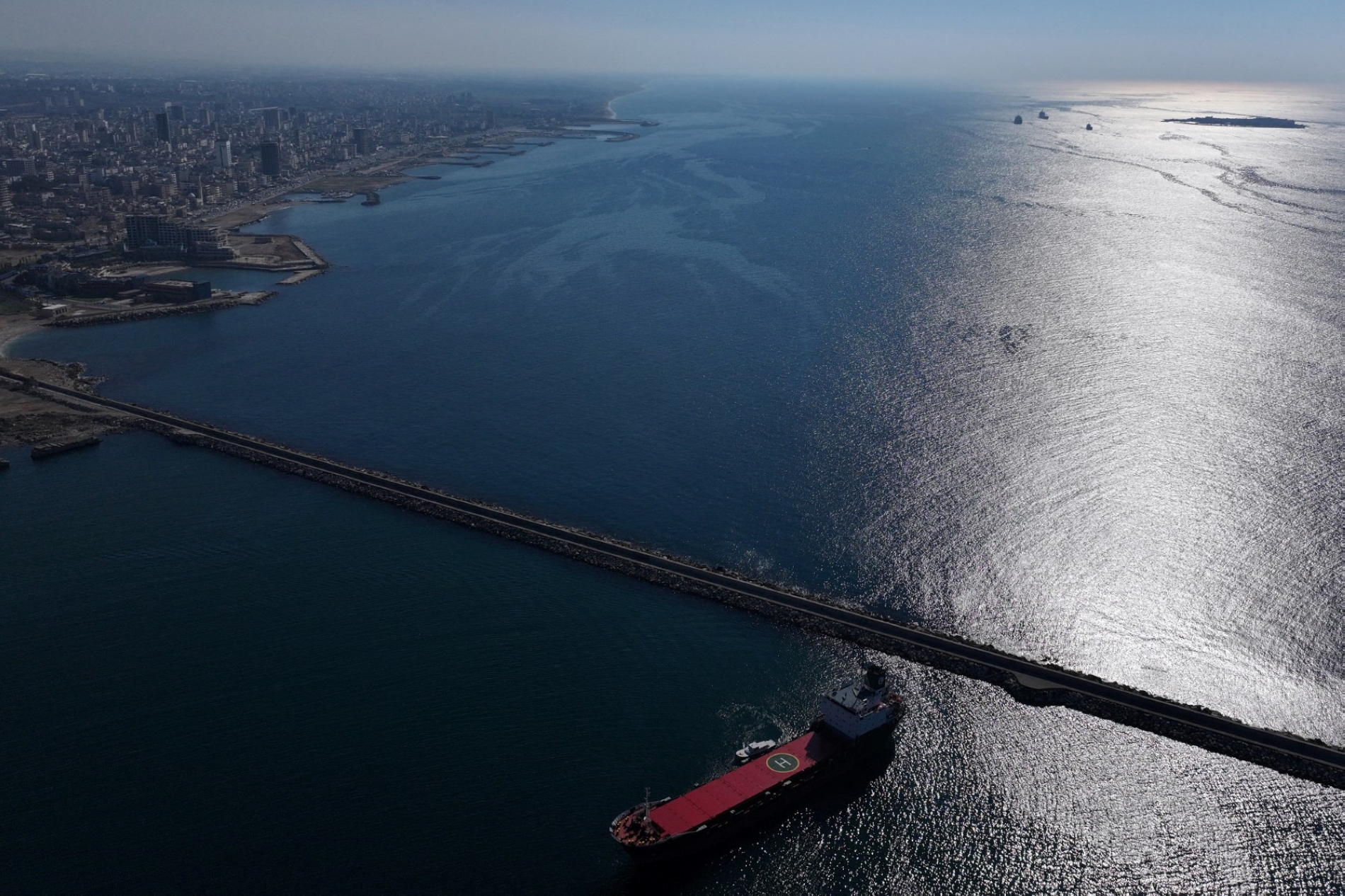
An aerial view showing the port of the Syrian city of Tartus, on 18 December 2024.
The emerging Gulf investment calculus
The war has not ended the Gulf's appetite for investing in its neighbourhood. It has added economic resilience to investment decisions, alongside financial returns and political influence. The evidence so far supports three careful conclusions: 1) capital allocation has become more selective, 2) projects offering alternative routes for energy, trade, and data are attracting new interest, and 3) reconstruction need alone is no longer a sufficient proposition.
The Gulf is not acting as a bloc. Qatar has remained focused on power generation, Saudi Arabia is building corridors and route redundancy, including in data, and the UAE is investing in ports and property.
The test of "redundancy diplomacy" comes over the next year. If the corridor projects reach financial close, the Gulf will have put money behind the concept. If they remain memoranda while Hormuz traffic normalises, the new corridor concept will look like a wartime reflex. For Syria, the task is to convert geography into bankable projects. For Lebanon, it is to resolve the conditions that are currently keeping interested Gulf capital at the door.