
The Arab world has a vibrant literary scene. Al Majalla selects titles in its fortnightly round-up of the latest Arabic books, highlighting trends and ideas across the Arab world.
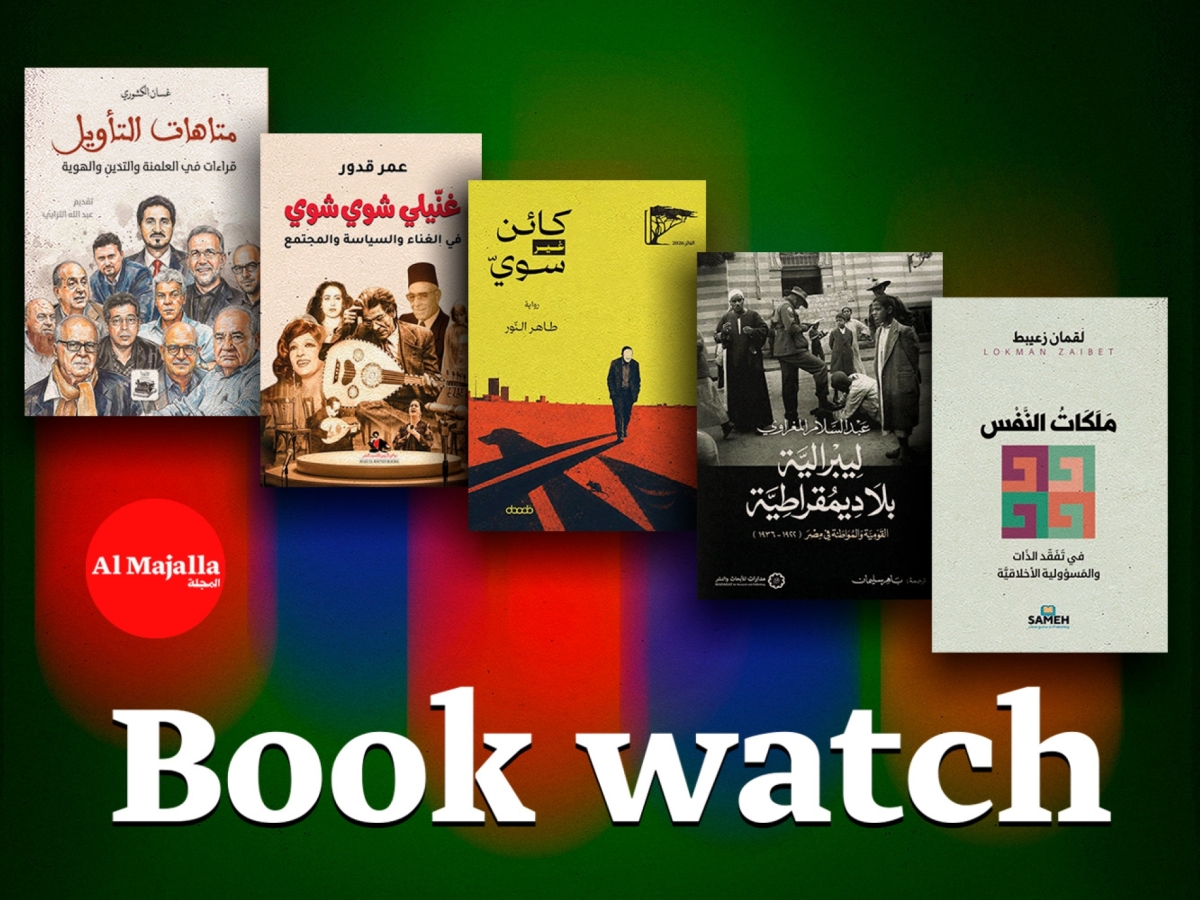
Sing to Me Softly: On Singing, Politics and Society
By: Omar Kaddour
Publisher: Riad El Rayyes Books and Publishing, Lebanon
In this critical and documentary study, Syrian novelist and writer Omar Kaddour revisits the history of Arab music and song from an era considered a golden age of artistic achievement. Yet his purpose goes beyond revisiting the past; he re-examines modern Arab singing, asking how its most celebrated figures emerged amid social, political, and economic change.
Rather than indulging in nostalgia or venerating familiar legends, Kaddour uses Umm Kulthum’s career to trace six decades of evolving Arab musical tastes, including the relationship between song, audience, media, and political power. Music becomes a prism for examining society and an arena for the struggle between tradition and innovation.
Kaddour opens with a revealing distinction between “Miss Umm Kulthum” and “the Lady Umm Kulthum”. In the 1920s and 30s, she experimented, took risks, and searched for her artistic identity, moving between traditional forms (such as the dawr and qasida) and newer forms (such as the monologue and the multi-section taqtuqa). In Cairo’s competitive music scene, she drew on masters such as Sheikh Abul Ela Mohamed, Mohamed El Qasabgi, and Zakaria Ahmed.
From the late 1940s until the 1970s, she became an icon, symbolising central cultural and state authority in the ‘Arab Republic of Umm Kulthum’, closely associated with the Nasserist era. This brought her dominance and a wide audience, but Kaddour says it also forced her to censor her own artistic choices, increasingly confining her to the extended song format. Other vibrant musical forms (like the dawr) were marginalised, and radical innovators such as El Qasabgi were sidelined. The composer eventually found himself “seated in the back row of oud players” in her orchestra.
Different visions
Kaddour gives considerable attention to the composers who shaped Umm Kulthum’s sound and, in turn, were shaped by her. He does not treat them merely as figures orbiting her voice but examines the differences between their musical visions and the tension between their ambitions and the demands of stardom. Behind these tensions lay a struggle for influence within the ‘Umm Kulthum laboratory’.
The book challenges the familiar portrayal of Zakaria Ahmed, the “father of continually renewed authenticity,” as merely a conservative traditionalist. It shows how he drew on a popular musical spirit imbued with the revolutionary fervour of 1919, along with stories of love and passion, to create a ‘hybrid Umm Kulthum style’ that combines the monologue, dawr, and taqtuqa, as heard in songs such as Habibi Yes’ed Awqatoh and Ana Fi Entezarak.
Kaddour dwells on the tragedy of Mohamed El Qasabgi, the “modernising intellectual” whose innovations brought Western forms into Arab music and produced complex compositions based on Arabic maqams. The book argues that Umm Kulthum’s move away from his music after the high point of Raqq El Habib in 1944 had nothing to do with his “creative exhaustion” or “wretched love”.
As she entered her more conservative phase (‘the Lady’), her artistic outlook could no longer accommodate his radical experiments or exacting musical demands. In Kaddour’s view, Riad Al Sunbati, the “brother and alter ego,” was the composer Umm Kulthum would have been had she composed music herself. He absorbed influences from different schools and composed majestic Sufi and romantic qasidas suited to an era of cultural dominance and the elevation of artists to near-sacred status.
Parallel careers
Rather than let the story revolve around a single protagonist, Kaddour sets Umm Kulthum’s career alongside the parallel careers of two exceptional singers in musical cinema: Asmahan and Leila Mourad. Asmahan had a commanding, distinctly feminine voice and a spirit of cultural openness influenced by French musical traditions and music from around the world. With compositions by El Qasabgi, Farid Al Atrash and Mohamed Abdel Wahab, her voice represented the only artistic project capable of rivalling Umm Kulthum’s, had tragedy not brought her life to an early end.
For Kaddour, Leila Mourad personified restrained modernity and the modern dream girl of the silver screen. Through musical films made with Togo Mizrahi and Anwar Wagdi, she offered an alternative to the grand concert song: shorter, livelier music woven into the story and its setting. Her films allowed leading composers to pursue their ideas beyond the strict conventions of the traditional concert stage.
The book also examines the social, political, and religious pressures surrounding Mourad’s career, showing how an artist’s life can become entangled with wider historical change. Kaddour then turns to Abdel Halim Hafez, questioning his legend in ways that may shock his many admirers. His analysis centres on Abdel Halim’s “melodramatic performance”.
The singer’s appeal, Kaddour argues, rested neither on vocal power nor on mastery of classical tarab techniques (such as elaborate vocal ornamentation and emphatic cadences), but on a simpler style of delivery charged with intense emotion, which turned “weakness, vulnerability and orphanhood” into a source of authority over his audience’s feelings. Abdel Halim made singing a form of “emotional sovereignty” that spoke to generations of young people and women. He became “Nasserism's pampered boy”, giving voice to both its rise and its devastating defeat. Meanwhile, Souad Hosny bid Nasserism a celebratory farewell in her song Ya Wad Ya Te’eel.