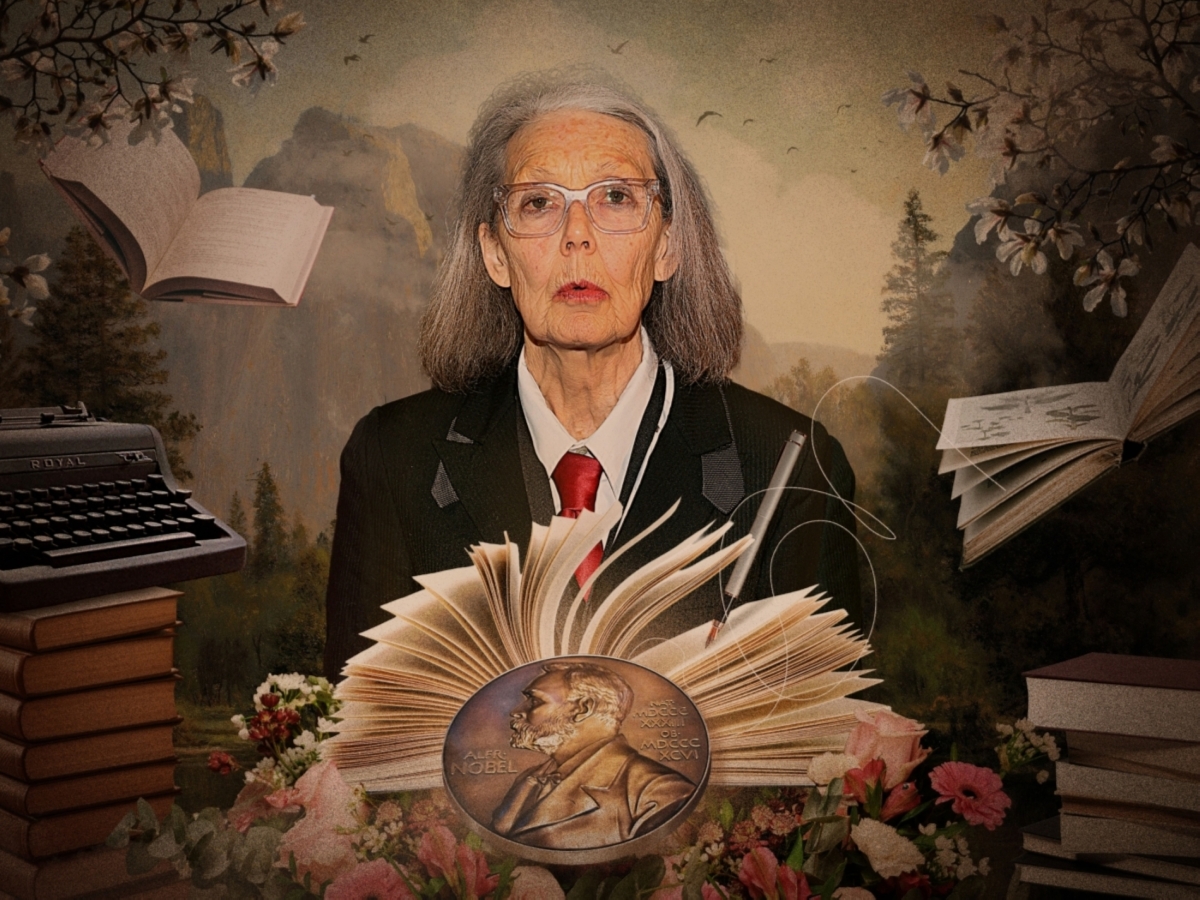

When the Swedish Academy opened its familiar doors in Stockholm this week, its Permanent Secretary, Ingrid Carlberg, emerged to tell the assembled journalists that Canadian poet Anne Carson had won the Nobel Prize in Literature. It was, she said, “for her bold and inventive oeuvre that, in playful dialogue with the classical tradition, has created new forms of contemporary literature.”
From the description, one word lingered longer than the rest: playful. The Academy is renowned for its seriousness and rigour, and the awarding of the annual Nobel Prize is one of its most solemn rituals. The word ‘playful’ gives pause to anyone familiar with Carson, born in Toronto in 1950, who spent years constructing a box for a brother who had died far away, across the Atlantic Ocean, and who devoted her life to translating Greek plays whose protagonists ultimately march towards their deaths. In every one of her jokes, there is the faint echo of earth being shovelled onto a grave.
There is a distance between the lightness perceived by the Academy and the sorrow that inhabits Carson’s books. Within that distance, another Carson reveals herself to those who spend enough time immersed in her world. For her, play is the language grief speaks when direct expression falters. It is also a means of summoning those who have passed into the present, sitting with them and exchanging jokes to keep them close for as long as possible. Perhaps the Academy, weighing its words with the utmost care, said more than it intended.
A joke to a grave
In 2012, Carson rewrote Sophocles’ play as Antigonick, opening on a darkened stage as Antigone and her sister Ismene enter. Antigone begins: “We begin in the dark, and birth is the death of us.” The sisters then begin a playful exchange over who said these words. Antigone credits them to Hegel, while Ismene thinks they sound more like Beckett. Antigone counters that Beckett himself was merely paraphrasing Hegel.
The conversation continues in this light-hearted vein until Antigone turns to her sister and sarcastically asks whether there has been any bitterness, pain, nausea, shame, or moral outrage they have been spared since birth, given the evils associated with their father, Oedipus. She then abruptly turns to what brought her there, declaring, “And now this edict.” By this, Antigone means the king’s decree that her brother’s corpse be left exposed in the open. The entire story revolves around a hand determined to scatter earth over that body. The philosophical joke at the beginning of the play thus becomes a light-hearted threshold to a grave.
Carson lived through a story not unlike her heroine's. In 1978, her brother Michael fled Canada after being accused of drug trafficking and remained absent from her life for more than 20 years. Eventually, they arranged to meet in Copenhagen, but he died before the reunion, and news of his death reached her only belatedly. From this absence emerged Nox in 2010, a book of unconventional physical form. It consists of a single sheet of paper, 12 metres long, folded into successive sections and housed in a box.
At the beginning of the book, Carson placed the elegy written by the Roman poet Catullus for his brother 2,000 years earlier. She then explained its 63 Latin words, one by one, along the left-hand side of the folds, using the detached language of dictionaries. On the right, she gathered photos and comments from her brother, her mother, and his wife.

Through this painstaking process, Carson enacted on paper what Sigmund Freud called the “work of mourning,” the effort through which memory revisits the traces left by the deceased until the bereaved psyche becomes capable of accepting separation. Carson moved through the words as a grieving person moves through memories, and the very slowness of the process became a funerary ritual.
Her mother, Margaret, had died a few years before Michael, passing away in 1997. Carson called her the love of her life and opened her 2005 book Decreation with poems mourning her loss, taking its title from Simone Weil’s concept of emptying the self of its ego. Moza Abdullah Al Abdouli translated some of these poems into Arabic, including Lines, in which the daughter speaks to her mother on the phone while arranging bookshelves.
She props books beside the telephone, gathers paper clips into a ceramic dish and brushes away scattered eraser crumbs, while her mother “goes on at length about death.” The mother then jokes that she refuses to pay the bill, and the poem ends with the paper clips “immortally aligned”. The poem is built on restraint: small objects, short sentences, and emotions held captive behind the act of tidying. Through that restraint, it achieves what more impassioned elegies cannot.
Opening the door
Perhaps the oldest among Carson’s dead are the ancient Greeks, whose presence would shape her subsequent literary pursuits. At one of the schools (she attended several because her father’s banking career meant the family moved around), a Latin teacher opened the door to ancient Greek for the young Carson, who entered a language its speakers had abandoned centuries earlier and made it her home.
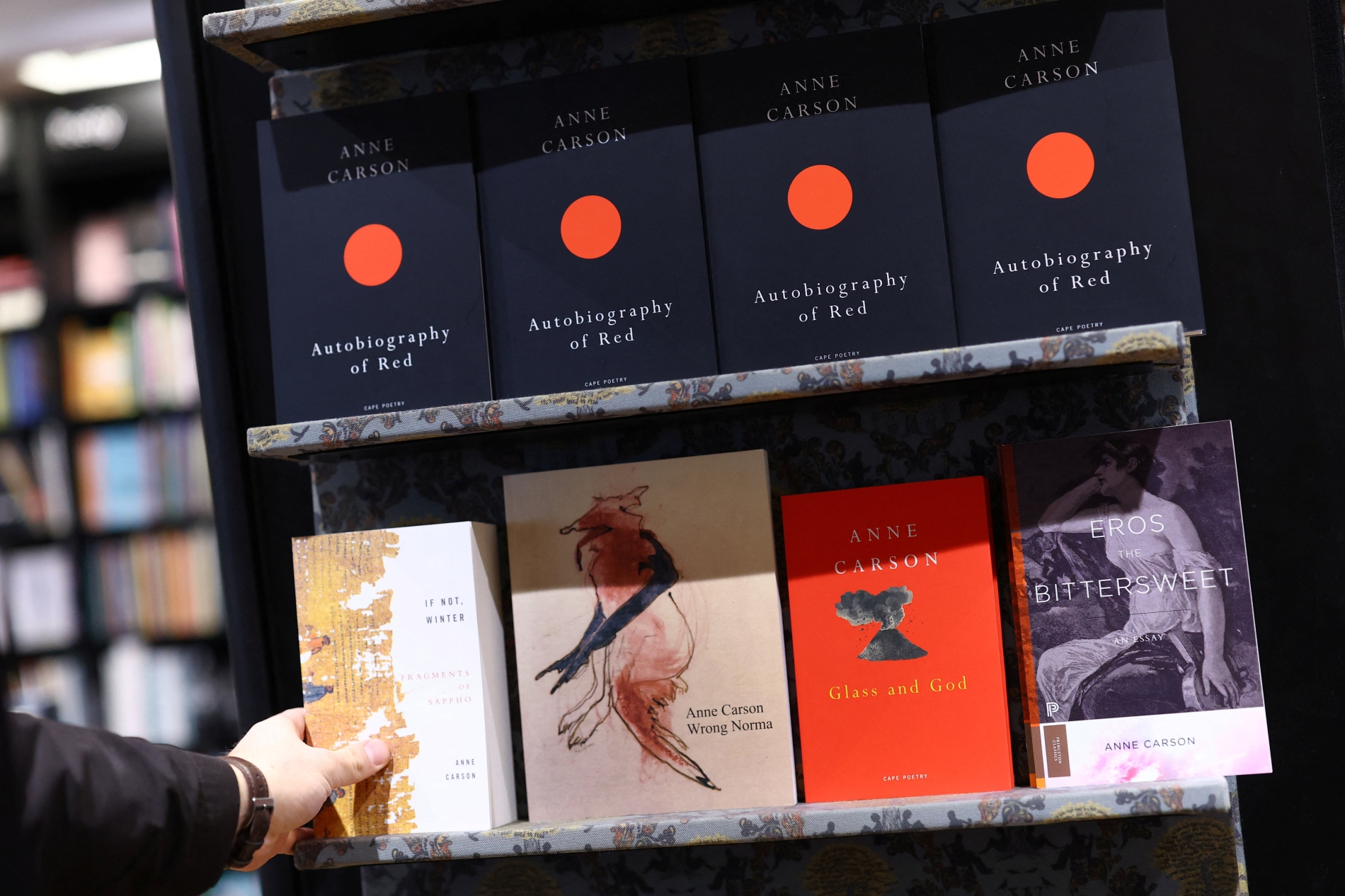
In 1981, she earned her doctorate with a thesis on love and desire among the ancient Greeks, titled Odi et Amo Ergo Sum (I Hate, and I Love, Therefore I Am), borrowing its opening words from Catullus himself. The thesis would later be published as Eros the Bittersweet: An Essay, which Youssef translated into Arabic in 2024. Princeton University denied her tenure in 1987, prompting her to move to McGill University in Montreal. There and elsewhere, she continued translating Fragments of Sappho and ten Greek tragedies, writing about these long-dead figures in the voice of someone who had known them intimately.
Carson once described poetry through an image that encapsulates her entire approach to writing: if prose is a house, then poetry is “a man on fire running quickly through it”. Fire is catastrophe, and running suggests lightness, yet both occur at the same time. This combination of catastrophe and lightness can be found in the work of Dutch historian Johan Huizinga, who argued in Homo Ludens that play predates culture, that poetry and ritual were born from it, and that the serious player enters a realm governed by its own rules and observes them with the gravity of life itself.
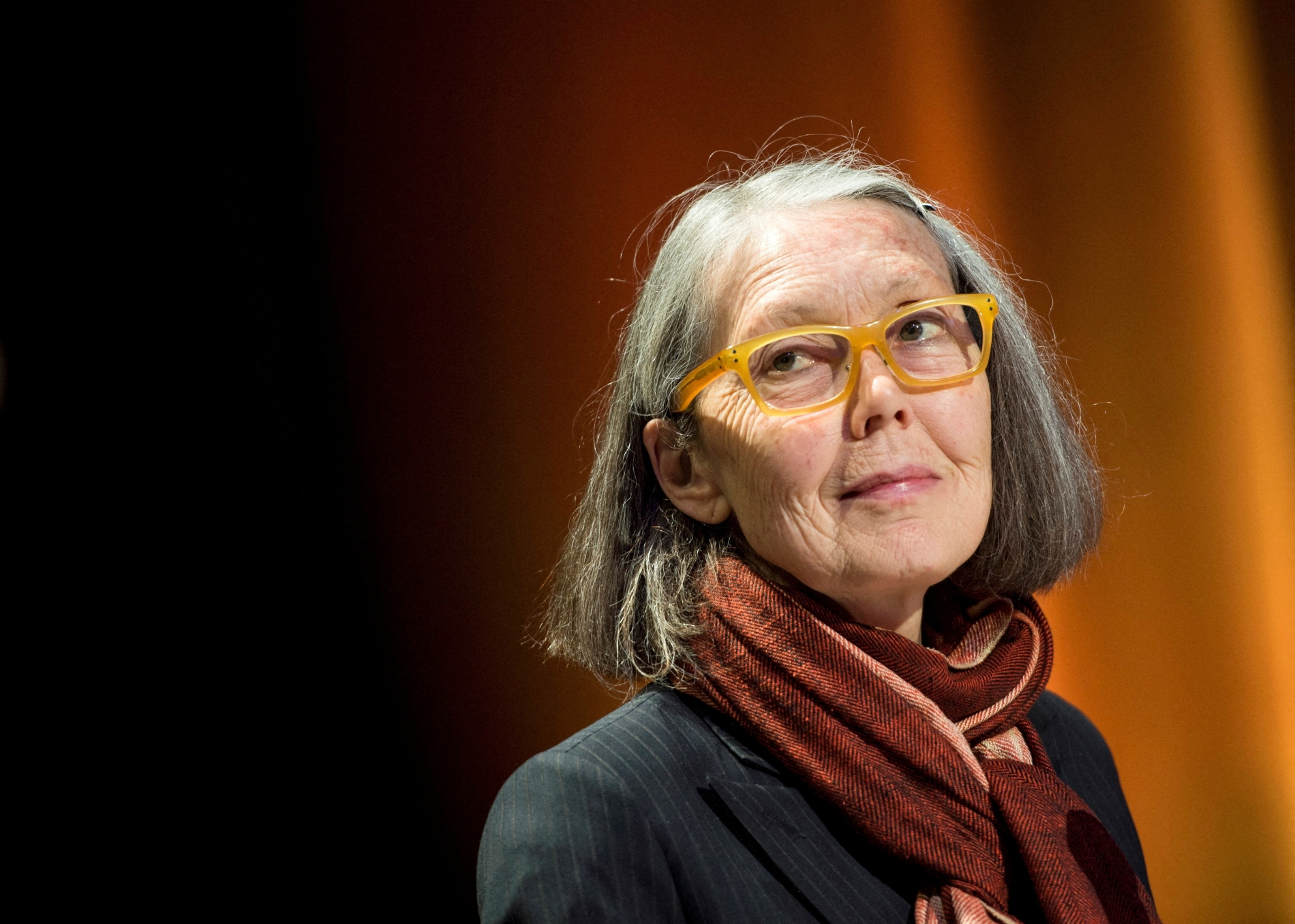
Carson plays with this seriousness, following rigorous rules that reveal themselves to those willing to read slowly. Her experimentation began in the classroom. At Princeton, she devised the ‘Short Talk’ to break the rigidity of the lecture, before collecting these pieces in a 1992 book called Short Talks.
In Short Talk on Ovid, for example, the Roman poet eats dinner in exile and returns to his room, where a bright green radio awaits him. He writes his letters and weeps, teaching himself the language of the locals so he can “compose an epic poem in it that no one will ever read”. A single radio is therefore enough to collapse 2,000 years of history, while one final line turns the description into a bitter joke about a poet writing for absent readers.
This form established Carson’s literary reputation and led practitioners of the ‘lyric essay’ in North America to regard her as a pioneer. Yet its extreme economy also makes it dependent on the final stroke. If the joke misses the mark, the short talk remains little more than a clever reflection, a weakness evident in some of the less successful pieces in the collection.
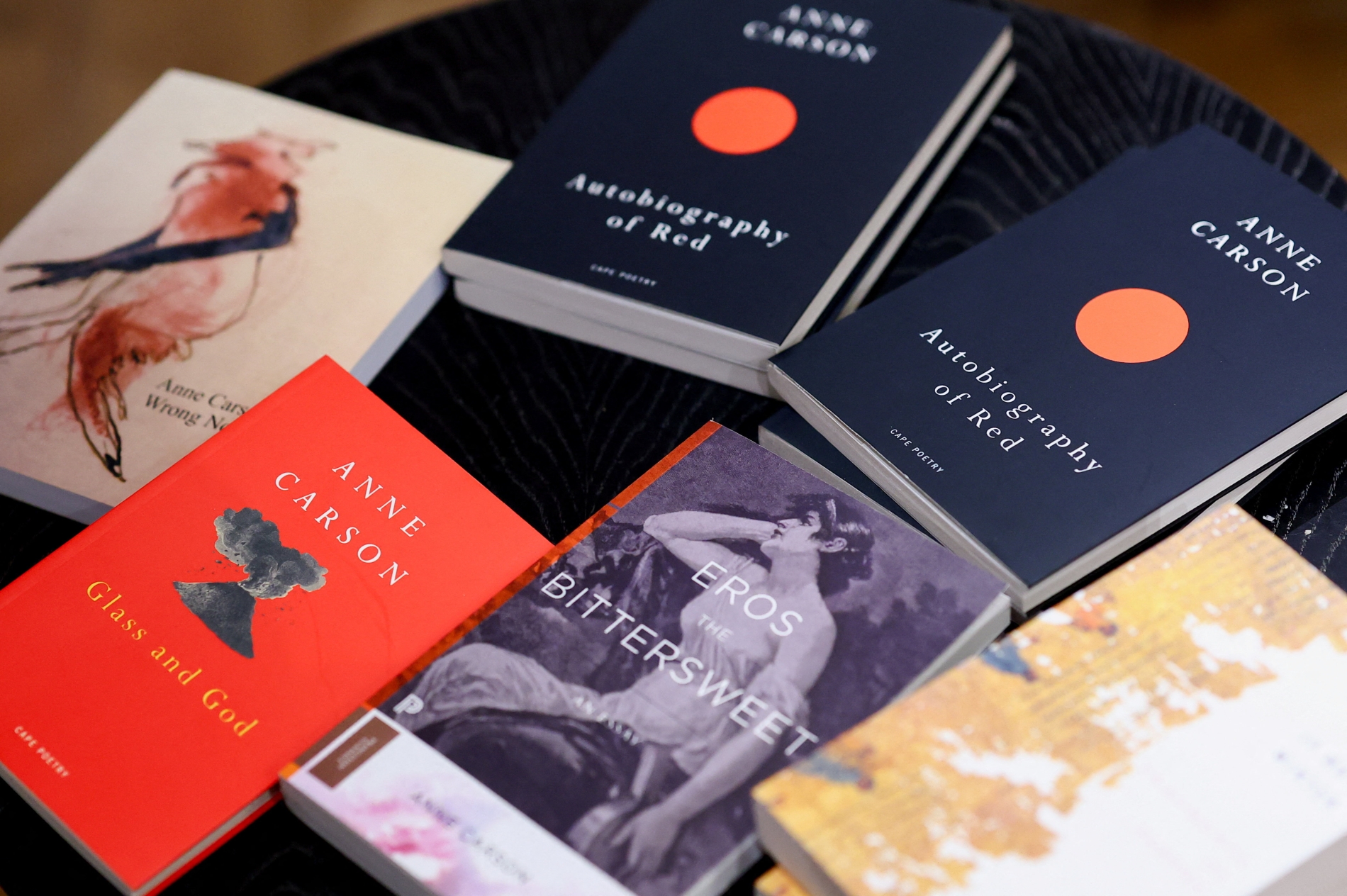
The experiment reached its height in 1998 with Autobiography of Red, translated into Arabic by Mamoun Al-Zaidi. Carson took a handful of fragments by the ancient Greek poet Stesichorus about Geryon, the winged red monster slain by Heracles, and transformed him into a shy boy who falls in love with his killer. She surrounded the narrative with an essay on the ancient poet, translations of his fragments, and an imaginary interview with him.
In a section titled Kiss, Geryon reads a sentence in Buenos Aires: “I will never know how you see red, and you will never know how I see it.” He then ventures out into the Saturday night, passing a Chinese restaurant, a beggar, and a bookshop, until his shoulder brushes against a man's, at which point “Geryon’s heart stopped; the man was Heracles”.
The book’s true audacity lies in its perspective. Myths are typically written by the victors from the hero’s point of view, but Carson writes this from the perspective of the defeated monster, giving the slain creature a voice, heart, and capacity to love. As for its form, American critic Adam Kirsch saw it as prose broken into lines. The long lines do read like prose, but the passage draws its power from the cinematic cuts between scenes and the unexpected juxtaposition of a philosophical lesson about colours with the physical collision of two bodies. It is a power registered by the eye before the ear.
Intellect and injury
Three years before Autobiography of Red, Carson wrote The Glass Essay, a poem depicting a woman emerging from a failed love affair who visits her mother and ailing father while reading Emily Brontë. Essay, literary criticism, and the intimate diary of a love affair converge in a single poem. It remains Carson’s most successful achievement in balancing intellect and emotional injury, as Brontë moves from object of study to companion in solitude.
Carson’s experiments with literary form continued in successive works. In The Beauty of the Husband, she recounts the collapse of a marriage through a fictional essay comprising 29 sections, each of which she calls a ‘tango.’ The book made her the first woman to win the T. S. Eliot Prize. Then came Float in 2016, presented as a transparent box containing 22 booklets that can be read in any order. In 2019, Norma Jeane Baker of Troy followed, in which Marilyn Monroe plays Helen.
In The Beauty of the Husband, experimentation finds its justification in the tango, which gives the disintegrating marriage the rhythm of two dancers stepping forwards and backwards together. In Float, it comes closer to a gimmick, as the game itself becomes more intriguing than its pages. In Norma Jeane Baker of Troy, however, the experimentation regains its seriousness when Carson lends Marilyn Monroe’s face to the phantom over which men fought at Troy, while the real Helen was far away.
All this play has a theoretical foundation that Carson laid early in Eros the Bittersweet, her thesis. Beginning with the word 'bittersweet', which Sappho used to describe the conflict of love, Carson constructs a triangle of desire whose three points are the lover, the beloved, and the distance between them. She reads Sappho's poem about a man sitting opposite the woman she loves as a perfect triangle of desire: the woman and the man form two points, while Sappho, watching them and thrown into physical turmoil by the sight, occupies the third.
Yet the elegance of this theory also carries its limitations, reducing all desire to a condition of lacking. Gilles Deleuze and Félix Guattari challenged this conception in Anti-Oedipus, where desire is a productive force before it becomes an emptiness seeking to be filled. Carson, however, writes about the desire of the ancient Greek lover and that of the reader. It is precisely in these two realms that her theory holds firm, for the reader engages in a game with a text that always remains one step beyond reach. And the game has its darker side.