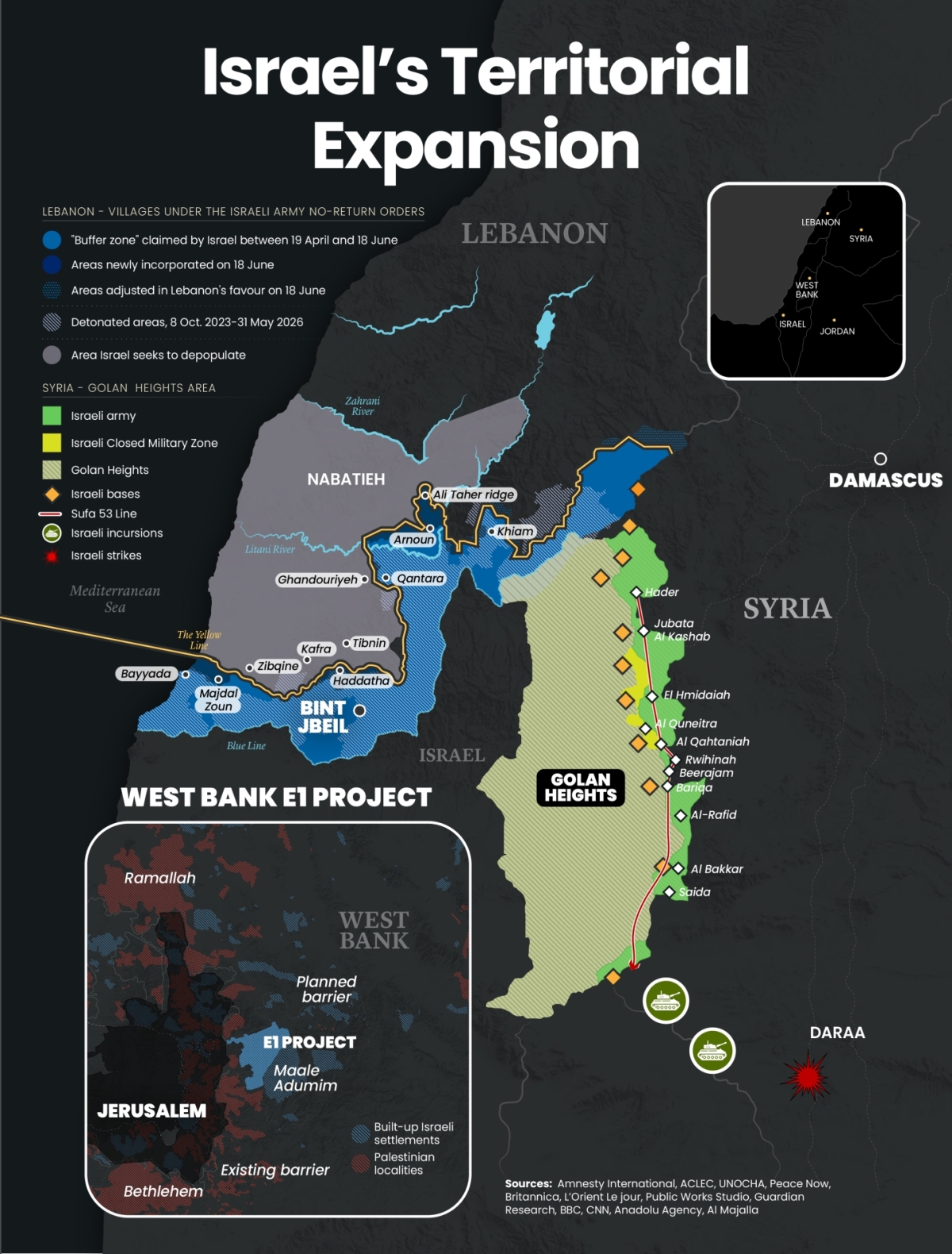

From southern Lebanon to the Golan Heights and the West Bank, military invasions and occupation are creating new realities on the ground and pushing Israel’s lines of control beyond their previous boundaries.
From southern Lebanon to the Golan Heights and the West Bank, a new Israeli map is taking shape, drawn through fire, fortifications, roads and settlements. Israel is turning temporary positions into permanent sites, pushing its "security perimeter" deeper into neighbouring territory and making a return to pre-war lines increasingly difficult.
In southern Lebanon, the latest war created a new reality around what has come to be known as the “Yellow Line.” Behind it, Israeli forces established what it calls a "military zone" on Lebanese land, razing infrastructure and roads and entire neighbourhoods in the process. It is also barring Lebanese from returning to their villages, with parts of the "buffer zone" becoming completely inaccessible.
On 26 June 2026, a US-backed tripartite framework agreement sought to reverse this reality. It called for the Lebanese state to restore authority over its territory and for a phased Israeli withdrawal, beginning with “pilot areas” where Lebanese forces would assume security responsibility after verifying they were free of weapons and infrastructure belonging to armed groups.
In practice, the framework tied the withdrawal to Hezbollah’s disarmament and set no final timetable. Israel has continued to occupy parts of southern Lebanon and conduct airstrikes, shelling and demolitions, while negotiations stalled over verification, withdrawal sequencing and disputed points along the Blue Line.
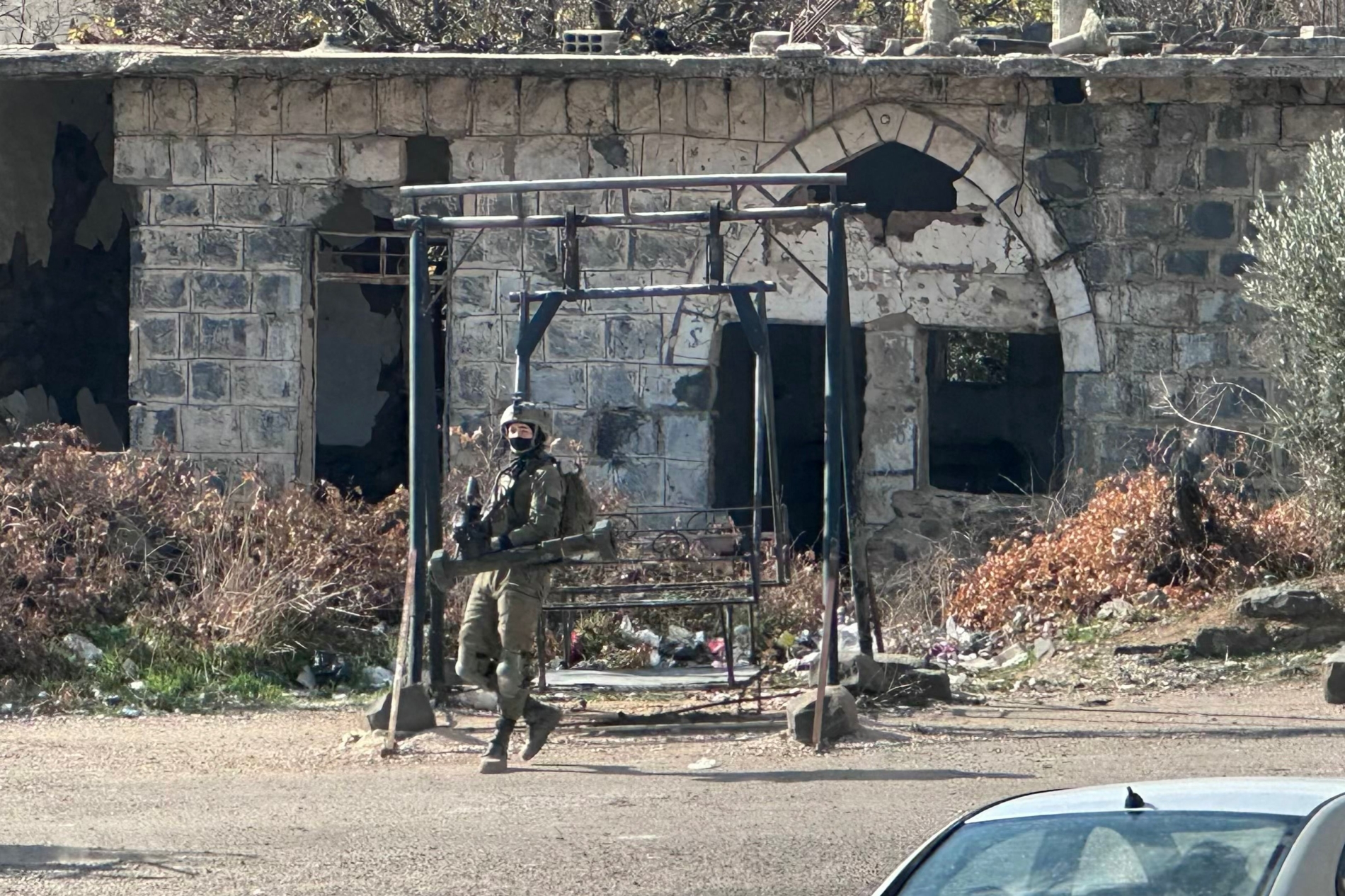
In the Golan Heights and southern Syria, Israeli expansion has deepened since the fall of Bashar al-Assad’s regime in December 2024. Israeli forces entered the UN-monitored buffer zone, moved beyond the 1974 separation line and established military positions inside Syria, saying the deployment was necessary to "prevent potential threats".
The UN documented Israeli forces maintaining and reinforcing at least 11 positions by August 2026, stretching from Mount Hermon through Quneitra to Daraa and the Jordanian border. The expansion includes military roads, fortifications, restrictions on civilian movement and damage to agricultural land. It has also extended into Daraa, where Israeli forces have carried out incursions, raids and arrests, established checkpoints and temporary positions, and conducted repeated air and artillery strikes.
The resumption of the “Sufa 53” project in Quneitra adds another layer. It includes a military road, fortifications, trenches and barriers along the separation line toward the Yarmouk Basin near Jordan. Damascus considers it a violation of the 1974 Disengagement Agreement, while Israel presents it as part of a broader security architecture to consolidate control over the area.
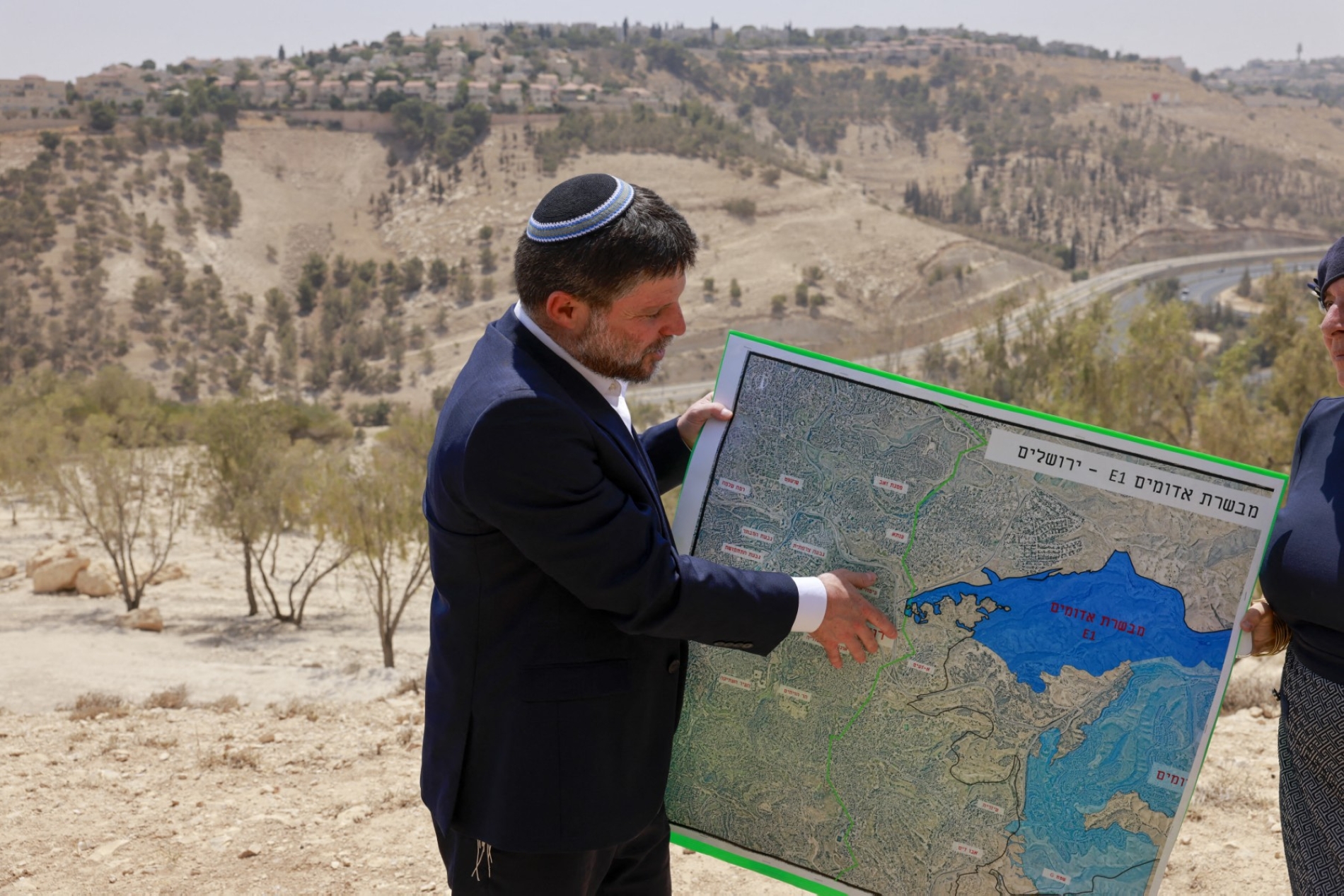
In the West Bank, settlement expansion is accelerating alongside growing pressure on Palestinian communities. The E1 project is central to this effort, with 3,401 settlement units entering the tendering stage after decades of delays. Located between East Jerusalem and Ma’ale Adumim, it occupies a strategic corridor linking the northern and southern West Bank. Its completion would strengthen Israeli settlement continuity east of Jerusalem while further separating East Jerusalem from its Palestinian surroundings. The UN, EU and human rights organisations have warned that it threatens the territorial contiguity needed for a viable Palestinian state.
E1 is also linked to broader efforts to intensify Israeli control over Area C. Across the West Bank, settlers establish outposts, restrict access to farmland, water and grazing areas, attack homes, farms and livestock, and block roads, creating conditions that can push families to leave. Since January 2023, such violence has contributed to the partial or complete displacement of around 107 communities comprising nearly 5,900 Palestinians.