Rain-soaked cities in the paintings of Saudi artist Fahad Al-Khalif

Imagination lies at the heart of Fahad Al-Khalif’s distinctive visual world, where architecture, memory, colour, and symbols create cities beyond familiar laws of place and perspective

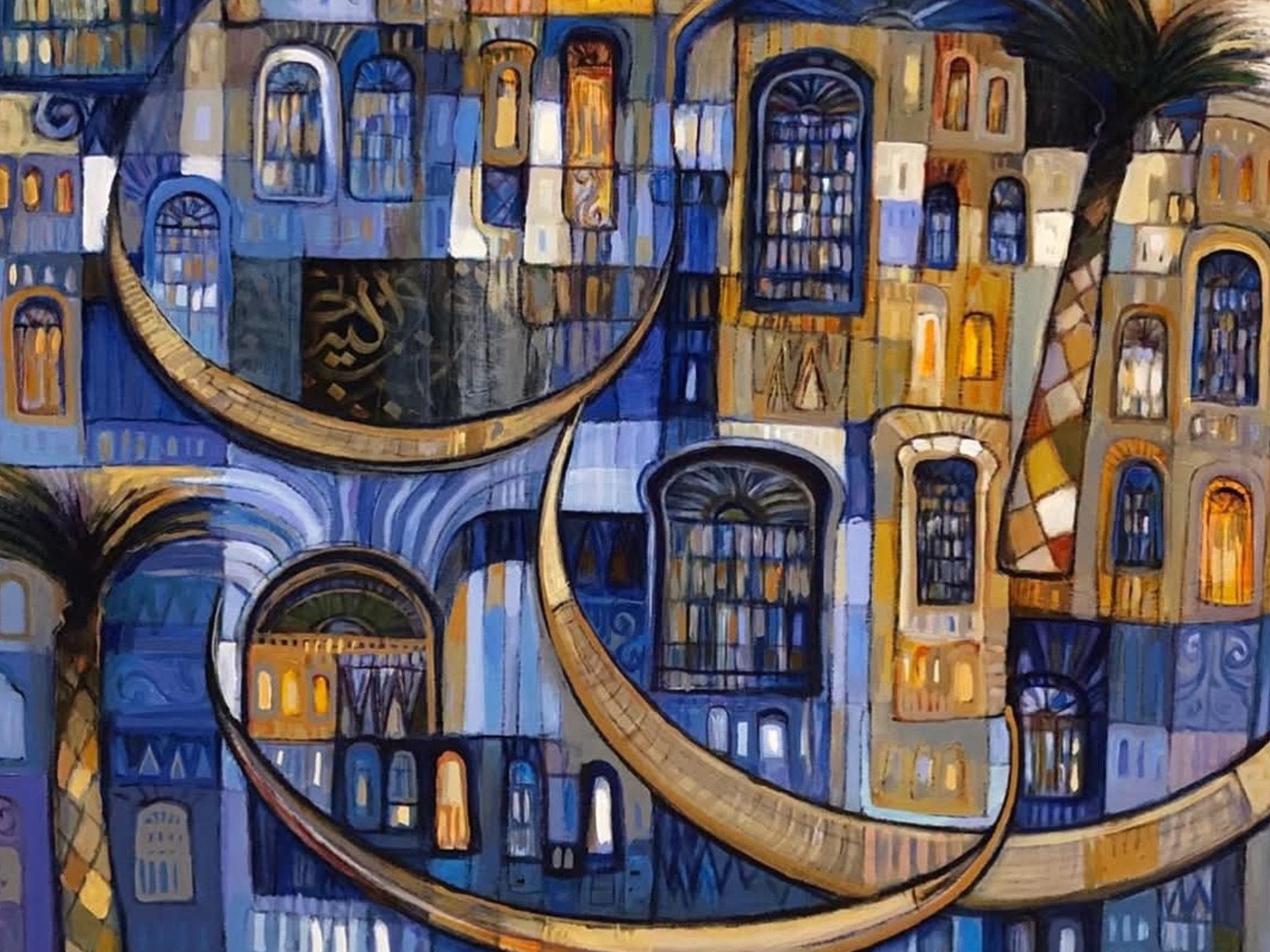
A painting by Fahad Al-Khalif

Rain-soaked cities in the paintings of Saudi artist Fahad Al-Khalif

Visual artist Fahad Al-Khalif has emerged as one of the most distinctive figures among Saudi Arabia’s younger generation of painters. Since 2018, his practice has attained a clear degree of artistic and intellectual maturity. This evolution has brought him to the threshold of an exceptional new phase, shaped equally by the ideas informing his vision and by the stylistic character of his work.

In his most recent works, the artist’s inward gaze suggests a liberation from the anxiety of searching for form. He has arrived at a visual language increasingly confident in itself, one that affords him greater expressive freedom. Its vocabulary draws particularly on the visual abundance of Asir’s ornamentation and the vernacular geometry of Al-Baha, two mountainous regions in southwestern Saudi Arabia, alongside influences from Jeddah and Makkah.

These diverse sources have carried his work towards a realm where surrealism encounters an expressionism infused with symbolic suggestion, while the distinctive character of his pictorial universe remains intact.

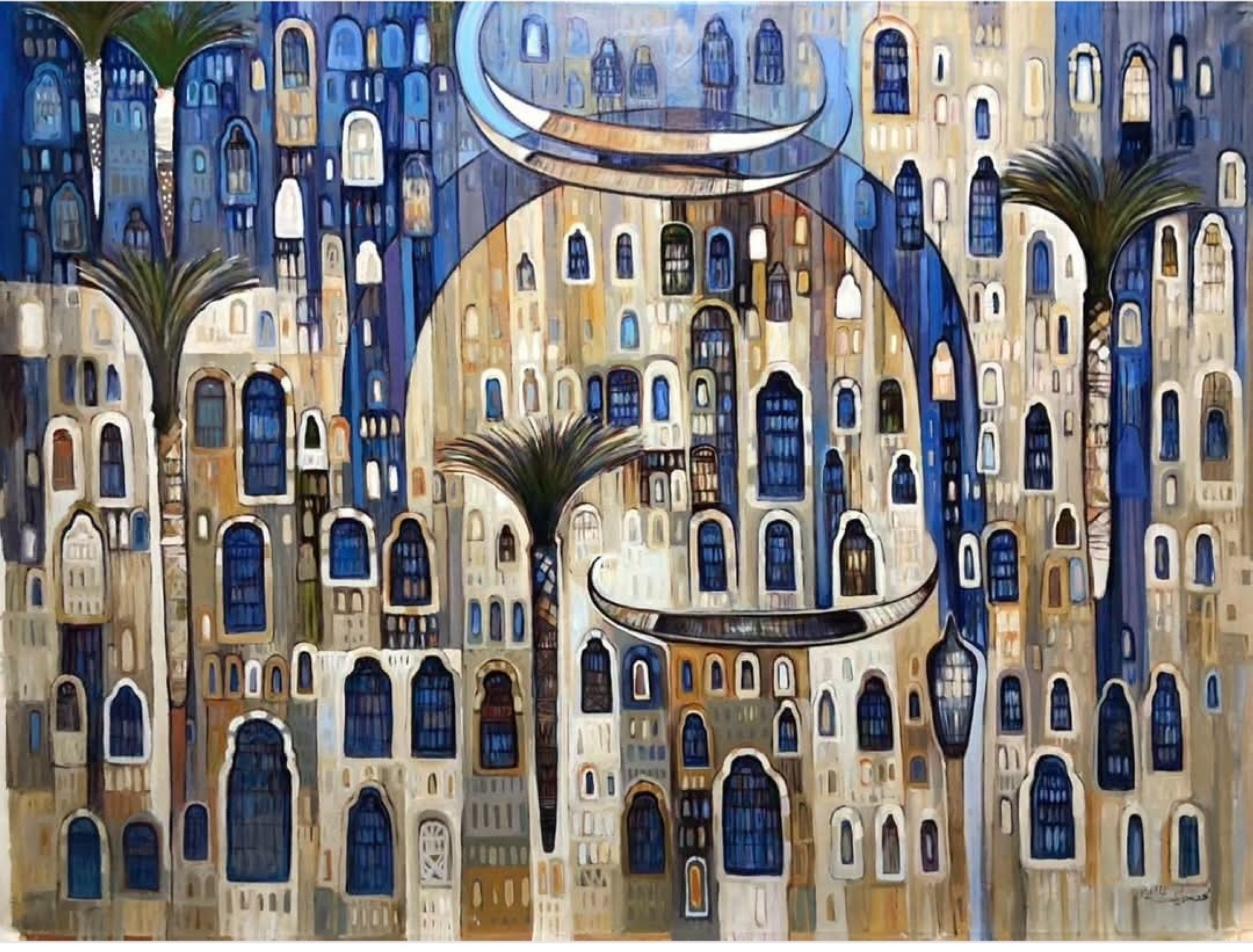
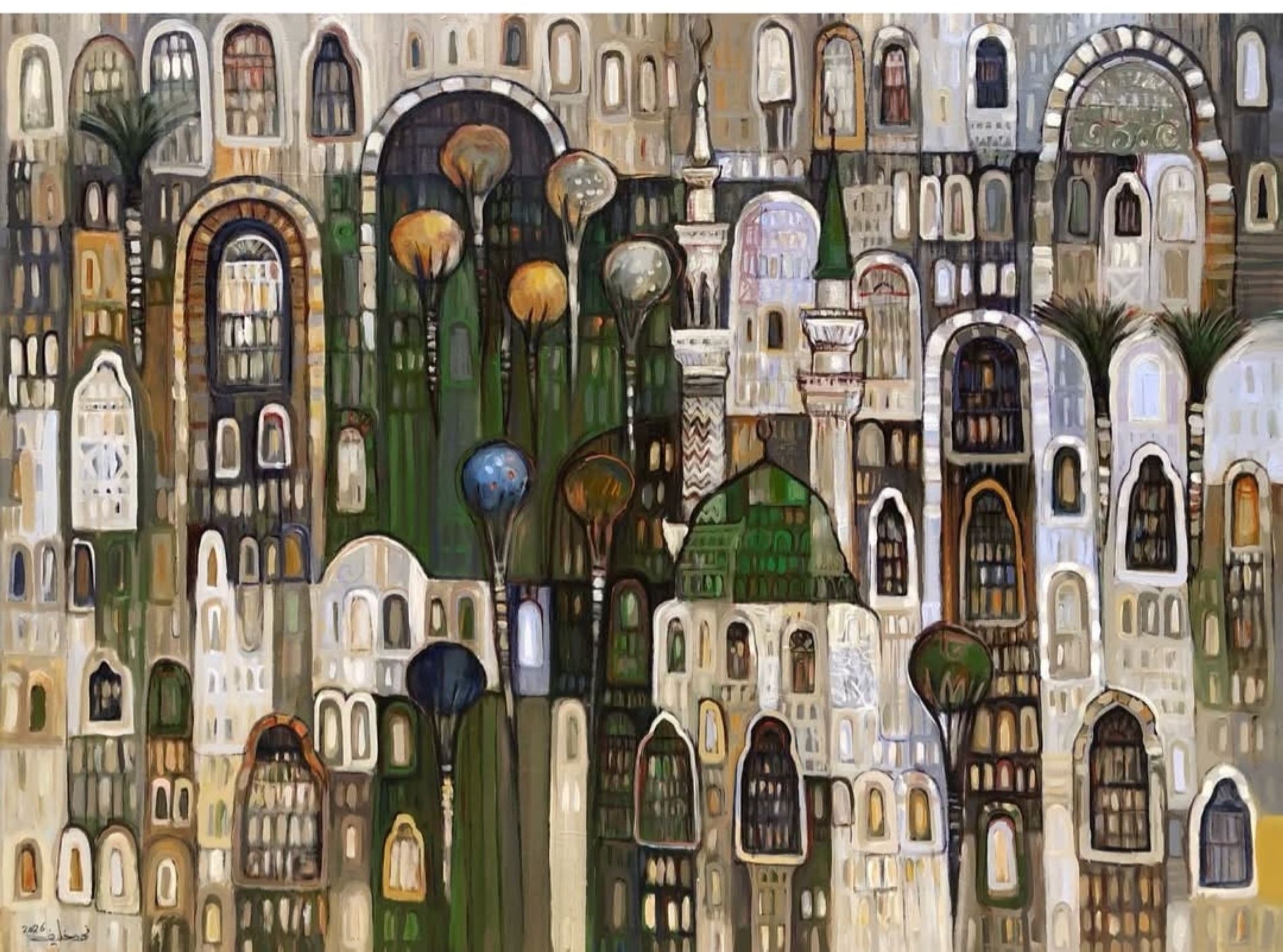
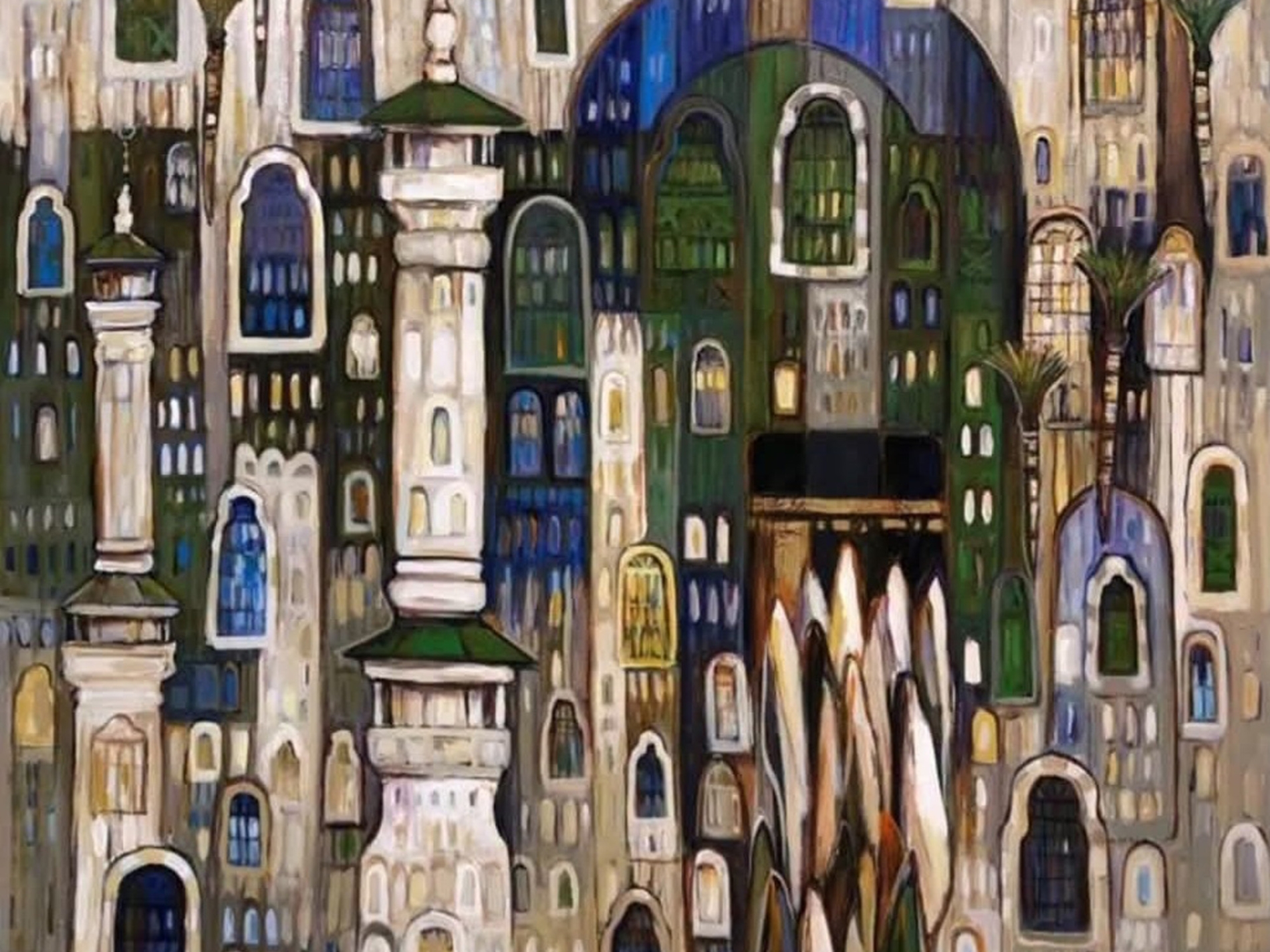
The cities he paints appear to have been conjured by the imagination rather than constructed according to any coherent architectural scheme. They readily slip beyond the laws of physical reality, their coherence arising from an internal logic that lends them a balance all their own. A house opens onto a door. Palm trees rise within enclosed interiors. The boundaries between inside and outside dissolve in a world governed more by imagination than by geography.
The bird that once perched on the arms of figures with indistinct, almost interchangeable faces has likewise moved beyond its earlier role as a pictorial motif to become an integral structural element within the painting. At times, it soars through the sky. Elsewhere, whether in the same canvas or another, it becomes a delicate visual bridge linking otherwise disparate areas and forms. Though it occupies only a small portion of the composition, it fulfils both an emotional and a formal function. Some paintings are difficult to imagine without it, since its disappearance would disturb their internal equilibrium, replacing harmony with a subtle sense of visual unease.

At this more mature stage of his practice, Al-Khalif has also introduced the shadow as an entity that accompanies forms while simultaneously assuming an existence of its own, a structure that, in a sense, casts a shadow upon itself.

His exploration of the shadow as an autonomous presence deserves particular attention: its shifting states and meanings can be read in their own right, as can its capacity to weave relationships among the painting's various elements. The shadow may yet develop into a visual subject in its own right, capable of accompanying the artist as an enduring preoccupation throughout the years ahead.
Expanding cities

Imagination is the defining quality that has shaped Al-Khalif's world and given it its unmistakable character. In this realm, grounded in an intimate knowledge of heritage, chess pieces appear almost as inhabitants of the city: walking, standing, or meeting the viewer with a silent, steady gaze. Rendered in white, they call to mind his white horses, which have themselves undergone a striking transformation over the course of his career. They have moved away from the familiar image of the Arabian horse inherited through visual tradition towards a more abstract symbol, while retaining their capacity to suggest strength and latent movement even in moments of stillness. Their almost 'stony' quality lends them a different kind of solidity.

Equally significant is his turn toward visual density, departing from the sparser compositions of his earlier work. This is particularly evident in several paintings where recurring motifs such as the table and chair reappear. The elements never seem crowded. Instead, they are harmoniously woven into a single visual fabric. This new boldness reveals how density, and an abundance of elements when skilfully arranged, can become one of the most fertile sources of a painting's beauty.
The Arabic letter, particularly the Thuluth script that the artist seems to favour, is itself a vessel of transformation

Al-Khalif has stripped gratuitous ornament from his artistic language. The profusion of detail now belongs to the work's deeper structure, entering into a continuous dialogue with colour, symbol, and space.

Here lies the significance of the shift. Visual density in Al-Khalif's work no longer opposes clarity. It has become a means of achieving clarity. His many elements do not compete for attention. Even calligraphic abstraction no longer asserts itself as an independent element within the composition. It has dissolved into the pictorial fabric and become part of its animating spirit. The letter has been released from its immediate function as writing and transformed into a mutable visual energy that merges with movement, rhythm and colour.

A painting by Fahad Al-Khalif

The Arabic letter, particularly the Thuluth script that the artist seems to favour, is itself a vessel of transformation. From this emerges Al-Khalif's visual language, which invites interpretation and draws the viewer into the making of meaning. In this sense, his world rests upon a network of recurring visual symbols that have gradually become part of his personal pictorial lexicon. The window, the door, the chair, the boat, the horse, the palm tree, and the chess pieces all acquire meaning through the relationships they form with one another within the painting.

The new strength of his recent work lies in this poetic fragmentation, which signals the liberation of elements from their conventional positions and their entry into more open and unexpected relationships. At times, the flutter of a bird's wing is enough to serve as a visual bridge. Elsewhere, the bird is released to glide through the scene.

This ability to gather a profusion of detail within an open pictorial field may help explain the artist's affinity for large-scale canvases, including murals. Among his murals are those displayed at King Abdulaziz International Airport. A viewer familiar with Al-Khalif's earlier work who searches his newer paintings for the chair and table that once appeared as clearly defined elements will still find them there, though now dissolved into the atmosphere of the city, enveloped by its houses and shifting moods until they have become part of its visual fabric and its memory.

A painting by Fahad Al-Khalif

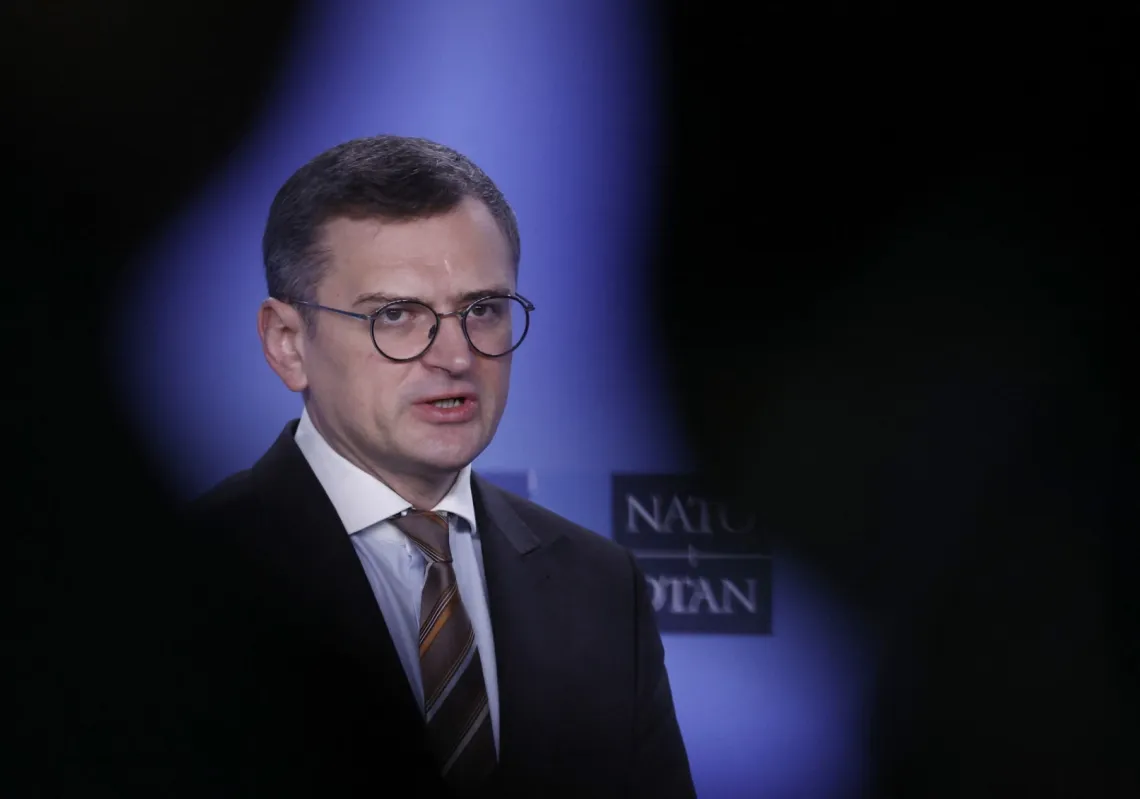
Rain-soaked cities

From that memory, and from that rain-laden space, emerge cities shaped more by imagination than by any coherent architectural design. They shift and transform from one painting to the next, reflecting Al-Khalif's capacity for wonder, a quality that helps explain both the abundance of his output and the compelling strangeness of his architecture. He has allowed it to grow freely, often unconstrained by the laws of perspective or the conventions of geometric construction.

A viewer needs only to step back a few paces from a single painting, or from a group of works, to discover rain-soaked cities whose buildings seem to descend from the sky before settling with assurance upon the ground. This vision is reinforced by the artist's mastery of perspective and his ability to make visual planes overlap, press against one another and converge in varied configurations that sometimes challenge logic and sometimes accommodate it, all without disturbing the painting's balance or weakening its power to persuade the eye.

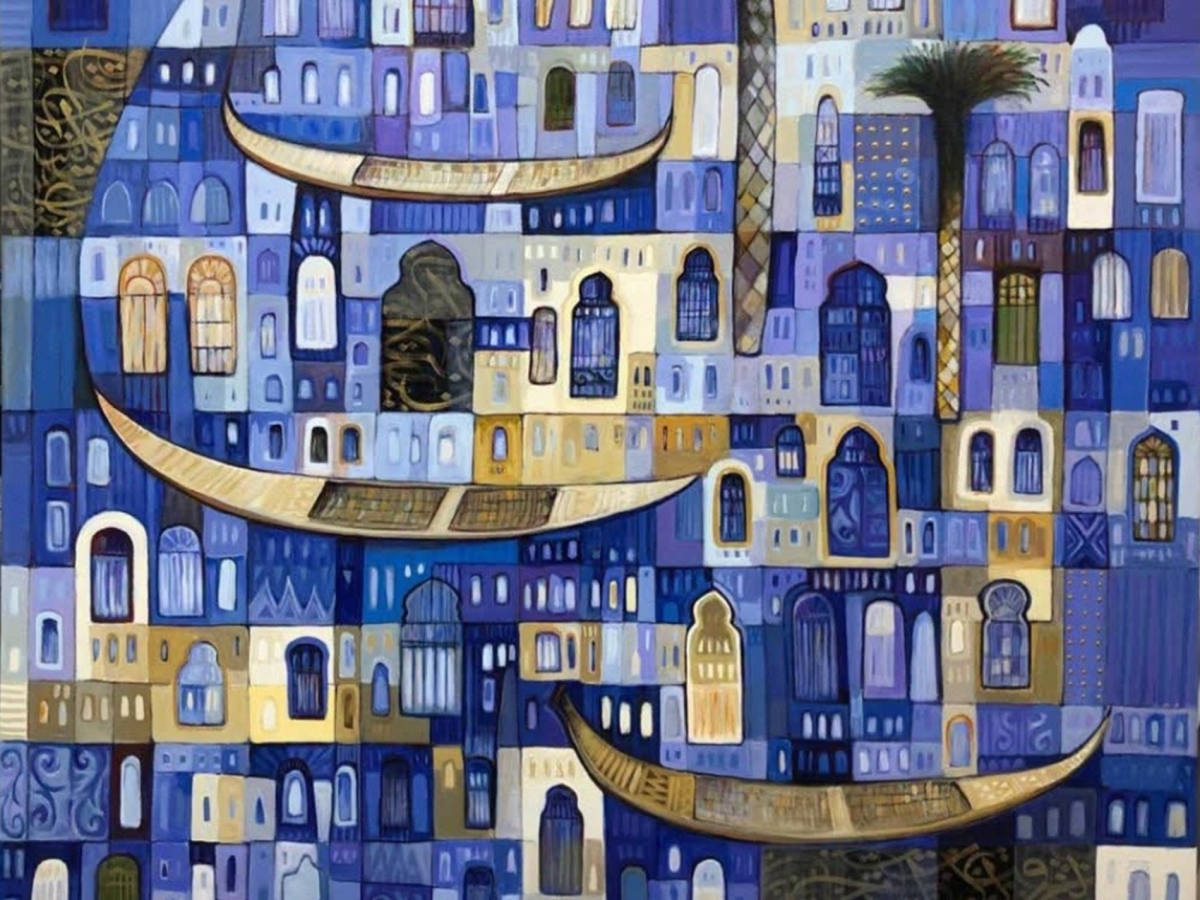
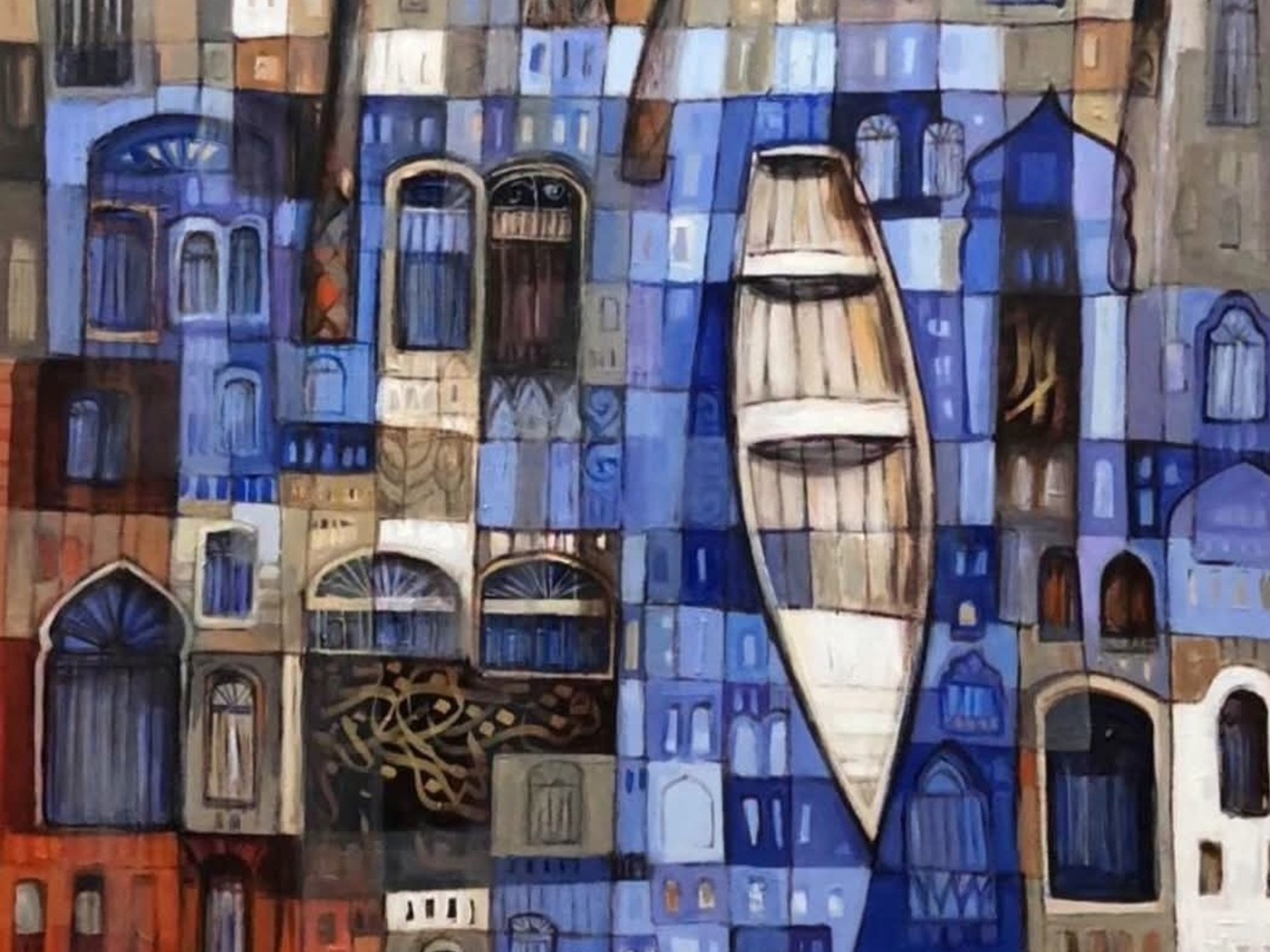
If Makkah, Al-Baha, and other historic places have left their aesthetic imprint on the artist's imagination, Jeddah, overlooking the Red Sea, seems to have instilled in him a profound affinity for blue. The colour has entered his paintings with such force that it has become an essential part of their pictorial structure. Blue emerges as the colour of rhythm and expansiveness, unfolding through a broad spectrum of gradations, from dark to light, from pure tones to shades touched with grey. 

A painting by Fahad Al-Khalif

When blue joins the atmosphere of wonder that permeates his paintings, and when it encounters the cascading architectural mass of tightly clustered houses, compositions emerge that would seem impossible in the physical world. Within this visual realm, boats drift and swim vertically, as though they had absorbed from the surrounding space a peculiar moisture belonging neither wholly to the sea nor wholly to rain, suspended somewhere between the two, where water and sky become difficult to distinguish. Through their visual effect rather than direct resemblance, these works recall René Magritte's Golconda, in which human figures seem to descend from the sky like raindrops in a scene that defies gravity.

Post-2018, rain-drenched cities became a recurring motif, with floating vessels taking the place of windows and balconies. These blue vessels bring together movement and stillness, and the idea of travel without actual departure, as though they were moving through memory rather than across physical space.

At its heart, this is what Al-Khalif's work has come to suggest since his artistic identity reached its mature form: the shimmer of the past summoned onto the sea-like surface of the present, where the cities never cease to rain.

font change