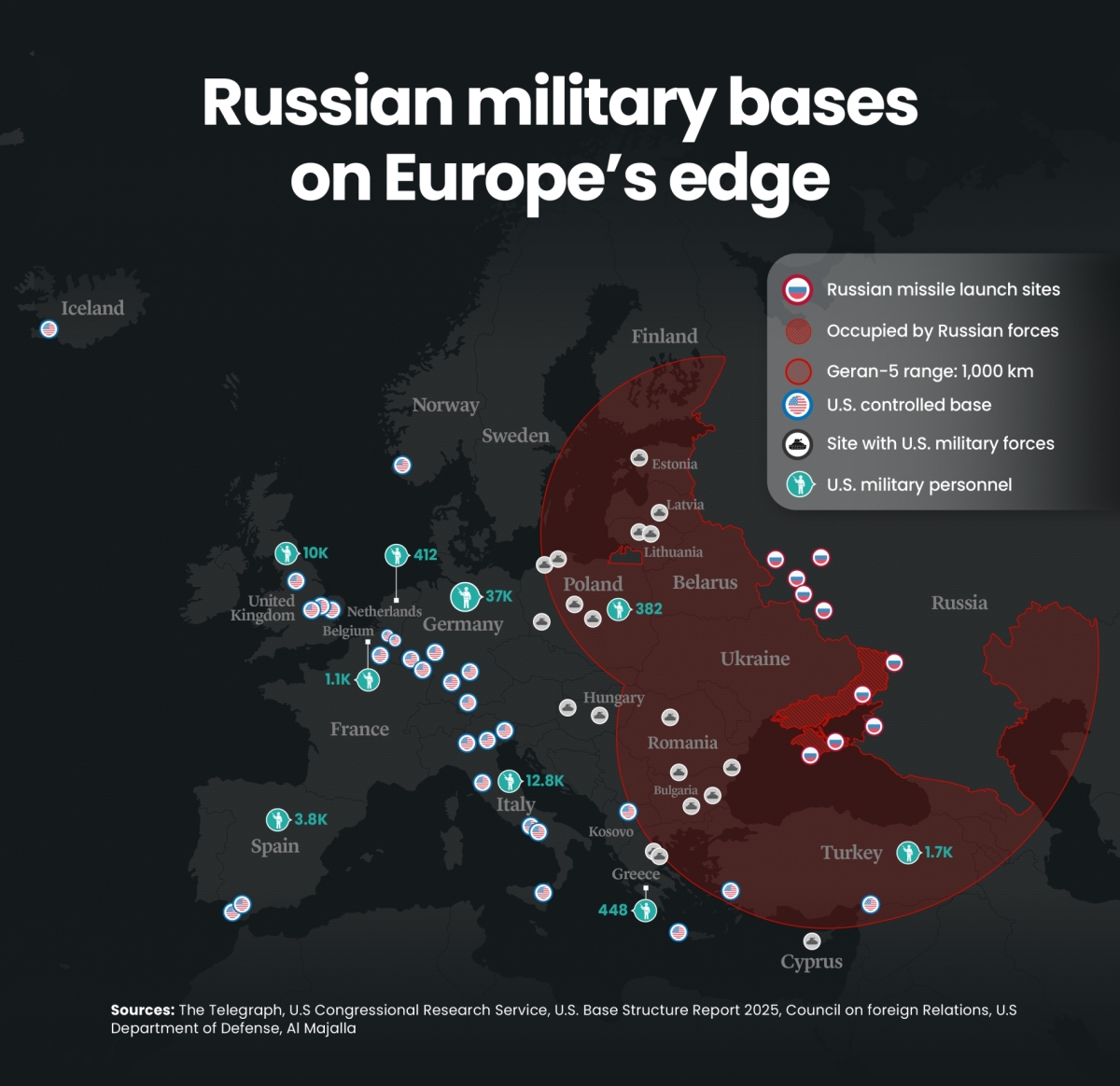

Russia is expanding a network of military and drone-launch facilities along its western border, bringing parts of NATO territory within range of its newest long-range attack drones. A Telegraph investigation last month identified 10 Russian sites near the borders with Ukraine and Belarus, with 59 newly built launch rails, including around 20 apparently designed for longer-range drones. Several of the sites have already been used in attacks on Ukraine.
The expansion does not, by itself, indicate that Russia is preparing an imminent attack on NATO. But it highlights a growing capability to conduct large-scale strikes deep into Europe. Russia’s evolving Geran drone family, including longer-range variants, could potentially reach parts of NATO territory from launch sites in western Russia. The infrastructure therefore gives Moscow greater options in a future confrontation—whether through direct military action, coercive signalling or attacks designed to test NATO’s response.
The most striking recent signal came from CIA Director John Ratcliffe, who made a secretive visit to Moscow in late August. According to people familiar with the trip, Ratcliffe warned Russian officials against attacking NATO member states.
Yet President Donald Trump, meanwhile, described the visit as “semi-routine” and has said he does not believe Russia will attack NATO. Finland’s President Alexander Stubb has offered a more reassuring assessment. He said he sees no evidence that Russia is preparing to attack NATO and argued that it would make little sense for Moscow to test the resolve of the world’s most powerful military alliance. At the same time, he stressed the need for Europe to prepare for the worst in order to prevent it.
The other side of Europe’s deterrence equation is the United States. Around 80,000 US troops are currently deployed in Europe, spread out across dozens of major bases and installations. Germany hosts the largest concentration, followed by Italy, the United Kingdom, and Poland. The US presence provides NATO with critical air, naval and ground capabilities, as well as logistics, intelligence, command and nuclear deterrence.
But Washington’s role is being reassessed. The Pentagon is reviewing the number of US forces in Europe, with options expected by November, amid President Trump’s push for European allies to assume a greater share of the continent’s defence. The review has fuelled concern among NATO members that the US footprint could shrink significantly.
Meanwhile, Congress has sought to limit the speed and scale of any withdrawal. Current legislation restricts the Pentagon from keeping US troop levels in Europe below 76,000 for more than 45 days without meeting specific conditions, including consulting NATO allies and certifying that the reduction serves US national security interests.