Unpacking the progressive left wave across America

Abdul El-Sayed’s victory in Michigan is the latest example among many of the growing appeal of democratic socialism and the changing politics of the American left

The audience cheers as US Rep. Alexandria Ocasio-Cortez speaks at The People V. The Powerful rally at the Detroit Opera House on 18 July 2026 in Detroit, Michigan.
Sarah Rice / AFP
The audience cheers as US Rep. Alexandria Ocasio-Cortez speaks at The People V. The Powerful rally at the Detroit Opera House on 18 July 2026 in Detroit, Michigan.

Unpacking the progressive left wave across America

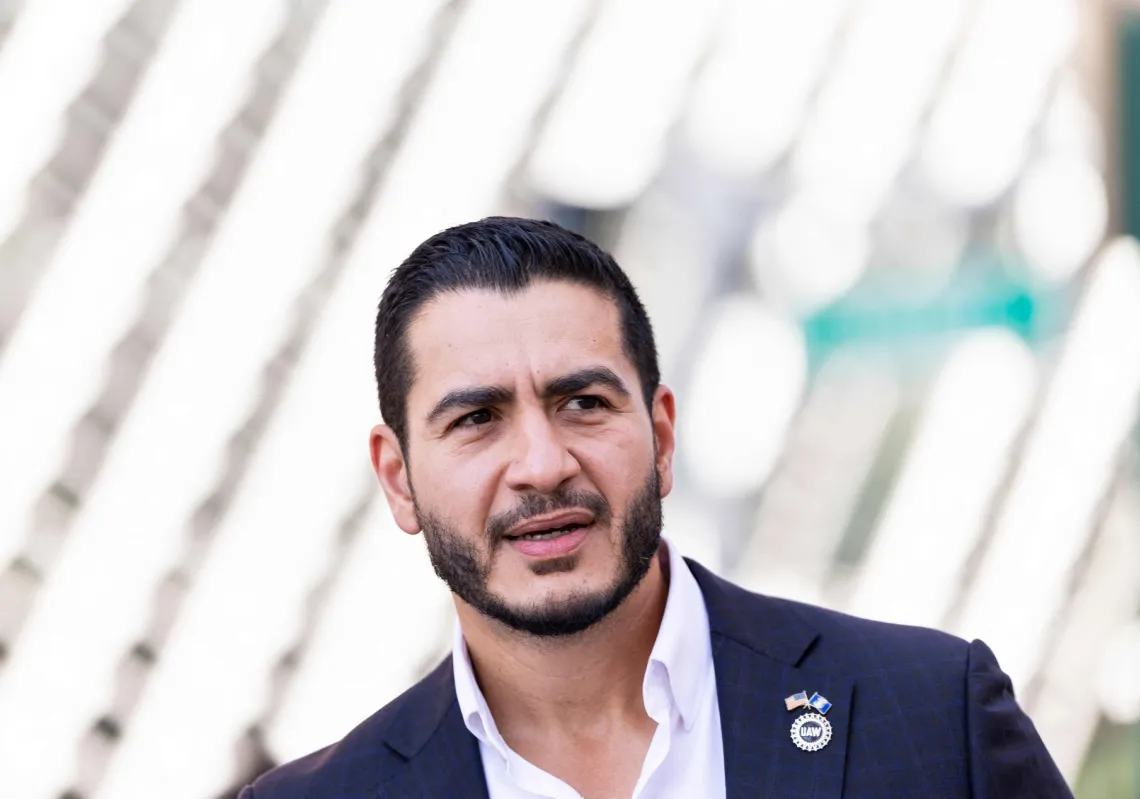
Abdul El-Sayed’s victory in the Democratic primary for Michigan’s US Senate nomination has put the rising American left firmly in the spotlight ahead of November’s midterm elections. Its significance lies partly in his position on the progressive left of the Democratic Party and his alignment with many of the views associated with the Democratic Socialists of America (DSA).

Equally striking was his ability to prevail despite the extraordinary level of financial and political support his Democratic rival, Haley Stevens, enjoyed. This support came from Michigan and beyond, most notably from the American Israel Public Affairs Committee (AIPAC)—one of the most influential pro-Israel lobbying organisations in the US.

In addition to the money raised directly by Stevens’s campaign, she benefited from more than $60mn in independent outside spending to support her or to oppose El-Sayed, much of it originating outside Michigan. AIPAC and affiliated groups accounted for roughly half of that expenditure, spending an estimated $30 to $32mn to defeat El-Sayed, who is known for his criticism of Israel and his opposition to unconditional US military assistance to the country.

El-Sayed and others who share his political orientation are seeking to push the Democratic Party further to the left while challenging long-established political taboos: speaking openly of socialism, questioning the ‘special relationship’ between the US and Israel, and confronting AIPAC openly. Their rise has caused considerable concern among Republicans and in the White House.

Republicans have portrayed El-Sayed as one of the Democratic Party's most radical figures, while Trump has gone further, seeking to turn him into a source of fear. Alongside his fierce attacks on El-Sayed, whom he has described as a "communist" and "full of crap", Trump marked the day of El-Sayed's primary victory by posting an image showing the president and his wife, Melania, on one side and El-Sayed with his hijab-wearing wife, Sarah Jukaku, on the other. The caption read: "Two very different Americas."

Trump's attacks have extended well beyond political disagreement. He has deliberately foregrounded El-Sayed's Muslim background, repeatedly referring to him by his full name, Abdulrahman Mohamed El-Sayed, rather than the shortened form he generally uses in public and political life.

The tactic recalls Trump's repeated use of former president Barack Obama's full name, Barack Hussein Obama, with the emphasis on 'Hussein' carrying political and identity-laden insinuations rooted in anti-Muslim sentiment. Such insinuations have long been a feature of anti-Obama rhetoric and are now being directed at El-Sayed.

Beyond Republican and presidential anxiety over El-Sayed's ascent, broader political attention in the US is increasingly focused on a deeper phenomenon reshaping the Democratic Party from within: the rise of democratic socialism. Organisationally, this current is represented most prominently by the DSA, which is institutionally separate from the Democratic Party but does not field candidates under its own banner.


El-Sayed and others who share his political orientation are pushing the Democratic Party further to the left while challenging long-established political taboos.

About the DSA

The DSA describes itself as a political and activist organisation rather than a party. Many of its members, and candidates it endorses, compete in Democratic primaries, using the party's extensive electoral infrastructure while seeking to move the Democratic Party and American politics further to the left. The organisation has no single settled view of its long-term relationship with the Democratic Party. Different currents within the DSA debate whether working through the party should remain a long-term strategy for political change or serve as a stage towards building a more independent working-class political force.

Like Senator Bernie Sanders, El-Sayed is not formally a member of the DSA, although he is ideologically close to the organisation and supports many of its policies. The DSA's influence extends beyond politicians who are sympathetic to its ideas. Its ranks include some of the most prominent democratic socialist figures in contemporary American political life, among them New York City Mayor Zohran Mamdani and Democratic Representatives Alexandria Ocasio-Cortez of New York and Rashida Tlaib of Michigan, who is of Palestinian heritage. Other democratic socialist candidates who have won Democratic primaries include Chris Rabb in Pennsylvania and Melat Kiros in Colorado.

Its reach extends well beyond Congress. DSA members and candidates endorsed by its local chapters also compete for seats in state legislatures and local government. By this summer, dozens of organisation-backed candidates had made gains in primary contests across several states, suggesting that the DSA's electoral presence is expanding beyond a handful of traditional left-wing strongholds.

MICHAEL M. SANTIAGO / AFP
Congressional candidate Claire Valdez, Brad Lander, Darializa Avila Chevalier stand with New York Mayor Zohran Mamdani at a rally at King's Theatre on 18 June 2026 in New York City.

The DSA was established in 1982 through the merger of two distinct organisations on the American left: the New American Movement, founded in 1971, and the Democratic Socialist Organising Committee, established in 1973 under the leadership of the socialist writer and activist Michael Harrington.

From the 1960s onwards, Harrington advocated a broad coalition bringing together trade unions, civil society organisations, and progressive forces within the Democratic Party. He favoured this approach over establishing a third party to challenge Democrats and Republicans in a political system where such parties face formidable electoral obstacles. He therefore called for working alongside progressive forces within the Democratic Party and using the party itself as an arena in which American politics could be reshaped and moved to the left. Since its founding, however, the DSA has continued to debate the nature of its relationship with the Democratic Party and the limits of working through it.

The DSA defines itself as "a political and activist organisation, not a party", and openly embraces a class-based, working-class identity. It argues that working people should exercise democratic control over the economy and society so that they serve human needs rather than generate profits for a small minority. It accordingly describes itself as an organisation "of, by, and for the working class".

From only a few thousand members in the middle of the last decade, the DSA now says it has more than 100,000 members and chapters in all 50 states.

Class conflict occupies an important place in the organisation's understanding of society and the economy. Its constitution explicitly identifies a fundamental conflict of interests between groups possessing immense economic power and the overwhelming majority of the population. The DSA nevertheless distinguishes its conception of socialism from authoritarian socialism and Soviet communism. It insists that socialist change must be democratic and rooted in political participation, popular organisation, elected institutions, and political freedoms, rather than one-party rule and the suppression of pluralism.

The principal distinction between the democratic socialism espoused by the DSA and the social democracy prevalent across much of Western Europe lies in their long-term objectives. Social democracy generally seeks to reform and regulate capitalism through stronger state intervention, market regulation, reduced inequality, and extensive social protections. The democratic socialism advocated by the DSA goes further, ultimately envisaging a move beyond capitalism towards a democratic socialist order.

Such a vision does not necessarily imply abolishing every form of private ownership or private economic activity. Rather, it entails expanding social and democratic ownership and control over resources and the means of production, particularly in essential sectors, to reduce the concentration of wealth and economic power among a small minority.

The precise role that market mechanisms should play, relative to economic planning, public and cooperative ownership, and various forms of worker control, remains a matter of debate within American democratic socialism. No single position is agreed on.

REUTERS/Rebecca Cook
Abdul El-Sayed rallies with Senator Bernie Sanders, Representatives Alexandria Ocasio-Cortez and Rashida Tlaib, UAW President Shawn Fain, and Michigan State Representative Donavan McKinney in Detroit, Michigan.

A mushrooming movement

Over the past decade, membership in the DSA has grown sharply, alongside a broader expansion in the political and popular reach of the ideas it represents. From only a few thousand members in the middle of the last decade, the organisation now says it has more than 100,000 members and chapters in all 50 states.

At the popular level, opinion polls suggest that democratic socialists, and the ideas associated with them, have moved from the margins of American political debate into a more visible position. Voters have also shown a growing willingness to support candidates who embrace such views. 

According to a Pew Research Center survey conducted in January and published in June, 17% of Americans said they viewed politicians who describe themselves as democratic socialists favourably, compared with 38% who viewed them unfavourably. A further 43% took a neutral view, saying they neither liked nor disliked such politicians. Among Democrats and Democratic-leaning independents, attitudes were more positive: 32% viewed democratic socialist politicians favourably, 11% unfavourably, while 56% remained neutral.

Several factors have driven the rise of democratic socialism in the US over the past decade, some linked to individual political figures and others to broader social and economic conditions. Foremost among them was Sanders's decision during the 2016 Democratic presidential primary to describe himself openly as a democratic socialist. In his campaign against Hillary Clinton, the preferred candidate of the Democratic Party establishment, Sanders, an independent politician with no traditional organisational affiliation to the party, succeeded in putting 'socialism' back at the centre of American political debate.

Through a campaign that attracted considerable attention and support, especially among younger voters, Sanders recast democratic socialism as a programme of social justice and support for middle- and lower-income Americans. He also sought to root it in an American reformist tradition exemplified by President Franklin D. Roosevelt's policies in the 1930s.

JEWEL SAMAD / AFP
US Democratic presidential nominee Hillary Clinton and Bernie Sanders listen to singer Pharrell Williams during a campaign rally in Raleigh, North Carolina, on 3 November 2016.

Sanders did not argue that Roosevelt himself had been a socialist. Rather, he pointed out that many of the reforms associated with the New Deal, including social security, the minimum wage, unemployment insurance, stronger labour rights, and tighter regulation of the banking system, had been denounced by their opponents at the time as 'socialist' before becoming firmly embedded in the American economic and social order. 

His argument, which found a wide audience, was that amid widening economic inequality, the weakening of the middle class, and the growing political influence of corporations and wealthy individuals, the US needed reforms comparable in scale and effect to those Roosevelt introduced in the 1930s.

Economic pressures facing many Americans, especially younger Americans since the 2008 financial crisis, have led some to see democratic socialism as a possible solution.

Other factors have also contributed to the growing appeal of democratic socialism, particularly among younger Americans. Those now in their 40s or younger did not grow up during the Cold War, which effectively ended with the collapse of the Soviet Union in 1991 after more than four decades of confrontation between the US and its Western allies and the communist bloc led by Moscow, whose political and economic system defined itself as socialist.

Throughout those decades, American ideological mobilisation against communism and socialism was intense across political life, the media, and popular culture. The two were frequently conflated, and socialism became associated in much of the American imagination with repressive regimes that curtailed personal and political freedoms, constrained economic liberty, and imposed a bleak form of equality that distributed hardship more readily than prosperity.

SCOTT OLSON / GETTY IMAGES NORTH AMERICA / Getty Images via AFP
Campaign literature sits on a table during a campaign event at Glow Hall on 1 August, 2026, in Kalamazoo, Michigan

Resonating with youth

Younger generations have been far less shaped by this anti-socialist ideological legacy. At the same time, the economic pressures facing many Americans, especially younger Americans since the 2008 financial crisis, have led some to see democratic socialism as a possible solution.

Proposals advanced by democratic socialists on student debt, unequal access to healthcare, the growing difficulty of homeownership for low- and middle-income households, and the rising cost of goods and services that weigh heavily on everyday life have consequently gained greater appeal. That appeal has been strengthened by the contrast between these pressures and the immense and growing wealth enjoyed by a small elite.

Together, these factors have fostered greater sympathy for democratic socialism and for its argument that such problems cannot be left to market forces alone. Its advocates call for strong state intervention, expanded social rights and public services, and a fairer distribution of wealth and economic power.

Political conditions may now favour the rise of democratic socialism, but its long-term place in American politics will depend on whether it can meet the challenges of governing. That is why considerable attention is focused on Mamdani, whose tenure is regarded as the first major, nationally visible test of whether this political current can move beyond criticising existing policies and proposing alternatives to demonstrate through governing that its programme can offer better solutions to the problems that brought it to office.

font change

Related Articles