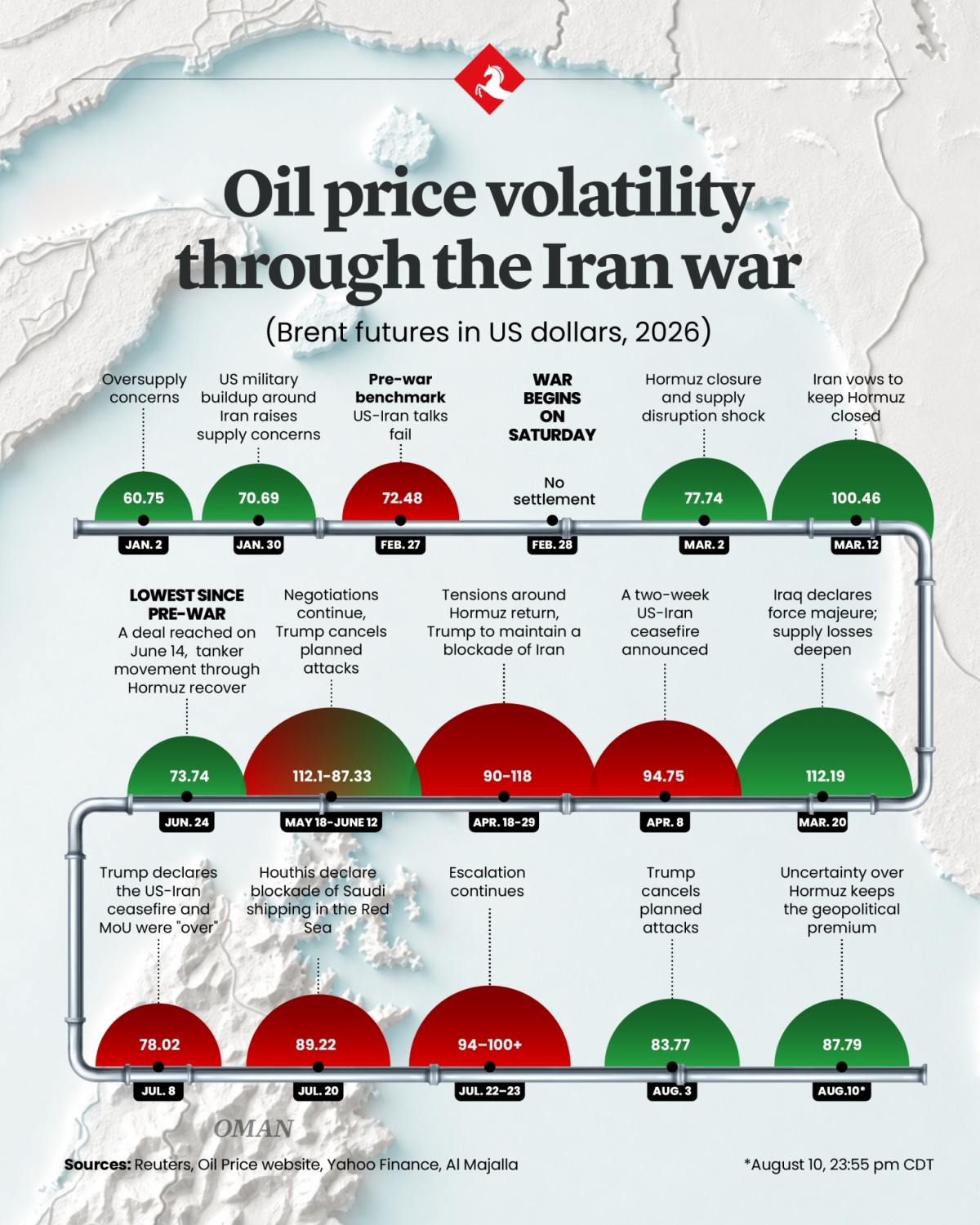

The Iran war did more than send oil prices higher. It repeatedly forced markets to reassess the risks with every dispute, agreement or period of deadlock in a conflict shaped by US and Israeli political imperatives that could alter its dynamics overnight.
Brent futures began 2026 at $60.75 a barrel, in a market still expecting ample supply. By the eve of the war, that assumption had already begun to erode: Brent reached $72.48 on 27 February as the prospect of confrontation raised the risk of disruption. Once the conflict began and the Strait of Hormuz was effectively closed, the risk became physical. Brent climbed above $100 and reached $112.19 on 20 March as exports were disrupted, force-majeure declarations multiplied, and the possibility of a prolonged maritime blockade came into view.
But the subsequent retreat was just as revealing as the surge. Prices fell whenever diplomacy suggested that the disruption might be temporary, then recovered as negotiations faltered or military escalation returned. The market was therefore not simply counting lost barrels; it was continuously assigning a probability to different futures: a rapid restoration of flows, or an escalation capable of taking additional production and infrastructure offline.
That distinction helps explain why the price response was ultimately smaller and more reversible than the scale of the physical shock might suggest. Producers began changing routes even when they could not immediately replace volumes. Saudi Arabia redirected exports through its East-West pipeline to Yanbu, the UAE relied on its Habshan-Fujairah pipeline, storage and alternative shipping arrangements, while Iraq restored flows through Türkiye. More crude shipments bound for Western markets were also redirected towards Asian buyers. These measures could not substitute for Hormuz, through which roughly 20 million barrels a day had moved before the war, but they reduced the quantity of supply that the market regarded as irretrievably stranded.
The other buffer was time. Strategic stocks were drawn upon on an unprecedented scale, while commercial inventories absorbed part of the shock. But that buffer came at a cost: global observed oil stocks fell sharply, and the IEA warned that continued withdrawals could push inventories towards historic lows. At the same time, high prices, disrupted economic activity and lower refinery runs weakened demand, narrowing the immediate supply-demand gap.
Hopes for a breakthrough in early August briefly brought Brent down as markets anticipated a deal between Iran, Oman and the United States to restore maritime shipping. Since then, however, that optimism has faded over disagreements over the mechanisms on which the strait could possibly reopen.