After Khamenei: the security state he built, and the son who inherits it

While Ruhollah Khomeini built the revolution, his successor Ali Khamenei built a state designed to survive him. With his son and heir Mojtaba absent from the funeral, what next for the regime?

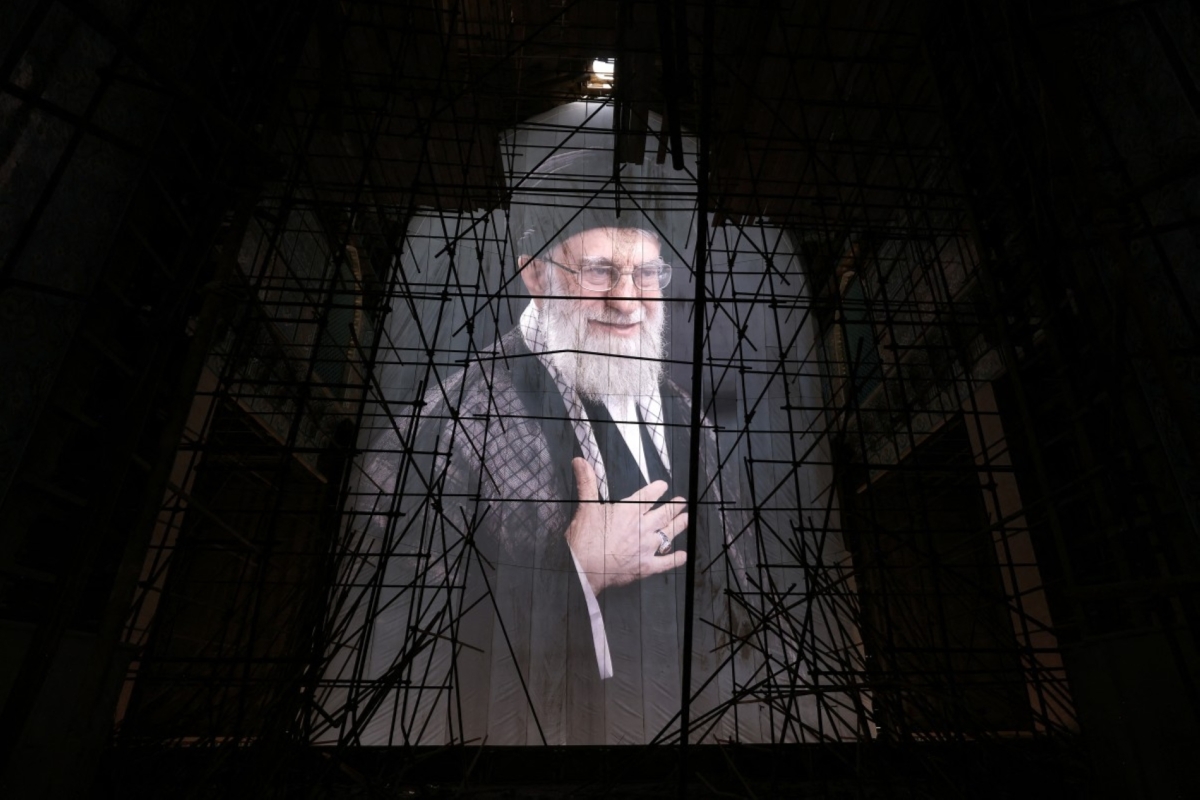
A picture of Iran's late Supreme Leader Ayatollah Ali Khamenei at the Grand Mosalla during his funeral ceremonies in Tehran on 4 July 2026.
Atta Kenare / AFP
A picture of Iran's late Supreme Leader Ayatollah Ali Khamenei at the Grand Mosalla during his funeral ceremonies in Tehran on 4 July 2026.

After Khamenei: the security state he built, and the son who inherits it

When it came to the funeral of Iran’s Supreme Leader Ali Khamenei in Tehran this week, the most important man—his son and successor—did not appear. Other relatives came, as did senior officials, who spoke of loyalty and bay’a (the oath of allegiance), as the crowds were told to chant for revenge. But Mojtaba Khamenei was nowhere to be seen at the ceremony designed partly as a handover.

His absence may have been one of caution, or clerical mystique, or stagecraft, but politically, it exposed the problem the whole event was meant to hide: that Mojtaba needs his father's legacy. He cannot simply inherit his father's power. An office can be transferred in an afternoon, but authority cannot. The funeral tried to convert grief into legitimacy, but the empty place where the heir should have stood left the transaction visibly unfinished.

This was not the burial of a man, but the attempt to bury uncertainty. Khamenei did not merely keep his predecessor Ayatollah Ruhollah Khomeini’s revolution alive; he converted it into a security apparatus built to run without him. Whether it can is the question that the funeral was meant to answer.

Funeral as referendum

A state funeral held at a moment of maximum vulnerability is never just about mourning. This job of this event was to prove that the state had survived the loss of its leader, that its institutions were still functioning, that its security apparatus was intact, that the crowds could still be summoned, and that foreign delegations would still arrive to pay their respects. It was arranged as a visual referendum on continuity, and the regime worked hard to win it.

The audiences were several, and Tehran knew each one. To Iranians, the message was inevitability: the system stands, and the loyalty owed to the dead leader now transfers to the next. To the ruling elite, it was a warning against hesitation—that this is a moment for discipline, not manoeuvring. To Washington and Jerusalem, it was a deterrent: killing Khamenei would not break the regime. To Iran’s regional partners, it was a reassurance that the networks would hold. And to Moscow, Beijing, and the Gulf, it was a reminder that Iran remained a governable, dangerous player.
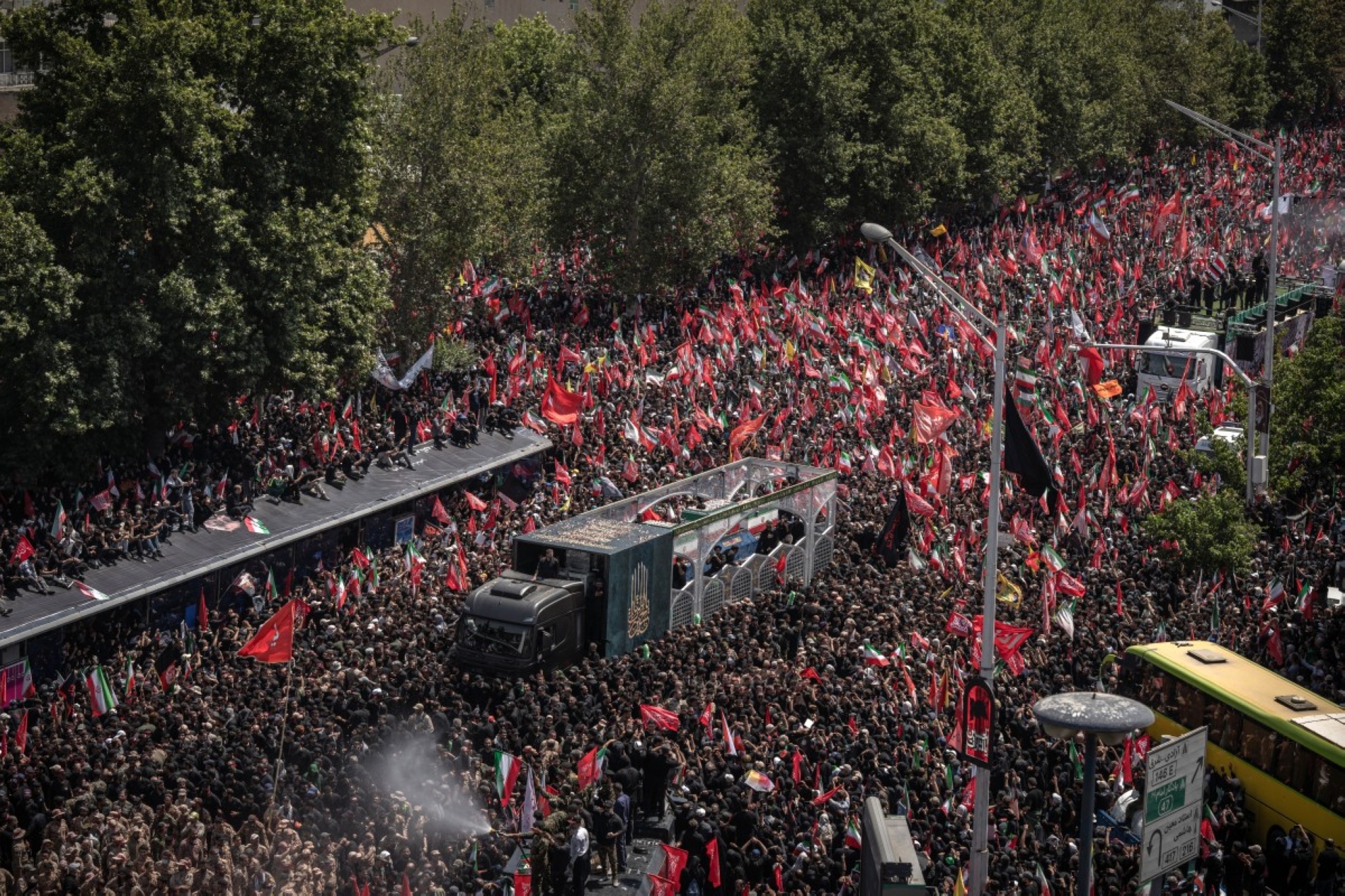
AFP
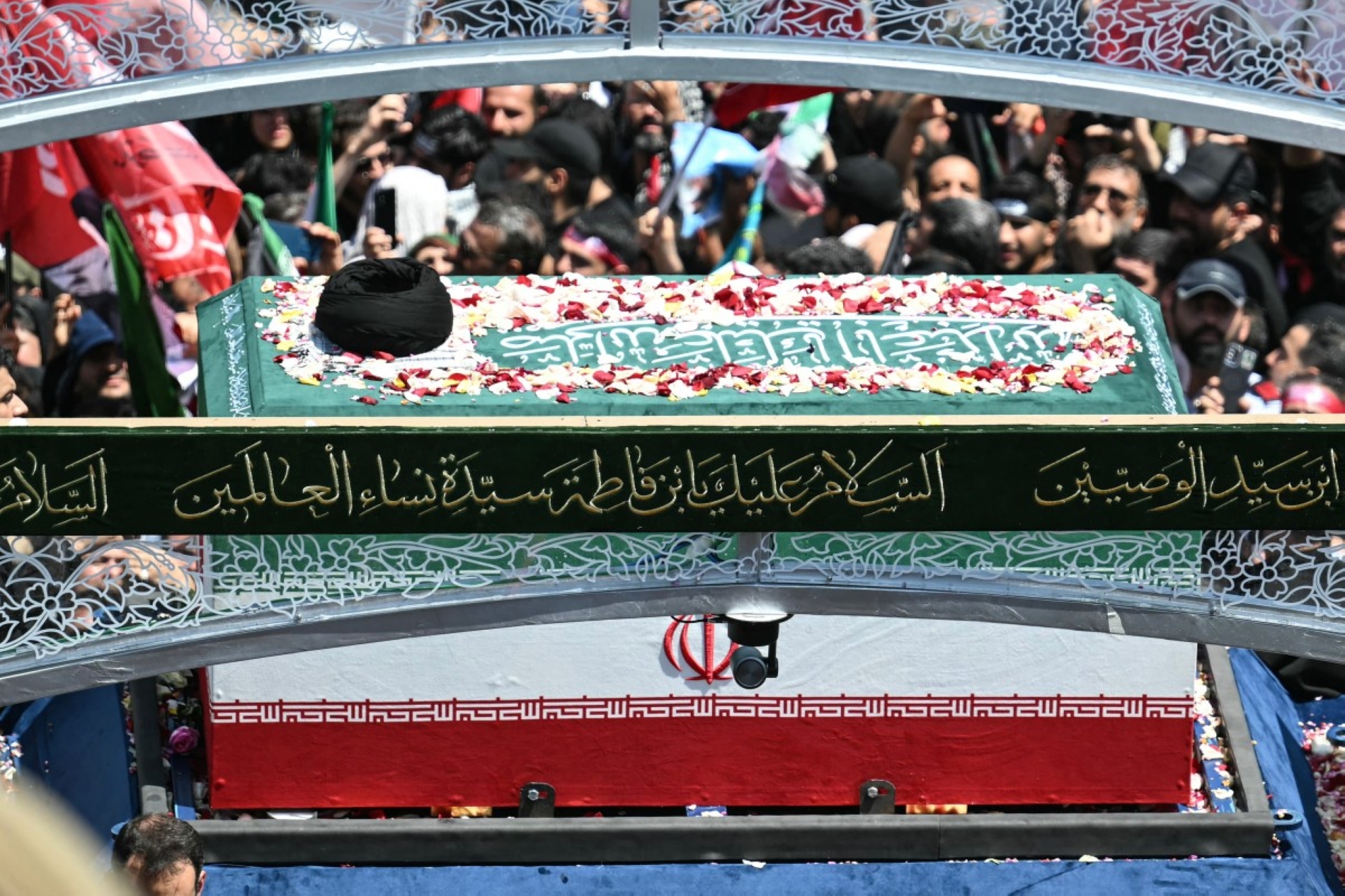
Mourners gather around a vehicle carrying the coffins of Iran's Supreme Leader Ali Khamenei and his family members, during the funeral procession in Tehran on 6 July 2026.

Yet the effort itself gave the game away. A state confident in its own succession does not need a funeral to function as a mass plebiscite. On the one hand it showed real power—the ability to close roads, move crowds, feed participants, blanket the television coverage, and dominate the day’s images. On the other, it looked like coercion and expense, public money spent on mourning theatre while ordinary Iranians faced record inflation, war damage, shortages, and a new economic grind.

Official commentary was on repeat: stability, sovereignty, deterrence, continuity. Rare was the revolutionary Islamist language of the Republic's first decades. That substitution is the real story. The funeral was not about burying Khamenei; it was about rehearsing how the state intends to rule without him, quietly changing the terms on which it asks to be obeyed.

Shifting narrative

Within weeks of his death in US-Israeli airstrikes on 28 February 2026, the official account of Khamenei’s life began to shift. For years he had been cast as the keeper of Khomeini’s 1979 revolution, a custodian more than a creator. Now he was being described as the leader who cured Iran of its long “psychology of defeat,” who ended a run of humiliations stretching from the 19th-century losses to Imperial Russia, through the Qajar capitulations, to the foreign occupations of the 20th century.

The claim now being built is that Khamenei proved Iran could absorb a direct blow from the world’s strongest military coalition and not collapse. Whether that survives scrutiny is beside the point; what matters is what the regime is doing by asserting it. It is changing the source of its own legitimacy. The revolution of 1979 is a wasting asset. Most Iranians alive today were born after it. Many have no memory of Khomeini at all.
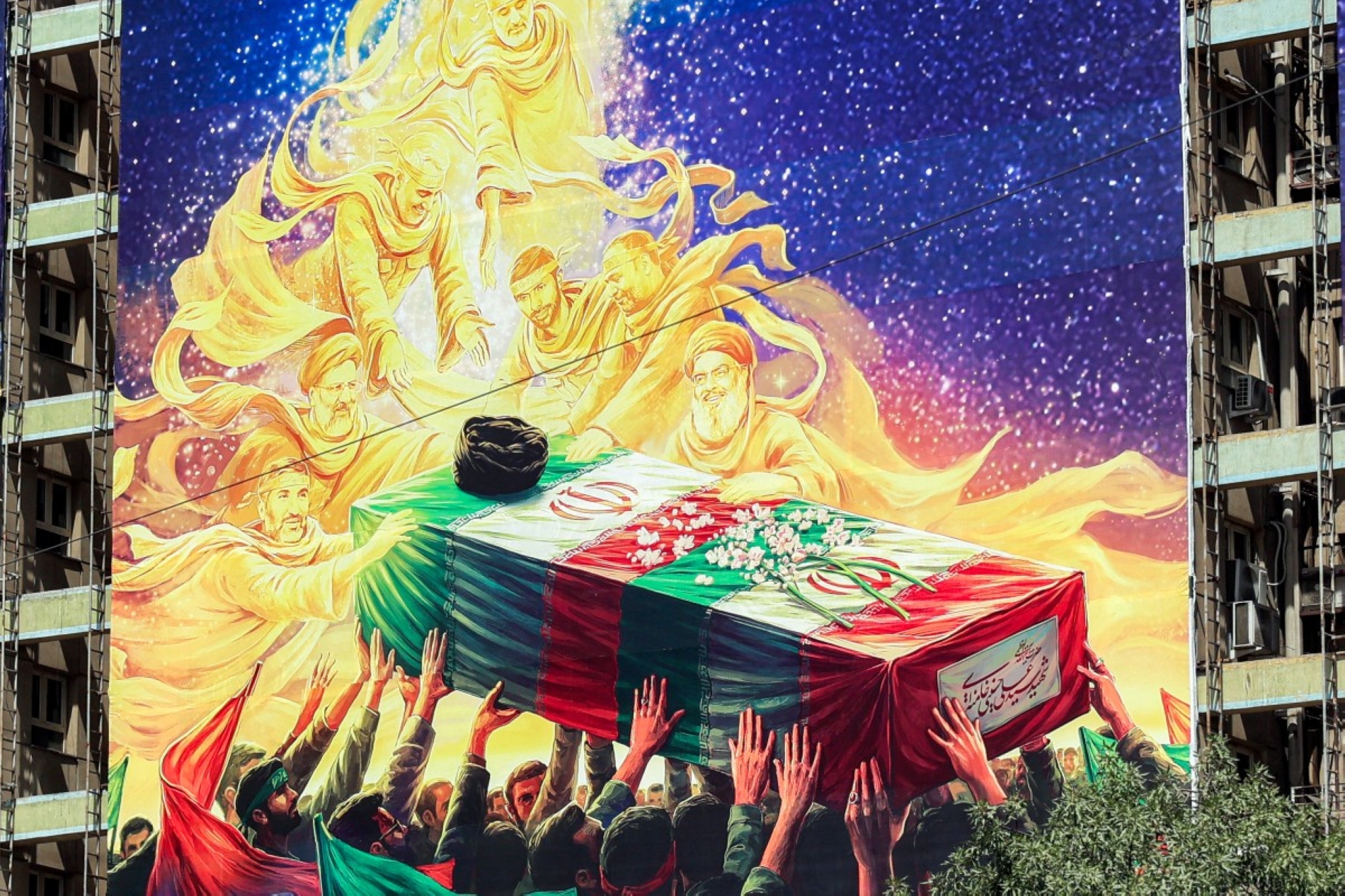
AFP
A mural depicts the late Iranian President Ebrahim Raisi, the late Revolutionary Guards commander Qassem Soleimani, and the late Hezbollah leader Hassan Nasrallah carrying the coffin of Iran's Supreme Leader Ali Khamenei in Mashhad.

A state that once justified itself by the promise of transformation now justifies itself by its survival. It no longer compares itself to other revolutionary movements, but to earlier chapters of Iranian history, when foreign powers dictated the country’s fate. The pitch has quietly moved from “we will remake the world” to “we alone kept Iran from being dictated to”. Swapping revolutionary purpose for national endurance may be Khamenei's most durable political mark. It is also a tell. States reach for nationalism when the revolution stops selling.

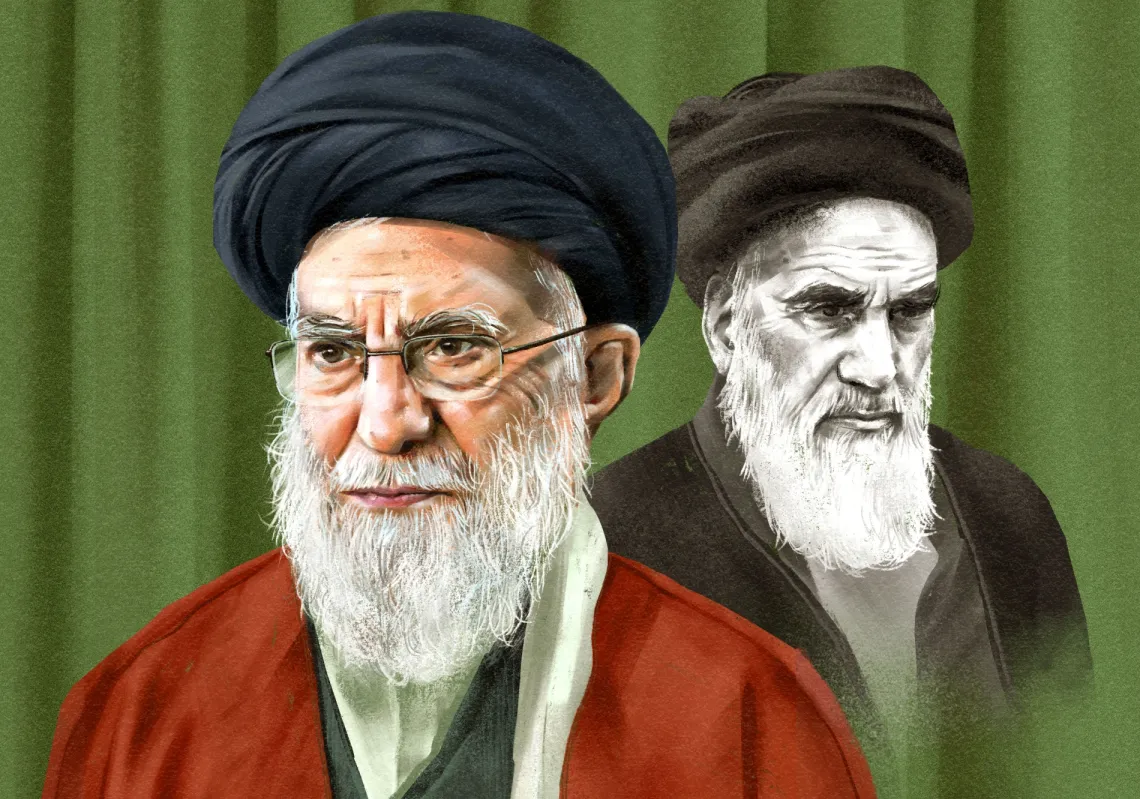
Khomeini made the revolution, Khamenei built the apparatus, and the lazy assumption is that Khamenei inherited Khomeini’s system and simply kept it running. In fact, he did something more consequential, because he had no choice. Khomeini ruled by charisma and religious stature; the institutions were extensions of his will. Khamenei had neither. When he took the office in 1989, he was not a marja (the senior clerical rank the role was assumed to require). His elevation needed the constitution to be rewritten to accommodate him.

Building authority

At first, much of the clergy watched with open scepticism, but Khamenei spent the next 37 years constructing a substitute for the authority he lacked. The Office of the Supreme Leader swelled from a modest bureau into a parallel government. He made sure that the Revolutionary Guards grew from a wartime militia into the country’s dominant political, economic, and intelligence institution, to act as his armed foot soldiers against his political enemies.

The Guardian Council tightened its grip on who was even allowed to run for office. The Supreme National Security Council became the room where strategy was coordinated across the state. Parallel intelligence services multiplied, watching the population and one another. Security-linked conglomerates spread into every corner of the economy: oil, construction, telecoms, ports.
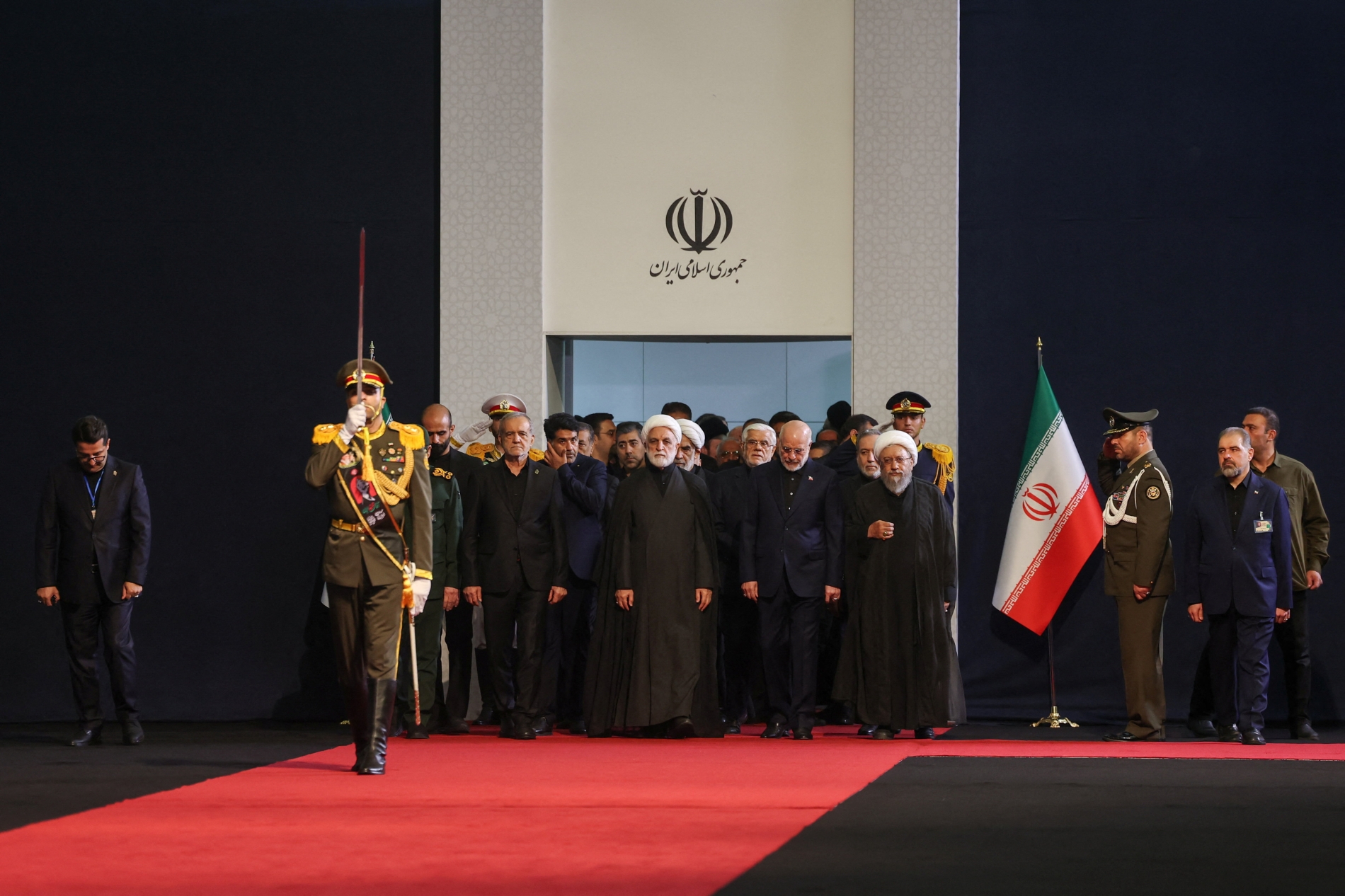
Mohammed Salem / Reuters
Iranian leaders, including Chief Justice Gholamhossein Mohseni Ejei, attend a farewell ceremony for Iran's late Supreme Leader Ayatollah Ali Khamenei in Tehran on 3 July 2026.

Each of these is familiar on its own, but together it amounted to the quiet conversion of a revolutionary regime into a security state. It was administrative work, not ideological. Khamenei's real innovation was essentially bureaucratic. He governed through committees, councils, and appointments, rather than from the pulpit, as Khomeini had done. He rarely picked open fights with rival power centres, but seeded loyalists throughout the system and made sure no single institution ever grew independent enough to threaten his office.

All this did not diminish the centrality of the Supreme Leader; rather, it changed what ‘being at the centre’ meant: less a prophet issuing commands than a chairman holding a board together. Here is the distinction the whole succession turns on, and it is worth being precise about, because it explains why replacing a Supreme Leader is harder than it sounds.

Inheriting power only

Khamenei had power and authority, and they are not the same thing. ‘Power’ was the office—appointments, command of the armed forces, control of intelligence, dominance of the political field—whereas ‘authority’ was everything the office could not confer—four decades of experience surviving crises, a personal thread running to every institution, knowing how to deter an elite that knew nothing else.

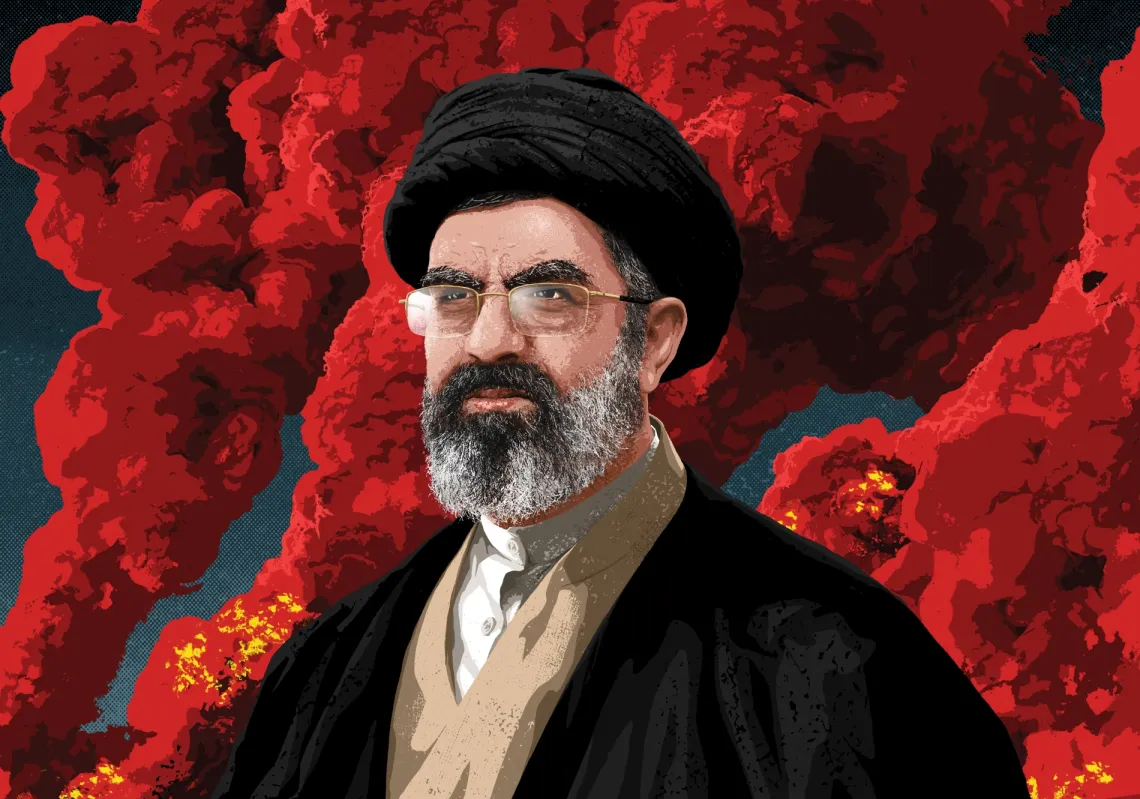
Power can change hands overnight, but authority is earned in time and cannot be handed over. Whoever succeeds Khamenei inherits the first and almost none of the second, which brings us back to the empty platform at the funeral. For 20 years, Mojtaba Khamenei has been one of the least visible and most powerful men in the Islamic Republic. He worked the Guards, the intelligence services, and his father's office while keeping his name off almost everything. That was an asset while his father was alive: influence without accountability. Unfortunately for him, leadership inverts every part of it.

He cannot summon Khomeini’s charisma, and he cannot fake his father’s authority, which took a lifetime of crises to build. There is also the thing the regime will never say aloud: this is a son following a father, a hereditary succession, in a republic founded on the rejection of monarchy. The Islamic Republic was designed, in part, precisely to prevent power from passing by blood. The entire doctrine of Iran’s Velayat-e Faqih system of governance is rule by the qualified jurist. That was Khomeini’s answer to a century of strongmen handing their countries to their sons. Now the machinery Khamenei built to embody that rejection is being asked to launder its most glaring contradiction.
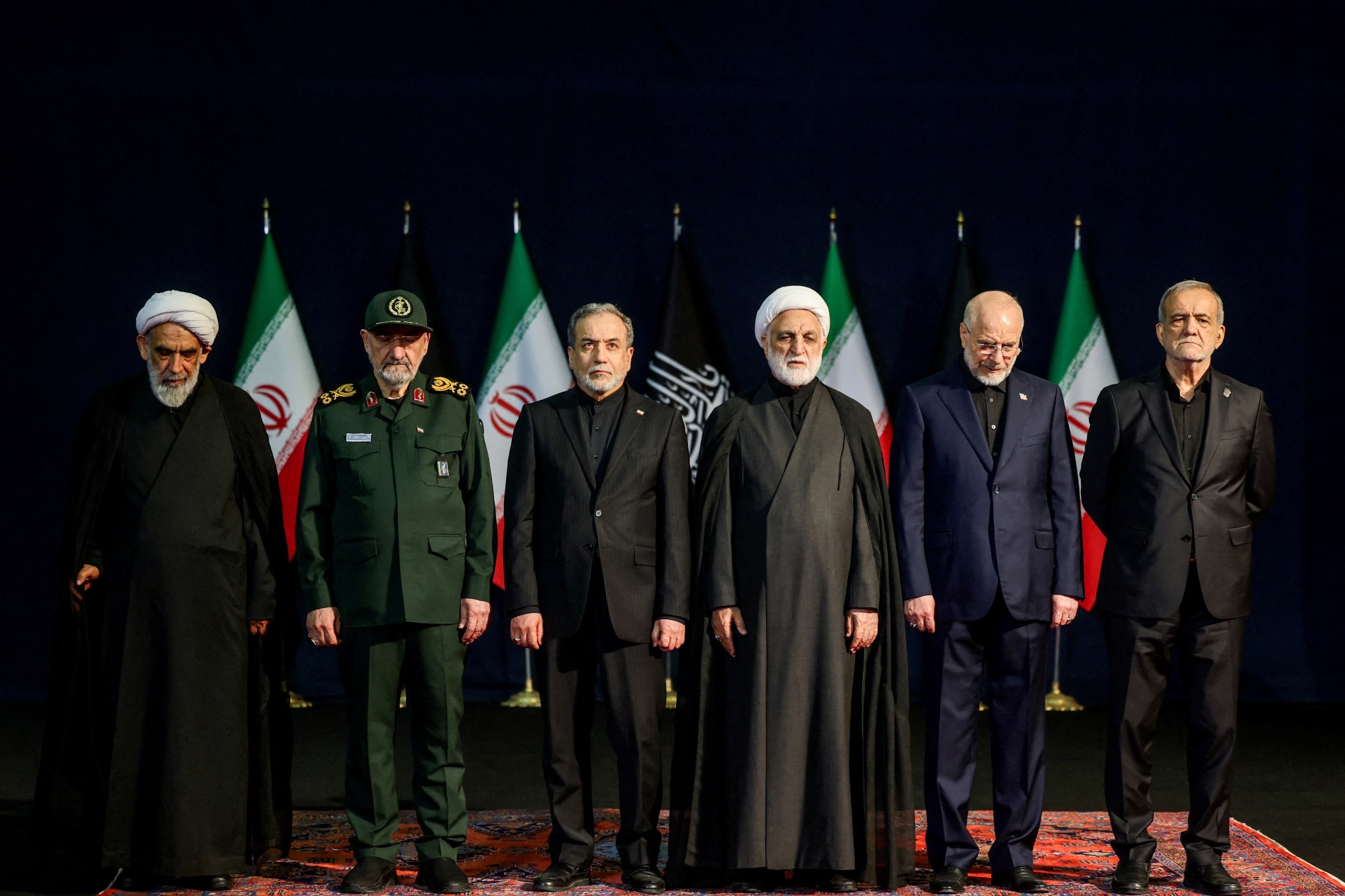
Working with his father, Mojtaba kept his name off almost everything. That was an asset while his father was alive: influence without accountability. Unfortunately for him, leadership inverts every part of it

The absence at the funeral was, perhaps among other things, an attempt not to stage the coronation too openly. So, Mojtaba will most likely rule through the institutions, rather than over them. That is not a break with his father's project; it is where the project was always heading. A leader who cannot rely on personal authority has to lean on the apparatus, and the apparatus is exactly what Khamenei spent 37 years making strong enough to lean on.

Test of resilience

The real question was never whether Mojtaba could be made Supreme Leader—the mechanics of that are the easy part. It is whether the machine is grown-up enough to cover for the authority he does not have. There is reason to think it might be. The idea that a Supreme Leader's death leaves a vacuum was far truer in 1989 than it is in 2026. When Khomeini died, the institutions were young, the Guards had not yet built an empire, the Leader's Office was modest, and the National Security Council (NSC) barely mattered.

Mojtaba inherits something denser and much harder to move. The Leader's Office is still the apex but no longer rules alone. The Guards own security, the missile programme, strategic industry, and large stretches of the economy. The NSC has a central role in coordination. Parliament, the Guardian and Expediency Councils, the judiciary, and the intelligence agencies all run real bureaucracies with room to act. No single institution is fully independent; none can swallow the others. The Leader increasingly arbitrates among them, rather than dictates to each.

You could already see the style after the 2026 war with the US and Israel. Big decisions read like the output of a committee rather than from a single hand. President Masoud Pezeshkian focused on economic recovery, Foreign Minister Abbas Araghchi on talks with Washington, Speaker Mohammad Bagher Qalibaf on reconstruction, with the NSC coordinating.

Mohammed Salem / Reuters
Senior Iranian officials including Speaker Mohammad Baqer Qalibaf (2R) and President Masoud Pezeshkian (R) at a funeral ceremony for Supreme Leader Ali Khamenei at the Imam Khomeini Grand Mosalla in Tehran on 3 July 2026.

None of it emptied the Supreme Leader's office of authority. Rather, work was distributed, which suits a leader who has just inherited power, but who still needs to earn his standing. When the committee succeeds, the system takes the credit. When it fails, a subordinate institution takes the blame. For a man in Mojtaba's position, that is not a weakness of the model; it is the point of it.

Generally aligned

The same logic now shapes Iran's conduct abroad more than any revolutionary reflex does. The argument inside Tehran over dealing with Washington is not 'moderates vs hard-liners' so much as a fight over terms. Almost no-one wants unconditional normalisation, but almost no-one wants another war.

What divides them is degree—how much sanctions relief, on what conditions, at what risk to the system etc. As such, any agreement is implemented slowly, piecemeal, and reversibly, not out of weakness, but because the balance Khamenei built rewards caution and punishes bold moves. His successors inherit more than a foreign policy; they inherit a decision-making machine built to minimise existential risk and to move only sideways.

The defining struggle in post-Khamenei Iran will not be between the regime and its opponents. That contest is settled for now. The opposition is fragmented, weak, and lacking the organisation needed to challenge the state. The war with Israel and the United States, whatever its cost, left the machinery of coercion stronger, not weaker.

The real struggle is inside the system, over what the system becomes. For the first time since 1979, the central question in Tehran is not revolutionary but managerial: how much power sits with the Leader, how much with the Guards, how much with the elected bodies, and how much with the security bureaucracy that keeps expanding underneath all of them. Four camps will decide it, and they overlap more than they collide.

Shuffling the deck

The Office of the Supreme Leader naturally wants the Leader's supremacy preserved, with no sudden shocks. The Guards are now a political party, intelligence service, business empire, and social elite all rolled into one, so they will back Mojtaba so long as he protects their money, their regional franchise, and their standing. Their loyalty is a transaction, not a dependency; that distinction may matter more than any other in the years ahead.

The technocrats, of whom the Parliamentary Speaker Qalibaf is one, draw their legitimacy from getting things built, rather than from ideological purity. The pragmatists around Pezeshkian are not trying to dismantle the Republic, whatever their enemies claim; they argue that it survives only through recovery, sanctions relief, and picking fewer fights. These are quarrels over method, not over survival. That shared floor is why the system looks sturdier than most outsiders expected, and why real change is so hard to imagine coming from within it.

Ozan Kose / AFP
Crowds of mourners surround the convoy carrying the coffins of Iran's slain supreme leader Ali Khamenei and members of his family during a funeral procession near Azadi Square in Tehran on 6 July 2026.

Yet institutional resilience does not fix what Khamenei leaves behind, and this is where the funeral's triumphalism runs into reality. He built a state that can absorb external shocks, and even the death of its own architect, but what he never did in his 37 years was deal with the accumulating rot, much of it due to his own choices. The result is economic mismanagement, corruption, sanction, and a security establishment that swallowed whole industries and is now answerable to no-one.

There is more. Rivers have run dry, and reservoirs are empty. A generation of the educated and the ambitious are lining up to leave the country. None of that disappears because the handover went smoothly. Indeed, it may bite harder now, with no personal authority to absorb the anger when it comes.

The funeral proved the state can still fill a street and dominate a broadcast, but it did nothing for the millions of Iranians watching their living standards fall, a point even the regime's own sympathisers conceded when, with the mourning barely over, they announced that the new leadership's real job was the economy. Deterrence and missiles cannot paper over a broken economy indefinitely. Khamenei's work was to build institutions that keep the Republic alive. Mojtaba's test is whether those same institutions can actually govern. Surviving and functioning are not the same thing, and the gap between them is where the next decade of Iranian politics will happen.

What comes next

History does not follow tidy scripts, but three paths look plausible, and all three fit inside Khamenei's long project of building up the state, rather than the revolution. The likeliest is cautious continuity: Mojtaba rules through his father's institutions rather than trying to dominate them personally. The Leader's Office referees the factions, the Guards keep their privileges without stepping into open political control, reforms are not structural, diplomacy with Washington inches forward, relations with the Gulf slowly warm. Iran remains a rival of the US but in the manner of managed friction, not open confrontation. In this version, Khamenei's apparatus does its job, and the Republic grows less dependent on any single man.

Morteza Nikoubazl/NurPhoto via Getty Images
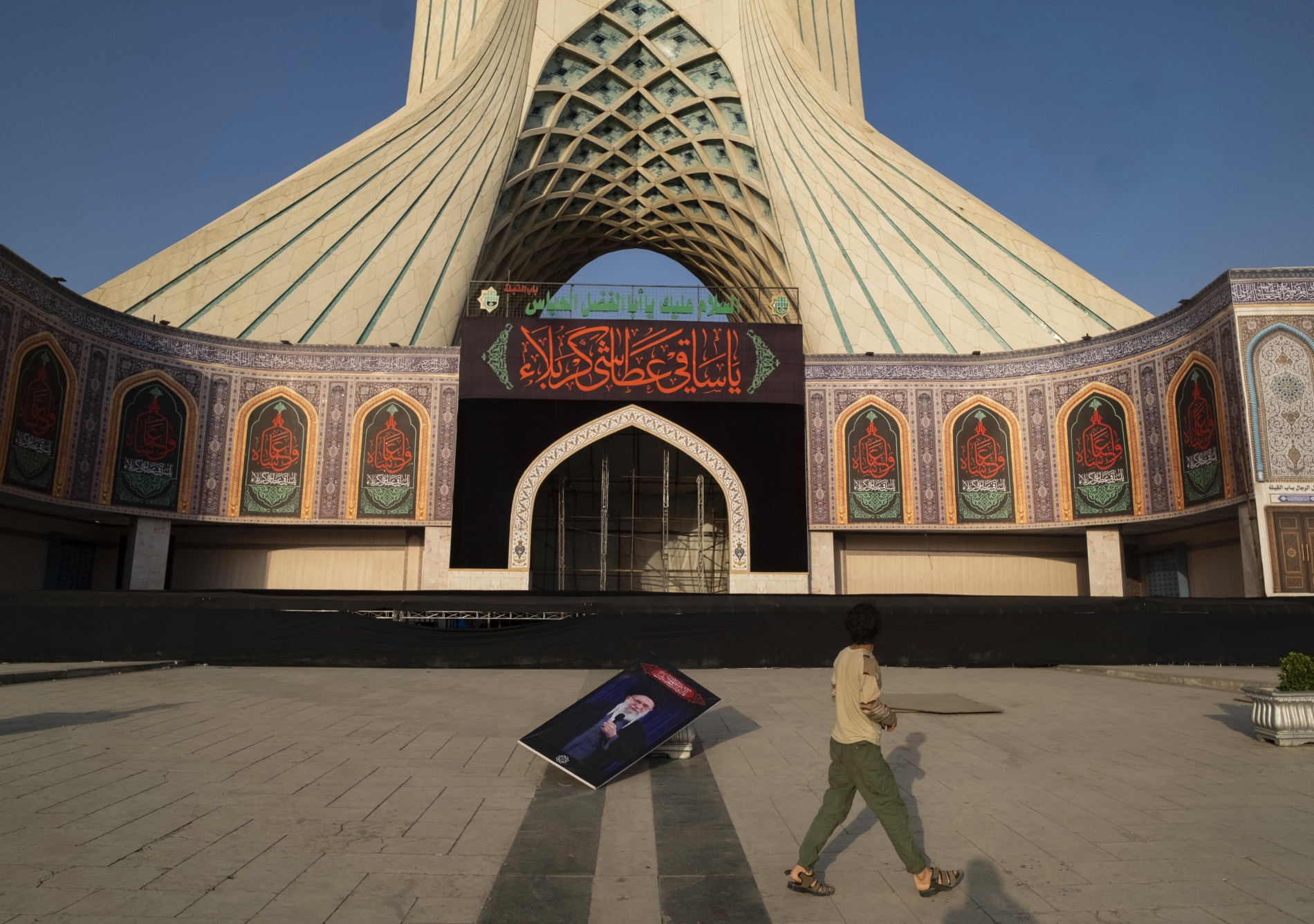
A man walks past a portrait of Iran's late Supreme Leader Ayatollah Ali Khamenei at Azadi (Freedom) Square in western Tehran on 7 July 2026, a day after his funeral.

The second path opens if the diplomacy fails or the region reignites. Security institutions gain ground, the Guards expand their hold on the economy and foreign policy, what little political space exists narrows further, and confrontation with Israel and the West intensifies. Even this would be continuity more than rupture, not a return to revolutionary fervour, but a harder, more centralised version of the same security state.

The third and least likely is a slow technocratic drift. Sustained economic pain convinces even the security establishment that normalisation and regional integration serve the regime's survival better than permanent confrontation. This would not be democratisation, and it would not be the end of the Islamic Republic; it would be an authoritarian developmental state—still repressive, still ideological, but run increasingly by economic necessity rather than revolutionary ambition. Ironically, even this would honour Khamenei's project, which was always about the strength of the state before the purity of the cause.

Outliving the architect

The same faultline runs through all three. Khamenei accumulated both power and authority; his successor gets only the power, which moves through offices and constitutions. Mojtaba may sit atop the strongest Islamic Republic since 1979 and still command only a fraction of his father's standing. Whether he slowly earns the rest, or whether the system simply settles into rule-by-committee with a figurehead at the top, is the story of the next chapter.

Khamenei will be remembered abroad for his enmity toward the United States, his reach across the region, and his refusal to let the Republic loosen its grip. The more lasting fact is duller and more important. Khomeini founded a revolution; Khamenei turned it into a state that could bury him and keep going. That is what the funeral was for: a first demonstration that the apparatus outlives the architect. But the demonstration was incomplete, and everyone watching knew it.

The system filled the streets and dominated the screens and said, in a dozen ways, that it still stood. Its unintended message was harder to shake. It may still stand, but it is no longer obvious who holds it up—the new leader, the memory of the old one, or the security machine that choreographed the whole day and left the heir's place on the platform empty.

font change