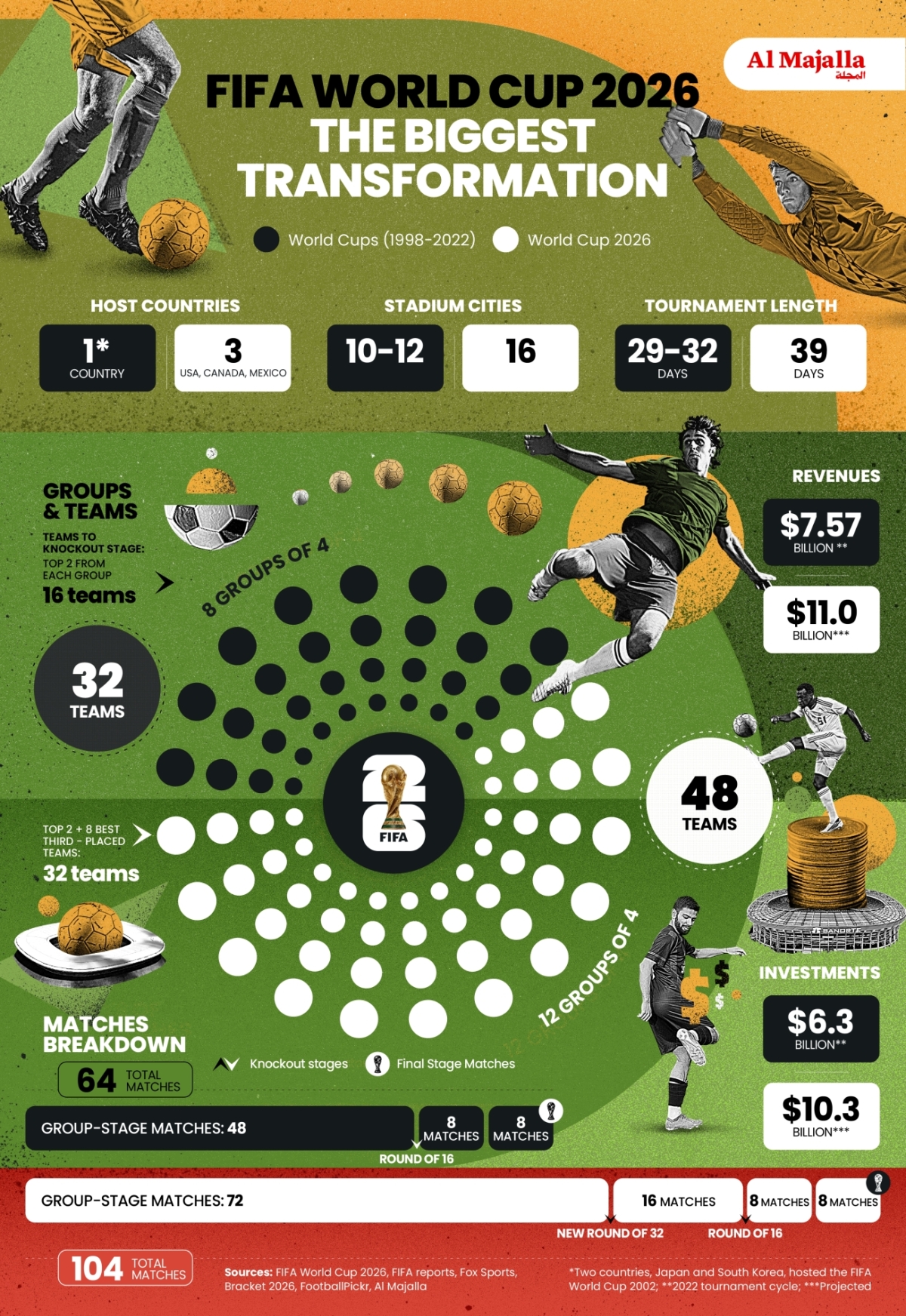

The 2026 FIFA World Cup will mark the most significant transformation in the tournament's nearly century-long history. For the first time, football's biggest event will be jointly hosted by three countries—Canada, the United States and Mexico—making it the largest World Cup ever in geographical terms. The tournament will span 16 host cities, from Vancouver in the north to Mexico City in the south, covering thousands of kilometres and presenting unprecedented logistical challenges.
Equally historic is the expansion from 32 to 48 teams. FIFA argues that the new format makes the World Cup more inclusive by giving nations from traditionally underrepresented regions a greater opportunity to qualify. As a result, four countries—Cape Verde, Curaçao, Jordan and Uzbekistan—are set to make their World Cup debuts.
The expanded field also reshapes the competition itself. The number of groups rises from 8 to 12, while the knockout phase grows from 16 to 32 teams through the introduction of a new Round of 32. Consequently, the total number of matches will jump from 64 in Qatar 2022 to 104 in 2026.
Beyond sporting considerations, the expansion carries major commercial and political implications. More matches create additional broadcasting, sponsorship, and ticketing opportunities, while the allocation of extra qualification places has strengthened support from football confederations in Asia, Africa, and other emerging regions.
The tournament will also feature regulatory and technological changes aimed at accelerating play and reducing time-wasting. Match officials will be granted greater authority to penalise delays, while FIFA is expected to deploy an enhanced version of its VAR technology, supported by artificial intelligence.
Advanced player-tracking systems, 3D visualisations and sensor-equipped match balls will help speed up decision-making and improve officiating accuracy. In addition, yellow-card regulations have been adjusted to reduce suspensions in the latter stages of the tournament, helping ensure that more key players remain available for decisive matches.
While supporters see the changes as a step toward a more global game, critics argue that the expansion could increase players' workloads and dilute the competitive quality. Either way, the 2026 World Cup is set to redefine the tournament like never before.