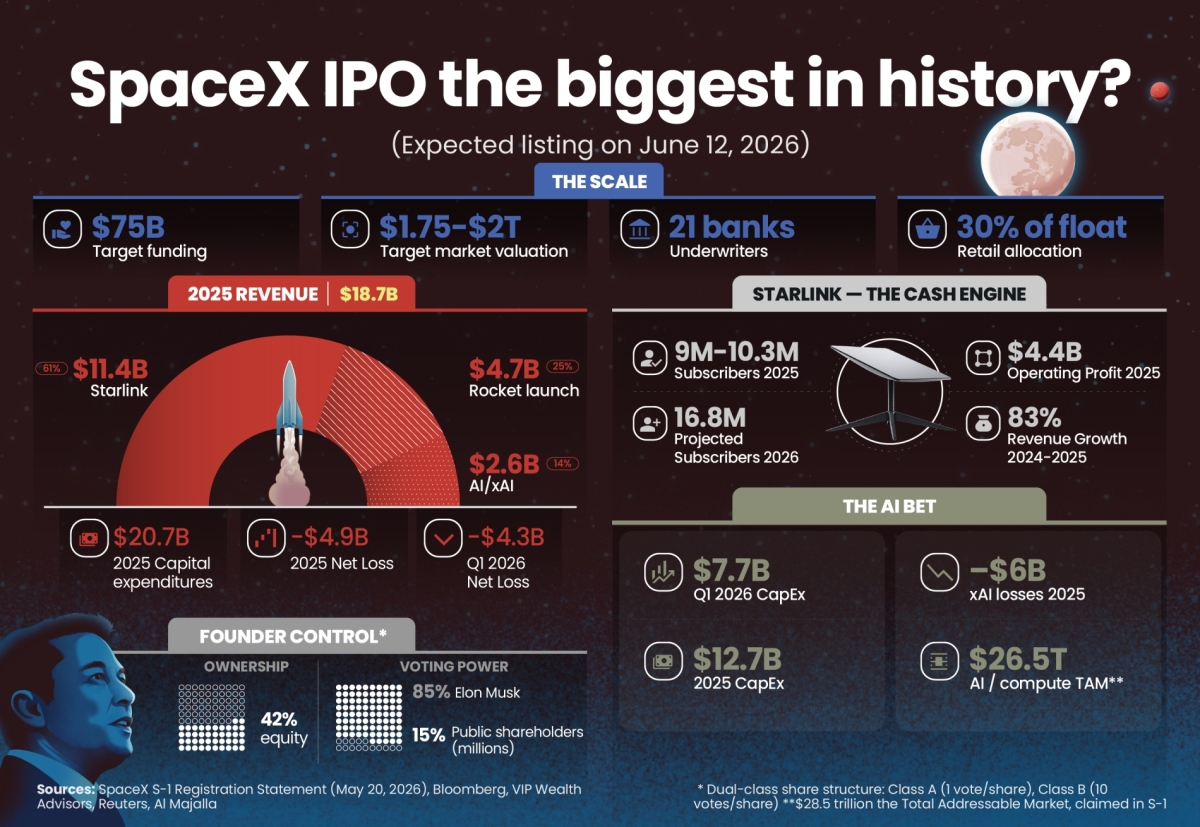

SpaceX is preparing for a 12 June initial public offering that could become the largest in history, targeting a valuation of at least $1.8tn and seeking to raise roughly $75bn in fresh capital. The listing would give public investors access to a business that has evolved far beyond its origins as a rocket manufacturer, combining launch services, satellite communications, artificial intelligence infrastructure, and long-term ambitions tied to Mars exploration.
Starlink sits at the core of SpaceX's growth strategy, having become the company's largest source of revenue and a key driver of its expansion. The satellite internet network generated more than $11bn in revenue in 2025, accounting for roughly 60% of SpaceX's total revenue, and helping fund ambitious investments in artificial intelligence and next-generation space systems.
However, that expansion came at a cost: the company posted a net loss of nearly $5bn in 2025 as spending surged on AI infrastructure, data-centre and computing activities, and the Starship programme. In its prospectus, SpaceX estimated its total addressable market at $28.5tn, with roughly $26.5tn linked to AI-related activities.
Yet the offering is not without controversy. Critics argue that the company’s valuation assumes years of rapid growth across multiple industries, despite ongoing losses and heavy capital expenditure requirements.
Governance is another concern: Elon Musk is expected to retain overwhelming voting control through a dual-class share structure, limiting the influence of public shareholders.
Questions have also emerged regarding disclosures related to a major computing agreement with Anthropic. While SpaceX's filing described the arrangement as a multiyear deal that could generate up to $1.25bn in monthly revenue through 2029, Musk later said the current contract runs for only 180 days and can be terminated by either party with 90 days' notice.
The discrepancy prompted scrutiny from some investors over the sustainability of the projected revenue stream and the consistency of the company's messaging.