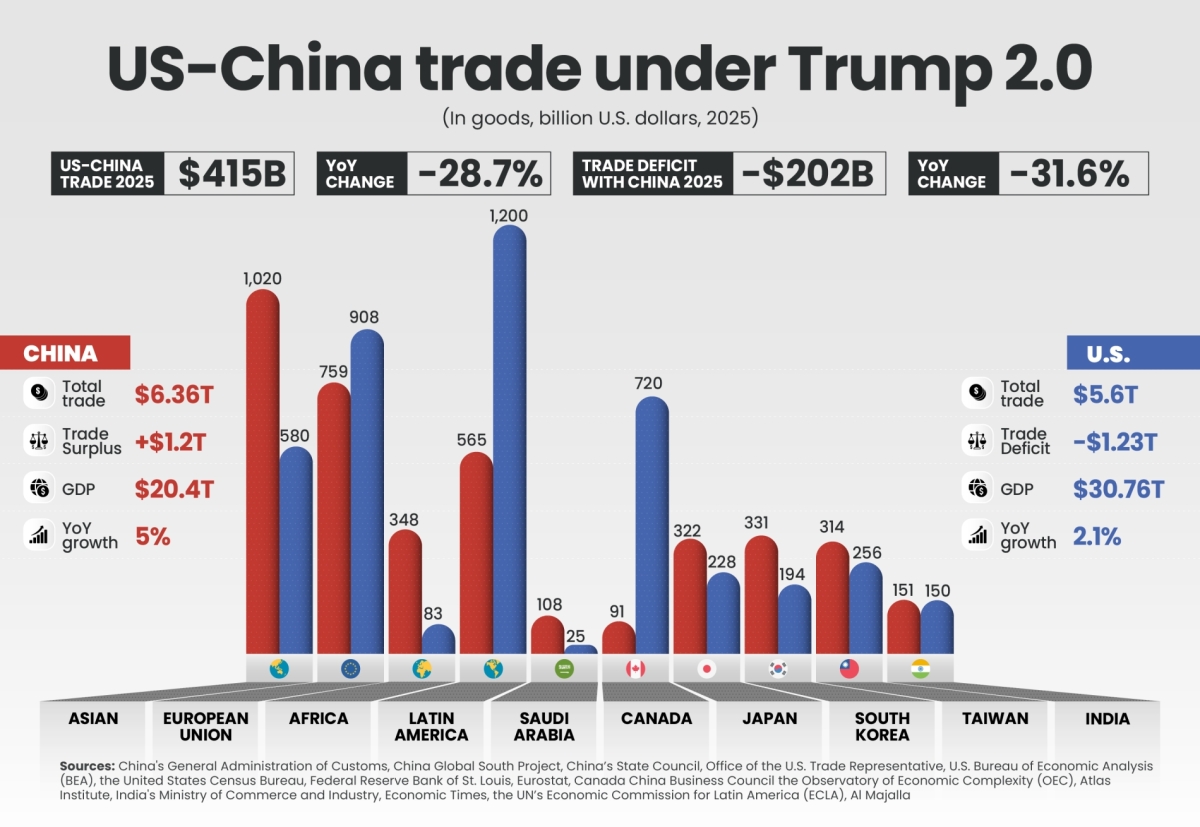

On the eve of Donald Trump’s visit to China, trade relations between the world’s two largest economies remain marked by tension, recalibration, and strategic competition. In 2025, rising US tariffs—which briefly climbed to 125% before being reduced—triggered a sharp decline in Chinese exports to the United States.
Trade between China and the US fell by 28.7% year-on-year, dropping to $415bn in 2025, while April alone recorded a 20.2% decline compared with the same month a year earlier. Despite a subsequent trade truce, exports to the US continued to weaken, suggesting global supply chains had already adapted to the new tariff environment.
Yet China’s broader trade performance remained resilient. The country’s trade surplus approached $1.2tn by the end of 2025, while total exports still grew 5.5% year-on-year. Much of this resilience was driven by a redirection of trade toward emerging markets, particularly Southeast Asia and Africa. Exports to ASEAN countries rose 13.4%, while shipments to Africa surged 25.8%.
Washington increasingly suspects that some of this growth reflects transhipment, with Chinese goods rerouted through third countries to circumvent US tariffs. Meanwhile, rare earth minerals have become one of Beijing’s most effective bargaining tools, highlighting how trade, supply chains, and strategic resources now sit at the centre of US-China relations.