
A recently released Saudi Vision 2030 report offered an optimistic yet cautious outlook for economic growth, highlighting areas where major international institutions agreed and disagreed.
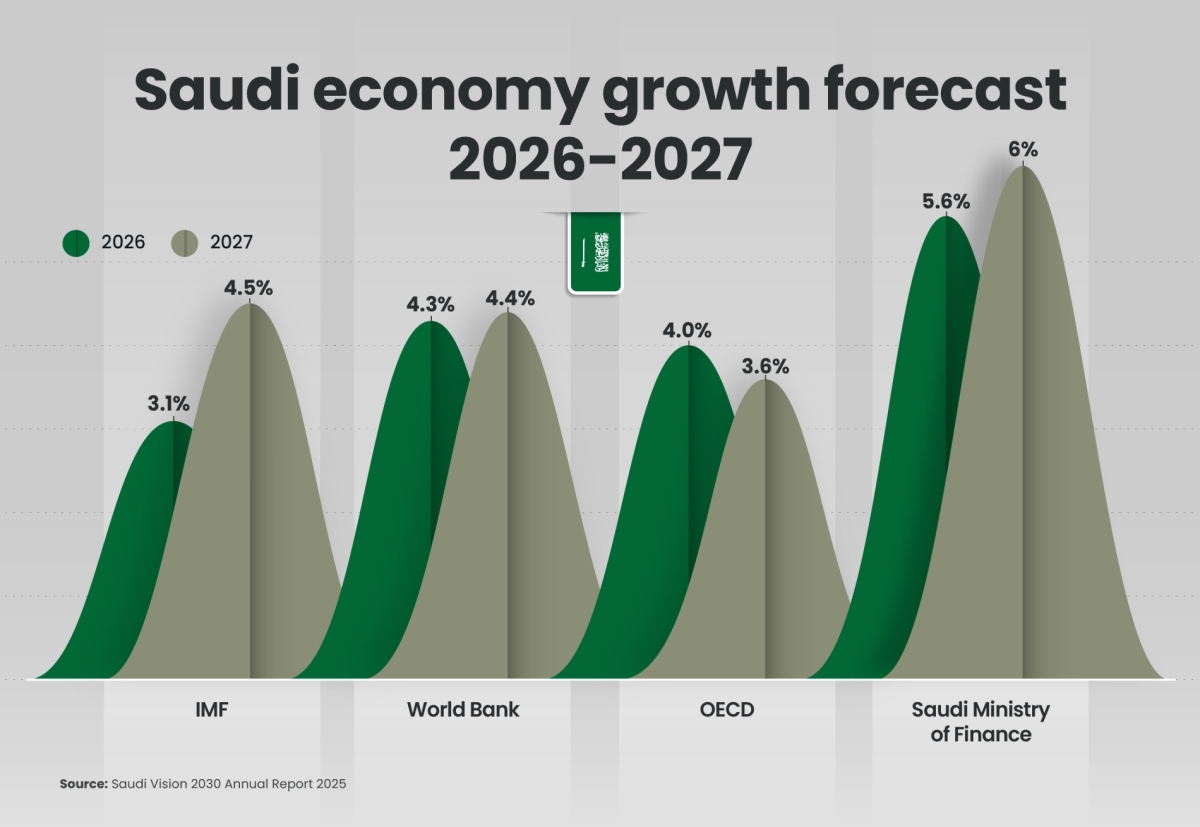
For its part, the International Monetary Fund (IMF), the World Bank, and the Organisation for Economic Cooperation and Development (OECD) expect the Saudi economy to maintain a positive growth trajectory through 2026 and 2027, despite ongoing volatility in global oil markets. The IMF projects growth of around 3.1% in 2026, accelerating to approximately 4.5% in 2027, driven largely by the continued expansion of non-oil sectors and the impact of structural reforms.
Equally, the World Bank expects a stronger short-term performance, with growth estimated at about 4.3% in 2026 and 4.4% in 2027, supported by rising investment and increased economic resilience. In contrast, the OECD presents a slightly more cautious outlook, forecasting growth of around 4% in 2026, easing to 3.6% in 2027.
At the domestic level, the report highlights more optimistic projections from Saudi Arabia’s Ministry of Finance, which expects GDP growth to reach approximately 5.6% in 2026 and 6% in 2027, underpinned by sustained government spending.
Overall, the projections point to tangible progress under Vision 2030 in restructuring the Saudi economy and enhancing its prospects for balanced and sustainable growth in the years ahead.