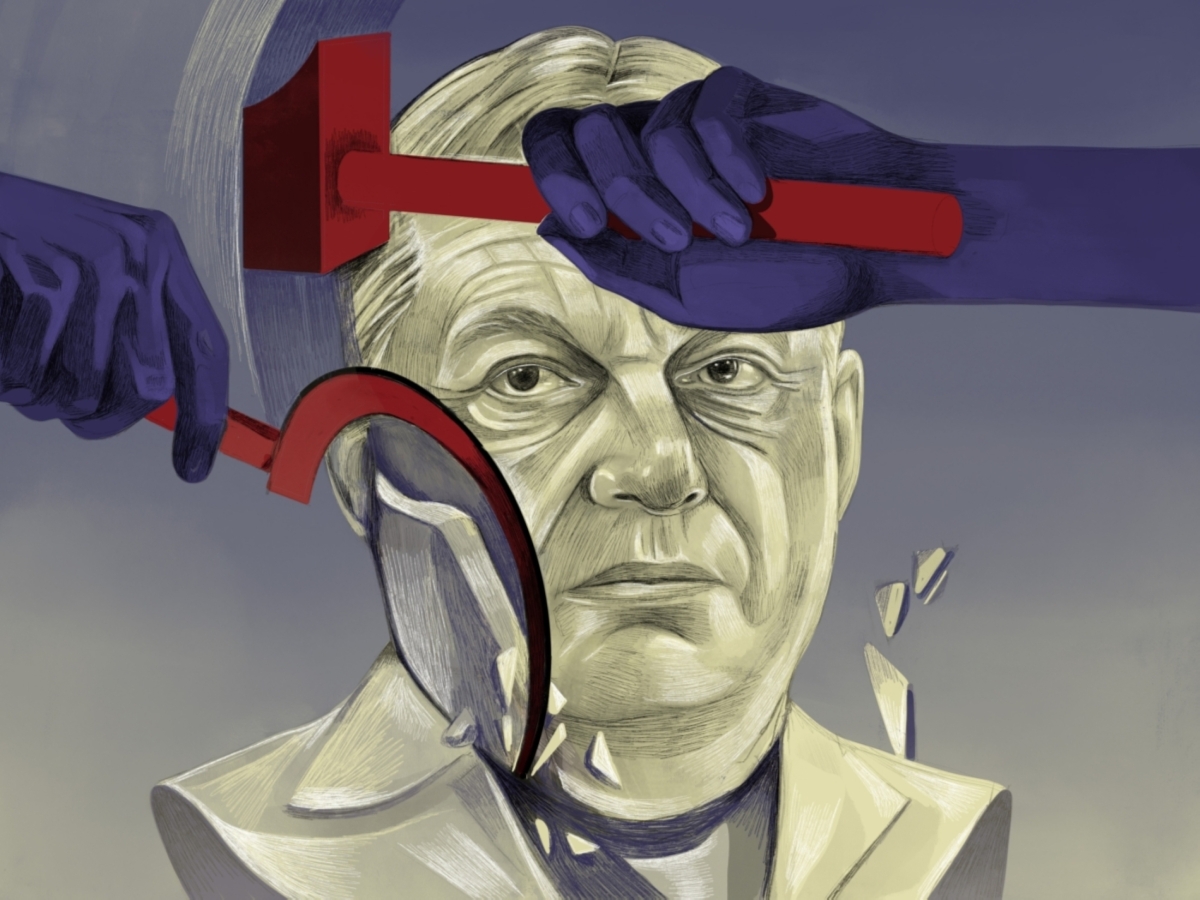

On the eve of Hungary's highly contested election, two main rivals have been heavily campaigning as Péter Magyar attempts to end 16 years of continuous rule by Viktor Orbán's party Fidesz.
Orbán, who has been trailing in most polls, got a boost when US Vice President JD Vance attended a campaign rally in Budapest on 9 April and called US President Donald Trump, who addressed the crowd via phone.
“I’m a big fan of Viktor. I’m with him all the way. The United States is with him all the way,” Trump told the crowd. The rally came two months after US Secretary of State Marco Rubio visited Budapest, when he stressed that “Hungary’s success is our success.”
“Remember this, he didn’t allow people to storm your country and invade your country, like other people have, and ruin their countries,” Trump told the Hungarian crowd via speakerphone. “He’s kept your country good. He’s kept Hungarian people in your country, and he’s done a fantastic job.”
The current American administration believes that a Trumpian revolution is coming to Europe, just one election cycle behind the US, and that Hungary is the trailblazer in that movement. Sunday’s election will test that belief. The opposition Tisza party, led by Magyar, has held a double-digit lead over the ruling Fidesz party in most polls for over a year, focusing primarily on domestic issues such as the economy, healthcare, and corruption.
This runs contrary to Orbán's approach, which has been heavily focused on foreign policy. Since returning to the premiership in 2010, Hungary has found itself deeply involved in the conflict taking place in neighbouring Ukraine. This has meant that Orbán, who has good relations with Putin, has found himself playing a pivotal role in efforts to end the conflict, not least because of Hungary’s membership of both the NATO alliance and the European Union. Orbán positioned himself as a key interlocutor, someone who fully understands the concerns of both sides.
His efforts to help end the Ukraine war—something Trump has said he is keen on resolving—have been welcomed by the White House. Trump’s affinity for the Hungarian leader was certainly very much in evidence when Orbán visited the White House in early November. The meeting ended with Trump announcing that he had exempted Hungary from sanctions over its continued purchases of Russian oil and gas for one year.
Early life and career
Orbán first made his mark on Hungary in the late 1980s, as the Soviet Union began to fall apart, by setting up a political movement called Fidesz, or the Alliance of Young Democrats. He was still a law student at Bibo College in the capital, Budapest, when in 1989 he delivered an audacious, seven-minute speech calling on the Soviet Red Army to go home.
“If we believe in our own power, we are able to finish the communist dictatorship,” he declared to an estimated quarter of a million Hungarians gathered in the city’s Heroes’ Square for the reburial of the man behind Hungary’s failed uprising in 1956, Imre Nagy.
Reflecting on his words 10 years later, Orbán said he had “exposed everyone’s silent desire for free elections, and an independent and democratic Hungary”.
Orbán was born in 1963, in a town an hour from the capital city Budapest. The eldest of three sons, his father was an agricultural engineer and Communist Party member and his mother was a special needs teacher. In the months before he went to university, he carried out his military service, where he says he turned down an approach from the communist secret services to become an informer.