
The Strait of Hormuz remains one of the most vital arteries of the global energy system, serving as a critical passage for crude oil moving from the Gulf to international markets. Its strategic importance has been thrust back into the spotlight amid the escalating conflict involving Iran, the United States, and Israel, a confrontation that has rattled energy markets and briefly pushed oil prices above $100 per barrel as traders priced in the risk of supply disruptions.
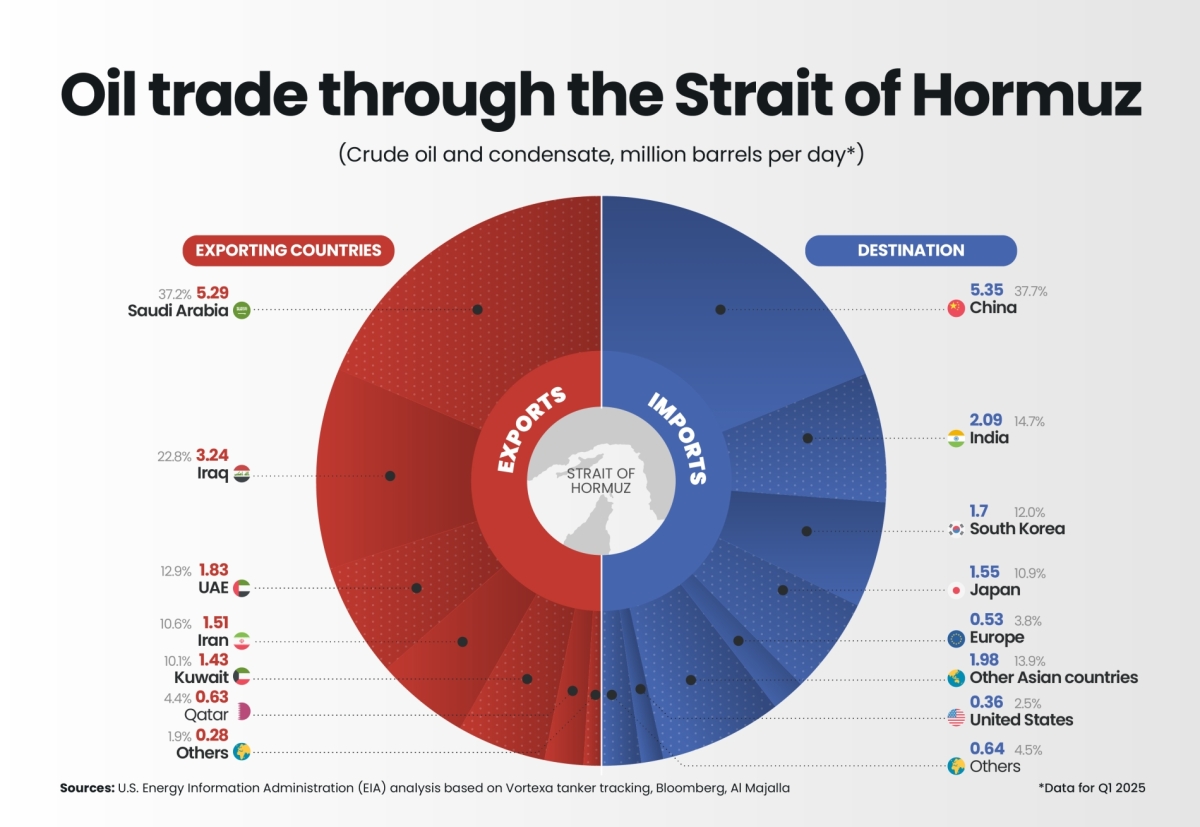
Saudi Arabia accounts for the largest portion of crude and condensate exports passing through the waterway, representing 37.2% of total volumes. Iraq follows with 22.8%, while the United Arab Emirates contributes 12.9%. Iran and Kuwait add 10.6% and 10.1%, respectively. Collectively, these five exporters account for 93.6% of all crude oil and condensate moving through the strait.
With Iran warning that vessels transiting the Strait could become targets during the ongoing military escalation, more than one-fifth of the world’s oil flows suddenly face heightened geopolitical risk—an uncertainty that has amplified volatility in global energy markets.
Demand for these shipments is overwhelmingly concentrated in Asia. Asian economies together absorb 89.2% of the crude oil and condensate transported through the strait. China alone accounts for 37.7% of total flows, making it by far the largest destination. India ranks second with 14.7%. Together, China and India receive more than half of all oil volumes transported through this critical global energy corridor
By comparison, the United States receives only about 2.5% of the oil that transits the strait, reflecting its growing domestic production and more diversified import portfolio.